A garment is cut to hang on a body, so in a frame it needs support across its whole area. We stitch it to a padded acid-free board in a shadow box, behind UV glazing.
We frame garments: christening gowns, kimono, vintage dresses, military and work uniforms, team kit, a child's first dance costume. A garment is cut to hang on a body. Hung in a frame from the shoulders alone, the cloth stretches under its own weight. So the garment is supported across its whole area on a padded board and stitched in place by hand, inside a shadow box, a frame built as a shallow box. The work is done at 1242 Davie Street.
How a garment is supported
A board is cut to the outline the garment will have in the frame, then covered with soft padding and a layer of cloth. The board, the padding and the cloth are acid-free, made so they stay free of the acid that yellows fabric. The garment is dressed over this form, or laid on it, so the padding fills the shoulders and the body. Small hand stitches in fine thread then hold it, placed along seams and hems where the cloth is strongest and the stitches are hidden. No glue touches the fabric, and no pin passes through cloth that shows. Cutting the thread frees the garment.
Full display or folded
Full display. The whole garment is shown, with the sleeves out or folded across the front. A kimono shown open with its sleeves spread makes a wide, tall frame.
Folded. The garment is folded so that one part shows: the collar and front of a uniform jacket with its badges, the embroidered back panel of a kimono, the bodice of a dress. The folds are padded so no hard crease forms. The frame is smaller and lighter.
A small garment, whole. A child's costume or a short gown can be shown whole, with the skirt spread or gathered.
We lay the garment out both ways on the counter so you can compare the two sizes before you decide.
An adult garment shown whole makes a large frame. For a sense of scale, Beyond Rise and Fall, an acrylic on canvas from our gallery showing a woman in a yellow dress, painted in yellow and blue, is 71.1 by 101.6 cm.
The box is built to the depth of the garment at its thickest point: a padded shoulder, a row of buttons, a belt buckle, a medal on a uniform. Spacers, thin strips hidden under the edge of the frame, hold the glazing away from the cloth. Glazing means the sheet of glass or acrylic at the front. Fabric pressed against glazing flattens and loses its shape. For a large frame we recommend acrylic, which weighs less than glass and does not shatter. Our guide to acrylic and glass compares the two.
Light and dye
Fabric dyes fade in daylight, and light also weakens silk and old cotton. UV glazing filters ultraviolet light, the part of daylight that fades dye fastest, and we recommend it for every garment. Hang the frame on a wall away from direct sun.
Weight and hanging
A deep frame with a heavy uniform inside is a heavy object. The hanging hardware is matched to the finished weight, and a large frame hangs from two fixing points on the wall. Our guide to hanging hardware shows the fittings.
A large painting is hung with the same care for weight. Femininity, an acrylic on canvas of a woman's face with a red scarf at the neck, is 120 by 120 cm, and a frame that wide hangs from two fixing points.
The outer size is the main factor, and an adult garment on full display makes a large frame. Depth, the glazing, the moulding (the shaped length of wood or metal the frame is cut from) and the hand stitching make up the rest. A folded display lowers the size and the cost. You get the quote at the counter when we have seen the garment.
What to bring or send
Bring the garment clean and dry, with any belt, hat or badge that belongs with it. Tell us if the fabric is fragile or torn. If you live outside Vancouver, send its length and width laid flat, and a photograph. Sports shirts are covered under jersey framing, and scarves and flat cloth under silk scarf and textile framing.
Walk in at 1242 Davie Street during opening hours. Enter your email on this page for a 10% framing code to show at the shop, and see custom framing for everything else we frame.
How it works
1
Bring it in, or send photographs
Walk in to 1242 Davie Street during opening hours. If you are not in Vancouver, send the dimensions and a photograph and we will work from that.
2
We look at the actual piece
What it is made of, what condition it is in, and where it is going to hang all change the answer. You get a straight recommendation and a price for your piece, not a rate card.
3
It is made by hand and fitted
Cut to the piece, using conservation materials, and finished with hanging hardware rated for the actual weight.
Common questions
How is a kimono mounted in a frame?
A kimono is mounted in a frame on a padded acid-free board and held by small hand stitches along its seams, with no glue. It can be shown open with the sleeves spread, which makes a wide frame, or folded so the back panel or one sleeve shows. Spacers keep the glazing off the silk, and UV glazing slows the fading of the dyes.
Can a christening gown be framed without damaging the fabric?
Yes, a christening gown can be framed without damage when it is stitched to a padded acid-free support with fine thread and no glue. The stitches go through seams and hems, where the cloth is strongest. The gown comes out again when the thread is cut, so another child in the family can still wear it later.
Is it better to frame a uniform folded or at full length?
A folded uniform is the better choice for most walls, because it makes a smaller, lighter frame that still shows the collar, the badges and the buttons. A uniform at full length shows the whole jacket and needs a frame as tall and wide as the jacket laid flat. Both use the same padded support and hand stitching.
Do medals and badges stay on a framed uniform?
Yes, medals and badges can stay on a framed uniform, pinned or sewn where they were worn. The shadow box is built deep enough for the thickest of them, and spacers hold the glazing in front. Heavy medals pull on old cloth, so a hidden stitch or support behind each one takes its weight off the fabric.
How big is a frame for an adult dress?
A frame for an adult dress shown whole is as tall and as wide as the dress laid flat, plus a border around it. A long dress therefore needs a frame that takes up much of a wall. Folding the skirt behind the bodice, with padding in the fold, shortens the frame. Acrylic glazing keeps a frame of this size lighter than glass.
Can a child's dance costume with sequins be framed?
Yes, a child's dance costume with sequins can be framed in a shadow box. The costume is stitched through its seams to a padded board, and the box is built deep enough that the glazing stays clear of the sequins, beads and net. Dance shoes or a ribbon from the same show can be mounted beside it on their own supports.
Should a vintage dress be cleaned before framing?
A vintage dress should be clean and dry before framing, because stains darken with age and damp cloth closed inside a frame can grow mould. Washing can damage old fabric, so ask a cleaner who works with vintage clothing before you wash it. We frame the dress in the condition you bring it, and you arrange any cleaning.
10% off your custom framing when you show this code at our shop
We frame, stretch canvas and reframe by hand, in our own workshop inside the gallery at
1242 Davie Street. Enter your email and your code appears right here. Show it at the
counter and we take 10% off the job. The code does not expire.
Send the measurements, what it is made of, and a photograph. We will tell you what it actually needs, including when the answer is that it needs less than you expected.
Choosing a selection results in a full page refresh.
Opens in a new window.
In-shop offer · 1242 Davie Street, Vancouver
Get 10% off your framing at our shop
Add your name and email and your code appears on the next screen. Show it at the counter
and we take 10% off any framing, stretching or reframing job you bring us. It does not
expire.
Exceptional Service and a Truly Memorable Art Purchase
I had a wonderful experience with Van Art Hub Gallery. I came across two pieces by Melina Ghaemi — *Mad Mirrors* and *Small World in the Hands of a Stranger* — and immediately fell in love with them.
I contacted Van Art Hub Gallery, and they were incredibly helpful throughout the entire process, from arranging the payment to organizing the shipping. At first, I was a little skeptical and nervous about how everything would work, especially since the paintings were still in Iran and it was shortly after the war. But the gallery handled everything with such professionalism and care that my concerns quickly disappeared. Amazingly, they were able to get the paintings to Canada in just two days!
The pieces are absolutely captivating. Even when I picked them up from the frame maker and was simply carrying them to my car, several people stopped and asked me about the paintings. That says a lot about how striking and special Melina Ghaemi’s work is.
A big thank you to Van Art Hub Gallery for making this experience so smooth and enjoyable. I truly appreciated their professionalism, communication, honesty, and integrity throughout the entire process. I would happily work with them again and highly recommend them to anyone interested in purchasing art through the gallery.
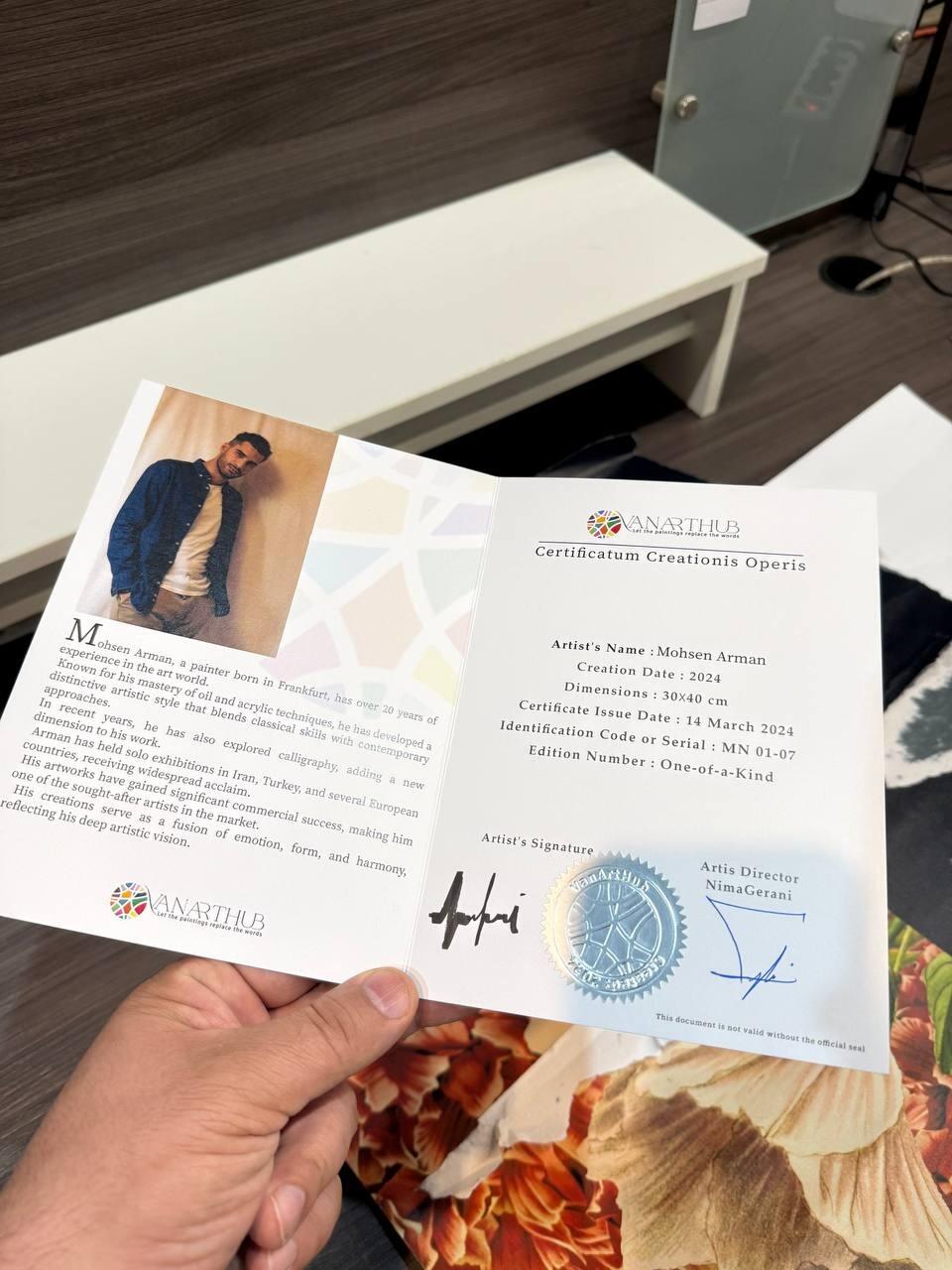
I got my order today and your work is really good. I didn’t expect to get a certificate for this painting, it was a surprise. Thanks for caring about small details.
The support team was really helpful and followed up nicely, wich I really appreciated. The painting is just like the photo – great quality and very detalied. I just wish it arrived a bit sooner, but honestly it was worth the wait.
I received my painting today. The support team was great and very responsive. The artwork is exactly what I was hoping for – even more beautifull in person. Truly a valuable piece. I’ll definetely order again. Thank you!