Rostam and Sohrab in Persian Painting: Story and Scenes
UpdatedRostam and Sohrab is the story of a father who kills his own son in single combat, because neither man knows who the other is. It comes from the Shahnameh, the Persian "Book of Kings" by the poet Ferdowsi, and it ends when the dying Sohrab shows the armband that Rostam once left with the boy's mother. We are VanArtHub, a Vancouver gallery that sells original paintings, and this is the Shahnameh story we would tell first to someone who has never opened the book. Below you will find the plot in order, the moments painters choose, and named paintings in named museums that you can look up online.
Who are Rostam, Sohrab and Tahmina?
The Metropolitan Museum of Art counts 50,000 rhyming couplets in the Shahnameh and says it tells the history of the kings of Iran "from the mythical beginnings to the Arab conquest in 651 A.D." The Encyclopaedia Iranica dates its completion to 8 March 1010, when Ferdowsi was in his seventy-first year. Our page on the Shahnameh in art covers the whole poem and its great illustrated copies.
Rostam is the hero of this story and of many others. The Smithsonian's National Museum of Asian Art calls him "the most celebrated and complex character in the Shahnama" and says he is still considered Iran's greatest folk hero. In its account he protects Iran's kings against their enemies, "particularly the people of Turan to the east". His horse is Rakhsh, a name the Smithsonian translates as Thunder.
Four more names matter. Tahmina is the daughter of the king of Samangan, in whose castle Rostam spends one night. Sohrab is the son she has with Rostam. Kay Kavus is the king of Iran in this part of the poem, and Afrasiyab is the king of Turan. Museums spell these names in several ways (Rustam, Suhrab, Tahmineh, Shahnama), and we keep each museum's spelling inside the title of its painting.
One detail from the Encyclopaedia Iranica shows how unusual this story is in Rostam's long life. Ferdowsi gives him more than three hundred years, and in all of them "only one night is spent in the amorous company of a woman". That night is where the story starts.
Guardian of Heritage by Reza Daryakenari is a staged photograph on Epson canvas with varnish, 135 x 90 cm. A bearded man in a helmet holds a sheathed sword beside a horse-like figure draped in patterned brown and gold cloth, against a deep green background. It is a contemporary work that shares one subject with this story: an armed man standing with his horse.

The night in Samangan
The story opens with a lost horse. The Fitzwilliam Museum in Cambridge tells it this way: Rakhsh "was stolen by a Turanian patrol while the hero was resting near the border of Turan", and Rostam asked for a night's lodging in the castle of the king of Samangan. Harvard Art Museums, which owns a painting of the moment made in Herat c. 1434, says the king's daughter Tahmina came to his room at night "to tell him that she wishes to marry him and bear his child", and that Rostam, caught by surprise, spent the night with her.
Tahmina is the one who acts in this scene. The Fitzwilliam says Ferdowsi "maintained that women of royal descent had equal rights with men when it came to matters of the heart", and it gives her visit as the first example. In the Harvard painting she looks out from behind a candle held by her chambermaid, Rostam lies under the bedcovers, and his armour and weapons are placed behind the bed.
Rostam gives Tahmina a token for the child. The museums name it in four ways: the British Museum calls it an armband, Harvard an amulet, the Metropolitan Museum an arm bracelet and the Fitzwilliam a jewel. All four agree that it can prove who the child's father is. Then Rostam leaves. Harvard says he "had departed the kingdom of his bride, Tahmina, before Sohrab's birth" and was unaware that he had a son.
Two accounts differ. The Smithsonian says Rostam marries Tahmina "in the course of his heroic deeds in Turan", where the Fitzwilliam and Harvard describe one night in her father's castle. Sir John Malcolm's History of Persia of 1815, quoted by the University of Toronto Libraries, says Tahmina wrote to Rostam that the child was a daughter, "fearing to lose her darling infant if she revealed the truth".
Sohrab goes looking for his father
Sohrab grows up in Turan without his father. The Smithsonian says he becomes "a great champion of the Turanians", and the Fitzwilliam adds that he "had grown up knowing that Rostam was his father". In the British Museum's account Tahmina gives him the armband before he sets off to find Rostam. The Metropolitan Museum gives her reason: she hoped it would protect him.
Afrasiyab sees a use for the young man. According to the Encyclopaedia Iranica, when Sohrab's fame reached him he sent his commander Homan with gifts and "an army of 12,000 men" to urge Sohrab to invade Iran. Homan carried one more order: to keep Sohrab from recognising his father. Afrasiyab hoped Sohrab would kill Rostam without knowing who he was.
The first fighting happens at the White Fort, which guards Iran's border with Turan, and the Iranica tells it in two short entries. Sohrab meets the fort's guard, Hojir, in single combat, overpowers him and spares his life. Then Gordafarid, the daughter of the fort's commander, puts on armour and challenges Sohrab. He defeats her, sees that she is a woman only when he removes her helmet, and falls in love at once. She makes promises she will break, leads him to the gate, walks in, and the gate closes behind her. The Iranica calls her conversation with Sohrab "the most haunting part of this episode".
Then the army of Iran arrives, and Sohrab makes what we read as his one attempt to avoid the fight. He asks his prisoner Hojir to name Iran's commanders from the emblems on their banners, hoping to find Rostam among them. Hojir fears that Sohrab will kill Rostam, so he keeps Rostam's identity to himself. The Iranica says he "thereby contributed to the tragedy". The Smithsonian owns a painting of the moment from the early 14th century, titled Sohrab summons Hajir and surveys the Persian camp (Hajir is its spelling of Hojir).
Naghsh-e Khial by Kamal al-Din Ghotb is a Persian miniature in oil and gold, 30 x 40 cm. Two armies face each other across a pale blue plain, with turbaned riders under an orange banner, trumpeters raising long gold horns, and columns of Persian verse above. It is a contemporary work that shares the setting of the next part of the story: two armies drawn up on open ground.

Three days of single combat
The two champions meet in front of both armies. Harvard says they "fought in fierce single combat on three successive days" without recognising each other. The Fitzwilliam gives the reason in one line: "With matching stubbornness they refused to reveal their identity to each other." Malcolm's summary says Rostam fought under a false name, which he calls "an usage not uncommon in the chivalrous combats of those days".
Malcolm also gives the result of each day. On the first day the two men agreed to stop, and Sohrab had the advantage. On the second day the young man won and let his opponent live. The Iranica adds that Homan was disappointed when Sohrab defeated Rostam and spared him, and took the mercy as a bad sign for Sohrab. On the third day Rostam won. Harvard says he "managed to wrestle Sohrab to the ground and fatally stab him". The Smithsonian quotes the poem: Rostam "swiftly drew a dagger from his belt, and tore the breast of that stout-hearted youth".
One point is told two ways. Harvard has Rostam wrestle Sohrab to the ground, while Marianna Shreve Simpson, writing in the Encyclopaedia Iranica about a star tile that shows two wrestlers beside verses from this story, notes that the combats "do not feature wrestling matches (at least, not the way Ferdowsi tells the tale)".
Put the three days side by side. On the second day the son wins and lets his father live. On the third day the father wins and uses the dagger. We think this is why people have kept telling the story for more than a thousand years.
The armband and a father's grief
In Malcolm's account the dying Sohrab warns his killer to fear the mighty Rostam, "who must soon learn that he had slain his son Sohrab". Rostam, in despair, asks for proof. Sohrab "tore open his mail, and showed his father a seal which his mother had placed on his arm". The Fitzwilliam tells it differently: Rostam opens Sohrab's clothing and finds the jewel himself. In both versions Rostam sees again the object he gave away in Samangan.
The Smithsonian quotes the poem again for the father: Rostam "wept a bloody stream and tore his hair". Malcolm says he cursed himself and tried to end his own life, and that only his dying son stopped him. The Smithsonian adds that Sohrab "consoles his father and blames the inevitability of fate". The Iranica records that on his deathbed he also obtained from Rostam "a pledge of safe conduct" for Homan and his army.
Then comes the burial. Malcolm writes that Rostam "burnt his tents and all his goods" and carried the body to Sistan, the home of his family, which Malcolm spells Seistan. Harvard's double page shows the walk. Rostam carries his son's coffin "singlehandedly", and the mourners around him "raise their arms in the air, beat their chests, and undo their turbans in grief".
Who is to blame? An essay in the Encyclopaedia Iranica by Amin Banani finds the tragedy in the killing and also in "the fear and vanity of Rostam himself". We agree. Afrasiyab plans the meeting and Hojir hides a name, but Rostam is the one who fights for three days under a false name.
Which moments painters choose
Painters choose the beginning and the end of the story. Simpson writes in the Encyclopaedia Iranica that "virtually all other illustrated volumes depict only the final fatal scene". The copy she contrasts with them is the Shahnameh made for Shah Tahmasp, a manuscript with 258 paintings according to the Metropolitan Museum, which shows "all three stages of the combat" and then Rostam's funeral lament. At the start of the story, the Fitzwilliam calls Tahmina's night visit "one of the most frequently illustrated episodes in the Shahnameh".
In our view the recognition is the hardest scene of the story to paint. The event is a change in what one man knows, and a painter has only bodies and objects to show it with. That is why we look at the bared arm first.
| Scene | Painting to look up | Where it is held |
|---|---|---|
| Tahmina comes to Rostam at night | Tahmina Comes into Rustam's Chamber, Herat, c. 1434 | Harvard Art Museums, 1939.225 |
| The same scene | Tahmineh comes to Rostam, Herat, c. 1444 | Royal Asiatic Society, London, Persian MS 239, fol. 56v |
| Sohrab questions Hojir about Iran's camp | Sohrab summons Hajir and surveys the Persian camp, early 14th century | Smithsonian, F1945.24.1 |
| Rostam stabs Sohrab | Sohrab slain by Rostam, Shiraz, c. 1430 | Bodleian Library, Oxford, MS Ouseley Add. 176, fol. 92r |
| The same scene | Rustam slays Suhrab, Shiraz, circa 1590 to 1600 | Smithsonian, S1986.259 |
| The same scene | "Suhrab Slain by Rustam", attributed to Bijapur in India, ca. 1610 | The Metropolitan Museum of Art, 1985.404.1 |
| Rostam recognises his son | Sohrab slain by Rostam, signed by Moin Mosavver, Isfahan, 1649 | British Museum, London, 1922,0711.0.2 |
| Rostam mourns beside his son | Rustam Mourns Sohrab and Carries His Coffin, right-hand page, Shiraz, 1575 to 1590 | Harvard Art Museums, 2002.50.32 |
| Rostam carries the coffin | The left-hand page of the same pair | Harvard Art Museums, 2002.50.131 |
If you look up only one, we would make it the Harvard double page. It shows the grief and the walk with the coffin side by side, and Harvard's page has a deep zoom, so you can look for the amulet on Sohrab's arm yourself. The Met's folio is small: the painted area is 6.7 cm high and 8 cm wide. The Met listed it as on view in Gallery 463 when we read its page in October 2026. In British Columbia, the Art Gallery of Greater Victoria holds a Shahnama page of Rostam mourning Sohrab, object number 1993.034.006, listed as not on view on the same date.
How to recognise the scene in a museum
Four signs tell you that a painting shows this story. Start with the young man's arm. Harvard describes its Shiraz page this way: "Sohrab's coat has been partially pulled off to reveal on his arm the amulet".
Next, look at what the older man does with his hands. In the British Museum's painting of 1649, the Fitzwilliam notes, "Rostam tears his clothes in anguish" while "Sohrab's expression suggests forgiveness". A man who tears his own clothes while he kneels over a body is a father who has just understood.
Third, count the onlookers. Harvard's page has "warriors of the two armies, looking on in shock", standing in a ring around the pair.
Last, check the older man's coat. Harvard, describing another of its Shahnameh paintings, mentions Rostam's "famous tiger-skin coat and leopard helmet".
The armband also exists outside paintings. The British Museum holds a 19th-century leather armband from Iran, museum number 2008,6040.1, set with 15 carnelian and chalcedony amulets and made for a wrestler. The curator's comments say the custom of giving wrestlers an armband "stems from Persian oral tradition and the national epic of Iran". To learn how pages like these were planned and painted, read our page on Persian miniature painting.
From the coffeehouse to an English poem
The story was also told aloud. The Iranica's entry on the coffeehouse describes a storyteller who "would erect a screen" painted with a scene and explain it to customers, who paid him. Its first example of a subject is the tragedy of Rostam and Sohrab. Another Iranica entry says professional storytellers gave this story "a particular place" in their telling of the Shahnameh, ending in a ceremony called sohrab-koshi, the performing of Sohrab's death. Our page on coffeehouse painting in Iran covers the large canvases made for those rooms.
The best-known English version is Matthew Arnold's "Sohrab and Rustum: An Episode" of 1853. The University of Toronto Libraries print the whole poem: 892 lines of blank verse, completed in April 1853, which Arnold called "by far the best thing I have yet done". The Iranica calls it "the best known adaptation" of the Shahnameh and records that Arnold, who first printed it without naming his sources, "was accused of plagiarism". His general source was the Malcolm summary quoted above.
Arnold changed things. Toronto's notes say he moved the episode from the reign of "the weak Kai Kaous" to that of "the great Kai Khosroo". In his poem the proof is a sign pricked into the skin of Sohrab's arm, in the form of a griffin. He ends with the river Oxus, now called the Amu Darya, flowing on to the Aral Sea. The Iranica finds in the poem "significant literary merits of its own" and "major differences with Ferdowsi's version".
Key Takeaways
- Rostam and Sohrab is a story from Ferdowsi's Shahnameh in which the hero Rostam kills his son Sohrab in single combat while neither knows the other.
- Harvard Art Museums says the two fought on three successive days, and Sir John Malcolm's summary of 1815 says Sohrab won the second day and let Rostam live.
- The proof of who Sohrab is comes from the token Rostam left with Tahmina, which museums call an armband, an amulet, an arm bracelet or a jewel.
- The Encyclopaedia Iranica says almost all other illustrated copies show only the final fatal scene, while the Shah Tahmasp Shahnameh shows all three stages of the combat and the funeral lament.
- Paintings to look up first: Harvard's double page from Shiraz of 1575 to 1590 and the Met's "Suhrab Slain by Rustam" of ca. 1610.
- To recognise the scene, look for a wounded young man with a band on his bared arm and an older man who tears his clothes.
Frequently Asked Questions
What is the story of Rostam and Sohrab?
The story of Rostam and Sohrab tells how the Persian hero Rostam kills his own son in single combat without knowing him. Sohrab, who grows up in Turan, invades Iran while he searches for his father. Harvard Art Museums says they fought on three successive days, and Rostam learned the truth only after he had stabbed Sohrab.
Who is Sohrab in the Shahnameh?
Sohrab is the son of the hero Rostam and of Tahmina, the daughter of the king of Samangan. The Smithsonian's National Museum of Asian Art says he grew up in Rostam's absence and became a great champion of the Turanians. He left Turan to look for his father and met him only on the battlefield.
Why did Rostam fail to recognise his own son?
Rostam failed to recognise Sohrab because he left Samangan before the boy was born, and the two had never met. Harvard Art Museums says he was unaware that he had a son. The Encyclopaedia Iranica adds that the Turanian king Afrasiyab ordered his commander Homan to keep Sohrab from recognising his father, and that the prisoner Hojir hid Rostam's identity.
How did Rostam find out that he had killed his son?
Rostam found out from the token on Sohrab's arm, which he had given to Tahmina years before. The Metropolitan Museum of Art calls it an arm bracelet, Harvard Art Museums an amulet and the British Museum an armband. In Harvard's painting from Shiraz, Sohrab's coat is pulled back from the arm so that the viewer can see it.
Where can I see a painting of Rostam and Sohrab?
Paintings of Rostam and Sohrab are held by Harvard Art Museums, the Metropolitan Museum of Art and the Smithsonian's National Museum of Asian Art, and each has its own page online. Harvard's double page from Shiraz, dated 1575 to 1590, shows Rostam mourning and then carrying the coffin. In British Columbia, the Art Gallery of Greater Victoria lists a Shahnama page of the mourning scene.
How do I recognise Rostam and Sohrab in a Persian miniature?
Look for a wounded young man with one arm bared and an older man kneeling beside him. Harvard Art Museums describes this in its Shiraz page, with warriors of both armies standing around the pair. The Fitzwilliam Museum notes that in the British Museum's painting of 1649 by Moin Mosavver, Rostam tears his clothes in anguish.
Is Matthew Arnold's Sohrab and Rustum the same story?
Matthew Arnold's "Sohrab and Rustum" of 1853 retells the same episode in 892 lines of English blank verse, with changes. The University of Toronto Libraries note that Arnold's general source was Sir John Malcolm's History of Persia and that he moved the story to another king's reign. The Encyclopaedia Iranica says the poem has major differences with Ferdowsi's version.
Is Naghsh-e Khial an original painting?
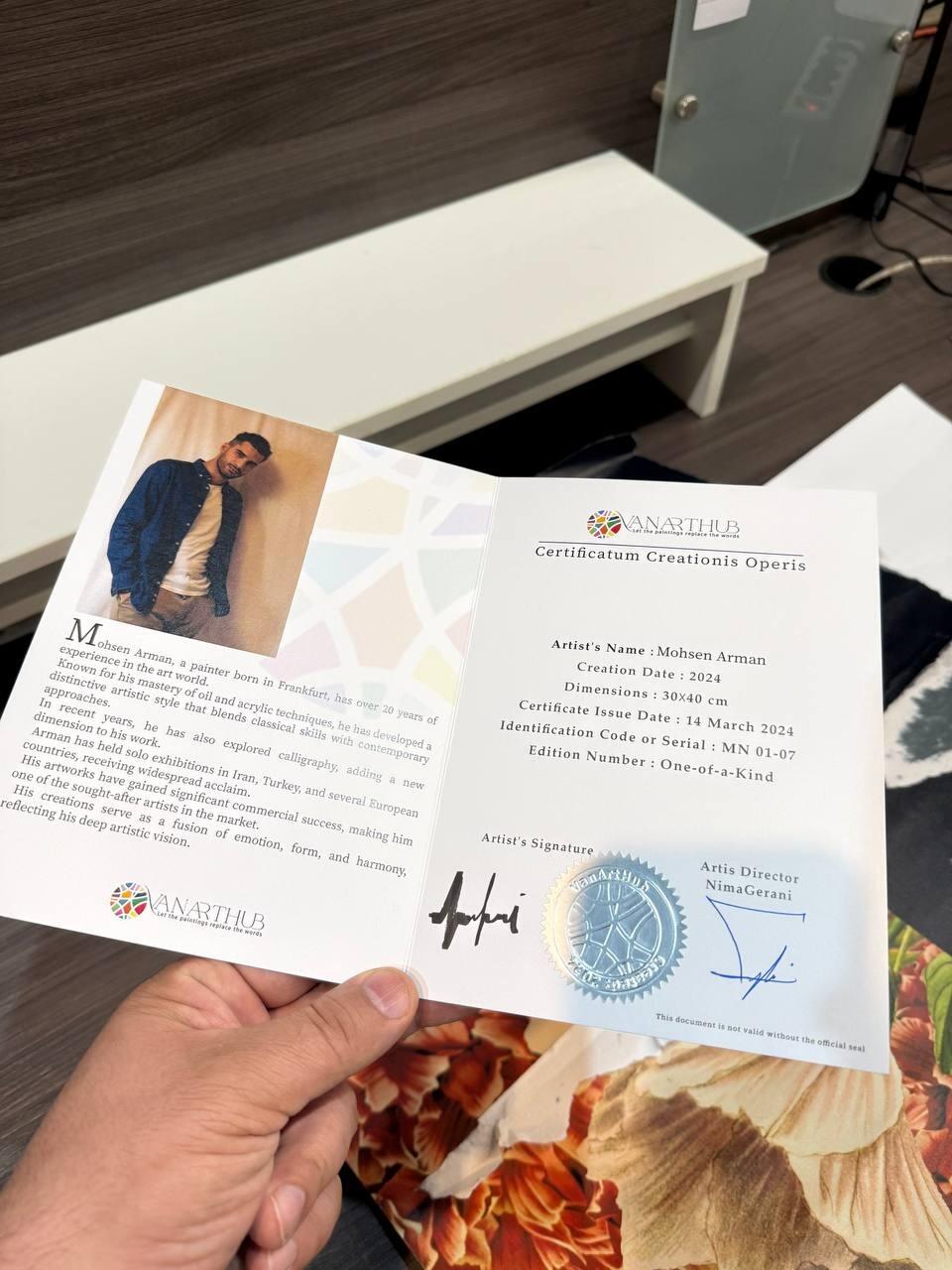
Naghsh-e Khial is an original, one-of-a-kind Persian miniature in oil and gold by Kamal al-Din Ghotb, 30 x 40 cm in size. Every painting VanArtHub ships is an original, signed work, and every piece comes with a Certificate of Authenticity. The picture shows two armies that face each other across a pale blue plain.
How does VanArtHub ship a painting?
VanArtHub ships every work free of charge and fully insured. Delivery takes 3 to 7 business days in Canada and 5 to 10 business days to the United States. The gallery is based in Vancouver, Canada, and each piece is an original, signed, one-of-a-kind work that arrives with its Certificate of Authenticity.
Can I return a painting to VanArtHub?
Yes, every work comes with a 14-day trial. You can return it within 14 days of delivery for a full refund, and we pay the return shipping. The trial gives you time to see the piece on your own wall and in your own light before you decide to keep it. Our Buy with Confidence page has the terms.
Sources
- Harvard Art Museums, Rustam Mourns Sohrab and Carries His Coffin, folio from a manuscript of the Shahnama by Firdawsi, 2002.50.32, read October 2026.
- Harvard Art Museums, Double page: Rustam Mourns Sohrab and Carries His Coffin, 2002.50.131, read October 2026.
- Harvard Art Museums, Tahmina Comes into Rustam's Chamber, illustrated folio from a manuscript of the Shahnama of Firdawsi, 1939.225, read October 2026.
- Harvard Art Museums, Text concerning Rustam's fifth and sixth trials, folio from a manuscript of the Shahnama by Firdawsi, 2002.50.134, read October 2026.
- The Metropolitan Museum of Art, "Suhrab Slain by Rustam", Folio from a Shahnama (Book of Kings) of Firdausi, 1985.404.1, read October 2026.
- The Metropolitan Museum of Art, Heilbrunn Timeline of Art History, The Shahnama of Shah Tahmasp, by Francesca Leoni, read October 2026.
- Smithsonian's National Museum of Asian Art, Folio from a Shahnama (Book of kings) by Firdawsi; verso: Rustam slays Suhrab, S1986.259, read October 2026.
- Smithsonian's National Museum of Asian Art, Folio from a Shahnama (Book of kings) by Firdawsi; verso: Sohrab summons Hajir and surveys the Persian camp, F1945.24.1, read October 2026.
- Smithsonian's National Museum of Asian Art, Shahnama: 1000 Years of the Persian Book of Kings, Rustam and Rakhsh, read October 2026.
- The Fitzwilliam Museum, University of Cambridge, The Shahnameh, No. 18 Tahmineh comes to Rostam, read October 2026.
- The Fitzwilliam Museum, University of Cambridge, The Shahnameh, No. 36 Sohrab slain by Rostam, read October 2026.
- The Fitzwilliam Museum, University of Cambridge, The Shahnameh, No. 48 Tahmineh comes to Rostam, read October 2026.
- The Fitzwilliam Museum, University of Cambridge, The Shahnameh, No. 82 Sohrab slain by Rostam, read October 2026.
- The Fitzwilliam Museum, University of Cambridge, The Shahnameh, Structure and Themes: Myth, Legend and History, read October 2026.
- The British Museum, Islamic Gallery, Arm-band, amulet, 2008,6040.1, read October 2026.
- Art Gallery of Greater Victoria, The Hero Rustam Mourning the Death of His Son Sohrab, 1993.034.006, read October 2026.
- Encyclopaedia Iranica, Shah-nama ii. Illustrations, by Marianna Shreve Simpson, read October 2026.
- Encyclopaedia Iranica, Ferdowsi, Abu'l-Qasem i. Life, by Djalal Khaleghi-Motlagh, read October 2026.
- Encyclopaedia Iranica, Homan, by Alireza Shapur Shahbazi, read October 2026.
- Encyclopaedia Iranica, Hojir, by Alireza Shapur Shahbazi, read October 2026.
- Encyclopaedia Iranica, Gordafarid, by Djalal Khaleghi-Motlagh, read October 2026.
- Encyclopaedia Iranica, Shah-nama v. Excursus, by Amin Banani, read October 2026.
- Encyclopaedia Iranica, Coffeehouse, read October 2026.
- Encyclopaedia Iranica, Shah-nama iv. The Shah-nama as a Source for Popular Narratives, read October 2026.
- Encyclopaedia Iranica, Shah-nama Translations iii. Into English, read October 2026.
- University of Toronto Libraries, Representative Poetry Online, Sohrab and Rustum by Matthew Arnold, read October 2026.
Sources read in October 2026. If you spot something out of date, tell us and we will correct this post.
About VanArtHub
VanArtHub is a gallery based in Vancouver, Canada, that sells original, signed, one-of-a-kind works, each with a Certificate of Authenticity, free insured shipping and a 14-day trial. Persian art is also called Iranian art, and our guide to contemporary Persian painting is a good first read. You can also see the paintings of Kamal al-Din Ghotb, or read the terms of the trial on Buy with Confidence.