Siyavash and the Fire in Persian Painting: Story and Scenes
UpdatedSiyavash is a prince of Iran in the Shahnameh, the Persian "Book of Kings" by the poet Ferdowsi. His stepmother Sudabeh accuses him of attacking her, and he proves his innocence by riding through a great fire, dressed in white, and coming out unharmed. Later he leaves Iran for the enemy country of Turan, where the king has him killed. We are VanArtHub, a Vancouver gallery that sells original paintings, and one of them shows this exact ride. Below you will find the story in order, the way painters show the fire, and named paintings in named museums.
Who is Siyavash?
The Smithsonian's National Museum of Asian Art says Ferdowsi composed the Shahnameh in the year 1010 and calls it "the most frequently illustrated text in Iran". Our page on the Shahnameh in art covers the whole poem and its great illustrated copies.
Siyavash is the son of Kay Kavus, the king of Iran. The Metropolitan Museum of Art tells his childhood beside folio 163v of the Shahnameh made for Shah Tahmasp (a folio is one leaf of a manuscript). Kay Kavus marries a second wife, a princess from Turan, and she gives birth to the boy. His horoscope is bad, so the king sends him to be raised by the hero Rostam in Zabulistan, and he returns to his father's court when he is grown. The Fitzwilliam Museum in Cambridge says he came back "from Sistan in south-east Iran, where he had been trained by Rostam". Rostam is the hero of our earlier post on Rostam and Sohrab.
One detail of the name helps in front of a painting. The Encyclopaedia Iranica translates an early form of his name as "the one with black stallions". The Met, Harvard Art Museums and the Fitzwilliam each describe a black horse in their paintings of the fire.
Five more names matter. Sudabeh is the king's wife and the prince's stepmother. Afrasiyab is the king of Turan, and Piran is his adviser. Farangis is Afrasiyab's daughter, and Kay Khosrow is the son she has with Siyavash. Museums spell these names in several ways (Siyavash is also written Siyavush and Siavash, and you will meet Sudaba, Kai Kavus and Kai Khusrau), so we keep each museum's spelling inside the title of its painting.
Sudabeh's accusation
The trouble starts with a death. In the Met's account, the prince's mother dies soon after he returns, and Kay Kavus tells his son to look for comfort with the king's first wife, Sudabeh. She falls in love with Siyavash. When he refuses her, the Met writes, "she claims that he tried to rape her".
The Smithsonian owns a 14th-century painting of the moment she goes to her husband. It is 5.7 cm high and 12.5 cm wide, and it comes from one of the earliest known illustrated copies of the poem.
Kay Kavus questions his wife and his son. According to the Met he decides that Siyavash is innocent, and then decides that the matter should be kept secret. Sudabeh tries again. The Fitzwilliam says she "'borrowed' her nurse's stillborn twins as evidence", and the University of Michigan Museum of Art says she accused the prince of causing her to lose twins. The Fitzwilliam notes that the Bible and the Qur'an share parts of this story, in Joseph and Potiphar's wife, or Yusuf and Zulaika.
The sources differ on who asks for the fire. The Met says the young prince "insisted upon undergoing ordeal by fire". Harvard says the king asked both of them and that Sudabeh refused. In the English verse translation of the poem, a priest advises that one of the two should pass through fire, Sudabeh answers that the prince should be the one, and Siyavash says he would cross a mountain of flame to be free of the shame.
The ride through the fire
The fullest account is the poem itself. The University of Michigan Museum of Art prints lines from an English verse translation, which it credits to Warner, beside its painting of the scene, and the Packard Humanities Institute hosts the full text. Kay Kavus sends for a hundred caravans of camels to bring firewood. Two mountains of wood rise on the plain, high enough to be seen from two leagues away. Between them is a path so narrow that an armed horseman can hardly pass. The king has black naphtha, a liquid fuel, poured over the wood, and two hundred men light it.
Siyavash comes before his father "with golden helmet, and raiment all of white", on a black horse. He sprinkles camphor over himself, and the poem gives the reason in one line: "So bodies are prepared for burial". He has made himself ready as a dead man is made ready. Then he tells his father, "Be not discomfited", prays, and rides in.
"From every side the flames closed o'er his head, and none could see his helmet or his horse." Then he rides out with a smile, and the crowd shouts: "The young Shah cometh from the fire!"
The king feasts for three days. On the fourth day he sends for Sudabeh and tells her that the punishment for her crime is to be hanged. Here the prince does what we find hardest to forget. The Fitzwilliam writes that "the noble Siyavosh would appeal on her behalf and the king would spare her life". The Met calls Siyavash, after the fire, "a symbol of purity and innocence".
Siyavash Passing Through the Fire by Kamal al-Din Ghotb is a Persian miniature in oil and gold, 40 x 30 cm, and it shows this trial by fire. The same rider in white appears three times across the page: he enters the fire at the left, crosses the centre of it with his arms open and his face lifted, and comes out at the right into a flowering spring landscape, unhurt.

Why Siyavash leaves Iran for Turan
The fire proves him innocent, and he still chooses to leave the court. Ehsan Yarshater, writing in the Encyclopaedia Iranica, says Siyavash "volunteers to head an expedition against" Afrasiyab, who has crossed the border again. Afrasiyab is warned by a dream and asks for peace. He agrees to every condition that Siyavash and Rostam set.
Kay Kavus is angry at the news and orders his son to continue the war. In Yarshater's summary Siyavash finds it "dishonorable to break his agreement" and distasteful to go home without doing what his father wants. Harvard, beside its painting of what follows, says he chose to disregard his father's orders and accept Afrasiyab's invitation to Turan.
The man who persuades him is Piran. Yarshater calls him Afrasiyab's "wise and humane uncle and respected general". Afrasiyab receives the prince with great honour and gives him his daughter Farangis in marriage. Harvard's page, made in Tabriz between 1520 and 1540 for Shah Tahmasp's Shahnameh, shows the two men off their horses and in each other's arms, with the white-bearded Piran watching from the left. The Met owns the wedding night from the same manuscript, with musicians playing on the terrace.
In our view this is the most important decision in the story. He keeps a promise made to an enemy, and he loses his home for it. In Turan he builds a city of his own, which the Encyclopaedia Iranica names Siyavashgerd.
The murder, and the plant that grows from his blood
His peace in Turan ends with a dream. One night, the Met writes, Siyavash woke from a nightmare that "showed the destruction of his kingdom and foreshadowed the end of his life", and he told it to Farangis. The Met's painting of that conversation is folio 195r of Shah Tahmasp's Shahnameh.
His success has made enemies at court. Yarshater names the chief one: Afrasiyab's brother Garsivaz, who turns the king against Siyavash and gets his consent to destroy him. Harvard tells the end beside a painting made in Shiraz in 1562. A man named Goruy, whom Harvard spells Guruy, "cut the prince's throat, catching his blood in a golden basin". Siyavash "met death bravely", Harvard says, knowing that Farangis would soon give birth to a son.
The poem then adds one more detail. In the verse translation, Afrasiyab orders the prince's blood to be poured out on a bare spot where grass never grows. Goruy empties the bowl there, and "From that blood presently there sprang a plant", which the poet calls the Blood of Siyavash. A storm of dark dust rises and covers the sun and the moon. Yarshater writes that Siyavash "exhibits many features of a vegetation deity", which means a god of growing plants.
Afrasiyab also wants to kill the child that Farangis is carrying. Piran asks for her life, and she is placed in his care. When the news reaches Iran, Rostam, "who had raised the prince as a youth", kills Sudabeh in revenge and invades Turan.
People mourned Siyavash outside the poem too. The Encyclopaedia Iranica entry on ta'zia, a form of ritual theatre, says later mourning processions were influenced by older "ritual parades lamenting the unjust and sudden deaths" of heroes, and it names Siyavash as one of them. The Aga Khan Museum holds a painting of grief from 1494: Zavara, Rostam's brother, is led by mistake to the thicket where his friend was murdered, and he releases a hawk in his honour.
Kay Khosrow, the son who returns
The son is born after his father's death, and the Encyclopaedia Iranica tells his childhood. He is born in Piran's house, and Piran gives him to herdsmen for his own safety. Afrasiyab is troubled by dreams and sends for the boy. On Piran's advice, Kay Khosrow "answers all the questions backward". Afrasiyab decides that the boy is an idiot and sends him and his mother to Siyavashgerd.
Iran has to find him. The Met's folio 210v shows the moment when the knight Giv, "after a seven-year search", discovers the prince in a spring landscape. The Iranica says Giv and Kay Khosrow then go to Iran with Farangis and appear before Kay Kavus.
The rest is revenge. The Iranica says the final battles with Afrasiyab are driven by the wish to avenge Siyavash. Afrasiyab is caught at last and brought before his grandson, who "fulfills his vow by cutting his head off with his sword". Kay Khosrow's own end is unusual. The Iranica says all the sources agree that he withdrew to worship God, "after which he disappeared".
How painters show the fire ride
Painters settled on a fixed way to show this scene. Harvard owns two versions, and its catalogue says the parts they share "suggest the existence of an established iconographic convention for illustrating this episode". Five things appear in painting after painting.
First, the rider. The Met says its painting of 1482 "follows the story closely", because it shows him "dressed all in white on a black charger". Second, the flames, which Harvard describes as "towering golden flames". Third, the father. In both Harvard versions Kay Kavus is on horseback too, and in the Isfahan page he "watches anxiously". Fourth, Sudabeh at a window. In Harvard's Shiraz page she "peers down in amazement" with a finger to her mouth, and in the Fitzwilliam's own manuscript she "watches with anxious guilt". Fifth, the number of fires. The Royal Asiatic Society's page of c. 1444 shows the prince "riding between two huge fires", which matches the two mountains of wood in the poem.
In the Fitzwilliam's page the black smoke is so thick that it hides the heads of the watchers' horses, and the prince rides in "with a gesture of prayer and a smile".
Most of these pages show one moment. Harvard's Isfahan page shows him galloping in, and the Royal Asiatic Society's page shows him coming out. A Persian painter may also show several moments at once. The British Institute of Persian Studies lists "simultaneous spaces and time" among the conventions shared by almost all schools, and our page on Persian miniature painting explains how such pages were planned. Kamal al-Din Ghotb uses that freedom for the whole ride, with three riders on one page. In his painting, blue and white cloud scrolls run behind the flames, and our page on symbols in Persian painting explains where cloud forms like these came from.
In our view the hardest thing to paint here is a fire that does no harm. The painters solve it with the face and the cloth: the prince smiles, and his white clothes stay white.
Caught in the Fire by Melina Ghaemi is an oil on canvas, 70 x 100 cm. A tall figure with closed eyes and a lifted head rises from a dark mass, and its body holds a glowing core of red, orange and yellow, against a sky full of stars. It is a contemporary work that shares one subject with this story: a single figure and fire.

Paintings of Siyavash to look up
The paintings below are listed in the order of the story, and each title links to the museum's own page.
| Scene | Painting to look up | Where it is held |
|---|---|---|
| Sudabeh accuses Siyavash | Sudaba makes accusations against Siyavush, 14th century | Smithsonian, F1930.90 |
| The ride through the fire | The fire ordeal of Siyavosh, Herat, c. 1444 | Royal Asiatic Society, London, Persian MS 239, fol. 76r |
| The same scene | Siyavush Passes Through the Fire, circa 1460 | University of Michigan Museum of Art, 1963/1.48 |
| The same scene | "The Fire Ordeal of Siyavush", probably Shiraz, dated 1482 | The Metropolitan Museum of Art, 45.150 |
| The same scene | Double page: The Trial by Fire of Siyavush, Shiraz, 1575 to 1590 | Harvard Art Museums, 2002.50.143 |
| The same scene | The Trial by Fire of Siyavush, Isfahan, late 16th century to early 17th century | Harvard Art Museums, 2002.50.30 |
| The same scene | The fire ordeal of Siyavosh, probably Astarabad, 1620 to 1621 | Fitzwilliam Museum, Cambridge, MS 311, fol. 82r |
| Afrasiyab welcomes Siyavash to Turan | Afrasiyab and Siyavush Embrace, Tabriz, 1520 to 1540 | Harvard Art Museums, 2002.50.13 |
| The wedding | "The Wedding of Siyavush and Farangis", folio 185v of the Shah Tahmasp Shahnameh, ca. 1525 to 1530 | The Metropolitan Museum of Art, 1970.301.28 |
| The murder | Guruy Executes Siyavush, Shiraz, 1562 | Harvard Art Museums, 2002.50.153 |
| Grief at the place of the murder | Zavara Comes to the Hunting Ground of Siyavush, Lahijan, 1494 | Aga Khan Museum, AKM91 |
If you look up only one, we would make it Harvard's double page from Shiraz. Harvard's page has a deep zoom, so you can study the flames and the black horse up close. The facing page, with Sudabeh at the palace, has its own record under the number 2002.50.142. To follow the whole story in one book, use the Met's folios from the Shahnameh of Shah Tahmasp. When we read the Met's pages in October 2026, the wedding folio was listed as on view in Gallery 462, and the fire folio of 1482 was listed as not on view.
Key Takeaways
- Siyavash is a prince in Ferdowsi's Shahnameh who is accused by his stepmother Sudabeh and proves his innocence by riding through a fire.
- In the poem he wears a golden helmet and white clothes, rides a black horse, and sprinkles camphor on himself as a body is prepared for burial.
- He later takes refuge in Turan and marries Farangis, the daughter of King Afrasiyab, who then orders his death. The poem says a plant grew from his blood.
- His son Kay Khosrow returned to Iran and later cut off Afrasiyab's head in revenge.
- To recognise the fire scene, look for a rider in white on a black horse, gold flames, a king on horseback and a woman at a window.
- Paintings to look up first: Harvard's double page from Shiraz of 1575 to 1590 and the Met's "The Fire Ordeal of Siyavush" of 1482.
Frequently Asked Questions
What is the story of Siyavash in the Shahnameh?
The story of Siyavash tells how a prince of Iran is falsely accused by his stepmother Sudabeh and proves his innocence by riding through a fire unharmed. He later takes refuge in Turan and marries Farangis, the daughter of King Afrasiyab. Afrasiyab has him killed, and his son Kay Khosrow grows up to avenge him.
Why did Siyavash ride through the fire?
Siyavash rode through the fire to prove that Sudabeh's accusation was false. Harvard Art Museums says the king held an inquiry that settled nothing and then asked both of them to undergo a trial by fire, which Sudabeh refused. The Metropolitan Museum of Art says the prince insisted on the ordeal himself. He came out unharmed.
Who is Sudabeh?
Sudabeh is the wife of King Kay Kavus and the stepmother of Siyavash. The Metropolitan Museum of Art says she fell in love with the prince and, when he refused her, claimed that he had tried to rape her. After the fire the king condemned her, and the Fitzwilliam Museum says Siyavash asked his father to spare her life.
How did Siyavash die?
Siyavash was killed in Turan on the order of King Afrasiyab, his wife's father. The Encyclopaedia Iranica says Afrasiyab's brother Garsivaz turned the king against him. Harvard Art Museums says a man named Guruy cut the prince's throat and caught his blood in a golden basin. In the poem, a plant grew where the blood was poured out.
Who is Kay Khosrow?
Kay Khosrow is the son of Siyavash and Farangis, born after his father's death. The Encyclopaedia Iranica says Piran gave him to shepherds for safety, and the Metropolitan Museum of Art says the knight Giv found him after a seven-year search. He became king of Iran, put his grandfather Afrasiyab to death, and in the end withdrew and disappeared.
Where can I see a painting of Siyavash and the fire?
Paintings of the fire ride are held by the Metropolitan Museum of Art, Harvard Art Museums, the Fitzwilliam Museum in Cambridge, the Royal Asiatic Society in London and the University of Michigan Museum of Art. Each has its own page online. Harvard's double page from Shiraz, dated 1575 to 1590, shows the prince in the flames and Sudabeh at the palace.
How do I recognise the fire scene in a Persian miniature?
Look for a rider on a black horse inside tall gold flames. The Metropolitan Museum of Art describes Siyavash in its painting of 1482 as dressed all in white on a black charger. Harvard Art Museums adds two more signs: the king, also on horseback, watching close by, and Sudabeh looking down from a palace window.
Is Siyavash Passing Through the Fire a one-of-a-kind original?
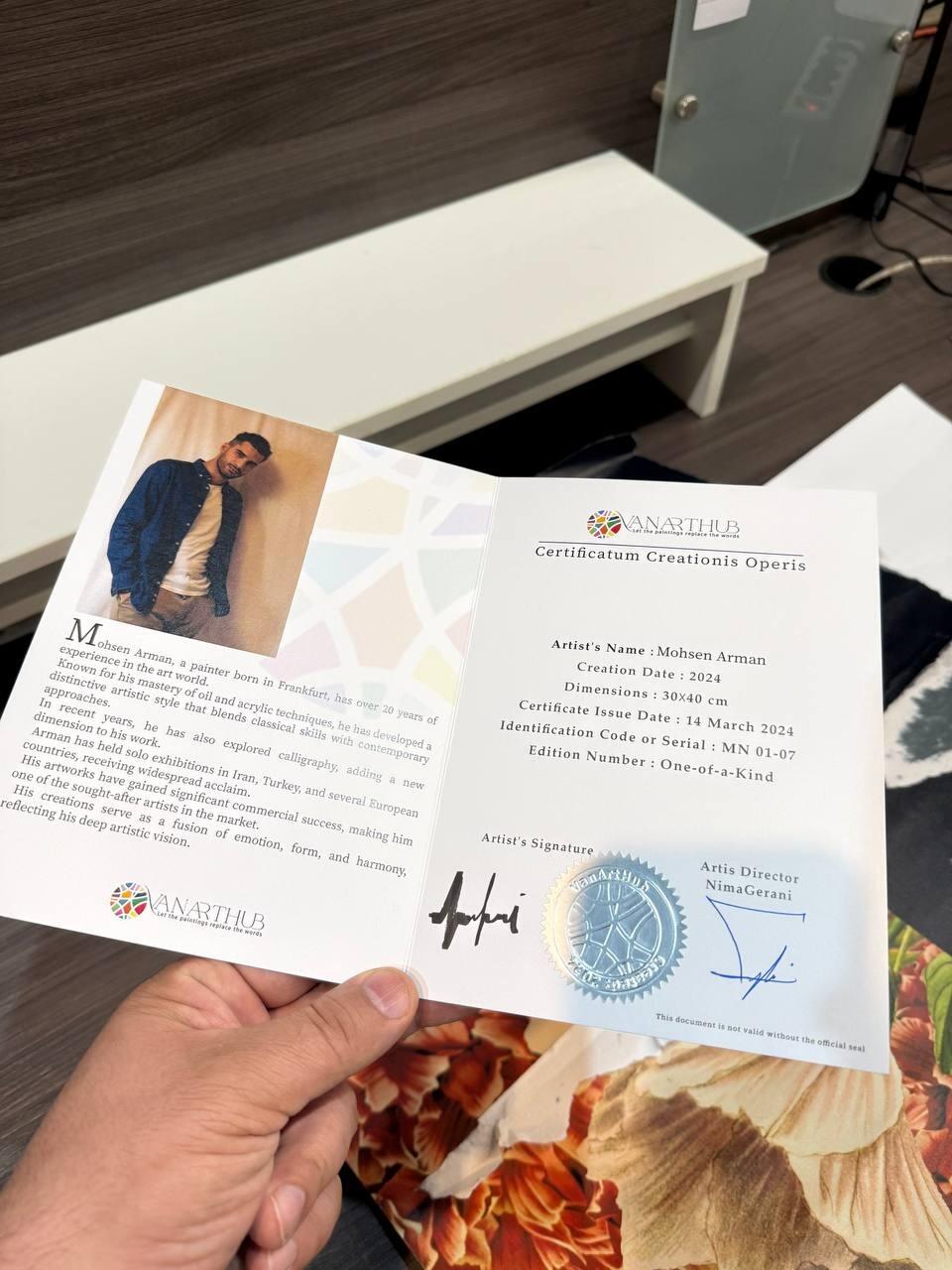
Yes, Siyavash Passing Through the Fire is an original, one-of-a-kind Persian miniature in oil and gold by Kamal al-Din Ghotb, 40 x 30 cm in size. The page shows the prince three times as he enters, crosses and leaves the fire. Every painting VanArtHub ships is a signed original, and each one comes with a Certificate of Authenticity.
How long does delivery take if I buy a painting from VanArtHub?
Delivery takes 3 to 7 business days in Canada and 5 to 10 business days to the United States. Shipping is free and fully insured on every work. We are based in Vancouver, Canada, and each painting is an original, signed, one-of-a-kind piece that arrives with its own Certificate of Authenticity.
What happens if the painting does not suit my room?
You can send it back. Every work comes with a 14-day trial: return it within 14 days of delivery for a full refund, and we pay the return shipping. That gives you two weeks to see the piece on your own wall and in your own light. The terms are on our Buy with Confidence page.
Sources
- The Metropolitan Museum of Art, "The Fire Ordeal of Siyavush", Folio from a Shahnama (Book of Kings) of Firdausi, 45.150, read October 2026.
- The Metropolitan Museum of Art, "Siyavush Stands Accused by Sudaba before Kai Kavus", Folio 163v from the Shahnama (Book of Kings) of Shah Tahmasp, 1970.301.23, read October 2026.
- The Metropolitan Museum of Art, "The Wedding of Siyavush and Farangis", Folio 185v from the Shahnama (Book of Kings) of Shah Tahmasp, 1970.301.28, read October 2026.
- The Metropolitan Museum of Art, "Siyavush Recounts His Nightmare to Farangis", Folio 195r from the Shahnama (Book of Kings) of Shah Tahmasp, 1970.301.29, read October 2026.
- The Metropolitan Museum of Art, "Kai Khusrau is Discovered by Giv", Folio 210v from the Shahnama (Book of Kings) of Shah Tahmasp, 1970.301.32, read October 2026.
- Harvard Art Museums, Double page: The Trial by Fire of Siyavush, left-hand side of a double-page painting from a manuscript of the Shahnama by Firdawsi, 2002.50.143, read October 2026.
- Harvard Art Museums, The Trial by Fire of Siyavush, folio from a manuscript of the Shahnama by Firdawsi, 2002.50.30, read October 2026.
- Harvard Art Museums, Afrasiyab and Siyavush Embrace, illustrated folio from a manuscript of the Shahnama by Firdawsi, 2002.50.13, read October 2026.
- Harvard Art Museums, Guruy Executes Siyavush, folio from a manuscript of the Shahnama by Firdawsi, 2002.50.153, read October 2026.
- The Fitzwilliam Museum, University of Cambridge, The Shahnameh, No. 49 The fire ordeal of Siyavosh, read October 2026.
- The Fitzwilliam Museum, University of Cambridge, The Shahnameh, No. 78 The fire ordeal of Siyavosh, read October 2026.
- Smithsonian's National Museum of Asian Art, Folio from a Shahnama (Book of kings) by Firdawsi; Sudaba makes accusations against Siyavush, F1930.90, read October 2026.
- University of Michigan Museum of Art, Siyavush Passes Through the Fire, from the Shahnama of Firdausi, 1963/1.48, read October 2026.
- Aga Khan Museum, Zavara Comes to the Hunting Ground of Siyavush, folio from the Big Head Shahnameh, AKM91, read October 2026.
- Encyclopaedia Iranica, Kayanian vi. Siiauuarshan, Siyawaxsh, Siavash, read October 2026.
- Encyclopaedia Iranica, Afrasiab, by Ehsan Yarshater, read October 2026.
- Encyclopaedia Iranica, Farangis, by Djalal Khaleghi-Motlagh, read October 2026.
- Encyclopaedia Iranica, Kayanian vii. Kauui Haosrauuah, Kay Husroy, Kay Khosrow, read October 2026.
- Encyclopaedia Iranica, Ta'zia, by Peter J. Chelkowski, read October 2026.
- The Packard Humanities Institute, Persian Literature in Translation, The Shahnama of Firdausi, Volume 2, pages 168 to 261, read October 2026.
- The Packard Humanities Institute, Persian Literature in Translation, The Shahnama of Firdausi, Volume 2, pages 262 to 353, read October 2026.
- British Institute of Persian Studies, A Note Persian Miniature Painting: Materials and Techniques, read October 2026.
Sources read in October 2026. If you spot something out of date, tell us and we will correct this post.
About VanArtHub
VanArtHub is a gallery based in Vancouver, Canada, that sells original, signed, one-of-a-kind works, each with a Certificate of Authenticity, free insured shipping and a 14-day trial. Persian art is also called Iranian art, and our guide to contemporary Persian painting is a good place to start. You can also see the paintings of Kamal al-Din Ghotb, or read our guide on how to buy Persian art.