Do Oil Paintings Need Glass?, from the VanArtHub custom framing guides

Glazing & Conservation · Protecting art

Do Oil Paintings Need Glass?

Usually not, and putting one behind glass wrong can damage it. The exceptions.

No. In almost every case an oil painting on stretched canvas should not be behind glass, and putting one there without a proper air gap can actively harm it.

This surprises people, because glass feels protective. For a work on paper it is. For an oil on canvas it is usually the wrong tool.

Why not

An oil film keeps working for years

Oil paint does not dry by evaporation, it cures by oxidation. It takes oxygen from the air and slowly cross-links, over months on thin passages and years on thick ones. While that happens it also gives off small amounts of solvent. A painting that is touch-dry is still chemically busy.

Seal that surface tight against glass and you interfere with the exchange. Solvent vapour has nowhere to go and can condense on the inside of the glazing, leaving a haze; in the worst case the surface stays tacky and picks up whatever it is touching.

The varnish is already the protective layer

Most finished oils are varnished, and the varnish is doing the job glazing would do: it takes the dust, the dirt, and the handling instead of the paint. It is also designed to be removable by a conservator, which is the point. Glazing adds a second protective layer to a surface that already has one.

It changes how the painting looks

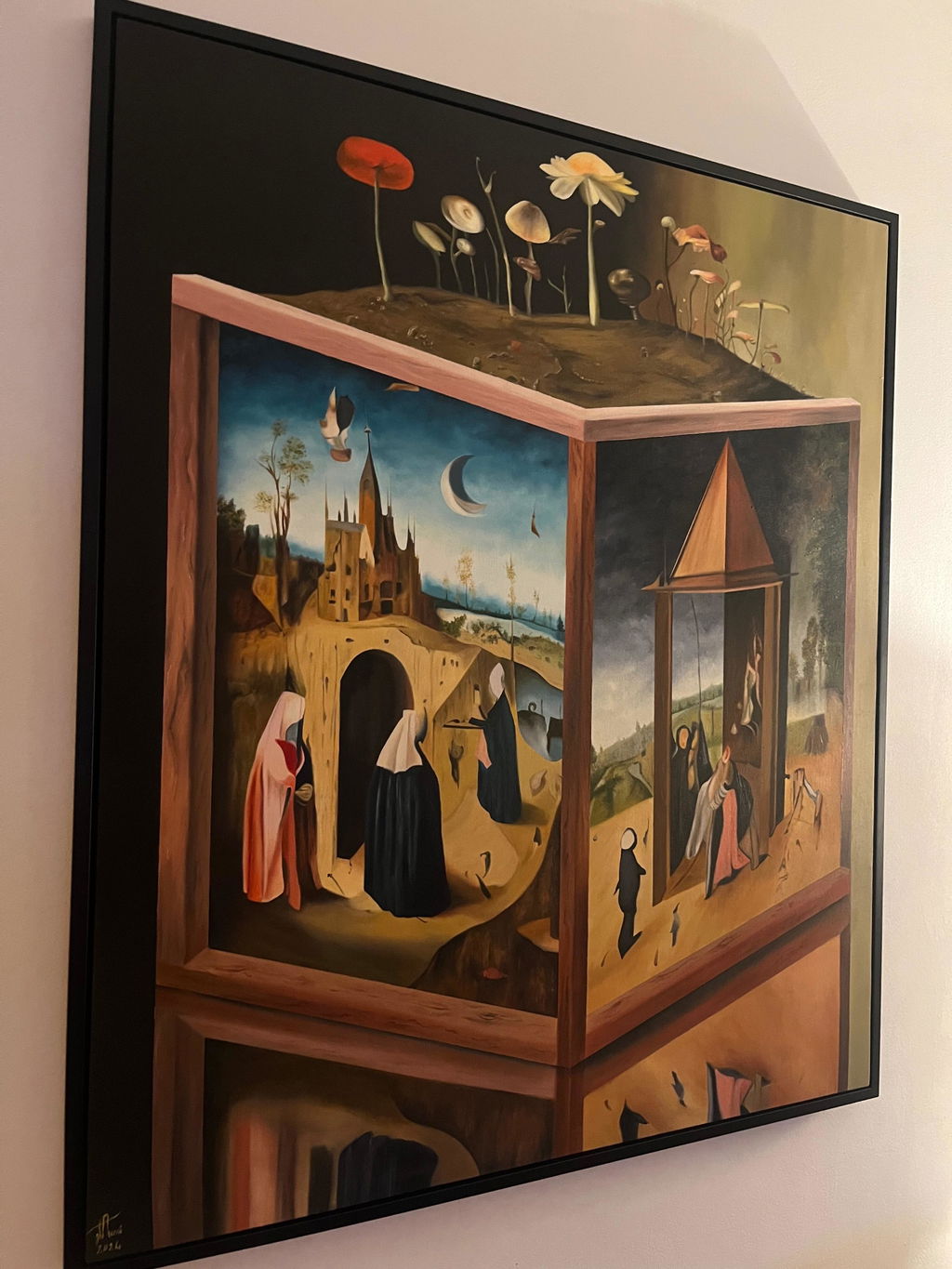
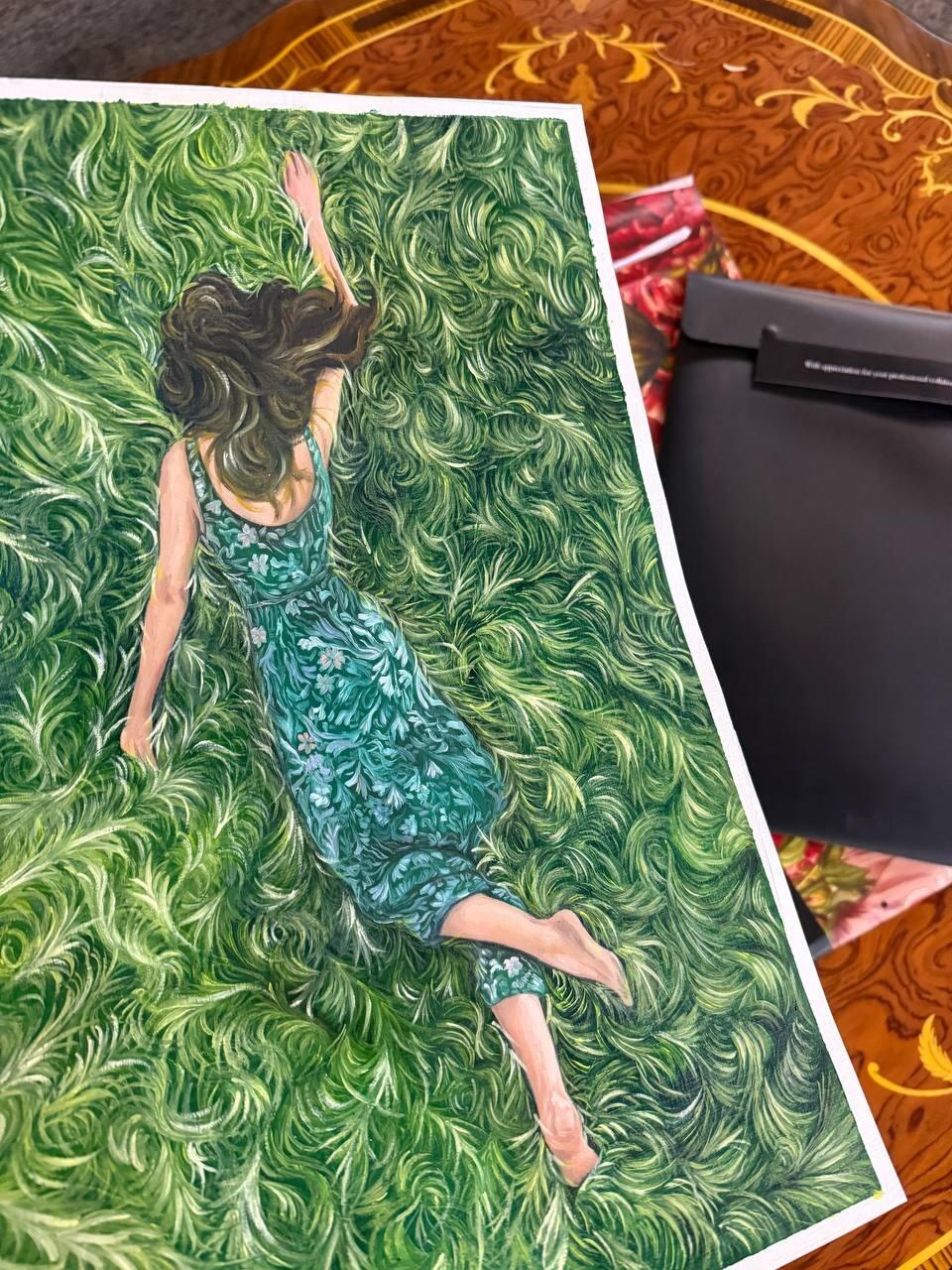
An oil surface has texture. Raking light across impasto is part of how the work reads, and a sheet of glass flattens that and replaces it with reflection. A piece like Caught in the Fire is worth looking at from an angle for exactly that reason, and glass would take it away.

The exceptions, and how they are done

There are real cases for glazing a canvas, and in every one the glazing is held well clear of the paint.

  • Genuinely hostile locations. A commercial kitchen, a restaurant wall near a pass, a busy corridor in a public building. Grease and repeated contact are worse than the compromise of glazing.
  • Unvarnished paintings. Some artists deliberately leave a matte, unvarnished surface. That surface is far more vulnerable, and glazing with a deep spacer is a legitimate answer.
  • Very valuable or historically important work. Museums do glaze paintings, always with a substantial air gap and often with a sealed microclimate behind. That is a conservation decision made piece by piece, not a general rule.
  • Fragile or flaking paint. If a surface is unstable, glazing protects it from air movement and contact while a conservator decides what to do.

In each case the requirement is the same: a deep spacer, several millimetres at minimum, and a package that is not airtight. Glass resting on paint is the failure mode, not glass in principle.

What to do instead

Protect an oil the way oils have always been protected.

  • A floater frame, which gives the edge protection where knocks actually happen, and leaves the face open. See floater frames for canvas.
  • Sensible placement: not above a working fireplace, not in direct sun, not in a doorway where people brush past it.
  • A backing board on the reverse of the stretcher. This is the genuinely useful and most-skipped step. It stops dust and insects getting behind the canvas and cushions the shock of a knock from behind, which is where most canvas damage comes from.
  • Dust with a soft dry brush. Never a cloth, never a solvent, never a proprietary cleaner.

Acrylic and varnished works on canvas

Acrylic on canvas follows the same reasoning: it does not need glazing, and it is framed the same way. Varnished photographic or mixed-media works printed on canvas, like Fortune Teller (First Sight), are also treated as canvases, since the varnish is the protective surface.

What if my oil painting is already behind glass?

Check whether the glass is touching the paint. Look along the edge of the frame from the side. If the surface is in contact, that should be dealt with soon. If there is a visible gap held open by a spacer, it is fine and can be left. Bring it in if you are not sure; opening a frame to look is a five-minute job.

Does an oil painting need to breathe?

"Breathe" is loose language, but the idea behind it is real: the paint film exchanges oxygen and releases solvent for a long time. It does not need airflow across the front, which is why a backing board on the reverse is fine. It needs not to be sealed hard against a non-porous surface.

How do I protect an oil in a busy household?

Hang it where nobody walks into it, put a frame on it so the edge takes any contact, and fit a backing board. That covers almost everything that actually happens to paintings in homes.

Glazing: glass or acrylic, UV filtering Spacer: holds the air gap open Window mat, bevel cut at 45° The artwork, hinged not glued Acid-free backing board Dust seal and flexible points Frame moulding and rebate FRONT OF FRAME
A framed work on paper cut through the side. Front of the frame is at the left. The spacer is what keeps the glazing off the surface of the art, which matters most for anything that can bloom, cockle, or stick.

Framed in-house

Not sure this applies to your piece?

Send the measurements, what it is painted on, and a photograph. We frame original work in-house and we will tell you what it actually needs.