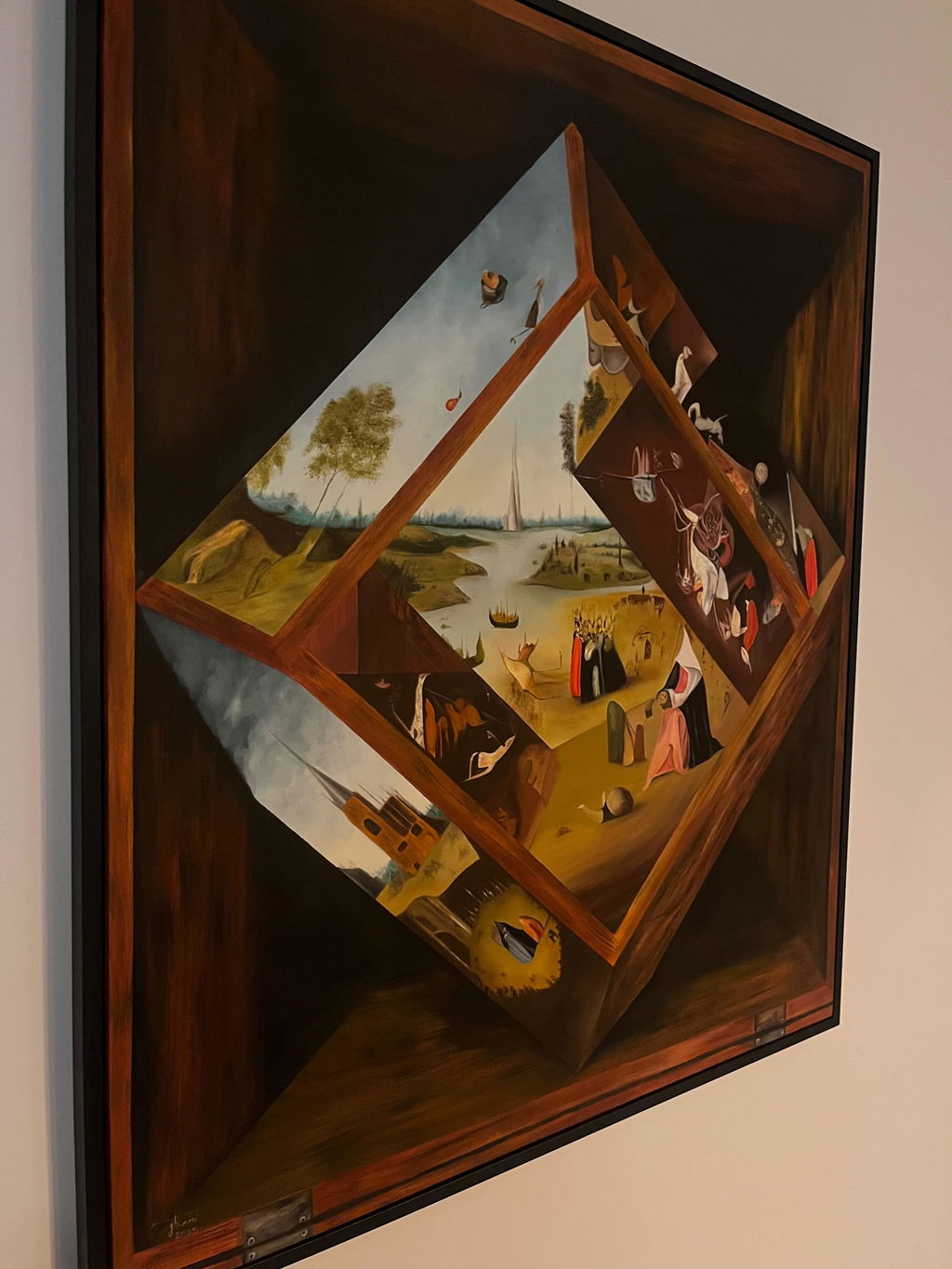
Here is a test. Stand where you normally stand to look at a framed picture in your home, in the middle of a bright afternoon. If you can see the window, the lamp, or yourself, you are not really looking at the artwork. You are looking at a partially reflective surface with a painting somewhere behind it.
Ordinary glass reflects about 8 percent of the light that hits it. That sounds small. It is not, because the reflection competes directly with the picture, and it wins wherever the painting is dark.
Why dark work suffers most
A reflection is additive: it lays light on top of whatever is behind the glass. Over a bright passage of paint, an 8 percent reflection is lost in the brightness. Over a dark passage there is almost nothing to lose it in, so the reflection is all you see.
This is why dark and monochrome work is hit hardest. A graphite drawing like The Last Channel lives in its greys and blacks, and those are exactly the areas where ordinary glass turns into a mirror. The same frame over a pale, high-key work would barely be noticed.
Anti-reflective coating, and what it is not
Modern anti-reflective glazing is optically coated, the same principle as a camera lens. The coating cancels reflection through interference rather than by scattering it. Reflection drops to under 1 percent, the image stays perfectly sharp, and the glass appears to vanish. Most people looking at a piece behind museum-grade glazing assume there is no glass in the frame at all.
Old non-glare glass is a different and much older product. The surface is etched or acid-frosted so it scatters reflections instead of cancelling them. It does cut glare, but it pays for it: the image softens, contrast drops, and the effect gets worse the further the art sits behind the glass. On a matted piece, where the mat holds the glazing several millimetres off the surface, etched non-glare glass visibly blurs the work.
If glare is the problem, coated anti-reflective glazing is the fix. Etched non-glare is a compromise from an era before the coating existed.
Where it earns its cost
- The picture faces a window. This is by far the most common case and the most dramatic improvement.
- There is a picture light or a spotlight on it.
- The work is dark, monochrome, or high contrast.
- It hangs in a room with a screen or a television opposite.
- The piece rewards close viewing, so people will stand near it and reflect in it.
Where you can skip it
- The picture is on the same wall as the window. Light comes from beside it, not at it, and reflection is minimal.
- Pale, light-toned work.
- Corridors and stairwells with no facing light source.
- A canvas, which has no glazing at all and therefore no glare. Reflection on an oil comes from varnish, and that is solved by lighting angle rather than by glazing.
Before you pay for glazing, move the picture
Glare is a geometry problem before it is a materials problem. The reflection you see depends on the angle between the light source, the glass, and your eye. Shifting a picture to an adjacent wall, or angling a picture light so it comes in from above at around 30 degrees rather than straight on, can remove the problem entirely and costs nothing.
It is worth trying first. If the picture has to hang on the wall facing the window, then the glazing upgrade is the answer, and it is a large visible improvement rather than a subtle one.
Rooms where anti-reflective glass matters most
AR glass is worth the upgrade in specific rooms, and a plain rule of thumb helps decide when to spend the extra rather than guessing. Ask where the light in the room comes from and where the painting will hang relative to it.
Facing a window. Any wall directly across from a window, especially a large one, throws a bright rectangle of reflected sky or glare across standard glazing every time the sun is out. This is the single most common complaint we hear about ordinary glass, and it is also the easiest case to predict before the piece is even hung: if you can see the window's reflection in a mirror held against that wall, you will see it in glass too.
Over a mantel with a light above. A picture light or spotlight mounted above a piece to illuminate it is, ironically, the exact setup that makes standard glass reflective, since the light source sits right where the viewer's eye also needs a clear view through the glass. AR glass is close to essential here, because the alternative is a bright glare spot sitting directly over the part of the painting the light was meant to show off.
Hallways and entryways with downlights. Recessed ceiling lights along a hallway create a moving reflection as you walk past a framed piece, which is distracting on a piece meant to be seen in passing.
Rooms without a strong opposing light source, an interior wall with only ambient room light, get less benefit from the upgrade, and standard glass is a reasonable place to save the cost there.
Common questions
Is anti-reflective the same as UV protection?
No, and this is the most expensive misunderstanding in framing. They are separate properties. Anti-reflective glass with no UV filter looks superb and protects the pigment barely at all. Ask for both explicitly. See museum glass vs conservation glass.
Does anti-reflective glazing change the colours?
Slightly, and for the better. Because less light is bounced off the surface, more reaches the artwork and comes back, so blacks look deeper and colour looks more saturated. Some coatings carry a very faint green or magenta cast visible at an angle, which is invisible when you are looking straight at the piece.
Can it be added to an existing frame?
Yes. Only the glazing is replaced, so the frame, mat and backing all stay. It is one of the cheapest upgrades available and one of the most noticeable.
Does anti-reflective glazing cost more than plain glass?
Yes, meaningfully more, since it requires a coated glass or acrylic sheet rather than a plain one. The price difference is usually worth it on a piece hung where reflections are a real problem, such as opposite a window or under a spotlight, and less worth it in a dim hallway where glare was never an issue.
Is anti-reflective glazing harder to clean?
No, it cleans the same way as plain glazing, with a soft cloth and a cleaner made for coated glass. What changes is that fingerprints and smudges show up more clearly against the reduced reflection, simply because there is less glare to visually mask them, so it may look like it needs cleaning more often when it does not.
Does anti-reflective glass work at every viewing angle?
It reduces reflection across the normal range of angles you view a wall from, but no coating removes glare completely at a sharp raking angle directly toward a bright light source. Standing normally in front of the piece, the improvement over plain glass is dramatic and consistent.
Can anti-reflective coating be applied to acrylic as well as glass?
Yes. Anti-reflective coatings exist for both glass and acrylic sheet, and the choice between the two base materials is made on weight, size and breakage risk, not on whether the coating happens to be available. See acrylic vs glass framing for how to choose between the two materials for a given piece.
Is anti-reflective glazing more fragile than plain glass?
No, the coating does not weaken the glass or acrylic underneath it. It sits as a thin optical layer on the surface and does not change the sheet's resistance to impact or flexing. Handling and shipping risk are the same as for the uncoated equivalent of the same material.