Persian Wedding Gift Guide: Choosing a Painting for a Couple
UpdatedA traditional Persian wedding gift, in the sources we read, is something for the bride or for the couple's home. The Encyclopaedia Iranica records a mirror, candlesticks and jewelry for the bride, and clothes, carpets and furniture given to the couple after the wedding night. An original painting is our own suggestion for a Persian wedding gift that stays on a wall. We are VanArtHub, a Vancouver gallery that sells original Persian miniatures and contemporary paintings that draw on Persian tradition, and this guide shows how to choose a painting for a couple whose walls you have never seen.
Who this guide is for, and when a painting is the wrong gift
This guide is for a guest, a relative or a friend of the couple.
A wedding gift registry comes before any surprise: if the couple has a list, buy from it. A painting is a personal choice, and some couples would prefer money toward a home, so ask a parent or a close friend first. And giving a painting at a Persian wedding is our suggestion: none of the sources we read records it as a custom.
Every work in our gallery is new and made by a living artist, and we ship no printed copies.
What the Encyclopaedia Iranica records as wedding gifts
The Encyclopaedia Iranica divides the wedding into phases: the betrothal, the marriage contract ceremony (aghd, written aqd in the Iranica) and the wedding celebration (arusi).
At the betrothal, Anne H. Betteridge writes, the groom's family may send trays of candied sugar, shawls, a ring and other jewelry to the bride's home. Before the contract ceremony a decorated tray carries the groom's gifts to the bride, which include a mirror, two candlesticks and a Quran. In the village of Owrazan the groom's guests pledge wedding gifts and promise to deliver them before the bride arrives at his house.
Willem M. Floor, in the Iranica's entry on gift giving in the Qajar period, records presents given to the married couple after the wedding night. They were called chashm-roshani, and they usually consisted of clothes, carpets, jewelry and furniture.
These records describe particular places and earlier times, so for what guests give today, ask the family. Our reading: most of these gifts are for a home, and the couple keeps them.
The wedding spread: images that are already part of the day
The contract ceremony is held at the sofreh aghd, the wedding spread. Betteridge and Hassan Javadi describe it in the Iranica as a cloth laid with symbolic objects that are meant to bring the bride a good married life.
The mirror and the light come first. At the far end of the cloth stands a mirror, called the mirror of luck, and the entry adds that it should later be the first object moved into the couple's new home. Two candlesticks stand beside it. One is said to represent the bride and the other the groom, and the lit candles symbolize brightness and long life.
Sweetness comes next. While the contract is read, a happily married woman rubs two cones of sugar together above a white cloth held over the bride's head, for a sweet future. In Shiraz a lamp made with honey and oil is lit, so that the bride and groom will get along like the honey and the oil.
Each region, the entry says, has its own customs about what must be on the spread. The entry's list has no flowers. Rose water appears in the account of the wedding procession, where people along the route may sprinkle it on the bride.
What a painting can share with the wedding, in our reading
The links below between a painting and a wedding are our own reading.
Birds in a pair. The Metropolitan Museum of Art holds a ketubah, a Jewish marriage certificate, from Kashan in Iran, dated 1889. The museum says that "the pairs of birds are allusions to the bride and groom". On that one marriage document, two birds stand for the couple.
The rose and the nightingale. Layla Diba writes in the Iranica that the rose and the nightingale (gol o bolbol) are the model pair of beloved and lover, and that Persian poets used them as a metaphor for spiritual and earthly love. In art the pair belongs to flower and bird painting (gol o morgh), and she calls it the principal decorative theme of the Safavid (1501 to 1722) and Qajar eras. The Met holds a lacquer mirror case by Aqa Ahmad, dated 1852 to 1853, with a rose and a nightingale on its outer surfaces and verses about the mirror inside. The museum reads the pair there as the lover's wish to unite with the beloved, who is God. So the same two figures can mean a human couple or the soul and God. See our page on symbols in Persian painting.
Gold and ornament. Marriage contracts (aghd-nameh) were decorated documents. Diba's entry on them describes painted and gilded designs, among them vases with flowers, and birds and flowers. The Met holds one by the calligrapher Abu'l Qasim Farhang ibn Vesal, dated 1874, in ink, opaque watercolor and gold on paper (1979.518.5).
A line of poetry. A painting that begins from a poem brings verse into a new home. Before you buy one, find out which verse the painter began from: see our guide to Rumi and Hafez paintings and our page on Persian poetry in painting.
Blossom Serenade by Phaedra is a work in colored pencil on artboard, 70 cm wide and 50 cm tall (27.6 x 19.7 in). Two birds sit on a flowering branch and face each other, among coral and deep pink flowers on a white ground. It is a contemporary work, and its product page makes no link to Persian painting. We show it here because it shares one subject with flower and bird painting: a pair of birds among flowers.

How to choose a painting for a couple
| What to settle | A good answer | Ask more questions when |
|---|---|---|
| Whether they want a painting | A parent or a close friend says yes | They have a registry, or asked for money |
| How well you know them | You can name a picture they chose | You know one of them, from work |
| Their home, and the size | A settled address, and a size in centimetres | They plan to move: choose a small work |
| The subject | Birds, flowers or gold ornament | A story scene whose ending you have not read |
| One giver or a group | One person chooses, and every name is on the card | Nobody has agreed who decides |
| When and where it is delivered | To the couple's home, after the wedding | To the reception hall |
| The card and the return terms | The card says the work can go back, and the seller's terms are in writing | The seller's page says nothing about returns |
Whether they want a painting, and how well you know them. A parent or a close friend usually knows whether the couple has a registry or is saving for a home. If the answer is money, give money. Then ask yourself: can you name a picture the couple chose for themselves? If you cannot, choose a small work with a plain subject, or give something else.
Their home, and the size. A couple who will move needs a gift that can move with them. The Canadian Conservation Institute (CCI) calls moving vulnerable paintings "one of the most hazardous activities". A small work fits in a box that one person can lift. If you know the room, our guide to Persian wall art for a living room shows how to measure the wall above a sofa.
Celestial Garden by Darya is Persian negargari in oil and gold, 30 x 40 cm (11.8 x 15.7 in), the small gift of the three. Small planets sit inside bands of gold ornament filled with flowers and scrolling vines, around a large gold spiral. Its link to the wedding is gold and flower ornament, which the decorated marriage contracts also carry. See the Darya collection, and our guide to framing a Persian miniature.

The subject. Choose a picture that needs no explanation when it is unwrapped: birds, flowers or gold ornament. Avoid sad or violent story scenes, and anything you would have to explain. Our Shahnameh buying guide names the hard scenes and the easier ones, and suggests one scene for a wedding.
One giver or a group. A large painting works best as a group gift. Agree first on who chooses, who places the order, and whose names go on the card. In our view one person should choose, after asking the couple's family.
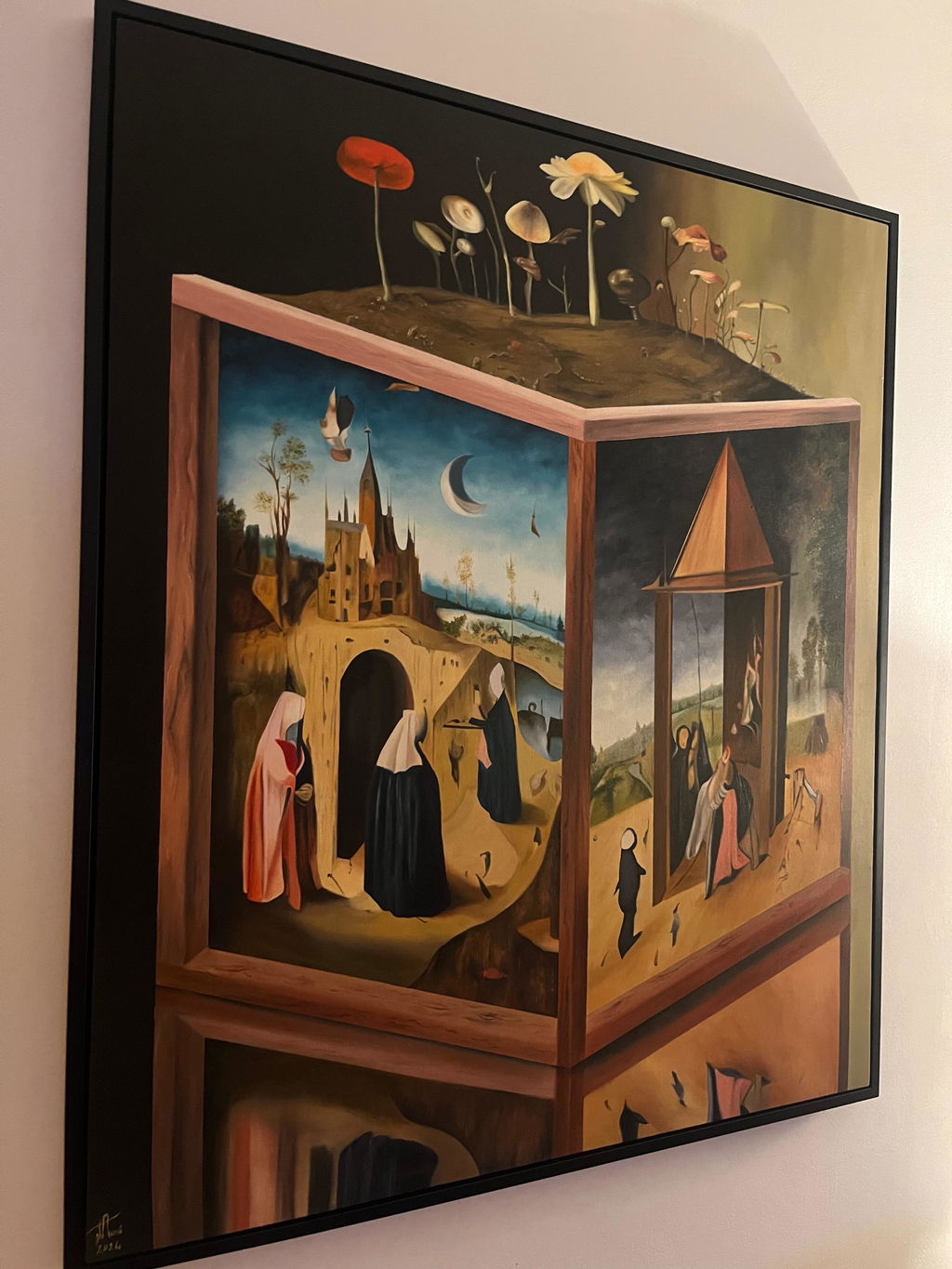
Beyond the Stone by Roshan is oil on canvas, 101.6 x 101.6 cm (40 x 40 in), the large gift of the three. On a dark ground a glowing head with closed eyes appears at the left, and at the right a seated figure made of broken forms raises a hand to its head. According to its product page, the painting began from a thought of Rumi: something old must come down before something new can be built. In our reading that thought suits the start of a shared life. The picture is serious and dark in tone, so give it only to a couple whose taste you know. See the Roshan collection.

When and where to give it. Give the painting after the wedding, and have it delivered to the couple's home. A reception is full of people, food and drinks, and CCI tells owners to keep food and drinks away from paintings. Bring a card to the wedding. Our Yalda gift guide explains how to wrap, carry and open a painting. In short: leave the protective packing on, and put the work down for the couple to open.
The card and the return terms. Write in the card what the painting is (title, artist, medium and size) and that it can be returned: "If this is wrong for your home, tell me and it goes back." Read the seller's return terms before you pay, and check the day the count starts.
Three sizes of gift
The small gift is Celestial Garden, 30 x 40 cm: one person can give it, and it travels in a box when the couple moves. The middle gift is Blossom Serenade, 70 cm wide and 50 cm tall. Two birds together among flowers need no explanation, so we would choose it first for a couple whose taste we knew less well. The large gift is Beyond the Stone, a square of 101.6 cm, for a large wall in a settled home.
Two of the three are on paper or artboard. CCI writes that visible light "fades colours often found on paper objects and artworks", so tell the couple to keep the work out of direct sunlight. Our gift-worthy art collection has more works to compare.
How buying a gift from us works
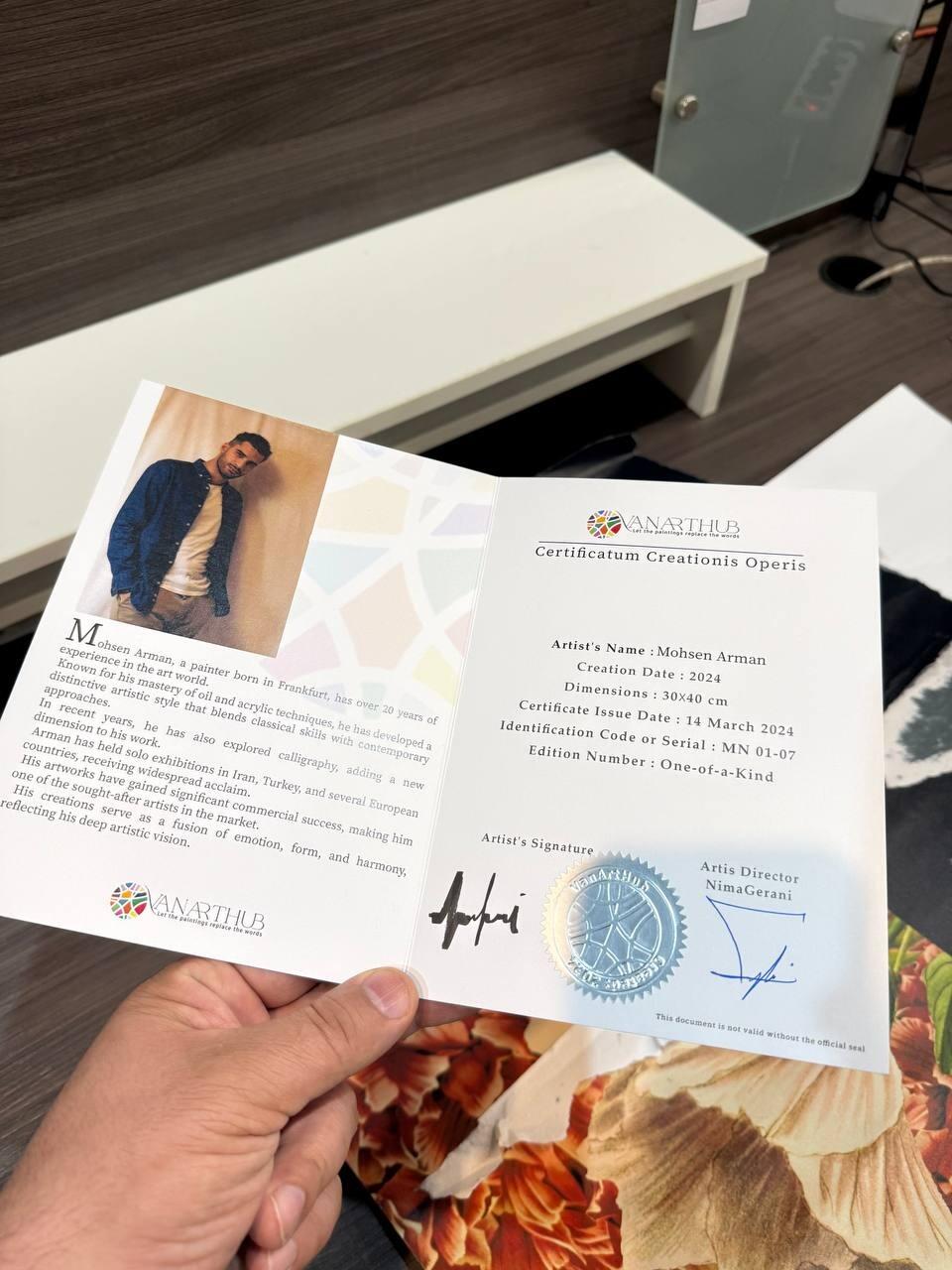
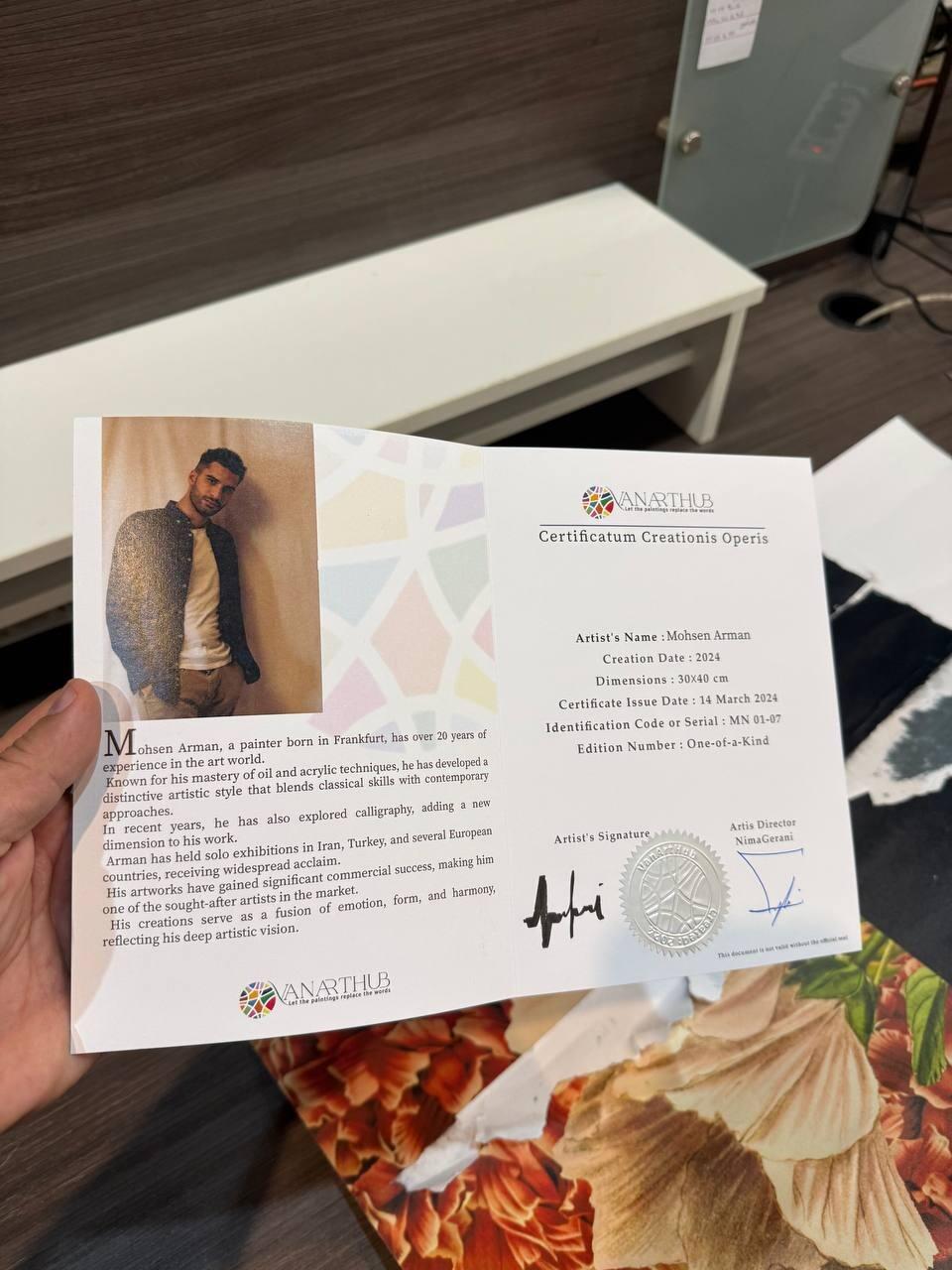
Every painting we ship is an original, signed and one of a kind, and it comes with a Certificate of Authenticity. Shipping is free and fully insured: 3 to 7 business days in Canada and 5 to 10 to the USA. We cannot promise a delivery day. We tell you before a work ships whether it will travel flat or rolled. If a carrier asks for a customs or brokerage fee, contact us before you pay it.
The 14-day trial starts on the day of delivery, so a gift sent to the couple's home after the wedding gives them all 14 days. A work returned within 14 days of delivery is refunded in full, and we pay the return shipping. Ask us before you order how a return works for a gift delivered to another person. The full terms are on our Buy with Confidence page.
Every product page has a form for questions about that work. Use it to ask about a frame, which the pages leave open. Framing is done in-house at our gallery and quoted per piece: see custom framing. We do not promise gift wrapping or a gift message, so plan to write your own card.
Our gallery is at 1242 Davie Street in Vancouver's West End, and the opening hours are on our West End gallery page. Contact us before you come, so we can confirm the work is at the gallery that day. Our guide on how to buy Persian art covers cross-border rules.
Each product page also offers Buy Print File, a high-resolution digital file of the image for personal printing: nothing is shipped, we email the file within 48 hours, and copyright stays with the artist. A print made from the file is a reproduction, and the painting itself still exists once.
Key Takeaways
- The Encyclopaedia Iranica records gifts for the bride and the home, from a mirror and jewelry to carpets and furniture.
- Giving a painting is our own suggestion. None of our sources records it as a custom.
- A registry comes first, and some couples prefer money toward a home. Ask a parent or a close friend.
- Choose a subject that needs no explanation, a small work for a couple who will move, and a large work only as a group gift.
- Send the painting to the couple's home after the wedding. Our 14-day trial starts on the day of delivery.
Frequently Asked Questions
What is a traditional Persian wedding gift?
Gifts for the bride and for the home are what our sources record. The Encyclopaedia Iranica describes a mirror, two candlesticks and a Quran given by the groom to the bride, jewelry sent at the betrothal, and, in its entry on the Qajar period, clothes, carpets, jewelry and furniture given to the couple after the wedding night. Customs differ by family and region.
What is on a sofreh aghd, the Persian wedding spread?
A mirror, two candlesticks and a Quran on a prayer cloth are the main objects on the sofreh aghd, in the Encyclopaedia Iranica's account. The same entry describes two cones of sugar that are rubbed together above the bride for a sweet future, and in Shiraz a lamp lit with honey and oil. Each region, the entry adds, has its own customs about what belongs on the spread.
Is a painting a traditional gift at a Persian wedding?
No source we read for this guide records a custom of giving paintings at a Persian wedding. The gifts that the Encyclopaedia Iranica records are for the bride and the home, such as a mirror, jewelry, carpets and furniture. A painting is our own suggestion: it is made for a home, the couple keeps it, and it hangs where they see it daily.
Do two birds in a picture have a meaning at a wedding?
On one marriage document from Iran they do. The Metropolitan Museum of Art says of a ketubah from Kashan, dated 1889, that its pairs of birds are allusions to the bride and groom. The Encyclopaedia Iranica calls the rose and the nightingale the model pair of beloved and lover. Reading two birds in a new painting as a couple is our own step.
Is Blossom Serenade a Persian flower and bird painting?
No. Blossom Serenade by Phaedra is a contemporary work in colored pencil on artboard, 70 cm wide and 50 cm tall, and its product page makes no link to Persian painting. Two birds face each other on a branch of coral and deep pink flowers. We show it because it shares one subject with Persian flower and bird painting: a pair of birds among flowers.
What size of painting suits a couple who will move soon?
A small one, in our view. A work of 30 x 40 cm fits in a box that one person can lift, and a home of any size has a wall for it. The Canadian Conservation Institute calls moving vulnerable paintings one of the most hazardous activities, over a short distance as well as a long one. Keep a large canvas for a couple with a settled home.
Should I bring a painting to the wedding reception?
No, send it to the couple's home after the wedding and bring a card to the reception. A reception is full of people, food and drinks, and the Canadian Conservation Institute tells owners to keep food and drinks away from paintings. With delivery after the celebration, the couple opens the parcel themselves and has the whole 14-day trial.
Can a couple send back a painting they received as a wedding gift?
Yes, a painting from VanArtHub can come back within 14 days of delivery for a full refund, and we pay the return shipping. The count starts on the day of delivery, so a gift delivered to the couple's home gives them all 14 days. Say in your card that a return is welcome, and ask them to keep the packing.
Can several guests give one painting together?
Yes, and a large painting is best given that way, in our view. Agree first on who chooses, who places the order and whose names go on the card. Let one person choose after asking the couple's family. For any question about paying as a group, write to us through the form on the product page before you order.
How long does a wedding gift take to reach an address in Canada or the USA?
Delivery takes 3 to 7 business days in Canada and 5 to 10 business days to the USA, and shipping is free and fully insured. We cannot promise a delivery day, which is one reason we suggest sending the gift after the wedding. If a carrier asks for a customs or brokerage fee, contact us before you pay it.
Sources
- Encyclopaedia Iranica, Aqd (marriage contract, marriage contract ceremony), by Anne H. Betteridge and Hassan Javadi, read October 2026.
- Encyclopaedia Iranica, Arusi (the wedding celebration), by Anne H. Betteridge, read October 2026.
- Encyclopaedia Iranica, Gift Giving v. In the Qajar Period, by Willem M. Floor, read October 2026.
- Encyclopaedia Iranica, Gol o bolbol (rose and nightingale), by Layla Diba, read October 2026.
- Encyclopaedia Iranica, Aqd-nama (marriage contract), by Layla Diba, read October 2026.
- The Metropolitan Museum of Art, Ketubah (Jewish Marriage Certificate), Kashan, dated 1889, 2025.100, read October 2026.
- The Metropolitan Museum of Art, Marriage Contract, calligrapher Abu'l Qasim Farhang ibn Vesal, 1979.518.5, read October 2026.
- The Metropolitan Museum of Art, Mirror Case, by Aqa Ahmad, 2023.501, read October 2026.
- Canadian Conservation Institute, Caring for paintings, read October 2026.
- Canadian Conservation Institute, Caring for paper objects, read October 2026.
Sources read in October 2026. If you spot something out of date, tell us and we will correct this post.
About VanArtHub
VanArtHub is a gallery based in Vancouver, Canada. Every painting we ship is an original, signed and one of a kind, and comes with a Certificate of Authenticity, free insured shipping and a 14-day trial. Persian art is also called Iranian art, and our guide to contemporary Persian painting introduces its traditions. You can also browse all artworks.