Persian Abstract Art: How to Choose a Painting for a Room
UpdatedPersian abstract art, in a listing, is abstract painting that takes something from Persian tradition. In practice a Persian abstract painting takes one of three things: ornament, script or a poem. The label is used loosely, so ask every seller which of the three a work takes. We are VanArtHub, a Vancouver gallery that sells original Persian miniatures and contemporary paintings that draw on Persian tradition, and this guide shows one work for each of the three.
What "Persian abstract art" means in a listing
"Persian" on an abstract painting is a claim about where its forms come from. A seller who makes the claim should be able to state the link in one sentence.
The first link is ornament: the geometric patterns, scrolling vines and carpet designs of Persian art. The second is script: letters, or marks shaped like writing, used as line and texture. The third is a poem: the painter starts from a verse and paints a response to it.
A museum label shows a full answer. The Metropolitan Museum of Art holds Flight of the Dolphin, made in 2010 by Monir Shahroudy Farmanfarmaian. Its label says she combined traditional reverse-glass painting, mirror mosaics and "principles of Islamic geometry" with modern concepts of minimalism.
This guide is for a buyer who has to choose a painting for a room from photographs. We sell new works by living painters and no antiques, and we ship no printed copies or posters. For a canvas by one of the modern painters of the 1960s, go to an auction house or a specialist dealer.
What abstract art is, in two paragraphs
Tate's glossary defines abstract art as art that "does not attempt to represent an accurate depiction of a visual reality" and that works through shapes, colours, forms and gestural marks. One type starts from an object, a figure or a landscape and simplifies its forms. The other uses forms "which have no source at all in an external visual reality". Abstract art, Tate adds, has been a central part of modern art since the early 1900s.
On meaning, Tate lists several theories. One holds that art should be like music, made of pure patterns of form, colour and line. Another holds that abstract art can be seen to represent the spiritual. So nobody can tell you what an abstract painting means, and that includes the seller. Choose the one you want to keep looking at.
The Secret of Creation by Roshan is acrylic on canvas, 101.6 x 101.6 cm (40 x 40 in). A figure with long purple hair appears at the upper left, partly covered by waves of yellow and light blue. The painting is abstract in Tate's first sense, because it starts from a figure. Its Persian link is a poem: the product page says the painter began from a verse of Hafez, and that the picture is about love as the source of existence and reason as the force that gives it order. The page prints no verse.

Persian art was abstract centuries before modern painting
The Metropolitan Museum of Art counts geometric pattern among the three types of decoration without figures in Islamic art, beside calligraphy and plant patterns, and calls the patterns "abstract designs". It finds their sources in late antiquity, among the Greeks, the Romans and the Sasanians in Iran.
The second form is the scrolling vine. Priscilla P. Soucek, in the Encyclopaedia Iranica, describes arabesques as "vine patterns in which stems and leaves grow one from the other", and records that 15th-century authors called the pattern eslimi. The Met notes that the word arabesque was coined in the early nineteenth century and that few scholars of Islamic art use it today. You will still meet it in listings, ours included.
The carpet combines the two. The Victoria and Albert Museum holds the Ardabil Carpet, which an inscription on one edge dates to 1539 to 1540. Each part of its design, the museum says, is filled with scrollwork set with swirling flowers or leaves. Roger M. Savory adds in the Iranica that carpets were frequently designed by the illuminators of manuscripts.
The Met also says that plant patterns in Islamic art are "largely devoid of symbolic meaning", apart from the garden and its reference to paradise. Our reading: you can enjoy ornament by looking at it, with nothing to decode.
Celestial Garden by Darya is Persian negargari in oil and gold, 30 x 40 cm (11.8 x 15.7 in). Striped and marbled planets sit inside sweeping bands of ornament, each band filled with small flowers, arabesques and scrolling vines. Its Persian link is ornament, the subject of this section. The product description calls the composition contemporary and abstract, and explains negargari as the art of the miniature and the illuminated manuscript.

Persian modern art in one short section
Persian art is also called Iranian art. Karim Emami, who wrote the Encyclopaedia Iranica's survey of modern painting in Iran, records that at the Second Tehran Biennale, held in 1960, "abstract canvases were on the increase", while other painters showed pictures with a clear local subject.
The Met says Mansour Ghandriz, who lived from 1936 to 1966, explored abstraction inspired by textiles and metalwork. Of the Saqqakhana painters, it says they "used letters and numbers as a decorative element" to fill the background of a picture, which removed the meaning the characters had as words. Our page on the history of modern Persian art tells the full story, and our page on Persian calligraphy in painting covers script in modern painting.
Silent Echo by Peyman Mehdizadeh is acrylic on canvas, 127 x 139.7 cm (50 x 55 in). Horizontal lines of white script cover a textured surface of orange-red and teal-green, with black shapes and splatters. The product description calls the script calligraphic and illegible. Its link is the narrowest of the three: script used as texture, the approach this section describes. The marks hold no words, so there is nothing to translate, and the product page names no language.

How to choose an abstract painting for a room
These nine decisions apply to a painting from any seller, and to ours.
| What to decide | A good answer | Ask more questions when |
|---|---|---|
| The Persian link | The seller says which it is: ornament, script or a poem | The listing says "Persian abstract" and stops there |
| Size against the wall and the furniture | Height and width in centimetres | A word such as "oversized" and no numbers |
| Colour against a rug or a sofa | A photo taken in daylight | The colours change from one photo to the next |
| How busy the surface is | A close photo and one taken from across a room | Every photo is taken from the same distance |
| The medium and the surface | Both named: acrylic or oil, on canvas or on paper | "Mixed media" with no list of materials |
| Which way up | The top edge is marked on the back | Photos show the work hanging two ways, with no explanation |
| The light | A wall that direct sun never reaches | Your only free wall faces a sunny window |
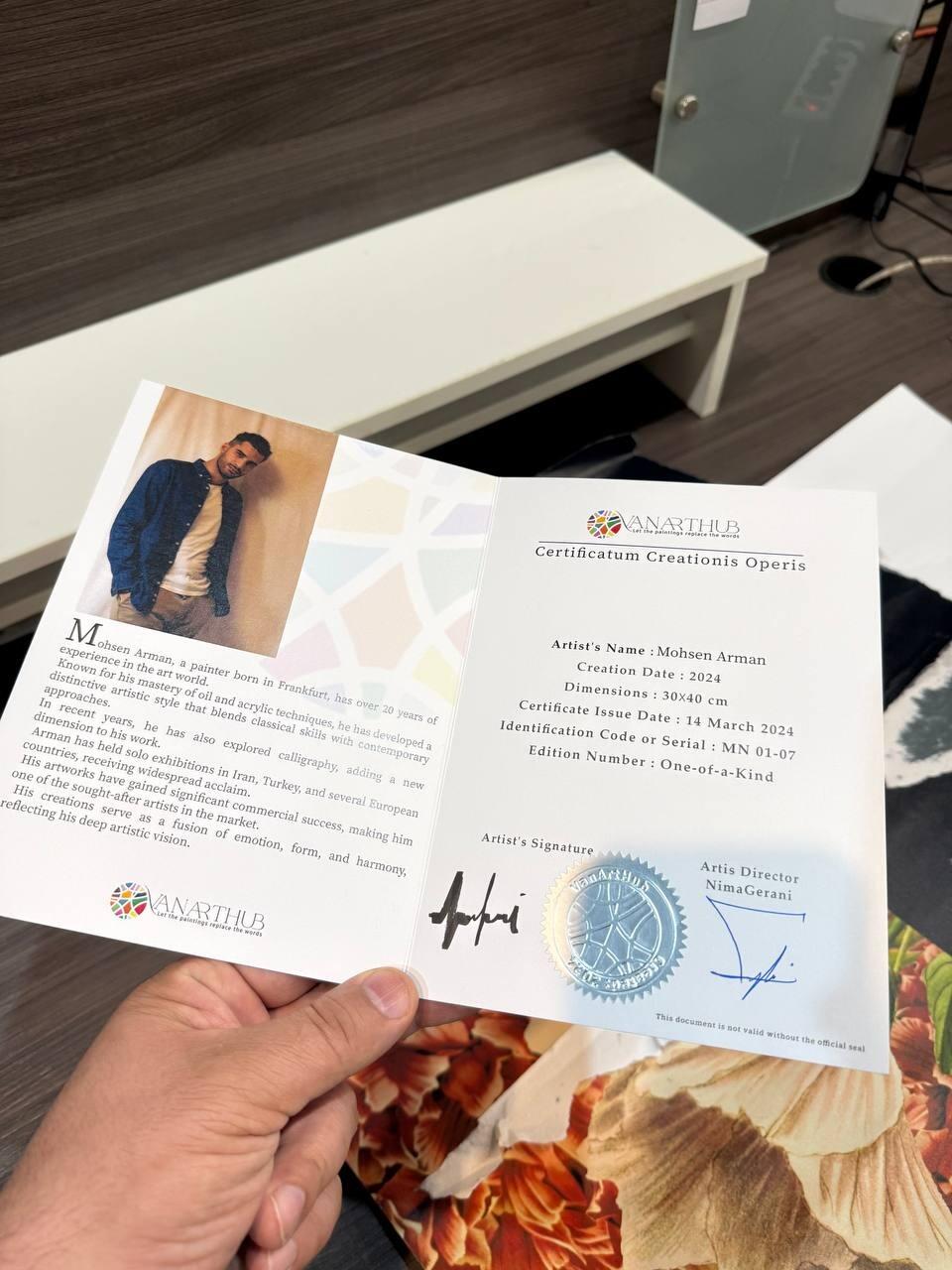
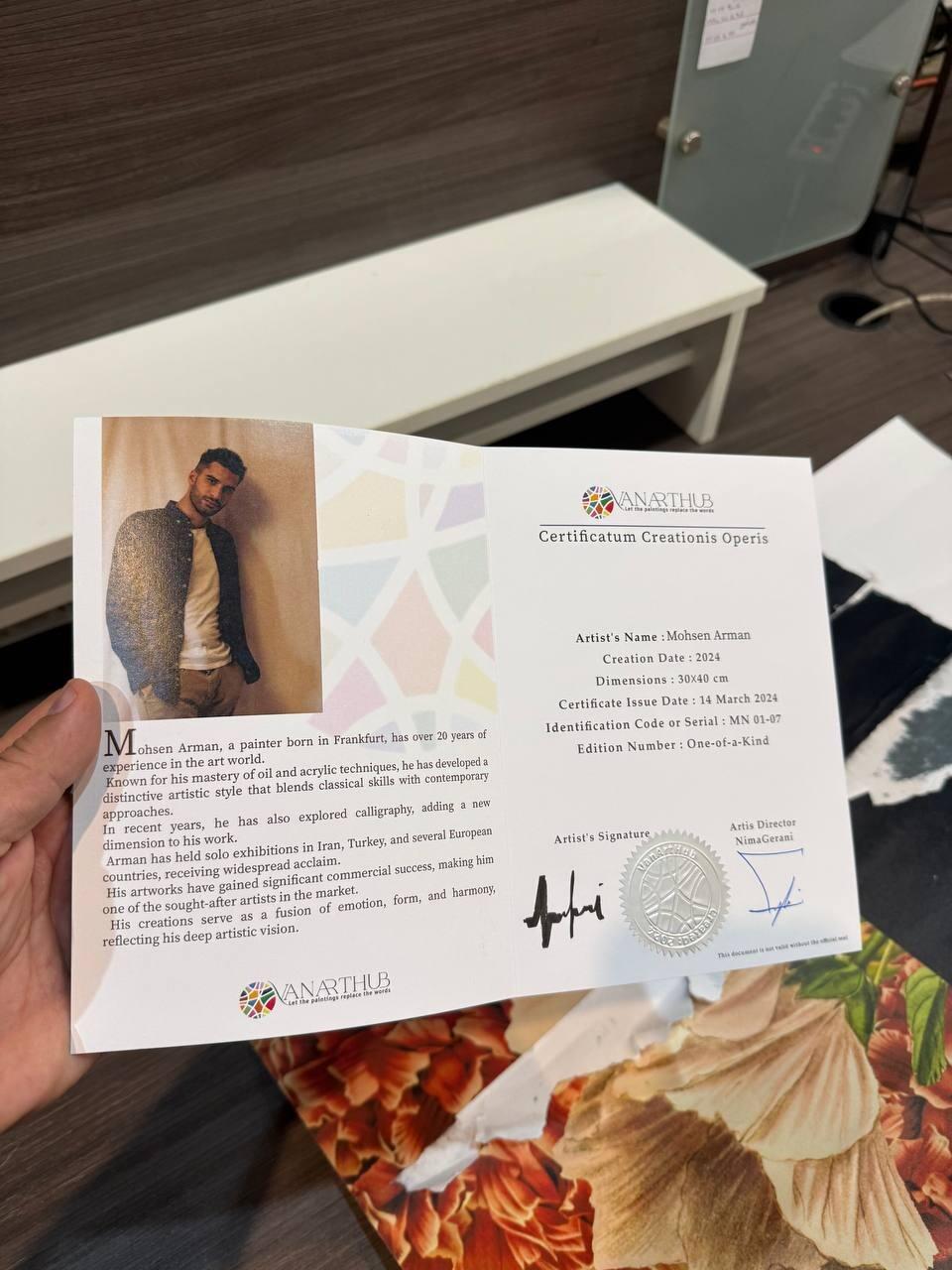
| The certificate | Signed, and it names the painter, the title, the medium and the size | None is offered, or it leaves out the painter |
| The return terms | In writing: the days, the refund, and who pays to ship the work back | Returns are refused, or the page says nothing about them |
The Persian link. Ask which of the three the painting takes. For a poem, ask which verse and whose translation: see our guide to Rumi and Hafez paintings. For script, ask whether the words can be read: see our guide to Persian calligraphy art. If the seller has no answer, judge the work as an abstract painting and nothing more.
Size. Measure the wall and the furniture under it first. Cut paper to the size of the painting, tape it to the wall and leave it for a day. Above a sofa, we would start at two thirds of the sofa's width. That fraction is our own preference: the museum and conservation sources we read give none. By that measure The Secret of Creation, at 101.6 cm wide, fits above a sofa of 152.4 cm or wider.
Colour against a rug or a sofa. A Persian rug already holds many colours and a dense pattern. So you have two choices, in our view: repeat one colour of the rug in the painting, or choose a painting with large plain areas, so that the rug stays the only strong pattern in the room. A painting does not have to carry a Persian link to suit a room with a Persian rug. The match depends on colour and size.
How busy the surface is. A work can change with distance. The Met describes early works by Siah Armajani as dense compositions that "looked abstract from afar" and were in fact made up of texts. In our view fine detail needs a viewer less than a metre away, so Celestial Garden, at 30 x 40 cm, belongs beside a desk or in a hallway.
The medium and the surface. Acrylic and oil are both good choices. The Canadian Conservation Institute lists resistance to fading and yellowing among the qualities of acrylic emulsion paints. It also warns that the oil from fingerprints "is especially harmful to unvarnished acrylic paintings", so keep your hands off the painted face. A work on paper, such as Celestial Garden, needs a frame, which the institute says protects against damage from handling. Framing is done at our gallery and quoted per piece at the counter: see custom framing. For gold, see what to check about gold.
Which way up. An abstract painting may have no horizon and no figure to show its top edge. The painter decides which edge is the top, so ask the seller to mark it on the back. A square canvas fits the wall four ways: ask before you turn one.
The light. Choose the wall before the painting. The institute's advice is to avoid direct sunlight, heating and cooling units, and poorly insulated exterior walls. Light damage, it says, "is proportional to light intensity multiplied by exposure time". Your rug needs the same care: the Victoria and Albert Museum lights the Ardabil Carpet for ten minutes on the hour and half hour, to preserve its colours.
The certificate and the return terms. Get both in writing before you pay. Our guide to telling an original from a print explains what a complete certificate says. In our view the return terms matter more for abstract work than for any other, because you cannot know how the colours look in your room until the painting hangs there.
The three works in our gallery now
The three works in this guide are by Roshan, Darya and Peyman Mehdizadeh. More by each painter is in the Roshan, Darya and Peyman Mehdizadeh collections.
Each suits a different room. Silent Echo, at 127 x 139.7 cm, is for a large wall seen from across the room: see also our large wall art collection. The Secret of Creation is a square of 101.6 cm for the wall above a sofa. Celestial Garden is for close viewing, and for a buyer who wants the old ornament itself, drawn and painted by hand.
Our three works have two limits. If you want pure geometric pattern, none of them is that. And none is sold with a statement of what it means.
How buying from us works
Each work we sell is an original, signed and one of a kind, and a Certificate of Authenticity comes with it. Shipping is free and fully insured: 3 to 7 business days in Canada and 5 to 10 to the USA. A stretched canvas ships flat in a rigid box. A work on unstretched canvas, or one too large to travel on its stretcher bars, ships rolled in a heavy tube, and we tell you before it ships which way it will travel. If a carrier asks you for a customs or brokerage fee, contact us before you pay it.
The 14-day trial is the part that helps most with an abstract painting. If you return the work within 14 days of delivery, you get a full refund and we pay the return shipping. The full terms are on our Buy with Confidence page.
Every product page has a form to ask us a question about that painting. Our gallery is at 1242 Davie Street in Vancouver's West End, and the opening hours are on our West End gallery page. Contact us before you come, so that we can confirm the work is at the gallery that day.
Each product page has one more option, Buy Print File: a high-resolution digital file of the image, which you print yourself. Nothing is shipped, we email the file within 48 hours, it is for personal printing only, and copyright stays with the artist. A print made from that file is a reproduction, and the painting itself still exists once.
Key Takeaways
- "Persian abstract art" in a listing is abstract painting that takes ornament, script or a poem from Persian tradition. Ask the seller which one.
- Geometric pattern, the scrolling vine and the carpet made Persian art abstract centuries before modern painting.
- A painting needs no Persian link to suit a room with a Persian rug. Match the colour and the size.
- Nobody can tell you what an abstract painting means. Choose the one you want to keep looking at.
- Measure the wall, pick one without direct sun, and get the certificate and the return terms in writing.
Frequently Asked Questions
What is Persian abstract art?
Persian abstract art is abstract painting that takes its forms from Persian tradition. In a listing the source is one of three things: ornament such as geometric pattern and scrolling vines, script used as line and texture, or a poem that the painter starts from. Sellers use the label loosely, so ask which of the three a work takes and where that is written.
Where can I buy an original Persian abstract painting?
Original Persian abstract paintings are sold by painters, by galleries that show living painters, and, for the modern painters of the 1960s, by auction houses and specialist dealers. VanArtHub in Vancouver has new originals by living painters, with free and fully insured shipping in Canada and to the United States. For a poster or a print, go to a print seller.
Is Persian abstract art the same as Persian modern art?
No. Persian modern art is the wider term, and abstract work is one part of it. The Encyclopaedia Iranica's survey of the period records that abstract canvases were on the increase at the Second Tehran Biennale of 1960, while other painters there showed pictures with a clear local subject. Our page on the history of modern Persian art tells the full story.
Does a painting need a Persian source to go with a Persian rug?
No, a painting needs no Persian source to suit a room with a Persian rug. The match depends on colour and size. In our view you have two choices: a painting that repeats one colour of the rug, or a painting with large plain areas, so that the rug stays the only strong pattern in the room.
How wide should an abstract painting be above a sofa?
Two thirds of the sofa's width is where we would start, and that fraction is our own preference. The museum and conservation sources we read for this guide give no figure. Tape paper of the painting's size to the wall and leave it for a day. By our measure a canvas 101.6 cm wide fits above a sofa of 152.4 cm or wider.
Can I hang an abstract painting sideways or upside down?
Only if the painter allows it. The painter decides which edge is the top, so ask the seller to mark the top on the back and to say whether another way is permitted. A square canvas fits the wall four ways, which is the reason to ask first. For our works, send the question through the form on the product page.
What does an abstract painting mean?
Nobody can give you one correct meaning for an abstract painting. Tate's glossary lists several theories: that art should be like music, made of pure patterns of form, colour and line, or that abstract art can be seen to represent the spiritual. A product page can report what the painter started from. Choose the painting you want to keep looking at.
What is an arabesque, and is eslimi the same pattern?
An arabesque is a pattern of scrolling vines, and eslimi is an older name for it. The Encyclopaedia Iranica describes arabesques as vine patterns in which stems and leaves grow one from the other, and records that 15th-century authors called the pattern eslimi. The Metropolitan Museum of Art notes that few scholars of Islamic art use the word arabesque today.
Will an acrylic painting fade in a bright room?
Any painting can fade in strong light, and the pigment decides how fast. The Canadian Conservation Institute says acrylic emulsion paints resist fading and yellowing, and also that no particular medium protects against light better than another. Light damage is proportional to light intensity multiplied by exposure time, so keep every painting out of direct sunlight.
Can I try an abstract painting on my wall before I decide to keep it?
Yes, every work from VanArtHub comes with a 14-day trial that starts at delivery. Hang the painting, look at it by day and by lamp, and decide. If you send it back within 14 days you get a full refund, and we pay the return shipping. The full terms are on our Buy with Confidence page.
Sources
- Tate, Art Terms, Abstract art, read October 2026.
- The Metropolitan Museum of Art, Heilbrunn Timeline of Art History, Geometric Patterns in Islamic Art, by the Department of Islamic Art, read October 2026.
- The Metropolitan Museum of Art, Heilbrunn Timeline of Art History, Vegetal Patterns in Islamic Art, by the Department of Islamic Art, read October 2026.
- The Metropolitan Museum of Art, Heilbrunn Timeline of Art History, Artists of the Saqqakhana Movement, by Julia Rooney and Maryam Ekhtiar, read October 2026.
- The Metropolitan Museum of Art, Flight of the Dolphin, by Monir Shahroudy Farmanfarmaian, 2010.395, read October 2026.
- Encyclopaedia Iranica, Decoration, by Priscilla P. Soucek, read October 2026.
- Encyclopaedia Iranica, Carpets i. Introductory survey, by Roger M. Savory, read October 2026.
- Encyclopaedia Iranica, Art in Iran xi. Post-Qajar (Painting), by Karim Emami, read October 2026.
- Victoria and Albert Museum, The Ardabil Carpet, read October 2026.
- Canadian Conservation Institute, Caring for paintings, read October 2026.
- Canadian Conservation Institute, Caring for paper objects, read October 2026.
Sources read in October 2026. If you spot something out of date, tell us and we will correct this post.
About VanArtHub
VanArtHub is a gallery based in Vancouver, Canada. We sell original, signed, one-of-a-kind works, each with a Certificate of Authenticity, free insured shipping and a 14-day trial. Our guide to contemporary Persian painting covers the traditions and movements of Persian painting, and you can browse all artworks in one place.