Persian Art Prints or an Original Painting: How to Tell
UpdatedAn original Persian painting is painted by hand and exists once, while Persian art prints are copies made by a machine or a press and can exist in any number. Both are fair to buy when the listing says plainly which one it is. We are VanArtHub, a Vancouver gallery that sells original Persian miniatures and contemporary paintings that draw on Persian tradition. Every painting we ship is an original, and the one copy we offer is a digital file of the image for personal printing. This guide shows how to tell the two apart, in a listing and with the work in your hands, whoever the seller is.
Who this guide is for, and when a print is the better choice
You typed "Persian art prints", "modern Persian art print" or "Persian painting for sale", and the results mixed all three. This guide is for a buyer who wants to know which one a listing offers.
A print is the right purchase in several cases: a small budget, a rented room, a child's room, or a famous page that a museum holds. Most of the pages in our guide to famous Persian paintings are in museum collections, so a printed copy is the only way to have one on your wall. The Metropolitan Museum of Art alone offers more than 492,000 images of public-domain artworks "for free and unrestricted use", and our guide to Shahnameh paintings explains what that means for posters. For a print of a museum page, go to a print seller or a museum shop. For a print of one of our own works, each product page has an option called Buy Print File: a high-resolution digital file of the image, which you print yourself at the size you want. Nothing is shipped, we email the file within 48 hours, it is for personal printing only, and copyright stays with the artist.
A painting, a reproduction and an original print
A painting is made once: the Canadian Conservation Institute describes it as the deliberate application, "by the artist", of a coloured medium onto a flat support. The Victoria and Albert Museum defines a print as an image created on one surface and transferred to another "in a process which is repeatable".
Two different things are both called prints. The first is a reproduction: a photograph of a painting, printed. The Smithsonian American Art Museum says items advertised as fine-art prints are sometimes "photomechanical reproductions of paintings or drawings". The second is an original print: an etching, a lithograph, a woodcut or a screenprint that the artist made as a print. Here, the Victoria and Albert Museum says, "the original work of art is the print itself". An original print is a real work of art. We ship neither. By these definitions, a print you make from our Buy Print File is a reproduction. Our page on Persian miniature painting explains how the old painted pages were made by hand.
The words in a listing, and what each one means
Read each of these eleven words as a statement about how the object was made.
| Word in the listing | What it means | Source |
|---|---|---|
| Original | A painting or drawing made by the artist's hand. One exists. | Canadian Conservation Institute |
| One of a kind | One exists. Ask what was made once: the whole picture, or only paint added on top of a print. | Our own reading |
| Giclee | An inkjet print: "a term often used for marketing fine-art inkjet prints". | Image Permanence Institute |
| Canvas print | A picture printed on canvas. An inkjet printer sprays ink onto paper "or some other material". | Victoria and Albert Museum |
| Hand-embellished print | A print with paint added by hand on top. We found no museum definition, so this meaning is ours. | Our own reading |
| Limited edition | A declared number of prints, usually signed and numbered, such as 1/25. | Tate |
| Open edition | A reproduction that "can be produced in any quantity". | Fine Art Trade Guild |
| Reproduction | A printed photograph of a painting. "The artist's involvement is not required." | Smithsonian American Art Museum |
| "After" a named artist | A copy of a known work by that artist. | Smithsonian American Art Museum |
| Poster | Traditionally a printed advertisement, and now also an open edition reproduction. | Fine Art Trade Guild |
| Original print (etching, lithograph, woodcut, screenprint) | Made by the artist as a print, by hand. Each impression counts as an original. | Smithsonian American Art Museum; Fine Art Trade Guild |
One caution: the Fine Art Trade Guild, a trade body with its office in London, notes that giclees "are not always reproductions", because artists also make original prints digitally. Ask whether the picture began as a painting.
The Thinking Monster (Div Andish) by Amir Fazelian is watercolour and ink on cardboard, 55.9 x 76.2 cm (22 x 30 in): a medium line that names a paint and a support. A horned creature with a crown, blue eyes and two white tusks fills the picture, and at the lower right a hand with two rings reaches over a chessboard. It is our example of an original on a paper-like support.

What to check before you buy
| What to check | A good answer | Ask more questions when |
|---|---|---|
| The sizes | One size, in centimetres | A choice of sizes |
| The medium line | A paint and a support: "acrylic on canvas" | "Giclee", "canvas print", "pigment print", or "mixed media" with no detail |
| The number available | One | A quantity box |
| The photos | Front, close detail, side light, an edge, the back | Only a flat image set into a photo of a room |
| The price | One price for one object | One price for each size |
| The surface in side light | Raised strokes that follow the shapes | Texture that follows no shape |
| Under a magnifier | Continuous colour in pale areas | Separate dots in pale areas |
| The edge and the back | Separate layers at the edge, and a support that matches the medium line | The picture continues round the edge as sharp as on the front |
| The gold | Bright at one angle, dark at another | One flat tone from every angle |
| The signature | In paint or ink, on the surface | Made of dots, or in pencil beside a fraction such as 5/25 |
Sizes and number. An original has one size and is listed once, because it is one object. A print can be made at any size, any number of times: the Guild describes "print on demand" services, where a buyer selects an image and the shop prints it at once.
The medium line. "Acrylic on canvas" names a paint and a support. "Giclee on canvas" names a printer, and so does "pigment print": the Image Permanence Institute writes of "pigment prints" on its page about inkjet. "Mixed media" tells you nothing until the seller lists the media.
With the work in your hands
Look without touching: the Canadian Conservation Institute warns that the oil from fingerprints "is especially harmful to unvarnished acrylic paintings".
The surface in side light. Hold a lamp low at one side of the picture. This is called raking light, and the National Gallery in London explains what it does: raised paint facing the light is lit, and paint facing away makes shadows. Then check that each ridge belongs to the picture. A raised stroke should begin and end where a colour does. If the texture follows no shape, ask whether a texture coat or added paint lies over a print, which is what "hand-embellished" means.
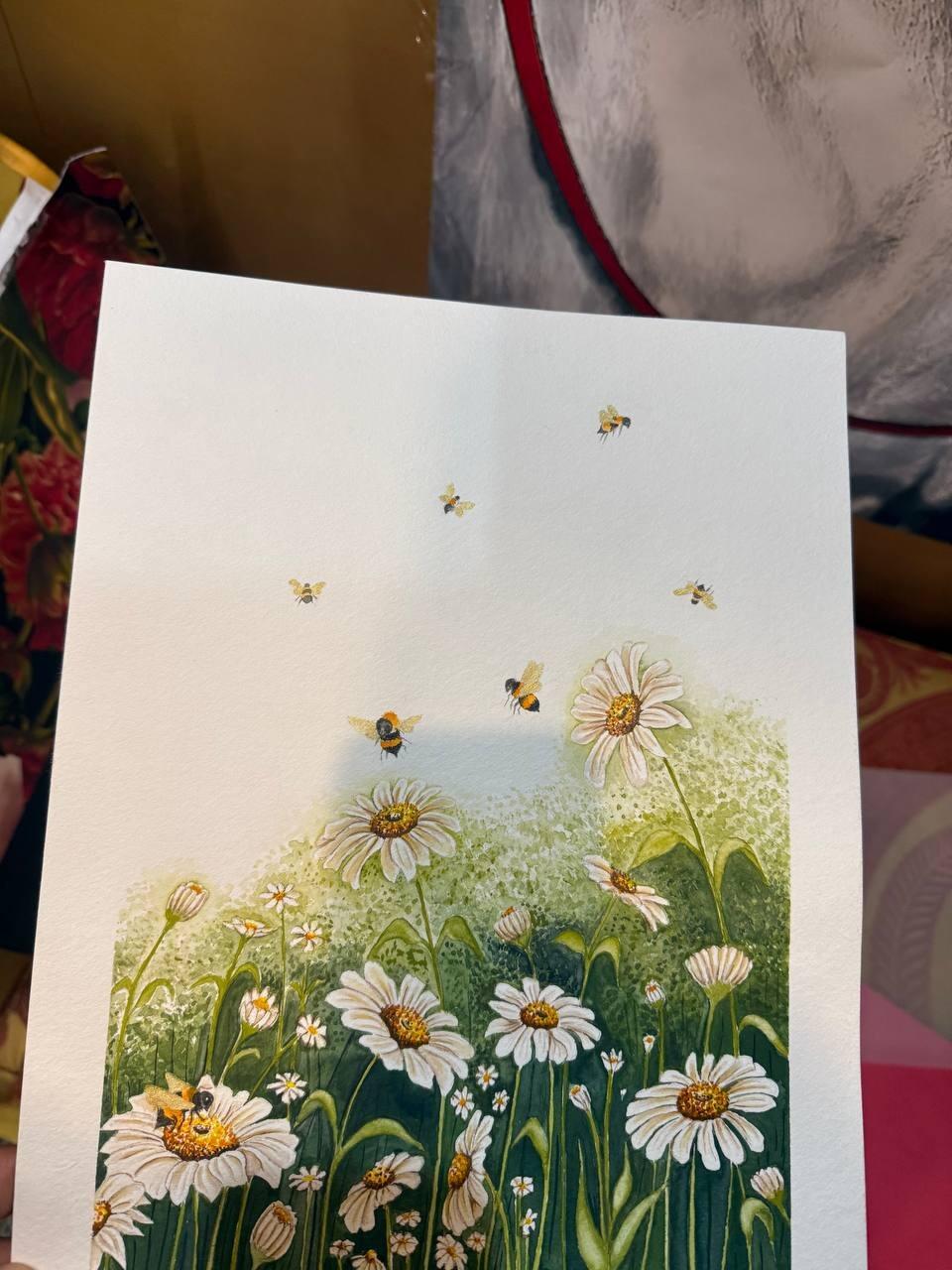
Flatness proves nothing for watercolour. The institute describes it as a thin wash that "penetrates the paper and remains transparent", so an original watercolour, such as our lead work, has no ridges to find.
Under a magnifier. Our guide to buying a Persian miniature gives the basic dot check. Start with the palest area. The Image Permanence Institute says inkjet printers build every picture from "colored dot patterns" and make light colours "by placing dots further apart", so a pale sky or face is where the dots are easiest to see. A painted pale area is continuous colour.
The edge and the back. The institute lists the layers of a painting on canvas: a stretcher, the canvas tacked to it, a ground layer, the paint, and a coat of varnish. Look for those separate layers at the edge. A blank back is normal, because the institute discourages writing on the back of a canvas.
Return by Roshan is acrylic on canvas, 61 x 78.7 cm (24 x 31 in). A dark rectangular form hangs in a pale blue sky, and below it a yellow and orange glow lights a staircase that many small dark figures walk toward. Its product page links the picture to a line of Rumi, a statement our guide to Rumi and Hafez paintings shows how to check. It is our example of an original on canvas.

The signature and the gold
The signature. Under the magnifier, a printed signature is built from the same dots as the picture. A signature in paint or ink lies on the surface as a continuous line. A pencil signature beside a fraction marks an edition print: the Smithsonian American Art Museum explains that 5/25 means the fifth print of twenty-five.
The gold. Tilt the work under a lamp. In our experience gold put on by hand goes bright at one angle and dark at another. A printer works with coloured inks, and the Image Permanence Institute says most printing systems use cyan, magenta, yellow and black. Printed gold is a mix of those inks, and in our experience it keeps one flat tone.
Mi'raj: The Night Journey by Kamal al-Din Ghotb is a Persian miniature in oil and gold, 30 x 40 cm (11.8 x 15.7 in). A haloed rider crosses a deep blue sky on Buraq, a winged steed with a crowned human face, among gold clouds and angels. Its product page says each figure was coloured by hand in oil and then finished with gold. It is our example of gold in an original: ask us for a video of it tilted under a lamp.

Questions to ask a seller
Send these seven before you pay, and keep the written answers.
- Is this the painting itself, or a print of a painting?
- How many exist, and can the image be printed again?
- What is the paint, and what is it painted on?
- Was any part printed, including under the paint?
- Can you send a close detail, a photo in side light, one edge and the back?
- Is the signature by hand, in pencil, or printed?
- What does the certificate state, and what are the return terms?
Why the difference matters
An original exists once. An open edition, the Guild says, "can be produced in any quantity", so a damaged print can be ordered again. A painting has no second copy, which is why packing, insurance and written return terms matter more for an original.
Each needs its own care. Ask a print seller which ink was used: the Image Permanence Institute says pigment colourants have tended to resist light better than dyes. For paintings, the Canadian Conservation Institute says to avoid direct sunlight. For watercolour, it says many of the pigments are sensitive to light, and it advises framing paper objects behind UV-filtering glazing where appropriate. It also notes that many paperboards "are not durable", so ask any seller, including us, what the board is. Framing is done at our gallery and quoted per piece at the counter: see our custom framing page.
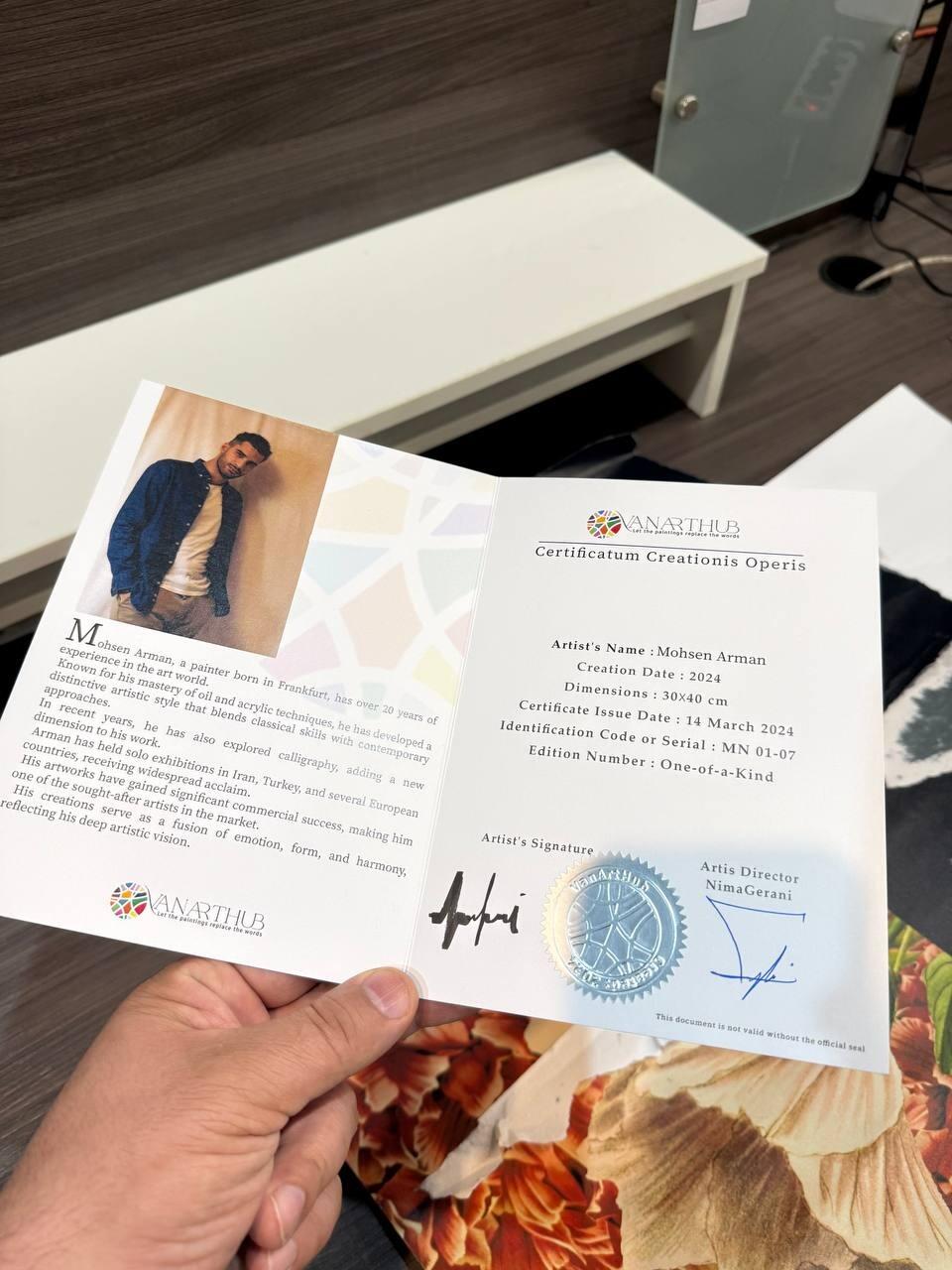
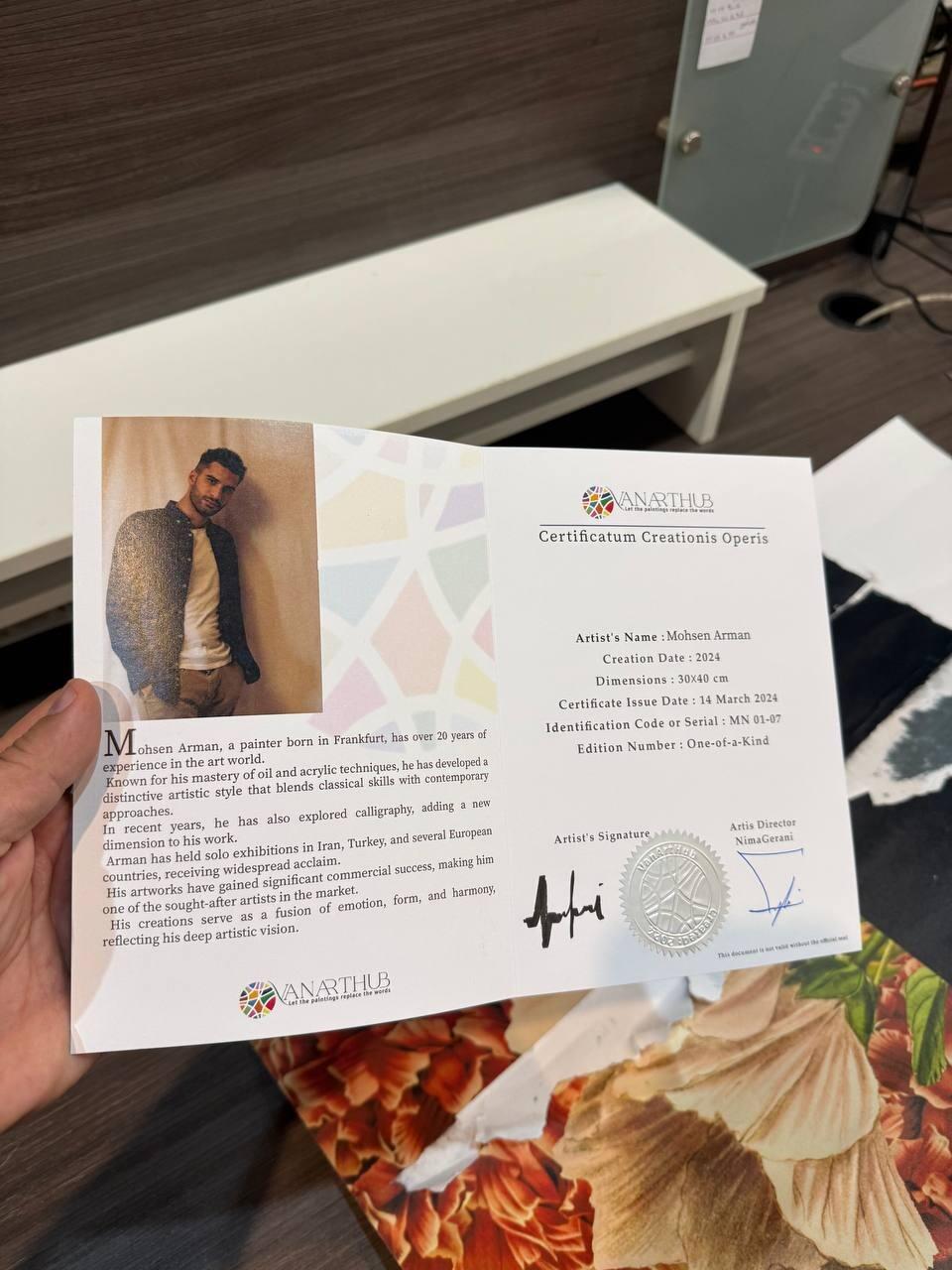
What the paperwork can prove. A complete certificate is signed and names the artist, the title, the medium, the size and the year. With your receipt, it begins the ownership record that our guide on how to buy Persian art calls provenance. The Guild calls the art market "as fickle and hard to predict as any other", and in 1996 the consumer protection director of the US Federal Trade Commission told art buyers to "be wary of promises of great investment returns". We promise no rise in value.
The three originals in this guide, and how buying from us works
Each of the three works shown here exists once. More by each painter is in the Amir Fazelian, Kamal al-Din Ghotb and Roshan collections. The Thinking Monster (Div Andish) is on cardboard, so ask us about framing behind glass.
Every work we sell is an original, signed and one of a kind, and each arrives with a Certificate of Authenticity. Shipping is free and fully insured: 3 to 7 business days in Canada and 5 to 10 to the USA. The 14-day trial starts at delivery and gives you time to make every check in this guide at home. Return the work within 14 days of delivery for a full refund, and we pay the return shipping. The full terms are on our Buy with Confidence page.
Every product page has a form to ask us a question about that painting. Our gallery is at 1242 Davie Street in Vancouver's West End, and the opening hours are on our West End gallery page. Contact us before you come, so we can confirm the work is at the gallery that day.
Key Takeaways
- An original painting is made by hand once. A print comes from a repeatable process and can exist in any number.
- An etching or lithograph made by the artist is an original print, a different thing from a printed photograph of a painting.
- "Giclee" means an inkjet print, "canvas print" means a picture printed on canvas, and a choice of sizes means prints.
- In your hands: side light for the surface, a magnifier on the palest areas, a tilt for the gold.
- A print suits a small budget or a famous museum page. Every painting we ship is an original, each product page also offers a digital print file, and we promise no rise in value.
Frequently Asked Questions
What is the difference between an original painting and a print?
An original painting is made by the artist's hand and exists once, and a print is made by a process that can be repeated. The Victoria and Albert Museum defines a print as an image created on one surface and transferred to another in a repeatable process. A reproduction is a printed photograph of a painting, and the artist need not be involved in making it.
What does giclee mean on an art listing?
Giclee means an inkjet print. The Image Permanence Institute at the Rochester Institute of Technology defines the word as a term often used for marketing fine-art inkjet prints. A giclee of a painting is a reproduction. The Fine Art Trade Guild adds that artists also use digital printing to make original prints, so ask the seller whether the picture began as a painting.
Is a limited edition print an original work of art?
Sometimes. An etching, lithograph, woodcut or screenprint that the artist made as a print is an original print, and the Smithsonian American Art Museum says each impression is considered an original. A limited edition reproduction is a printed photograph of a painting in a declared number of copies. Ask which of the two the listing offers, and ask for the edition size.
How do I spot a print in an online listing for a Persian painting?
Read four things: the sizes, the medium line, the number available and the photos. A choice of sizes, a quantity box, or the words giclee, canvas print, pigment print or reproduction all describe prints. An original has one size, a medium line that names a paint and a support, and photos of its edge and its back.
What does a magnifier show on a print?
A magnifier shows separate dots of ink, and they are easiest to find in the palest areas. The Image Permanence Institute says inkjet printers make light colours by placing dots further apart and dark colours by placing them close together. A painted area under the same magnifier is continuous colour, and a brush line changes in width along its length.
Is a Persian art print a good choice for my home?
Yes, in several cases. A print suits a small budget, a rented room or a child's room, and it is the only way to own the image of a famous manuscript page that a museum holds. The Metropolitan Museum of Art makes images of its public-domain works free to use. Buy from a print seller or a museum shop, and check that the listing calls it a print.
Does VanArtHub sell prints of its Persian paintings?
We ship no printed copies: every painting we send is an original, signed and one of a kind. Each product page also offers Buy Print File, a digital file of the image for personal printing. We email it within 48 hours, nothing is shipped, and copyright stays with the artist. A print made from that file is a reproduction.
What paperwork should come with an original painting?
A signed certificate and a receipt should come with every original. A complete certificate names the artist, the title, the medium, the size and the year. Every work we sell arrives with a Certificate of Authenticity. Keep it with your receipt, because the two papers together record where the work came from and when you became its owner.
Does an original painting rise in value over time?
No seller can promise that, and we make no such promise. The Fine Art Trade Guild describes the art market as hard to predict, and in 1996 the consumer protection director of the US Federal Trade Commission told art buyers to be wary of promises of great investment returns. Buy an original because you want to live with that one object.
Can I send an original back if my own checks leave me with doubts?
Yes. Every work we sell comes with a 14-day trial that starts at delivery, so you can look at the surface in side light, use a magnifier and tilt the gold at home. Return the work within 14 days for a full refund, and we pay the return shipping. Shipping to you is free and fully insured.
Sources
- Smithsonian American Art Museum, Want to Research Prints or Find Posters?, read October 2026.
- Smithsonian American Art Museum, Q and Art: Copies of Artworks, read October 2026.
- Victoria and Albert Museum, What is print?, read October 2026.
- Tate, Art Terms, Edition, read October 2026.
- Fine Art Trade Guild, Print Info and Advice: a 10-point guide to getting it right, read October 2026.
- Image Permanence Institute, Rochester Institute of Technology, DP3: Digital Print Preservation Portal, Glossary, G, read October 2026.
- Image Permanence Institute, Rochester Institute of Technology, DP3: Digital Print Preservation Portal, Inkjet, read October 2026.
- The National Gallery, London, Glossary, Raking light, read October 2026.
- Canadian Conservation Institute, Caring for paintings, read October 2026.
- Canadian Conservation Institute, Caring for paper objects, read October 2026.
- The Metropolitan Museum of Art, Open Access at The Met, read October 2026.
- US Federal Trade Commission, press release of January 24, 1996, on a settlement of charges about fake art prints, read October 2026.
Sources read in October 2026. If you spot something out of date, tell us and we will correct this post.
About VanArtHub
VanArtHub is a gallery based in Vancouver, Canada, that sells original, signed, one-of-a-kind works, each with a Certificate of Authenticity, free insured shipping and a 14-day trial. Persian art is also called Iranian art, and our guide to contemporary Persian painting introduces its painters and styles. You can also browse all artworks.