Persian Miniature Paintings for Sale: What to Check First
UpdatedPersian miniature paintings for sale today fall into four groups: antique manuscript pages, later pictures painted on old pages, printed copies, and new miniatures painted by hand by living painters. Where to buy Persian miniatures depends on the group you want. Antique pages are sold by auction houses and specialist dealers, and new work is sold by the painter or by a gallery that represents the painter. We are VanArtHub, a Vancouver gallery that sells original Persian miniatures and contemporary paintings that draw on Persian tradition. This guide lists the checks we would make before paying for a miniature online, from any seller.
What you can buy today, and who this guide is for
The first group is antique pages from old books that were taken apart. The Metropolitan Museum of Art says the Shahnameh (also written Shahnama) made for Shah Tahmasp, with its 258 paintings, is "dispersed among private and public collections", and the museum holds seventy-eight of the painted pages. A buyer of an antique page needs a documented ownership history and independent expert advice. We sell no antiques.
The second group needs the most care: a newer picture on an older page. Sheila S. Blair writes in the Encyclopaedia Iranica that forging Persian works became widespread in the late 19th century, in most cases as "a response to the high prices paid by museums and collectors". The Whipple Museum, a University of Cambridge museum, holds thirteen leaves of Ottoman Turkish manuscript acquired from Istanbul in 1998. Its record says the written sheets are from the 18th and 19th century, and that the pictures on them "were likely added shortly before the sheets were acquired". An old sheet can carry a new picture.
The third group is printed copies: posters, book plates and inkjet prints of famous pages. A print is a fair purchase when it is sold as a print and priced as one. The problem is a print described as hand-painted, and the magnifier check below finds it.
The fourth group is new work, painted by hand and signed. This is the group we sell. If you want an antique page or a poster, another seller is the right place for you, and most of the checks below still apply. The guide is written for a buyer of new work who can see only photographs before paying.
What a Persian miniature is
A Persian miniature is a small, detailed painting that began as a picture inside a handwritten book. Anahita Alavi, writing for the British Institute of Persian Studies, says that from the 13th to 17th centuries poems such as the Shahnameh by Ferdowsi and the Khamsah by Nizami were "the sources of inspiration for painters". An old miniature therefore usually shows a scene from a story. We have told four of those stories in earlier posts: Rostam and Sohrab, Siyavash and the fire, Zal and the Simorgh, and Khosrow and Shirin.
After the 16th century, Alavi writes, the art "diverged from manuscripts" and turned to single pages. Massumeh Farhad, in the Encyclopaedia Iranica entry on the Isfahan school, says many single works were gathered into albums together with examples of calligraphy. An album of this sort is a muraqqa, which the Iranica spells moraqqa'. Our page on Persian miniature painting covers the schools and their best-known painters.
Muraqqa': The Gold Shamseh by Kamal al-Din Ghotb is a Persian miniature in oil and gold, 30 x 40 cm, painted as an album page. A gold sunburst medallion, called a shamseh, sits at the centre, and around it are a calligraphy panel on gold, two panels of roses and birds, a falconry party and a black-ink drawing of birds. We show it here because it is a new work in the album form just described.

How traditional miniatures were made, and how ours differ
The work began with paper. A technical study by Nancy Purinton and Mark Watters, published in 1991 in the Journal of the American Institute for Conservation, says the paper was burnished on both sides with a polished stone.
The paint was water based. Alavi lists pigments from stones such as lapis lazuli and malachite, and says gum arabic was the binder for colours used on paper. The Met calls the result opaque watercolour: it gives the medium of its Shah Tahmasp page as "Opaque watercolor, ink, silver, and gold on paper". Purinton and Watters describe the painter laying one thin layer of colour at a time and burnishing often, until the colour was opaque and had a gloss.
Gold was a paint too. Alavi says pure gold was pounded into a thin leaf and ground with honey to make shell gold, and the Met says gilded pages were burnished with a smooth, hard stone such as agate or rock crystal. Our page on Persian illumination explains the gold ornament part by part.
Oil paint arrived later. Farhad writes that during the latter part of the 17th century artists in Isfahan "also experimented with oil painting", a technique introduced from Europe that became popular in the 18th and 19th centuries.
We want to be exact about what we sell. The miniatures in our gallery are new works in oil and gold. They follow the miniature tradition in subject, layout and detail, and their paint is oil, where a traditional miniature used opaque watercolour. In our view a new miniature should be judged on the handwork you can see under a magnifier and on how plainly the seller names the medium.
Naghsh-e Khial by Kamal al-Din Ghotb is a Persian miniature in oil and gold, 30 x 40 cm. Two armies meet across a pale blue plain, trumpeters raise long gold horns, and the scene is set inside columns of Persian verse. Its product page says dozens of figures fill the panel, many no larger than a fingernail, each drawn and coloured by hand in oil and then finished with gold. It is shown here as an example of that method.

What to check before you buy a miniature online
These ten checks work for any seller, including us. The first one decides whether you need the other nine.
| What to check | A good answer | Ask more questions when |
|---|---|---|
| Painted by hand or printed | A close photo shows continuous brush lines | A close photo shows a regular pattern of dots, or the listing says "print" or "reproduction" |
| The surface | Fine outlines lie on top of the colour | Every part is equally flat and equally sharp |
| The gold | In a tilted photo or a video the gold goes bright and dark like metal | The gold stays one flat colour from every angle |
| The signature | A signature by hand, and the painter's full name on the listing | No painter is named, or a famous old name is on a page that looks new |
| The size | Height and width in centimetres | Only words such as "small" or "medium" |
| The paper or support | The listing names what the work is painted on | No support is named, or a new picture sits on old written paper |
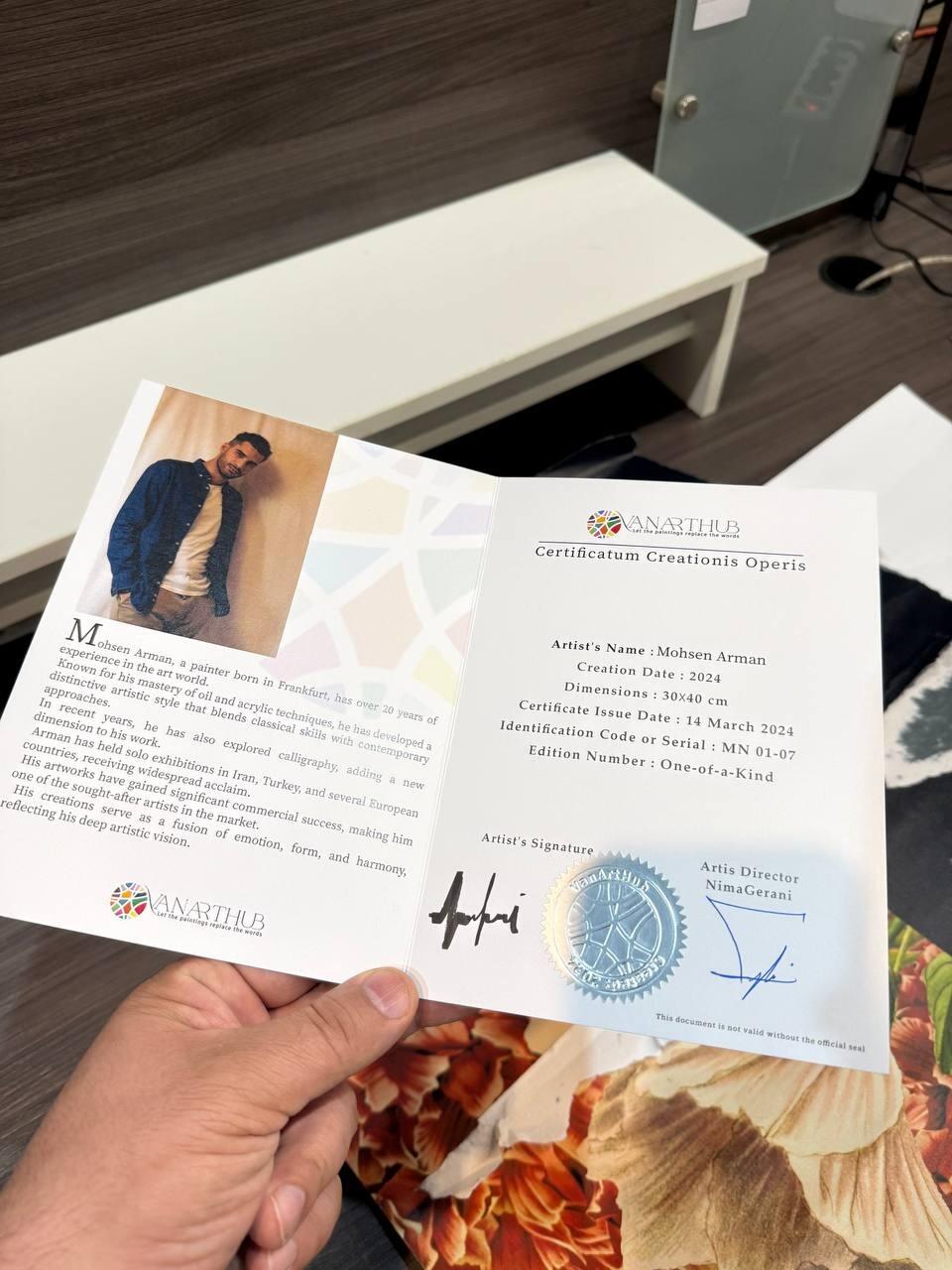
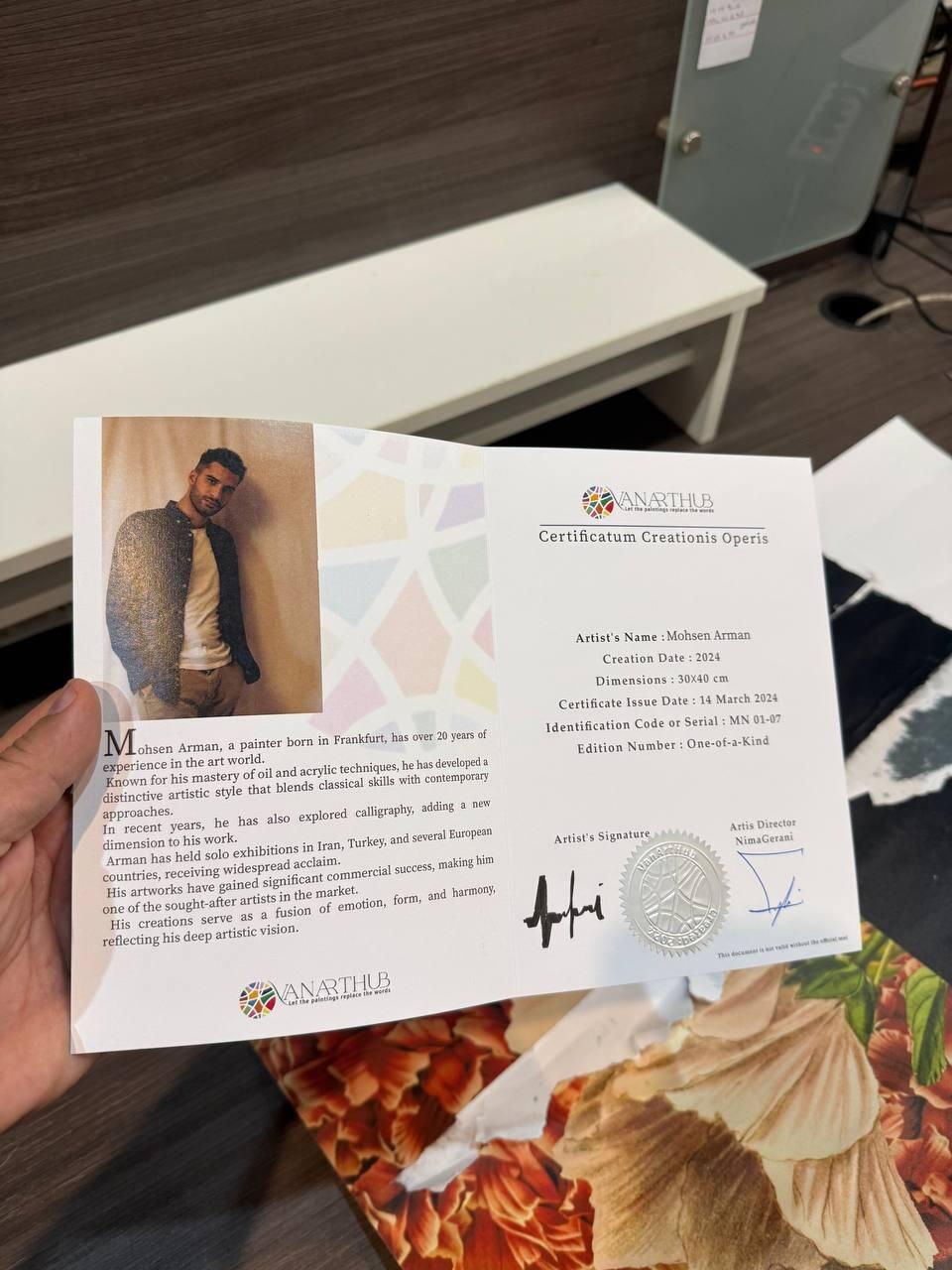
| The certificate | Signed, and naming the artist, title, medium, size and year | Unsigned, or no artist named |
| The photos | Front, back, signature, one edge and a close detail, in daylight | One photo only, or a photo copied from a book |
| Shipping and insurance | Insured for the full price, with the packing described | Insurance costs extra, or the packing is unknown |
| The return terms | A stated number of days, a full refund, and who pays the return shipping | "Final sale", or no written terms |
Painted by hand or printed. A printed picture is built from dots. The Victoria and Albert Museum explains this on its record of a leaflet printed by the four colour process: the dots "can be seen through a magnifier", a single colour forms a grid of dots of varying sizes, and a mixed colour appears as "a multi-coloured circle of dots". Inkjet prints are made of dots too: the Image Permanence Institute at the Rochester Institute of Technology says inkjet printers create dark colours by placing dots of ink close together and light colours by placing dots further apart. A painted line under the same magnifier is one continuous stroke that grows wider and narrower. So ask for a close photo of a face or a flower.
One caution. Fine handwork can look dotted at first, because Persian painters shaded with stippling and parallel hatching, as Purinton and Watters record. Printed dots repeat in a regular grid across the whole picture, and hand stippling is uneven.
The surface and the gold. In the order of work that Alavi describes, the colours go on first and then "every detail will be outlined again", so the last fine lines lie on top of the paint. For the gold, ask for a short video of the work tilted under a lamp. In our gallery, gold laid on by hand goes bright and dark as the angle changes, and printed gold keeps one flat colour.
The signature. A name on a page is a claim to check. Farhad notes that 17th-century works from Isfahan were frequently signed and dated, and also that followers of the painter Reza Abbasi "often added his name to their work to enhance their importance and value". For a living painter, the signature on the work should match the name on the certificate and on the gallery's page for that painter.
The size and the support. Measure the space on your wall and compare in centimetres. The three works in this guide each measure 30 x 40 cm, which is 11.8 x 15.7 in. Then ask what the work is painted on. For each of these three, the product page gives the medium as oil and gold on paper. The Canadian Conservation Institute advises framing paper objects behind UV-filtering glazing where appropriate, so plan for the cost of a frame.
After it arrives: light and framing
A miniature often hangs in a hallway or a study, where people can stand close to it, and sometimes that wall has a window. The Canadian Conservation Institute says visible light "fades colours often found on paper objects and artworks", and its table rates light from a window or study lamp at 5000 lux, against 50 lux for low museum lighting. The Library of Congress advises minimal exposure to all kinds of light and no exposure to direct or intense light. So choose a wall that direct sun never reaches. Framing is done at our gallery and quoted per piece at the counter, and our custom framing page explains how.
The miniatures in our gallery now
The three works in this guide are by Kamal al-Din Ghotb and Darya. The two shown above keep classical forms: the album page, and the battle scene framed by verse. You can see more from both painters in the Kamal al-Din Ghotb collection and the Darya collection.
The third work has no story scene. Celestial Garden by Darya is a Persian negargari in oil and gold, 30 x 40 cm. Striped and marbled planets sit inside sweeping bands of ornament filled with small flowers, arabesques and scrolling vines, around a large gold spiral. Its product page says every line was drawn and painted by hand. We show it to make one point: a new miniature can keep the fine line and the gold and still be an abstract picture. If you want a battle or a court scene, this is the wrong piece for you.

How buying from us works
Every painting we ship is an original, signed and one of a kind. Each one arrives with a Certificate of Authenticity. Shipping is free and fully insured, and it takes 3 to 7 business days in Canada and 5 to 10 business days to the USA. If a carrier asks you for a customs or brokerage fee, contact us before you pay it.
The 14-day trial starts when the work is delivered. Return it within 14 days of delivery for a full refund, and we pay the return shipping. The full terms are on our Buy with Confidence page.
Every product page has a form to ask us a question about that painting. Use it to ask for a close photo, a tilted photo of the gold, or a photo of the back. Our gallery is at 1242 Davie Street in Vancouver's West End, and the opening hours are on our West End gallery page. Contact us before you come, so we can confirm that the work you want to see is at the gallery that day. For price, ownership history and cross-border rules, read our guide on how to buy Persian art.
Each product page has one more option, Buy Print File: a high-resolution digital file of the image, which you print yourself. Nothing is shipped, we email the file within 48 hours, it is for personal printing only, and copyright stays with the artist. A print made from that file is a reproduction, and the painting itself still exists once.
Key Takeaways
- Persian miniatures on sale today are antique pages, newer pictures on old pages, printed copies, or new works painted by hand. The paintings we ship belong to the last group.
- Traditional miniatures were painted in opaque watercolour and gold on burnished paper. Ours are new works in oil and gold that follow the tradition in subject, layout and detail.
- A print breaks into a regular pattern of dots under a magnifier. A painted line is one continuous stroke.
- Ask for a tilted photo of the gold, a photo of the signature, the size in centimetres, and the name of what the work is painted on.
- Buy only with a signed certificate, insured shipping and written return terms.
Frequently Asked Questions
Where can I buy a Persian miniature painting?
You can buy a new Persian miniature from the painter or from a gallery that represents the painter, and an antique page from an auction house or a specialist dealer. VanArtHub, a Vancouver gallery, sells new originals by living painters and ships them free and fully insured within Canada and to the United States. We sell no antiques and ship no printed copies.
What is a Persian miniature?
A Persian miniature is a small, detailed painting that began as a picture inside a handwritten book. The British Institute of Persian Studies says poems such as the Shahnameh and the Khamsah inspired painters from the 13th to 17th centuries, and that after the 16th century the art moved from manuscripts to single pages. The Encyclopaedia Iranica adds that many single works were kept in albums.
How can I tell if a Persian miniature is hand-painted or printed?
Look at it through a magnifier. A printed picture breaks into dots: the Victoria and Albert Museum says the dots of the four colour process can be seen through a magnifier, in grids and in circles of several colours. A line painted by hand is one continuous stroke that changes width. Ask the seller for a close photo and a tilted photo of the gold.
What were traditional Persian miniatures painted with?
Traditional Persian miniatures were painted with water-based colour and gold on prepared paper. The British Institute of Persian Studies lists pigments from stones such as lapis lazuli and malachite, bound with gum arabic, and shell gold made by grinding gold leaf with honey. The Metropolitan Museum of Art records the medium of one royal page as opaque watercolor, ink, silver and gold on paper.
Are the Persian miniatures at VanArtHub antique?
No, every Persian miniature at VanArtHub is a new work by a living painter. The works by Kamal al-Din Ghotb and Darya in this guide are painted in oil and gold, and they follow the miniature tradition in subject, layout and detail. Miniatures of earlier centuries were painted in opaque watercolour, and those are sold by auction houses and antiques dealers.
How big is a Persian miniature?
Persian miniatures are small because they were made for books. One page of the Shah Tahmasp Shahnameh at the Metropolitan Museum of Art has a painting 27.9 cm high and 18.7 cm wide, on a page 47.3 cm high. The three new works in this guide each measure 30 x 40 cm, or 11.8 x 15.7 in. Compare every size in centimetres.
Does a Persian miniature from VanArtHub come with a certificate?
Yes, every work we sell arrives with a Certificate of Authenticity. A complete certificate is signed and names the artist, the title, the medium, the size and the year, and you should expect the same from any seller of a new miniature. Keep the certificate with your receipt, because the two papers together record where the work came from.
Do you ship Persian miniatures to the United States?
Yes, we ship to the United States, and shipping is free and fully insured. Delivery takes 5 to 10 business days to the USA and 3 to 7 business days within Canada. If a carrier asks you for a customs or brokerage fee, contact us before you pay it. Our guide to buying original art from Canada is written for collectors in the United States.
What if the miniature looks different at home than on my screen?
You can send it back. Every work comes with a 14-day trial: return it within 14 days of delivery for a full refund, and we pay the return shipping. Use those days to look at the gold in daylight and in lamp light, and to check the size on your own wall. The full terms are on our Buy with Confidence page.
Can I see a Persian miniature in person before I buy?
Yes, by arrangement. Our gallery is at 1242 Davie Street, in the West End of Vancouver, and the opening hours are on our West End gallery page. Contact us first, so we can confirm that the miniature you want to see is there that day. Bring a magnifier: the fine lines and the gold, seen from a few centimetres away, answer the first three checks better than a photo can.
Sources
- The Metropolitan Museum of Art, Making a Royal Manuscript, read October 2026.
- The Metropolitan Museum of Art, Heilbrunn Timeline of Art History, The Shahnama of Shah Tahmasp, by Francesca Leoni, read October 2026.
- The Metropolitan Museum of Art, "Siyavush Stands Accused by Sudaba before Kai Kavus", Folio 163v from the Shahnama (Book of Kings) of Shah Tahmasp, 1970.301.23, read October 2026.
- British Institute of Persian Studies, A Note Persian Miniature Painting: Materials and Techniques, by Anahita Alavi, read October 2026.
- Journal of the American Institute for Conservation, A Study of the Materials Used by Medieval Persian Painters, by Nancy Purinton and Mark Watters, section 5, The Classical Technique, read October 2026.
- Encyclopaedia Iranica, Isfahan xi. School of Painting and Calligraphy, by Massumeh Farhad, read October 2026.
- Encyclopaedia Iranica, Forgeries iii. Of Islamic Art, by Sheila S. Blair, read October 2026.
- Whipple Museum of the History of Science, University of Cambridge, Accession No 5358.2, Ottoman Turkish manuscript page with a later image, read October 2026.
- Victoria and Albert Museum, Print, four colour relief halftone and lineblock leaflet, E.665-1993, read October 2026.
- Image Permanence Institute, Rochester Institute of Technology, DP3: Digital Print Preservation Portal, Inkjet, read October 2026.
- Library of Congress, Care, Handling, and Storage of Works on Paper, read October 2026.
- Canadian Conservation Institute, Caring for paper objects, read October 2026.
Sources read in October 2026. If you spot something out of date, tell us and we will correct this post.
About VanArtHub
VanArtHub is a gallery based in Vancouver, Canada, that sells original, signed, one-of-a-kind works, each with a Certificate of Authenticity, free insured shipping and a 14-day trial. Persian art is also called Iranian art, and our guide to contemporary Persian painting is a good first page to read. You can also browse all artworks or write to us with a question.