Khosrow and Shirin in Persian Painting: The Story in Order
UpdatedKhosrow and Shirin is a long Persian love poem by Nizami of Ganja, written in the twelfth century. It tells how the king Khosrow (also written Khusrau) and the Armenian princess Shirin fall in love before they meet, miss each other for years and marry late. A sculptor named Farhad dies for love of Shirin, Khosrow is murdered, and Shirin takes her own life beside his body. We are VanArtHub, a Vancouver gallery that sells original paintings, and two of them come from the book arts that produced the painted copies of this poem. Below you will find the story in order, what to look for in the scene at the pool, and paintings to look up in named museums.
Who wrote Khosrow and Shirin, and when?
The poet is Nizami of Ganja (also written Nezami). The Metropolitan Museum of Art gives his dates as 1141 to 1209 and places Ganja in present-day Azerbaijan. The British Library's catalogue gives other years: born in 1140 or 1141, died in 1202 or 1203.
Khosrow and Shirin is the second of the five poems in his Khamsa, or Quintet, and our page on the Khamsa of Nizami in art covers the other four. The Encyclopaedia Iranica entry on this poem, by Paola Orsatti, dates the writing between 1175 or 1176 and 1191. A second Iranica article, by Charles-Henri de Fouchécour, gives the year 1181. Nizami said that his source "was a manuscript kept in" Barda, an old capital in the Caucasus.
The poem reached readers as a handwritten book, and such a book needed several crafts. The British Library's record for the Khamsa copied for Shah Tahmasp names the calligrapher and six painters, and it describes margins "decorated throughout with designs in gold of birds, animals, mythical beasts, trees and plants". Our page on Persian miniature painting explains how such pages were made and how single pages were later gathered into albums.
Muraqqa': The Blue Robe by Kamal al-Din Ghotb is a Persian miniature in oil and gold, 30 x 40 cm, composed as an album page. A youth in a pale blue robe plays the panpipes, framed by a gold calligraphy panel, bands of marbled paper, a study of pink lilies and an ink drawing of a bird. It is a contemporary work in the album page tradition of the Persian book arts, the same arts that produced the Khamsa manuscripts in this post. Its subject is its own: a young musician.

Were Khosrow and Shirin real people?
Yes, both. Khosrow II, called Parviz, ruled the Sasanian empire of Iran from 590 to 628, and James Howard-Johnston, writing in the Iranica, calls him "the last great king of the Sasanian dynasty". Orsatti lists the events behind the poem: his father Hormoz was deposed and blinded, the army commander Bahram Chubin rose against the new king, and Khosrow fled to the Byzantine emperor Maurice. Nizami mentions all this only briefly.
Shirin is real too. Orsatti quotes a letter that Khosrow sent to the shrine of Saint Sergius, in which he calls her a Christian and says that he holds "this one among my wives as legitimate". A seventh-century Armenian historian, Sebeos, calls her "a Christian from Khuzestan". Orsatti writes that the tradition of her Armenian birth "appears to be of later origin".
Ferdowsi tells of the same king in the Shahnameh, the book retold in our posts on Siyavash and the fire and Zal and the Simorgh. Howard-Johnston notes that Ferdowsi gives Khosrow more than six times the space he gives to the founder of the dynasty, and the love story is one part of that long reign. It reads differently. In Ferdowsi, Orsatti says, Khosrow forgets Shirin once he is king, and she is "a woman of humble origin and ill repute" who poisons a rival wife. Nizami "follows a tradition in favor of" her: his Shirin is chaste, and firm in refusing the king.
Shapur the painter and the portrait
The love story starts with words and a picture. Harvard Art Museums tells it beside a folio painted in Shiraz in 1584 (a folio is one leaf of a manuscript). The young prince Khosrow has a friend named Shapur, who describes "a beautiful and virtuous princess he had seen in Armenia". Khosrow sends him to bring her to Iran.
Shapur is "a skilled artist". He draws portraits of Khosrow, and when Shirin sees them she falls in love and sets out for his kingdom. The Aga Khan Museum in Toronto gives the same order of events. The Cleveland Museum of Art tells it in the opposite order: Khosrow fell in love "after seeing her portrait".
The Walters Art Museum in Baltimore holds a painting of the moment the picture reaches her: Shirin "in the company of her maidens admiring the portrait". We sell paintings, so we enjoy this part. Two people who have never met fall in love, one through a friend's words and one through a painter's work.
Shirin sets out, and Khosrow sees her at the pool
Shirin leaves Armenia for Khosrow's kingdom. Khosrow, the Aga Khan Museum says, "has fled his palace to escape the wrath of his father", and he travels disguised in common clothes.
On the way Shirin stops to bathe in a natural spring, and Khosrow finds a woman in the water. He "doesn't recognize" her, the museum writes, and he stops to look. When she notices him, "she hides her breasts with her hair and runs away". The Cleveland Museum of Art adds that he is "transfixed by the woman's beauty" and wants both her and "her magnificent black horse".
The stories around this king name his horse, Shabdiz. In the English verse translation of the Shahnameh hosted by the Packard Humanities Institute, the musician Barbad laments the fallen king and asks where Shabdiz is now. Orsatti notes that Nizami's poem tells the legend of how Shabdiz was conceived.
Harvard describes the next part of the poem as "a series of failed encounters".
Years of missed meetings, and the marriage to Maryam
They do meet, in Armenia, at the court of Shirin's aunt Mehin Banu, and Shirin sets a condition. Orsatti writes that she "firmly rejects the young man's advances" and makes any marriage depend on his solving the problems of his kingdom first.
So Khosrow travels west to Rum, the Byzantine empire, and marries Maryam, the emperor's daughter, "who helps him defeat" Bahram Chubin and win back his throne. Historians doubt that she existed: Orsatti says that no ancient source mentions a daughter of Maurice married to Khosrow.
Shirin, the Smithsonian's National Museum of Asian Art says, is "displeased with Khosraw's behavior and his marriage to another woman", and she withdraws to her castle. Maryam dies, and still Khosrow avoids a wedding. Orsatti writes that he tries to take Shirin as a concubine, tires of her teasing, and marries a courtesan of Isfahan named Shakar.
In our view this is the most honest part of the poem. The hero behaves badly, and the poet lets you see it.
Farhad, the milk channel and Mount Bisotun
Now a third person enters. Heshmat Moayyad, in the Iranica, says that Nizami describes Farhad as an architect and sculptor with "immense physical strength". His first job is small. The Met tells it beside a folio dated 1524 to 1525: Shirin wants milk from goats that graze in a distant field, so Farhad cuts "a channel from the goats' mountain pastureland to a pool at the foot of Shirin's palace". The Aga Khan Museum says that he "instantly falls in love with her".
Khosrow is jealous. Moayyad says that Farhad "defeats" the king "in a verbal duel". So Khosrow sets him a task that looks impossible: cut a road through the rock of Mount Bisotun (also written Behistun, and Bisutun by the Aga Khan Museum). The reward is that Khosrow will give up "his own claim to" Shirin.
Shirin visits Farhad at the mountain, and the Aga Khan Museum's page of 1527 shows her "bringing Farhad a jug of milk". On the rock, the Smithsonian says, he has carved her likeness "as a token of his affection".
The road is close to finished when Khosrow sends, in Moayyad's words, "the false news of" Shirin's death. The sources differ by one verb. Moayyad says that Farhad "falls from the rocks and dies". The Aga Khan Museum says that he "throws himself off the mountain".
Bisotun is a real mountain in the Kermanshah province of western Iran. UNESCO put it on the World Heritage List in 2006 for the relief and inscription that Darius I ordered there in 521 BC. One cut section of the cliff is called Tarash-e Farhad. Heinz Luschey, in the Iranica, calls it "the biggest such work in Iran" and reports that local tradition gives it to Farhad. He adds that Nizami never left Ganja and so never saw the mountain.
We think Farhad is the person most readers remember. He does the hardest work in the story, and he dies because of a lie.
The wedding, the murder and Shirin's death
After the death of his queen, the Smithsonian says, Khosrow "repeatedly attempts to see Shirin, who finally yields to his request". Its page of ca. 1400 shows him under the royal umbrella, where he "gestures in supplication" toward Shirin at her window. The museum points out one change: the poem sets the visit at dawn "in the dead of winter", and the painter has given it a green garden under a waning moon.
They marry. The Met owns the wedding, folio 104 of its Khamsa of 1524 to 1525, and says that the union was delayed "by many trials, tribulations, and intervening marriages".
In history and in Ferdowsi, the king's own son orders the killing. Orsatti names him as Shiruya, the son of Khosrow and Maryam. Howard-Johnston writes that the prince was crowned on 25 February, and three days later "it was Khosrow's turn". The Met tells Ferdowsi's version beside a Shahnameh page: the prince's advisers pressed him to order the killing, and the murderer "entered Khusrau's chamber and stabbed him through the heart".
Ferdowsi gives Shirin's end in detail. In the verse translation the new king wishes to marry her, and she asks one favour, to enter the dead king's tomb. There she lays her face on his and takes poison: "She set her back against the wall and died". For Nizami's poem, de Fouchécour gives the end in one sentence: Shirin "commits suicide over the body of her murdered husband".
In our view Shirin is the strongest person in the poem. She sets a condition at the start, and she chooses her own end.
How painters show Khosrow and Shirin
The meeting at the pool is the scene to know first. Orsatti calls it "the famous episode" of the two "at the spring", and four of the ten paintings in our table show it. Our page on Persian poetry in painting sets Nizami beside the other poets whom painters illustrated.
Five things help you recognise it. First, a woman in water, which museums call a stream, a spring or a pond. Second, the colour of that water: the Met says the pond in its folio was first painted "in shining silver" and "has now tarnished to near black". Third, a black horse close to her. Fourth, her clothes: in a velvet of 1550 to 1599 at Cleveland, she has placed "her crown and tunic atop a branch". Fifth, a young man who has stopped to look.
The Aga Khan Museum adds that the scene "has been considered by many to be a powerful commentary on the ethics of the male gaze". In our view it is the hardest scene in the poem to paint well. Neither person knows who the other is, and the painter has to show that without one word inside the picture.
Farhad's scenes look different from the pool: look for bare rock and a man at work on it. The Met's folio of the milk channel has a goat at the top of the hill. The Smithsonian's page of ca. 1400 has tall rocks "as if shaped by molten lava", and its faces were rubbed out afterwards "by someone objecting to figural representation".
The British Library's Or 2265 is the Khamsa copied for Shah Tahmasp in Tabriz between 1539 and 1543. Its record lists five paintings for Khosrow and Shirin, among them the bathing scene by Sultan Muhammad. The same book holds a painting of another subject at folio 195r, inside the Haft Paykar, another of the five poems: the ascent of the Prophet to heaven on Buraq, guided by Jibra'il "and escorted by angels".
Mi'raj: The Night Journey by Kamal al-Din Ghotb is a Persian miniature in oil and gold, 30 x 40 cm. A haloed rider crosses a lapis sky on Buraq, the winged steed with a crowned human face, carried upward through gold clouds by a host of angels. Its subject is the Mi'raj, the ascent, and its link to this post is the book: the British Library records a painting of the same subject inside Shah Tahmasp's copy of Nizami's Khamsa.

Paintings of Khosrow and Shirin to look up
Each title links to the museum's or library's own page. We keep the museum's spelling in each title.
| Scene | Painting to look up | Where it is held |
|---|---|---|
| Shirin sees the portrait | Shirin Admiring the Portrait of Khusraw, composition of 1516, repainted in the 18th century | Walters Art Museum, W.609.44B |
| Khosrow sees Shirin at the pool | Khusraw discovers Shirin bathing, ca. 1400 | Smithsonian, F1931.32 |
| The same scene | "Khusrau Catches Sight of Shirin Bathing", folio 50, by Shaikh Zada, Herat, dated 1524 to 1525 | The Metropolitan Museum of Art, 13.228.7.3 |
| The same scene | Khusraw Spies Shirin Bathing, fol. 52r, Shiraz, 1527 | Aga Khan Museum, AKM270 |
| The same scene | Khusraw watches Shirin bathing, f. 53v, by Sultan Muhammad, Tabriz, 1539 to 1543 | British Library, Or 2265 |
| Farhad and the milk channel | "Farhad Carves a Milk Channel for Shirin", folio 74, Herat, dated 1524 to 1525 | The Metropolitan Museum of Art, 13.228.7.5 |
| Shirin visits Farhad | Shirin visits the sculptor Farhad at work, ca. 1400 | Smithsonian, F1931.35 |
| Khosrow asks Shirin to see him | Khusraw at the castle of Shirin, ca. 1400 | Smithsonian, F1931.36 |
| The wedding | "Marriage of Khusrau and Shirin", folio 104, Herat, dated 1524 to 1525 | The Metropolitan Museum of Art, 13.228.7.6 |
| The murder, as Ferdowsi tells it | "The Assassination of Khusrau Parviz", folio 742v of the Shahnameh of Shah Tahmasp, ca. 1535 | The Metropolitan Museum of Art, 1970.301.75 |
If you look up only one book, we would make it the Smithsonian's. The museum calls its manuscript of ca. 1400 "one of the earliest known illustrated copies of this work". When we read the Met's pages in October 2026, the milk channel and the wedding were listed as on view in Gallery 455, and the bathing folio was listed as not on view.
Key Takeaways
- Khosrow and Shirin is the second of the five poems in the Khamsa of Nizami of Ganja, written in the twelfth century.
- The king is real: Khosrow II Parviz ruled the Sasanian empire from 590 to 628, and Shirin was his Christian wife.
- The love begins with the painter Shapur, and the two first see each other when Khosrow finds Shirin bathing at a spring.
- Farhad cuts a milk channel for Shirin and a road through Mount Bisotun, and he dies when Khosrow sends false news of her death.
- Khosrow is killed on the order of his son, and Shirin takes her own life beside his body.
- To recognise the bathing scene, look for a woman in a pool, a black horse, clothes on a branch and a young man watching.
Frequently Asked Questions
What is the story of Khosrow and Shirin?
Khosrow and Shirin is a love story about a Sasanian king and an Armenian princess. They fall in love through a description and a portrait, see each other first at a spring where she is bathing, and then spend years apart while he marries other women. They marry late. Khosrow is murdered, and Shirin kills herself beside his body.
Who wrote Khosrow and Shirin?
Nizami of Ganja wrote Khosrow and Shirin as the second of the five poems in his Khamsa, or Quintet. The Metropolitan Museum of Art gives his dates as 1141 to 1209, and the Encyclopaedia Iranica dates the writing of the poem between 1175 or 1176 and 1191. Ferdowsi told of the same king earlier, in the Shahnameh.
Was Shirin a real person?
Yes, Shirin was a real wife of the Sasanian king Khosrow II. The Encyclopaedia Iranica quotes a letter in which the king calls her a Christian and his legitimate wife, and an Armenian historian of the seventh century says she was a Christian from Khuzestan. The Iranica adds that the tradition of her Armenian birth appears to be later.
Who is Farhad, and how does he die?
Farhad is a sculptor and architect who falls in love with Shirin when she asks him to cut a milk channel to her palace. Khosrow promises to give her up if Farhad cuts a road through Mount Bisotun. When the work is close to done, the king sends false news that Shirin is dead, and Farhad dies in a fall from the rocks.
How do Khosrow and Shirin die?
Khosrow is killed on the order of his son, and Shirin takes her own life beside him. The Encyclopaedia Iranica says that in Nizami's poem she commits suicide over the body of her murdered husband. In Ferdowsi's Shahnameh she enters the tomb, lays her face on the dead king's face and takes poison.
Where can I see a painting of Khosrow and Shirin?
Paintings of Khosrow and Shirin are held by the Metropolitan Museum of Art in New York, the Smithsonian's National Museum of Asian Art in Washington, the British Library in London and the Aga Khan Museum in Toronto, and each has a page online. The Met's pages listed its milk channel and wedding folios as on view when we read them in October 2026.
How do I spot Khosrow watching Shirin bathe in a Persian miniature?
Look for a woman in a pool with a black horse close by and a young man watching her. The Cleveland Museum of Art describes her crown and tunic hung on a branch. The Metropolitan Museum of Art explains that the pond in its folio was painted in shining silver and has now tarnished to near black.
What do I receive if I buy Muraqqa': The Blue Robe?
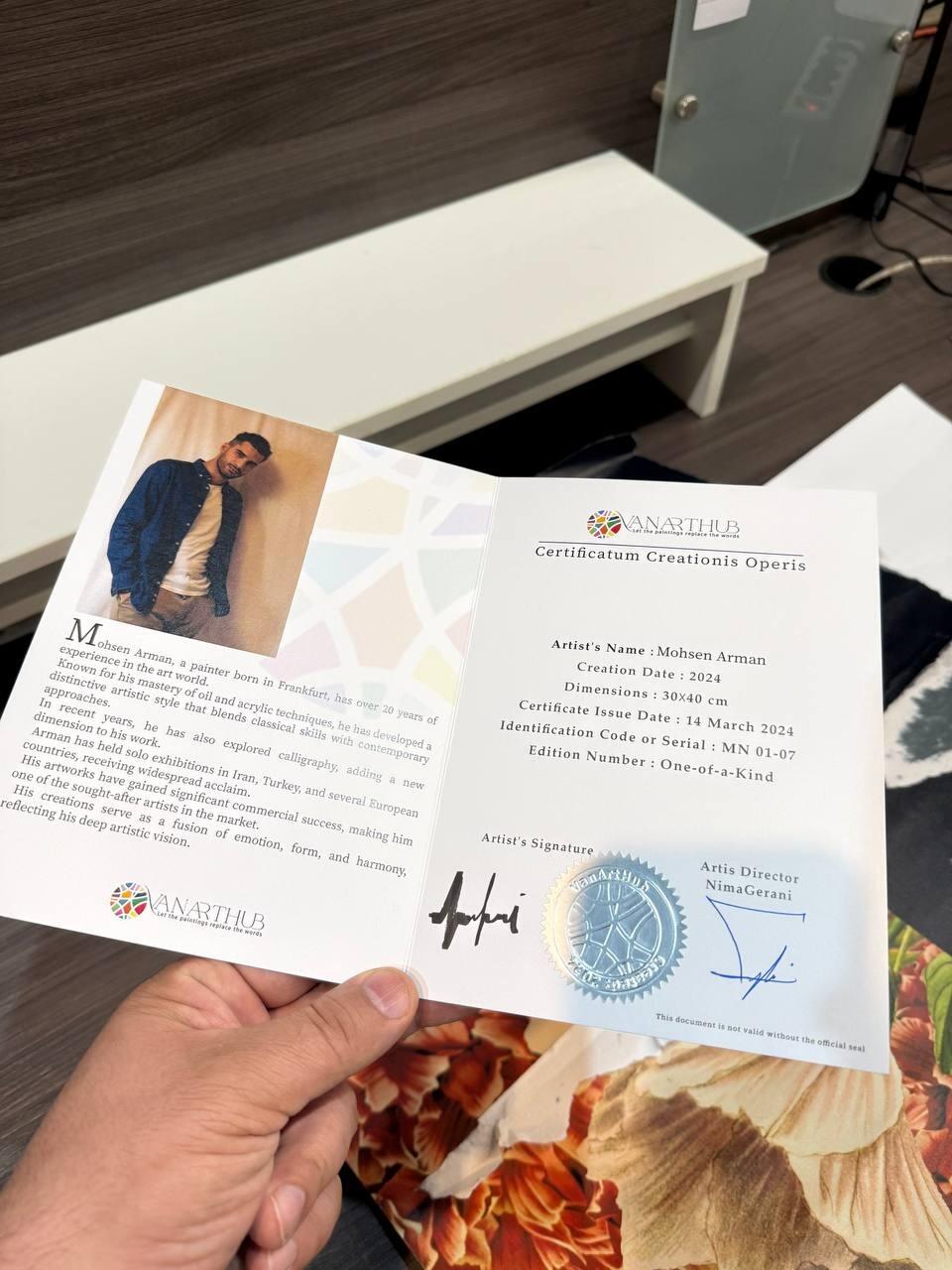
You receive the original painting itself: Muraqqa': The Blue Robe by Kamal al-Din Ghotb, a Persian miniature in oil and gold that measures 30 x 40 cm (11.8 x 15.7 in). Only one painting exists, and the painting itself is what we ship. A Certificate of Authenticity comes with the work, as it does with every original we sell.
Is a painting insured while it travels from Vancouver to me?
Yes, every painting we send is fully insured for the whole trip, and the shipping is free. Delivery takes 3 to 7 business days inside Canada and 5 to 10 business days to the United States. Each work we ship from Vancouver is an original, signed, one-of-a-kind piece with its own Certificate of Authenticity.
Who pays the shipping if I send a painting back?
We pay the return shipping. Every work comes with a 14-day trial, so you can return it within 14 days of delivery for a full refund and we cover the cost of sending it back. The full terms are on our Buy with Confidence page, and our guide on how to buy Persian art covers other common questions.
Sources
- Encyclopaedia Iranica, Kosrow o Sirin and its imitations, by Paola Orsatti, read October 2026.
- Encyclopaedia Iranica, Farhad (1), by Heshmat Moayyad, read October 2026.
- Encyclopaedia Iranica, Khosrow II, by James Howard-Johnston, read October 2026.
- Encyclopaedia Iranica, Iran viii. Persian Literature (2) Classical, by Charles-Henri de Fouchécour, read October 2026.
- Encyclopaedia Iranica, Bisotun ii. Archeology, by Heinz Luschey, read October 2026.
- UNESCO World Heritage Centre, Bisotun, read October 2026.
- The Metropolitan Museum of Art, "Khusrau Catches Sight of Shirin Bathing", Folio 50 from a Khamsa (Quintet) of Nizami of Ganja, 13.228.7.3, read October 2026.
- The Metropolitan Museum of Art, "Farhad Carves a Milk Channel for Shirin", Folio 74 from a Khamsa (Quintet) of Nizami of Ganja, 13.228.7.5, read October 2026.
- The Metropolitan Museum of Art, "Marriage of Khusrau and Shirin", Folio 104 from a Khamsa (Quintet) of Nizami of Ganja, 13.228.7.6, read October 2026.
- The Metropolitan Museum of Art, "The Assassination of Khusrau Parviz", Folio 742v from the Shahnama (Book of Kings) of Shah Tahmasp, 1970.301.75, read October 2026.
- Harvard Art Museums, Khusraw and Shirin with Courtiers and Pomegranates, folio from a manuscript of the Khamsa (Khusraw and Shirin) by Nizami, 2002.50.2, read October 2026.
- Aga Khan Museum, Khusraw Spies Shirin Bathing, Fol. 52r from a manuscript of the Khamseh of Nizami, AKM270, read October 2026.
- Aga Khan Museum, Shirin Visits Farhad at Mount Bisutun, Fol. 81r from a manuscript of the Khamseh of Nizami, AKM270, read October 2026.
- Smithsonian's National Museum of Asian Art, Folio from a Khusraw u Shirin by Nizami; Khusraw discovers Shirin bathing, F1931.32, read October 2026.
- Smithsonian's National Museum of Asian Art, Folio from a Khusraw u Shirin by Nizami; Shirin visits the sculptor Farhad at work, F1931.35, read October 2026.
- Smithsonian's National Museum of Asian Art, Khusraw at the castle of Shirin, from a manuscript of the Khusraw and Shirin by Nizami, F1931.36, read October 2026.
- Cleveland Museum of Art, Velvet Fragment, Khusrau Sees Shirin Bathing, 1944.499.b, read October 2026.
- The Walters Art Museum, Shirin Admiring the Portrait of Khusraw, W.609.44B, read October 2026.
- British Library, Archives and Manuscripts Catalogue, Or 2265, Shah Tahmasp's Khamsah of Nizami, read October 2026.
- The Packard Humanities Institute, Persian Literature in Translation, The Shahnama of Firdausi, Volume 9, pages ix to 85, read October 2026.
Sources read in October 2026. If you spot something out of date, tell us and we will correct this post.
About VanArtHub
VanArtHub is a gallery based in Vancouver, Canada. We sell original, signed, one-of-a-kind works, each with a Certificate of Authenticity, free insured shipping and a 14-day trial. Persian art is also called Iranian art, and our guide to contemporary Persian painting is a good first page to read. You can also see the paintings of Kamal al-Din Ghotb, or browse every original we have for sale.