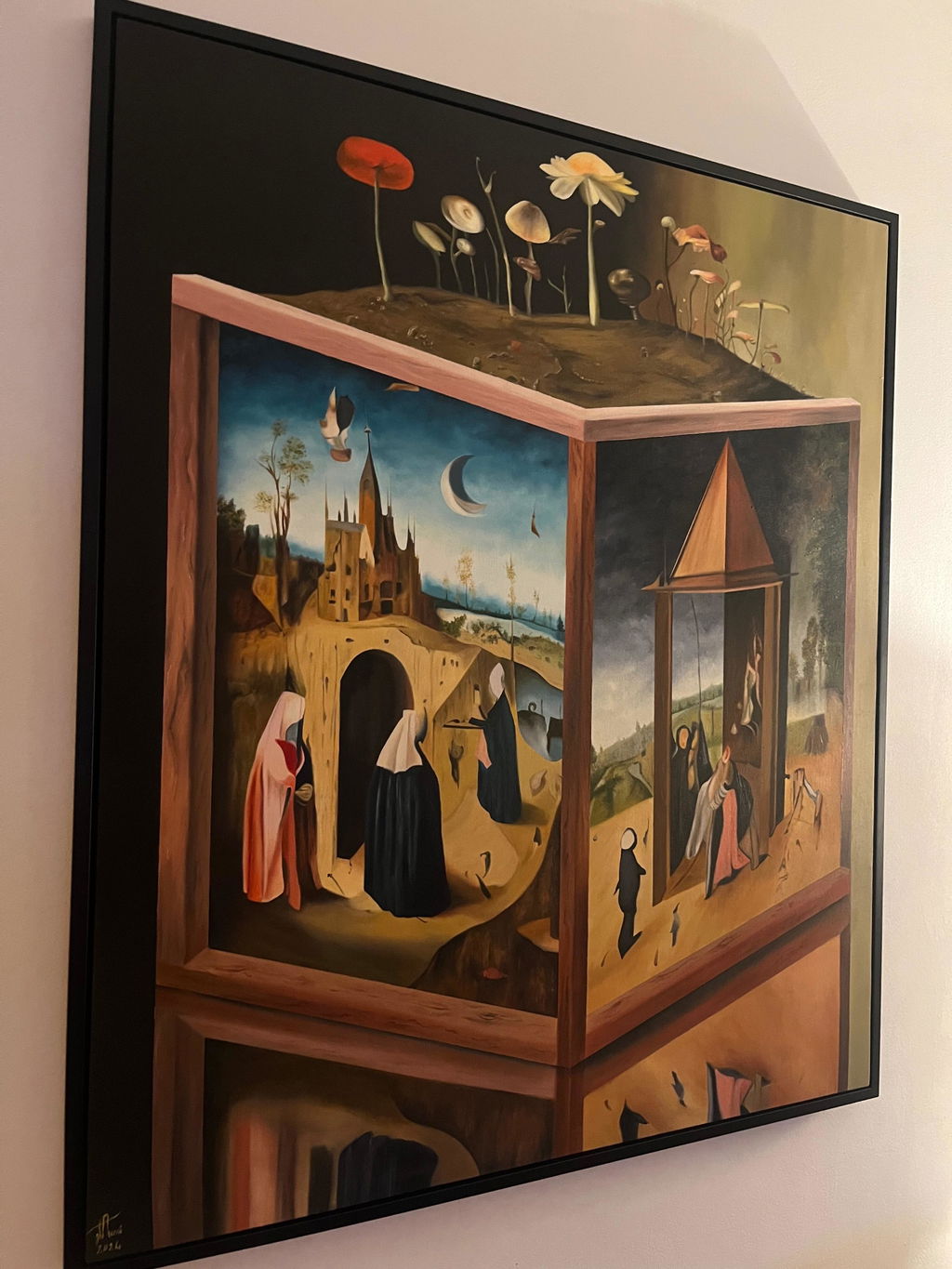
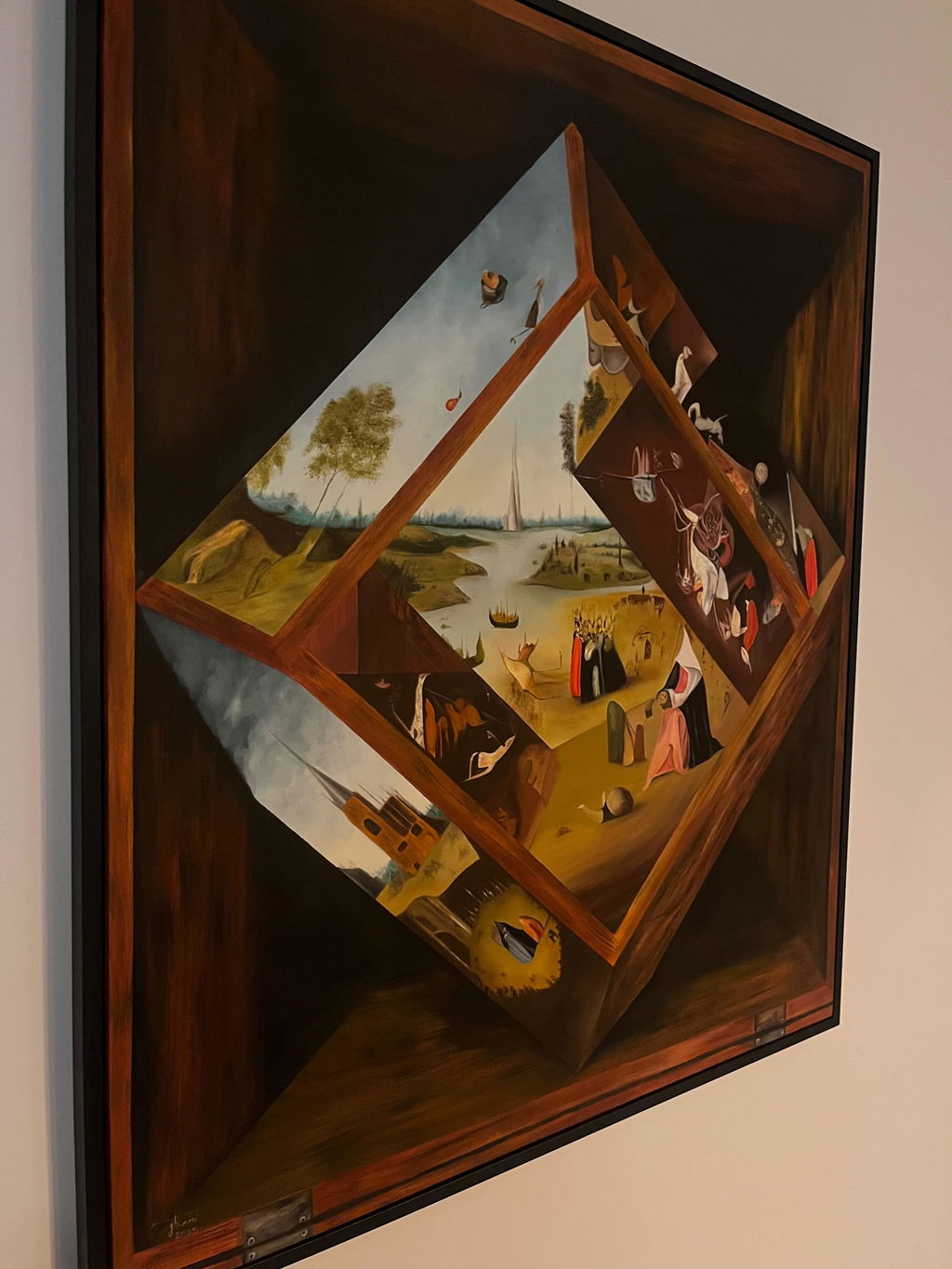
Wood and metal are not two versions of the same thing. They behave differently, they age differently, and they suit different work. Choosing between them is mostly a question of whether you want the frame to feel warm or precise.
Wood
Wood has grain, and grain means every length is slightly different. That variation is why a wood frame feels handmade even when it is machine-milled, and why it sits comfortably with painting, which is also handmade.
It also takes finish in a way metal cannot: it can be stained, waxed, painted, limed, or gilded, and the grain shows through most of those. A wood frame can be almost any colour and still read as wood.
Its weakness is movement. Wood responds to humidity, and a long length in a room that swings between wet and dry can bow very slightly over years. On a small frame this is invisible. On a very large one it is a real engineering consideration, which is why big frames need deeper sections.
Metal
Metal is dimensionally stable, does not care about humidity, and is far stronger for its thickness. That last point is the practical one: a metal frame can be much narrower than a wood frame of the same strength, so you get less frame and more art.
It is also cooler in tone, even in a warm finish like bronze, and it holds a precise machined edge that wood cannot. That precision suits photography, print, and hard-edged abstract work. A crisply resolved piece like Fractured Harmony reads well in a narrow metal profile, where the machined corner echoes the geometry of the image.
Its weakness is character. Metal has no grain and takes only a surface finish, so it never develops the depth a wood frame does. It is also unforgiving: a knocked corner on a metal frame dents visibly and cannot be filled and refinished the way wood can.
Side by side
|
Wood |
Metal |
| Feel |
Warm, handmade, variable |
Cool, precise, uniform |
| Strength for width |
Lower; needs bulk |
Higher; can be very narrow |
| Humidity |
Moves slightly |
Stable |
| Weight |
Heavier in wide profiles |
Lighter for the same strength |
| Repairable |
Yes, fillable and refinishable |
Not really; dents stay |
| Suits |
Painting, drawing, warm interiors |
Photography, print, modern interiors |
When metal is the better answer
-
Very large works on paper. The glazing is already heavy. A narrow metal frame adds strength without adding much more weight.
-
Damp rooms. Kitchens, bathrooms, and anywhere with a real humidity swing. See framing art for kitchens and bathrooms.
-
Anywhere the frame should disappear. A 9 mm black metal profile is about as close to no frame as a glazed piece can get.
When wood is the better answer
-
Anything painted by hand. Wood belongs with painting. It is not a rule, but it holds most of the time.
-
Rooms with wood already in them. Floors, beams, furniture. Metal in a room full of oak tends to look like it wandered in from an office.
-
Anything that may be reframed later. A wood frame can be recut, refinished, and reused. A metal one usually cannot.
A worked example: a large abstract in a condo with underfloor heating
Take a 900 mm wide abstract painting going into a Vancouver condo with underfloor heating. Underfloor heat dries the air near the floor and pulls moisture out of anything nearby, and it runs for months at a stretch through the winter. A wide wood frame in that room sees a bigger swing between summer and winter humidity than the same frame in a house with a furnace and a humidifier, because the heat source sits directly under it rather than across the room.
At 900 mm wide, that swing is enough to show. A wood moulding that width can bow a millimetre or two at the centre of each rail over a few heating seasons, which is small but visible along a straight top edge. A metal frame in the same width will not move, because aluminium and steel do not absorb or release moisture the way wood does.
The painting itself points the same way. If it is a hard-edged abstract with straight lines, a metal frame's machined corner suits the geometry and sidesteps the humidity problem in one choice. If the piece is loose and painterly, the trade-off is real: wood is the better visual match, but it needs a deeper, stiffer section to resist bowing at that width, and the room should ideally hold humidity between about 40 and 55 percent year-round, which most underfloor systems do not manage on their own without a separate humidifier. Ask about the room's heating type when you order a wide wood frame. It changes the section we recommend, not just the finish.
Common questions
Is metal cheaper than wood?
Not reliably. Plain aluminium sections are usually less than a hand-finished hardwood, but a good metal frame and a plain wood frame land close together. Price depends far more on size and on glazing than on which of the two you pick. See custom framing cost.
Can you combine the two?
Yes, and it can work well: a metal outer frame with a wooden fillet at the inner edge, or a wood frame with a thin metal slip. It has to be deliberate rather than accidental, and it is easier to get wrong than either material on its own.
Which lasts longer?
Both outlive us if they are kept indoors. Metal is more stable; wood is more repairable. In practice what fails first on an old frame is never the frame, it is the backing board and the tape inside it.
Does a metal frame need any maintenance?
Very little. Aluminium and steel profiles used in framing are usually anodized or powder-coated, so the finish resists scratching and does not need reapplying. A dry cloth is enough for dust. The main thing to avoid is dragging the frame across a hard surface, which can chip the coating at a corner.
Can wood frames warp in a dry climate?
Yes, though it takes an extreme swing, such as forced-air heating running all winter in a very dry house. Solid wood moves slightly with humidity and can develop a faint bow or a gap at one mitre joint over years. A stable veneered moulding over an engineered core resists this better than solid timber of the same width.
Which is better for a very large painting?
Metal, in most cases, once a canvas gets past about 120 cm on a side. Aluminium sections hold a long straight run without the sag or twist a wide wood moulding can develop, and the frame stays lighter for shipping. We recommend a profile based on the actual size when we quote large work.
Do metal frames scratch more easily than wood?
The surface coating can show a fine scratch more visibly than an oiled or waxed wood finish, because the contrast between the coating and the bare metal underneath is sharp. Wood scratches too, but a light scuff often blends into the grain. Neither is fragile in normal handling; both should be padded for shipping.
Can I get a metal frame in a wood tone finish?
Not a true wood tone, no. Metal profiles come in solid colours, anodized tones like bronze or champagne, and occasionally a printed woodgrain film, but the printed finish looks different up close from real wood and we do not recommend it for original art. If you want a wood look, choose an actual wood moulding.