Persian Wall Art for a Living Room: Size, Height, Light
UpdatedPersian wall art for a living room is sold today in three forms: printed decor, small framed miniatures, and large original paintings that draw on Persian tradition. For the main wall we think one large painting usually suits better than several small ones, because a room with a Persian rug already holds many small shapes, and one large picture gives people a single thing to look at. We are VanArtHub, a Vancouver gallery that sells original Persian miniatures and contemporary paintings that draw on Persian tradition. This guide covers size, height, colour and light, then measures three real canvases.
What Persian art for a wall means today
Printed decor is a photograph of an old manuscript page, printed on paper or canvas: our guide to telling an original from a print shows how to check a listing. A Persian miniature is a small painting made by hand and drawn to be seen from close by, so it belongs in a hallway more than above a sofa: see our guide to buying a Persian miniature. The third form is a large canvas by a living painter who takes a subject, a poem or a type of mark from Persian tradition.
This guide is for a reader who wants Persian art for a home and has one main wall to decide on. We sell new works by living painters and no antiques, and we ship no printed copies or posters.
Start with the room: what a Persian rug already brings
Jasleen Dhamija writes in the Encyclopaedia Iranica that "the most popular color for carpets has always been red", and that the most common red dye was madder, taken from the root of a plant. Blue came from the fermented leaves of the indigo plant, and yellow from sources such as vine leaves, pomegranate rinds and turmeric. Cloth already dyed with indigo turned green in a yellow dye.
The Victoria and Albert Museum counts ten colours in the wool of its Ardabil Carpet: three reds, three blues, yellow, green, black and white, on a dark blue ground with a yellow medallion. The Smithsonian's National Museum of Asian Art writes of the "red-ground carpets" of Safavid Iran, and the Metropolitan Museum of Art notes that the yellow field of its Anhalt Medallion Carpet is rarely seen in carpets of its type. Our reading: expect red or dark blue over the largest area.
The pattern is as dense as the colour. Annette Ittig writes in the Iranica that the most common design is a central field enclosed by a border of patterned stripes, and that a medallion-and-corner design adds a medallion at the centre and a quarter of one in each corner. Our page on Persian rugs and painting explains where these designs come from.
So the floor already supplies strong colour and small repeated shapes. In our view the wall needs one picture large enough to be seen as a single shape from across the room.
Eight decisions for the wall
| What to decide | A good answer | Ask more questions when |
|---|---|---|
| Width | Two thirds of the sofa's width | The listing gives no width in centimetres |
| Height | 15 to 20 cm above the sofa back | The picture is taller than the space above the sofa |
| Colour | One colour of the rug repeated, or none | The painting holds every colour of the rug |
| Pattern | Large forms above a floor of small ones | Small repeated shapes cover both rug and canvas |
| Subject | Everyone in the home has agreed to it | One person dislikes the face on the wall |
| Light and glare | No direct sun, and no lamp reflected when you sit down | Gold or a glossy varnish would face a window |
| One work or a group | One large work on the main wall | A group hangs with wide gaps |
| Delivery | "Flat" or "rolled" in writing | Nobody has measured the lift or the stairs |
Width. Our guide to what size painting to hang above a sofa gives two thirds of the sofa's width and accepts 60 to 75 percent. For a wall with no furniture, our guide to sizing art to a wall gives half to three quarters of the usable width.
Height. Our guide to how high to hang a painting gives 145 cm from the floor to the centre of the picture, and 15 to 20 cm between a sofa back and the bottom of the picture. For a tall canvas, add the sofa back, the gap and the height of the painting, then compare the total with your ceiling. The Canadian Conservation Institute advises two points of hanging contact in the wall, so that if one fails the second holds.
Colour. In our view two approaches work. Repeat one colour of the rug and only one, such as the red of the field. Or choose a painting whose main colours cover no large area of the rug. Then check the colour under your own lamps: the US Department of Energy lists 2,700 K as the warm colour temperature used in homes, while the Canadian Conservation Institute reports studies in which viewers preferred 3500 to 4100 K for paintings. Ask the seller for a photo taken under a household lamp.
Pattern. A painting made of small repeated units gives the room a second field of small pattern. We would put large forms on the wall: one figure, or broad areas of colour.
Subject. A large figure on the wall faces the sofa all day. A face, a demon or a battle is a real choice, and everyone who lives in the room should agree to it. For gentler subjects see our page on symbols in Persian painting, and for stories see our guide to choosing a Shahnameh scene.
Light and glare. Our guide to lighting a painting at home gives 30 degrees from vertical as the angle for a lamp. The institute's test for reflections, written for pictures under glass, is to stand where the viewer will be and check the surface for the lamps. Do that test sitting on the sofa. The institute says traditional resin varnishes were glossy and gave "high reflectance", and that varnishes are made in gloss and matte forms, so ask which one the painting has. For gold, see our guide to gold in Persian painting. Shade the rug as well: the institute places indigo on wool among the colours that fade slowly, and most plant yellows and greens among those that fade fastest.
One work or a group. Both of our sizing guides say one large piece is usually the stronger choice, and that pieces hung 6 to 8 cm apart are seen as one object.
Delivery. Ask how the work will travel before you pay. A rolled canvas arrives in a tube and must be stretched on bars again: see our page on shipping a canvas rolled. A stretched canvas arrives flat in a box, so measure the front door, the stairs, the lift and the door of the room. The institute asks for two people to carry even an easel-sized painting.
Worked example one: a tall div on a wall of its own
The sums use our guides' figures. A painting two thirds as wide as the sofa means a sofa 1.5 times as wide as the painting, and the 60 to 75 percent range gives the widest and the narrowest sofa. We round to one decimal place. Our product pages print two numbers for each size and do not label the width. The photographs of the first and third works are taller than they are wide, so we read the smaller number as the width.
The first canvas is 119.4 cm wide and 152.4 cm tall. 119.4 x 1.5 = 179.1 cm, so it suits a sofa 179.1 cm wide, within a range of 159.2 cm (119.4 / 0.75) to 199.0 cm (119.4 / 0.60). Take a sofa back of 85 cm and a ceiling of 240 cm as examples. With a 15 cm gap, the top would sit at 85 + 15 + 152.4 = 252.4 cm, above the ceiling. So we would give this work a wall with no furniture. With the centre at 145 cm, its bottom and top edges sit at 68.8 cm and 221.2 cm (145 - 76.2 and 145 + 76.2), and the usable wall should be 159.2 cm to 238.8 cm wide (119.4 / 0.50).
A div is the demon of Persian stories. The Encyclopaedia Iranica translates the word as "demon, monster, fiend" and says Persian epics give divs long teeth and claws. This one is painted in bright red, blue, yellow and green. It will take most of the attention in the room, and some households will not want a monster facing the sofa.
The Monster (Div) Trapped in Data by Amir Fazelian is acrylic on canvas, 119.4 x 152.4 cm (47 x 60 in). A monstrous figure with red skin, orange eyes and sharp teeth wears a crown and a pearl necklace and holds a blue and silver chess piece, among floating dice. Its shop tags include Persian Mythology, and its product page names no story. More is in the Amir Fazelian collection.

Worked example two: a square canvas above the sofa
The second canvas is a square of 101.6 cm. 101.6 x 1.5 = 152.4 cm, so it suits a sofa 152.4 cm wide, within a range of 135.5 cm (101.6 / 0.75) to 169.3 cm (101.6 / 0.60). On the 210 cm three-seat sofa that our guide uses as its example, it covers 101.6 / 210 = 48.4 percent, which is under the range. Height works: above the same sofa, the top sits at 85 + 15 + 101.6 = 201.6 cm, which is 38.4 cm under the ceiling.
Beyond the Stone by Roshan is oil on canvas, 101.6 x 101.6 cm (40 x 40 in). On a dark ground, a head with closed eyes and yellow hair rising upward appears at the left, and at the right a seated figure made of broken forms raises a hand to its head. Two large forms on a dark ground: beside a red rug this is our second approach to colour. The product page says the painter started from an idea of Rumi: that old structures have to fall so that new ones can rise. See our guide to Rumi and Hafez paintings and the Roshan collection.

Worked example three: lines of script beside a patterned rug
The third canvas is 127 cm wide and 139.7 cm tall. 127 x 1.5 = 190.5 cm, within a range of 169.3 cm (127 / 0.75) to 211.7 cm (127 / 0.60). It is the only one of the three inside the range on a 210 cm sofa: 127 / 210 = 60.5 percent. Height is close: 85 + 15 + 139.7 = 239.7 cm, which is 0.3 cm under the ceiling. This canvas needs a lower sofa, a higher ceiling or a wall of its own.
Lines of script are small repeated marks, which tests our advice on pattern. Two things separate this canvas from a rug: its marks run in straight horizontal rows, and it has two colours in large areas.
Silent Echo by Peyman Mehdizadeh is acrylic on canvas, 127 x 139.7 cm (50 x 55 in). Horizontal lines of white script cover a textured surface of orange-red and teal-green, with black shapes and splatters. The product description calls the script calligraphic and illegible, so it holds no words to read. Our guide to Persian calligraphy art covers script that can be read. More is in the Peyman Mehdizadeh collection and in our large wall art for the living room collection.

How buying from us works
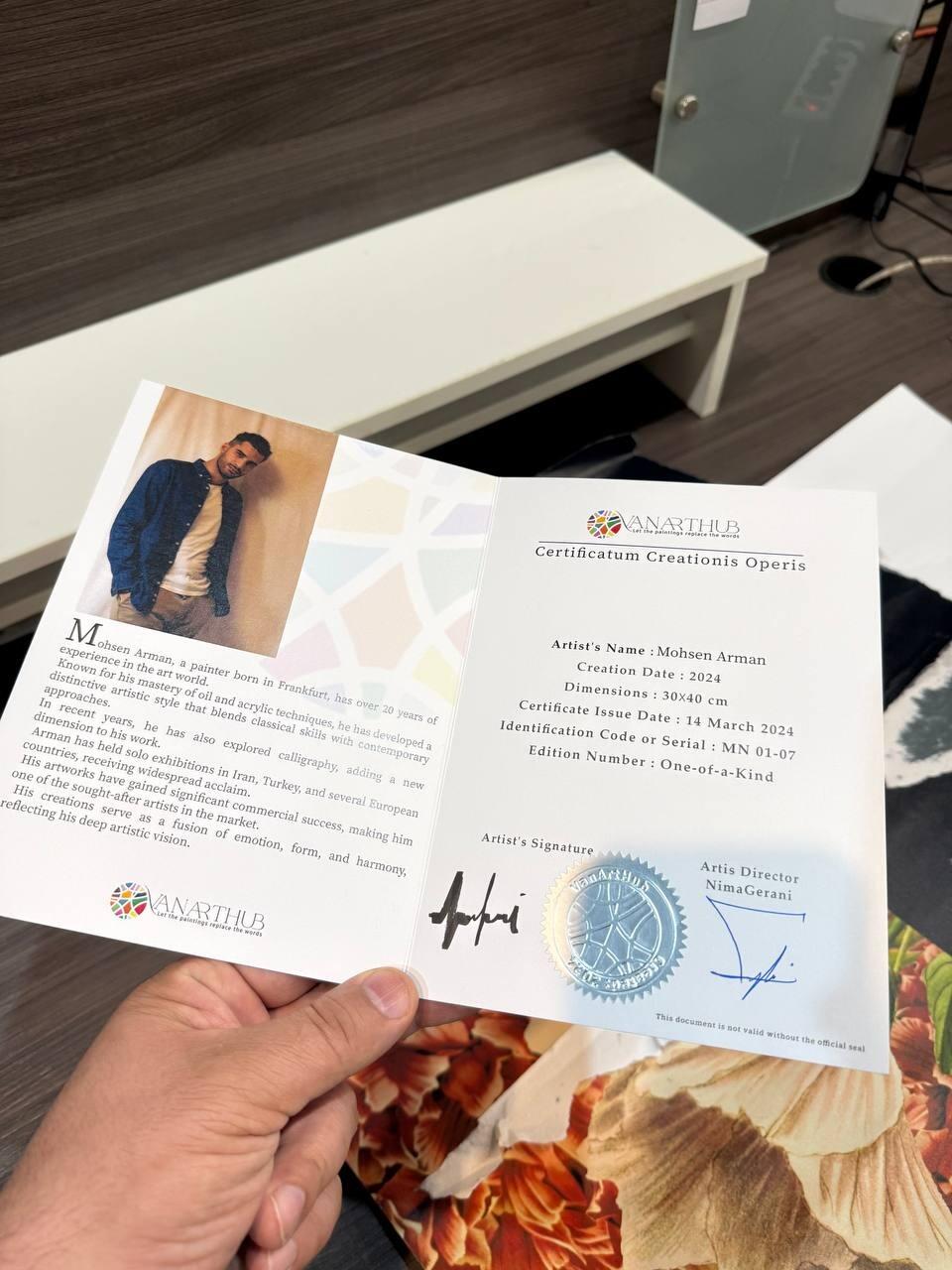
Each work we sell is an original, signed and one of a kind, and it comes with a Certificate of Authenticity. Shipping is free and fully insured: 3 to 7 business days in Canada and 5 to 10 to the USA. A stretched canvas ships flat in a rigid box. A work on unstretched canvas, or one too large to travel on its stretcher bars, ships rolled in a heavy tube, and we tell you before it ships which way it will travel. If a carrier asks you for a customs or brokerage fee, contact us before you pay it.
The 14-day trial is the real test for a large work. Only the painting itself shows the colour beside your rug, the glare from your window, and how the household feels about the subject. If you return it within 14 days of delivery, you get a full refund and we pay the return shipping. The full terms are on our Buy with Confidence page.
Every product page has a form to ask us a question about that painting. Our gallery is at 1242 Davie Street in Vancouver's West End: see our West End gallery page for the hours, and contact us before you come, so that we can confirm the work is at the gallery that day.
Each product page has one more option, Buy Print File: a high-resolution digital file of the image, which you print yourself. Nothing is shipped, we email the file within 48 hours, it is for personal printing only, and copyright stays with the artist. A print made from that file is a reproduction, and the painting itself still exists once.
Key Takeaways
- Persian wall art is sold as printed decor, small miniatures or large original canvases. We would choose one large canvas.
- A Persian rug already gives the room strong colour and dense pattern. Repeat one colour of the rug, or none.
- Multiply a painting's width by 1.5 to find the sofa it suits.
- Add the sofa back, a 15 cm gap and the painting's height before you buy a tall canvas.
- A large face or a monster is a choice for the whole household, and a 14-day trial lets you test it.
Frequently Asked Questions
What is Persian wall art for a living room?
Persian wall art for a living room is any picture for the wall that takes its subject or its forms from Persian tradition. Shops sell three kinds: printed decor, small framed miniatures painted by hand, and large original canvases by living painters. On the main wall of a living room we would hang one large canvas, and keep miniatures for a hallway.
Where can I buy large Persian wall art that is painted by hand?
Large hand-painted Persian wall art is sold by painters and by galleries that show living painters. VanArtHub in Vancouver has new original canvases, each signed and one of a kind, with free and fully insured shipping in Canada and to the United States. For a printed poster or an antique carpet to hang on the wall, go to a seller of those.
What size of painting fits above a three-seat sofa?
Two thirds of the sofa's width is the target in our sofa guide, with 60 to 75 percent as the accepted range. On a 210 cm three-seat sofa that is 140 cm, or between 126 and 157.5 cm. Leave 15 to 20 cm between the sofa back and the bottom of the picture, and check that the top stays clear of the ceiling.
What colour of painting goes with a red Persian rug?
Two choices work with a red Persian rug, in our view. One is a painting that repeats the red and no other colour of the rug. The other is a painting whose main colours cover no large area of the rug, such as a dark picture with yellow and green. Compare the two reds in daylight first, because reds that almost match look like a mistake.
Is one large painting better than a group of small Persian pictures?
One large painting is the better choice for the main wall of a room with a Persian rug, in our view. The rug already fills the room with small shapes, and a group of small frames adds more of them. Our sizing guides say pieces hung 6 to 8 cm apart are seen as one object, so keep the gaps small if you do hang a group.
Is a painting of a div right for a family living room?
A painting of a div suits a family room only when everyone who lives there likes it. The div is the demon of Persian stories, and the Encyclopaedia Iranica says the epics give divs long teeth and claws. A large figure of that kind faces the sofa all day. Show the picture to the whole household before you buy.
Will a canvas 152.4 cm tall fit through my door and into my lift?
A flat canvas of 119.4 x 152.4 cm, carried on its long edge, passes any doorway taller than 119.4 cm. The lift is the harder test: the canvas needs 152.4 cm in one direction inside it, which can be the depth, the height or the diagonal of the floor. Measure the lift, the stairs and every turn before you pay, and ask us for the box size.
Does a large painting ship to the United States flat or rolled?
Either, depending on the work. A stretched canvas ships flat in a rigid box. A work on unstretched canvas, or one too large to travel on its stretcher bars, ships rolled in a heavy tube, and we tell you before it ships which way it will travel. Shipping is free and fully insured, and takes 5 to 10 business days to the USA.
Are these three large works on display at 1242 Davie Street?
We confirm that for the day of your visit, so ask us before you come. Our gallery is at 1242 Davie Street in Vancouver's West End, and the opening hours are on our West End gallery page. Contact us first, so that we can confirm the work you want is at the gallery that day. Bring the width of your sofa and the height of your ceiling.
Can I send a large painting back if it clashes with my Persian rug?
Yes, within 14 days of delivery. Every work from VanArtHub comes with a 14-day trial: return the painting in that time for a full refund, and we pay the return shipping. Use the days to see the colours beside the rug by daylight and under your lamps. Keep the box or the tube until you have decided.
Sources
- Encyclopaedia Iranica, Carpets ii. Raw materials and dyes, by Jasleen Dhamija, read October 2026.
- Encyclopaedia Iranica, Carpets iv. Knotted-pile carpets: Designs, motifs, and patterns, by Annette Ittig, read October 2026.
- Encyclopaedia Iranica, Div, by Mahmoud Omidsalar, read October 2026.
- Victoria and Albert Museum, The Ardabil Carpet, museum number 272-1893, collection record, read October 2026.
- Smithsonian's National Museum of Asian Art, Carpet, Iran, Safavid period, S2018.18, read October 2026.
- The Metropolitan Museum of Art, The Anhalt Medallion Carpet, 46.128, read October 2026.
- Canadian Conservation Institute, Caring for paintings, read October 2026.
- Canadian Conservation Institute, Environmental Guidelines for Paintings, CCI Notes 10/4, read October 2026.
- Canadian Conservation Institute, Agent of deterioration: light, ultraviolet and infrared, read October 2026.
- US Department of Energy, Federal Energy Management Program, Purchasing Energy-Efficient Light Bulbs, read October 2026.
Sources read in October 2026. If you spot something out of date, tell us and we will correct this post.
About VanArtHub
VanArtHub is a gallery based in Vancouver, Canada. Every work we sell is an original, signed and one of a kind, and comes with a Certificate of Authenticity, free insured shipping and a 14-day trial. Persian art is also called Iranian art, and our guide to contemporary Persian painting explains how painters today use the older tradition. You can also browse all artworks in one place.