Persian Calligraphy Art for Sale: Readable or Ornament?
UpdatedPersian calligraphy art for sale is one of four things: printed lettering, calligraphy written by hand that a reader of Persian can read, an album page that joins writing with painting and gold, or a Persian calligraphy painting in which the letters are shapes and say nothing. The first question for any seller is which of the four is on offer. We are VanArtHub, a Vancouver gallery that sells original Persian miniatures and contemporary paintings that draw on Persian tradition. We have the last two kinds, and this guide shows how to judge all four.
Four things sold as Persian calligraphy art, and who this guide is for
The first is a print: a poem or a word in ornamental letters, printed on paper or canvas and often offered in several sizes. It is a fair purchase when it is sold as a print. We sell none.
The second is calligraphy written by hand: ink on paper, by a calligrapher, with words a reader of Persian can read. Old sheets are sold by auction houses and specialist dealers, and new ones by the calligrapher. We sell no antiques, and none of our three works is a single sheet of this kind.
The third is the album page. From the second half of the 15th century, the Smithsonian's National Museum of Asian Art explains, calligraphers wrote a few lines of poetry in large letters on a single sheet, and such sheets were later mounted onto illuminated margins "and gathered into albums". Massumeh Farhad writes in the Encyclopaedia Iranica that paintings went into such albums, which are called muraqqa (the Iranica spells it moraqqa'). Two of our three works are new miniatures built this way.
The fourth is calligraphic painting. Gholam-Hosayn Yusofi records in the Iranica that since the 1960s some calligraphers have tried to combine calligraphy with painting. Some of these works can be read. In others the marks only have the shape of writing, and our lead work is one of those.
This guide is for a buyer choosing from photographs, and especially for one who reads no Persian.
The scripts in one short section
Nastaliq (also written nasta'liq) comes first, because it is the script of Persian poetry. Yusofi writes that it developed in the second half of the 14th century from two older scripts, naskh and ta'liq. By 1430, the Smithsonian says, it was used "throughout the Persian-speaking world", and Farhad describes it as reserved for poetry since the early 15th century.
You can recognise nastaliq without reading it. Yusofi gives two marks: only 1/3 to 1/6 of the strokes are straight, and the round strokes slope downward from right to left. He also calls the script "easily legible".
One more name appears in listings. Shekasteh, the "broken" script, is a fast form of nastaliq from the early 17th century, and Yusofi notes that its standard style may be difficult to read. Our pages on the types of Persian calligraphy and on Persian calligraphy in painting cover every script and its history.
Muraqqa': The Blue Robe by Kamal al-Din Ghotb is a Persian miniature in oil and gold, 30 x 40 cm (11.8 x 15.7 in), laid out as an album page. A youth in a pale blue robe plays the panpipes inside a frame of couplets, below a calligraphy panel on a gold ground pressed with oval seals. The product page names the script of the couplets as nastaliq. We show it as a new example of the third kind.

The first decision: must the words be readable?
Calligraphy began as a way to pass on a text. The Metropolitan Museum of Art's essay on calligraphy in Islamic art calls it "principally a means to transmit a text, albeit in a decorative form". It adds that some of the people who saw a legible inscription could not read it, and that an entire word "can give the impression of random brushstrokes".
Two later changes made writing more like a picture. For the single sheets, the Smithsonian says, "the visual essence of nasta'liq ultimately became as important as the text itself". Then, in the early 1960s, the Saqqakhana artists of Iran used letters and numbers as decoration to fill the background of a picture, which, a Met essay says, removed the meaning the characters had as words.
Yusofi reports that many leading calligraphers regard this mixing as "a questionable innovation" and class the result as painting. We agree with the label and see nothing wrong with the work. A calligraphic painting is a painting, and it should be sold and judged as one.
So decide first what you want from the letters. For a poem on your wall you need readable calligraphy, and you need to know what it says. For the rhythm of written lines as a picture, a calligraphic painting is enough.
Our advice for a buyer who reads no Persian is one request: ask the seller to type out the words in Latin letters and to translate them. A seller of readable calligraphy can do both, or can ask the calligrapher. If the seller cannot, treat the writing as ornament and judge the work as a picture, by its colour, size and surface.
Silent Echo by Peyman Mehdizadeh is an acrylic on canvas, 127 x 139.7 cm (50 x 55 in). Lines of white script run horizontally across a textured ground of orange-red and teal-green, with black shapes and splatters among them. Its product page calls the script calligraphic and illegible, so we present it as calligraphic painting: writing used as texture, with nothing to read or translate.

What to check before you buy Persian calligraphy art
These eight checks work for any seller, and for us.
| What to check | A good answer | Ask more questions when |
|---|---|---|
| Readable or not | The seller states which one it is | The listing says "calligraphy" and leaves this open |
| What the text says and where it is from | The words typed out, a translation, and the poet or the book | "A Persian poem" and nothing more |
| Written by hand or printed | "Original", one size, and a close photo of continuous strokes | "Print", a choice of sizes, or a close photo that shows dots |
| The surface | Named: ink and gold on paper, or paint on canvas | No surface or medium is named |
| Which way up, and the light | The top edge is marked on the back | Nobody can say which edge is the top |
| The size | Height and width in centimetres | Only "large" or "small" |
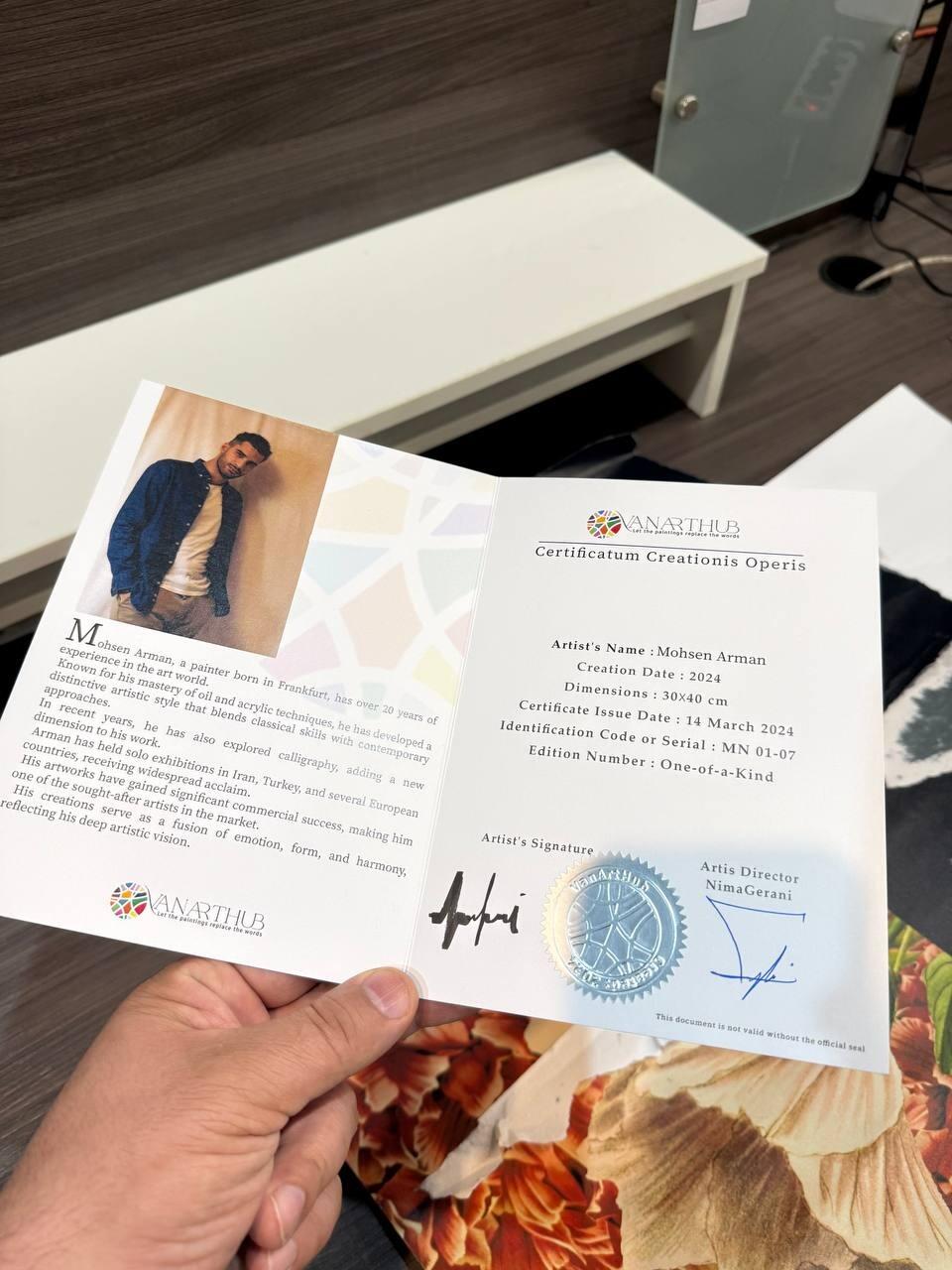
| The signature and the certificate | A signed certificate with the maker, title, medium and size | A famous old name on a sheet that looks new |
| The return terms | Written: the days, a full refund, who pays the return shipping | "Final sale", or nothing in writing |
What the text says. A full answer names the poet and gives the words in English. For one sheet signed by Mir Ali Haravi, the Smithsonian names Hafez (it writes Hafiz) as the poet of the quatrain and prints the poem on the sheet in English, beginning "O Emperor, may your holiday be happy and blessed." Our guide to Rumi and Hafez paintings explains how to check a quoted line and its translator.
Words beside a picture. On an album page, ask about each panel, because the writing may have nothing to do with the picture. Of one album page signed by Sultan Ali Mashhadi, the Smithsonian says the quatrain has no relation to the border verses or to the figures painted later, and calls this "almost always the case" with album pages.
Written by hand or printed. A printed sheet is made of dots, which the Victoria and Albert Museum says "can be seen through a magnifier" on a leaflet printed by the four colour process. A pen stroke is one continuous mark, and the Smithsonian describes large nastaliq as having long strokes with strong changes in width. Ask for a close photo of one long stroke. Our guide to buying a Persian miniature gives this check in full.
The signature. A famous name on a sheet is a claim to check: the Smithsonian says hundreds of sheets carry the signature of Mir Ali Haravi, and that many of them were in fact written by his students. For a new work, the name on the work and on the certificate should be the same.
The surface. The Smithsonian's labels for the old sheets read "Ink, opaque watercolor, and gold on paper". Our calligraphic painting is acrylic on canvas, and the product pages of our two miniatures give oil and gold on paper.
Which way up it hangs, and how to light it
If you cannot read a script, you cannot see when it hangs upside down. Yusofi's mark helps: the round strokes of nastaliq slope downward from right to left. On a single sheet with diagonal lines, the Smithsonian notes, the calligrapher's name usually appears in the lower left triangle. For a calligraphic painting the painter decides which edge is the top, so ask the seller to mark it on the back.
Light is the larger risk for paper. The Canadian Conservation Institute says visible light "fades colours often found on paper objects and artworks". Its table places carbon inks among the materials with no sensitivity to light. It then warns that the tint of the paper and tints added to the ink are often in the high-sensitivity group. So hang paper where direct sun never reaches it. The institute advises framing paper objects behind UV-filtering glazing where appropriate. Framing is done at our gallery and quoted per piece at the counter: see our custom framing page.
A canvas needs different care. For paintings, the institute says to avoid direct sunlight and display on poorly insulated exterior walls. It adds that drying acrylic paint releases substances that attract dirt and dust, and that cleaning with water, done improperly, can drive dirt into the paint.
The three works in our gallery now
The works in this guide are by Kamal al-Din Ghotb and Peyman Mehdizadeh. More by each painter is in the Kamal al-Din Ghotb collection and the Peyman Mehdizadeh collection.
We have to be exact about the two miniatures. Their product pages describe the calligraphy: couplets in nastaliq around the picture, and on Muraqqa': The Blue Robe a panel of writing on gold. The pages print no translation of those words and name no poet. If the words matter to you, ask us through the form on the product page before you buy.
Mi'raj: The Night Journey by Kamal al-Din Ghotb is a Persian miniature in oil and gold, 30 x 40 cm (11.8 x 15.7 in). A haloed rider crosses a deep blue sky on Buraq, a winged steed with a crowned human face, among gold clouds and angels, above a city of domes and minarets. Its product page names the subject as the Mi'raj, the Ascension, and says couplets in nastaliq frame the picture. It is our second example of script used as a frame.

Which work suits which buyer? If you want a poem to read aloud to a guest, none of the three is the right purchase, and a sheet by a calligrapher is. If you want the album tradition with fine detail and gold, look at the two miniatures. If you want written lines as a large abstract picture, Silent Echo is 127 cm wide, so measure your wall first.
How buying from us works
Every work we sell is an original, signed and one of a kind, and each arrives with a Certificate of Authenticity. Shipping is free and fully insured: 3 to 7 business days in Canada and 5 to 10 to the USA. A stretched canvas ships flat in a rigid box. A work on unstretched canvas, or one too large to travel on its stretcher bars, ships rolled in a heavy tube, and we tell you before it ships which way it will travel. If a carrier asks you for a customs or brokerage fee, contact us before you pay it.
The 14-day trial starts at delivery. Return the work within 14 days for a full refund, and we pay the return shipping. The full terms are on our Buy with Confidence page.
Every product page has a form to ask us a question about that painting. Our gallery is at 1242 Davie Street in Vancouver's West End, and the opening hours are on our West End gallery page. Contact us before you come, so we can confirm the work is at the gallery that day. For price, ownership history and cross-border rules, read our guide on how to buy Persian art.
Each product page has one more option, Buy Print File: a high-resolution digital file of the image, which you print yourself. Nothing is shipped, we email the file within 48 hours, it is for personal printing only, and copyright stays with the artist. A print made from that file is a reproduction, and the painting itself still exists once.
Key Takeaways
- Persian calligraphy art on sale is a print, a readable sheet written by hand, an album page, or a calligraphic painting whose marks cannot be read.
- If you read no Persian, ask the seller to type out and translate the words. If the seller cannot, judge the work as a picture.
- On an album page the writing often has no link to the picture, so ask about each panel.
- Carbon ink keeps its colour in light, and tinted paper and colours fade. Keep paper out of direct sun.
- Our three works are two album-style miniatures with nastaliq couplets and one calligraphic painting.
Frequently Asked Questions
Where can I buy original Persian calligraphy art?
Original Persian calligraphy is sold by calligraphers, by galleries that represent them, and, for old sheets, by auction houses and specialist dealers. VanArtHub in Vancouver has new miniatures with panels of nastaliq writing and the calligraphic painting Silent Echo, each with free, fully insured shipping in Canada and to the United States. For a printed poem, go to a print seller.
What counts as Persian calligraphy art?
Four kinds of work are sold under the name: printed lettering, readable calligraphy written by hand, album pages that join writing with painting and gold, and calligraphic painting whose letters are shapes. The Encyclopaedia Iranica records that since the 1960s some calligraphers have combined calligraphy with painting, and that many leading calligraphers class the result as painting.
Which script is used for Persian poetry?
Nastaliq is the script of Persian poetry. The Encyclopaedia Iranica says it developed in the second half of the 14th century from two older scripts, naskh and ta'liq, and the Smithsonian's National Museum of Asian Art says it was used throughout the Persian-speaking world by 1430. Its strokes are mostly round, and the round strokes slope downward from right to left.
Can I buy Persian calligraphy art if I cannot read Persian?
Yes, if you make one request. Ask the seller to type out the words in Latin letters and to translate them. A seller of readable calligraphy can do both. If the seller cannot, treat the writing as ornament and judge the colour, the size and the surface as you would for any picture.
How do I check that calligraphy was written by hand?
Ask for a close photo of one long stroke and look at it enlarged. A printed sheet breaks into dots, which the Victoria and Albert Museum says can be seen through a magnifier. A pen stroke is one continuous mark that changes in width. A listing that offers the same design in several sizes is selling prints.
What is calligraphic painting?
Calligraphic painting is painting that uses letters, or marks shaped like letters, as its forms. The Metropolitan Museum of Art says the Saqqakhana artists, a group of Iranian painters of the early 1960s, used letters and numbers as decoration, which removed their meaning as words. Some calligraphic paintings can be read and others cannot, so ask the seller which kind is on offer.
Which way up does a calligraphy painting hang?
The seller should mark the top edge on the back, so ask for that before the work ships. For nastaliq there is a second sign: the Encyclopaedia Iranica says its round strokes slope downward from right to left. On an old single sheet with diagonal lines, the Smithsonian places the calligrapher's name in the lower left triangle.
Does light fade calligraphy on paper?
Light fades the colours and the tinted paper first. The Canadian Conservation Institute places carbon inks among materials with no sensitivity to light, and warns that the tint of the paper and tints added to the ink are often highly sensitive. Hang paper away from direct sun, and frame it behind UV-filtering glazing where appropriate.
Do the calligraphy works at VanArtHub come with a translation of the words?
No translation is printed on the product pages. The two miniatures by Kamal al-Din Ghotb are framed by couplets in nastaliq, and their pages describe the writing and name no poet. Silent Echo by Peyman Mehdizadeh has script that its page calls illegible, so it has no words to translate. Ask us through the form on the product page.
How does a canvas as large as Silent Echo reach me, and can I send it back?
Shipping is free and fully insured, and takes 3 to 7 business days in Canada and 5 to 10 to the USA. A canvas too large to travel on its stretcher bars ships rolled in a heavy tube, and we tell you before it ships. You have 14 days from delivery to return it for a full refund, and we pay the return shipping.
Sources
- Encyclopaedia Iranica, Calligraphy ii. Scripts, by Gholam-Hosayn Yusofi, read October 2026.
- Encyclopaedia Iranica, Calligraphy v. Painting and calligraphy, by Gholam-Hosayn Yusofi, read October 2026.
- Encyclopaedia Iranica, Isfahan xi. School of Painting and Calligraphy, by Massumeh Farhad, read October 2026.
- Smithsonian National Museum of Asian Art, Nasta'liq: The Genius of Persian Calligraphy, Masters and Pupils, read October 2026.
- Smithsonian National Museum of Asian Art, Nasta'liq: The Genius of Persian Calligraphy, Mir Ali Haravi, read October 2026.
- Smithsonian National Museum of Asian Art, Nasta'liq: The Genius of Persian Calligraphy, Sultan Ali Mashhadi, read October 2026.
- The Metropolitan Museum of Art, Heilbrunn Timeline of Art History, Calligraphy in Islamic Art, by the Department of Islamic Art, read October 2026.
- The Metropolitan Museum of Art, Heilbrunn Timeline of Art History, Artists of the Saqqakhana Movement, by Julia Rooney and Maryam Ekhtiar, read October 2026.
- Victoria and Albert Museum, Print, four colour relief halftone and lineblock leaflet, E.665-1993, read October 2026.
- Canadian Conservation Institute, Caring for paper objects, read October 2026.
- Canadian Conservation Institute, Caring for paintings, read October 2026.
Sources read in October 2026. If you spot something out of date, tell us and we will correct this post.
About VanArtHub
VanArtHub is a gallery based in Vancouver, Canada, that sells original, signed, one-of-a-kind works, each with a Certificate of Authenticity, free insured shipping and a 14-day trial. Persian art is also called Iranian art, and our guide to contemporary Persian painting covers its painters and styles. You can also browse all artworks.