How to Frame a Persian Miniature: Mat, Glass and Mount
UpdatedTo frame a Persian miniature, put it behind glass, with a mat or a spacer that keeps the glass off the paint and the gold. Use acid-free board, and a mount that a later framer can undo. Leave every painted border visible, because on a Persian page the border is part of the painting. We are VanArtHub, a Vancouver gallery that sells original Persian miniatures and contemporary paintings that draw on Persian tradition. This guide gives seven decisions, six things a framer must never do, and the sums for three real works.
Who this guide is for
You own a Persian miniature, or you are about to buy one, and you searched for "Persian painting frame" or "how to frame a Persian miniature". Our framing guides cover general framing, so we give each point in a sentence and link the page.
We sell new works by living painters. Take an antique page to a paper conservator before any framer handles it: see our guide to a new or an antique Persian miniature. For what a miniature is, read our guide to buying a Persian miniature.
Why a Persian miniature needs a frame
The Canadian Conservation Institute (CCI) gives three reasons for framing a work on paper: "to protect it, to display it more easily, and to enhance its aesthetic appearance". Protection is the main one: CCI says a frame gives "additional protection from damage due to handling" and keeps out dust.
A Persian album page was made for a book. Julia Poirier, a conservator at the Chester Beatty, explains that the Persian word muraqqa' means album, or more literally "patched". A page in a closed book stays in the dark. A page in a frame is lit every day, and the Library of Congress says long-term display of paper "is not recommended because light exposure causes permanent damage".
The frame can do harm too. Icon, the Institute of Conservation, writes: "Poor quality mounting and frames damage more works of art on paper than any other agent."
The border is part of the page. Poirier writes that each folio of the Mughal album she treats is "constructed with decorative margins and inner borders". The Harvard Art Museums describe the drawing on a Persian album folio of the late 16th century as "framed by multiple rulings and a stenciled margin" drawn in gold. Our pages on Persian illumination and Persian miniature painting name these parts.
Muraqqa': The Blue Robe by Kamal al-Din Ghotb is a Persian miniature in oil and gold on paper, 30 x 40 cm. On this new album page a youth in a pale blue robe plays the panpipes below a gold-ground calligraphy panel, a study of pink lilies and an ink drawing of a bird, with painted borders between the panels. We show it for its borders. See the Kamal al-Din Ghotb collection.

Seven decisions to make with your framer
| What to decide | A good answer | Ask more questions when |
|---|---|---|
| Mat or float | Every painted border stays visible | The window would sit on a painted border |
| Mat width and colour | 80 mm on a 30 x 40 cm page, in white, cream or buff | The mat is narrower than the frame |
| Glazing | Filters ultraviolet, anti-reflective, touches nothing | Etched "non-glare" glass, or glass on the paint |
| Backing and mount | Acid-free board, and paper hinges or corners | Tape, glue, or "we mount it flat" |
| The frame | Deep enough for glazing, mat and backing | A ready-made frame the sheet "nearly fits" |
| What you tell the framer | Medium, year, sheet size and painted size | The framer asks nothing about the medium |
| Where it hangs | An inside wall, out of direct sun | A picture light fixed to the frame |
Mat or float. A window mat covers part of the sheet: CCI tells framers to let it "overlap the edges of the artifact by at least 2 mm to 4 mm in order to hold down the work". On a page painted to its edge, that hides 2 to 4 mm of border on each side. If plain paper runs outside the painted border, the mat can rest there. If the paint reaches the edge, float the sheet. The American Institute for Conservation (AIC) says: "If design, signature, or inscriptions extend to sheet edges, float mounting may be warranted." Our guide to framing works on paper says a float mount hinges the sheet on top of a backing board, with a spacer holding the glazing clear. A float protects less: the Library of Congress says "overmatting provides more protection".
Mat width and colour. Our mat border width guide gives 60 to 80 mm for a work whose longest side is 200 to 400 mm, and 80 to 100 mm for 400 to 600 mm. The longest side of a 30 x 40 cm page is 400 mm, and 80 mm is in both ranges. The guide cuts the bottom border deeper: its example is 96 mm under an 80 mm top. CCI recommends "white or buff" board. In our view a coloured mat takes attention from a painted border.
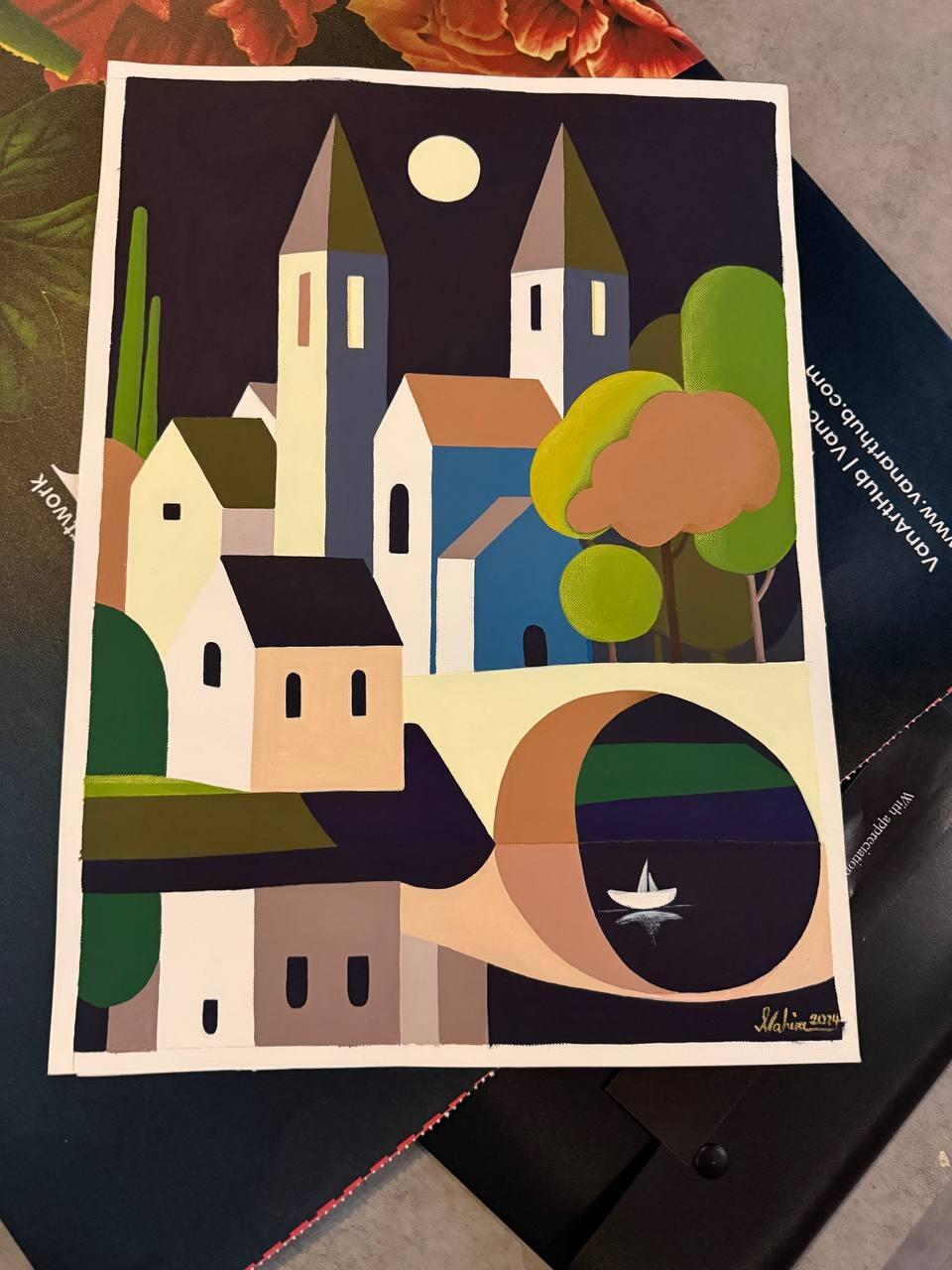
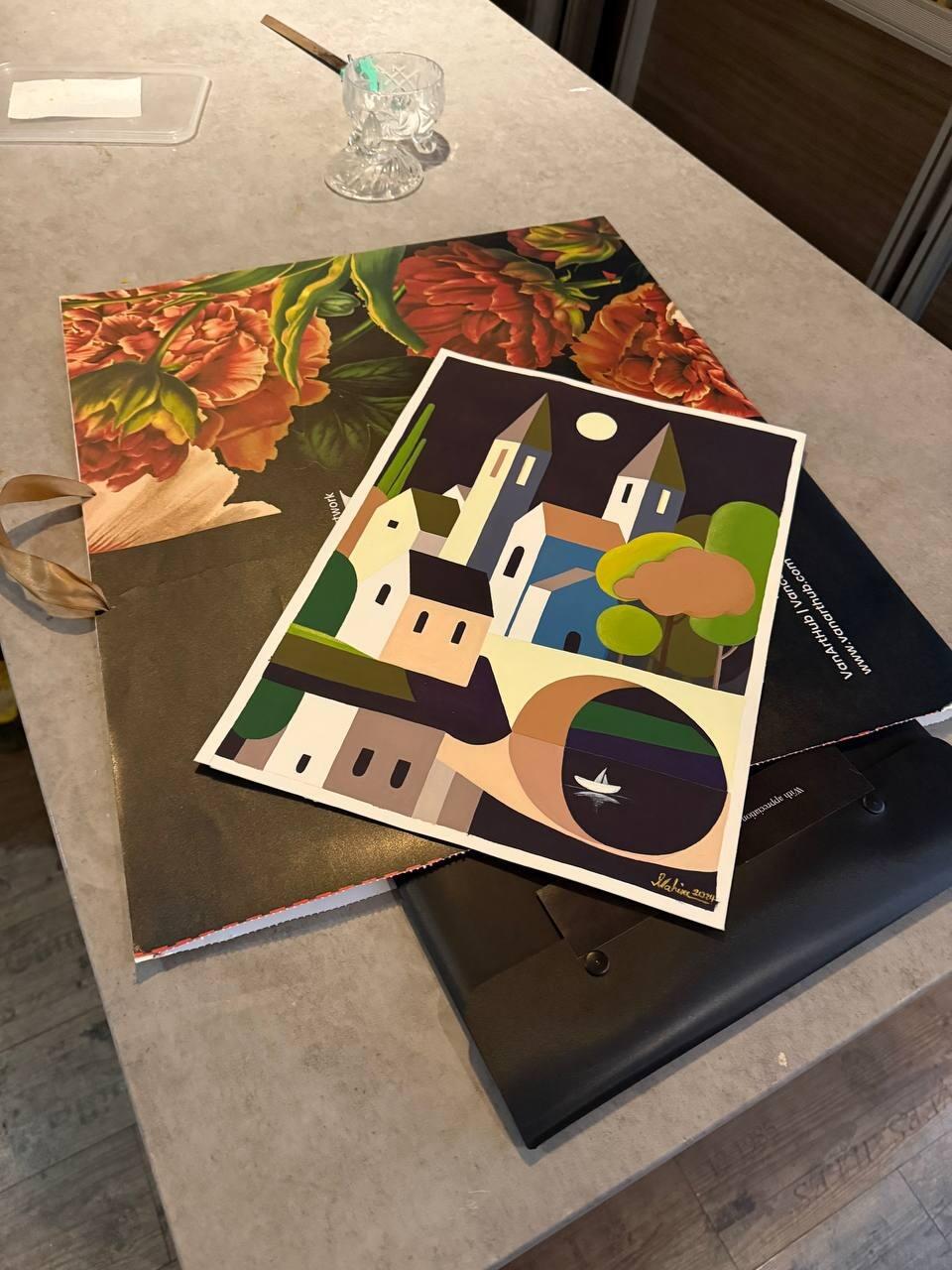
Celestial Garden by Darya is a Persian negargari (miniature painting) in oil and gold on paper, 30 x 40 cm, landscape. Striped and marbled planets sit inside bands of ornament around a gold spiral, and at the edges the pattern ends in fine curls and dots on cream-gold paper. A window mat would come close to those curls or cover them, so this is our example for a float. See the Darya collection.

Glass, mount, frame and wall
Glazing. Glazing is the clear sheet in front of the work, in glass or acrylic. It touches nothing: CCI writes that "a framed work of art should not touch the glazing", because condensation inside the glass "can be transferred to paper". It filters ultraviolet (UV): our guide to UV glass and glazing says no glass stops fading completely. It lets you read the page from close by. Our guide to museum glass and conservation glass says the museum grade adds an anti-reflective coating, and that your own reflection appears when you lean in to study detail. CCI says the older etched "non-glare" glass looks hazy unless it lies on the artwork.
A miniature in oil on paper needs glass because it is on paper. Our guide to when an oil painting needs glass, written for canvas, asks for an air gap of several millimetres whenever oil paint sits behind glass.
Backing and mount. CCI calls hinging "the best way to attach works on paper to their mats", because the paper can move and the hinge comes off again. The Library of Congress prefers mounting corners, with no adhesive on the work, "whenever possible". Behind the sheet, CCI does not recommend masonite, corrugated cardboard or wood: see our guide to acid-free mats and backing.
The frame. CCI calls the style of moulding "a matter of personal preference". Ours, for a page with its own painted border, is a narrow, plain moulding. Our guide to gold and ornate frames takes the opposite view: an ornate gilded frame continues the gold of a miniature in oil and gold. Both keep the rule in our mat guide that the mat is wider than the frame.
What to tell the framer. Give the medium as the seller wrote it, the year, the size of the sheet and the size of the painted area. Then ask a question from Icon's list: "Will the work of art be attached to the under-mount only using paper hinges?"
Where to hang it. The Library of Congress says out of direct sunlight, away from radiators, and on interior walls. CCI adds: "Do not attach light fixtures to frames." Our guide to how high to hang a painting gives 145 cm from the floor to the centre, or 5 to 10 cm lower where people sit. We would set the centre at the eye height of the person who will read the page.
What a framer must never do
- Dry mount the sheet or glue it down. Our conservation framing standards page says dry mounting cannot be undone. CCI says artworks pasted to a backing are at high risk, because changes in humidity "can lead to cockling or tearing". For photographs, CCI says dry mounting "is no longer recommended".
- Trim the sheet. Our standards page says that if the piece does not fit the frame, the frame is wrong. CCI says a mat window "must be large enough to reveal the image, platemark, signature, title, and any other significant notations".
- Put tape on the sheet. AIC: "Tape should never be applied to the paper object when matting and framing."
- Lay the glass on the paint or the gold. CCI says a space behind the glazing helps "to avoid image transfer, staining, or mould growth".
- Press the sheet between two panes of glass. CCI says this "puts unnecessary pressure on the artifact".
- Clean, flatten or retouch the painting. Icon: "Avoid the temptation to restore works of art on paper yourself." Ask a paper conservator, and for the gold see our guide to gold in Persian painting.
Three works, measured
These sums use the borders in our mat guide. Each result is the size of the glass, before the moulding.
A portrait page, 30 x 40 cm. Take Muraqqa': The Blue Robe as a sheet 300 mm wide and 400 mm tall. With 80 mm at the top and sides and 96 mm at the bottom, the width is 300 + 80 + 80 = 460 mm and the height is 400 + 80 + 96 = 576 mm. The main photo on its product page shows a wide cream area around the borders. Ask us whether that is the margin of the sheet or a mat, and which of the two the 30 x 40 cm measures.
A landscape page, 40 x 30 cm. Celestial Garden floated with the same borders needs 400 + 80 + 80 = 560 mm of width and 300 + 80 + 96 = 476 mm of height.
A larger work on board, 55.9 x 76.2 cm. Above 600 mm our mat guide starts at 100 mm. With 100 mm at the top and sides and 120 mm at the bottom, the same proportion, the glass is 559 + 100 + 100 = 759 mm wide and 762 + 100 + 120 = 982 mm tall: 0.745 square metres, against 0.265 for the portrait page. CCI notes that large sheets of glass need "sturdy frames and adequate hanging systems". Light matters more than glass: CCI places watercolours "in general in the high-sensitivity category", and says that filtering only the UV has "a beneficial but much more limited effect" than lowering the light.
The Thinking Monster (Div Andish) by Amir Fazelian is watercolour and ink on cardboard, 55.9 x 76.2 cm. A crowned, horned creature with brown fur, blue eyes and two white tusks faces the viewer across a chessboard, and its product page calls it a demon. It is larger than a miniature, and we include it as the work where the glazing matters most. Persian painters also worked on board: our page on Persian lacquer painting describes watercolour on pasteboard under clear varnish. More is in the Amir Fazelian collection.

Framing at our gallery
Framing is done in-house at our gallery, 1242 Davie Street, Vancouver. It is quoted per piece and has no online checkout, and our custom framing page explains the service. If you enter an email on one of our framing pages, a code appears on the screen for 10 percent off a framing job at the shop. The code does not expire.
Our custom framing page says that anything on paper or board needs framing before it goes on a wall, and that we will frame a piece you buy from us before it ships if you want us to. The three product pages in this guide each say the price carries "no framing charge", and none says whether the work arrives in a frame. So ask us through the form on the product page, before you buy, how the work you want will arrive.
How buying from us works
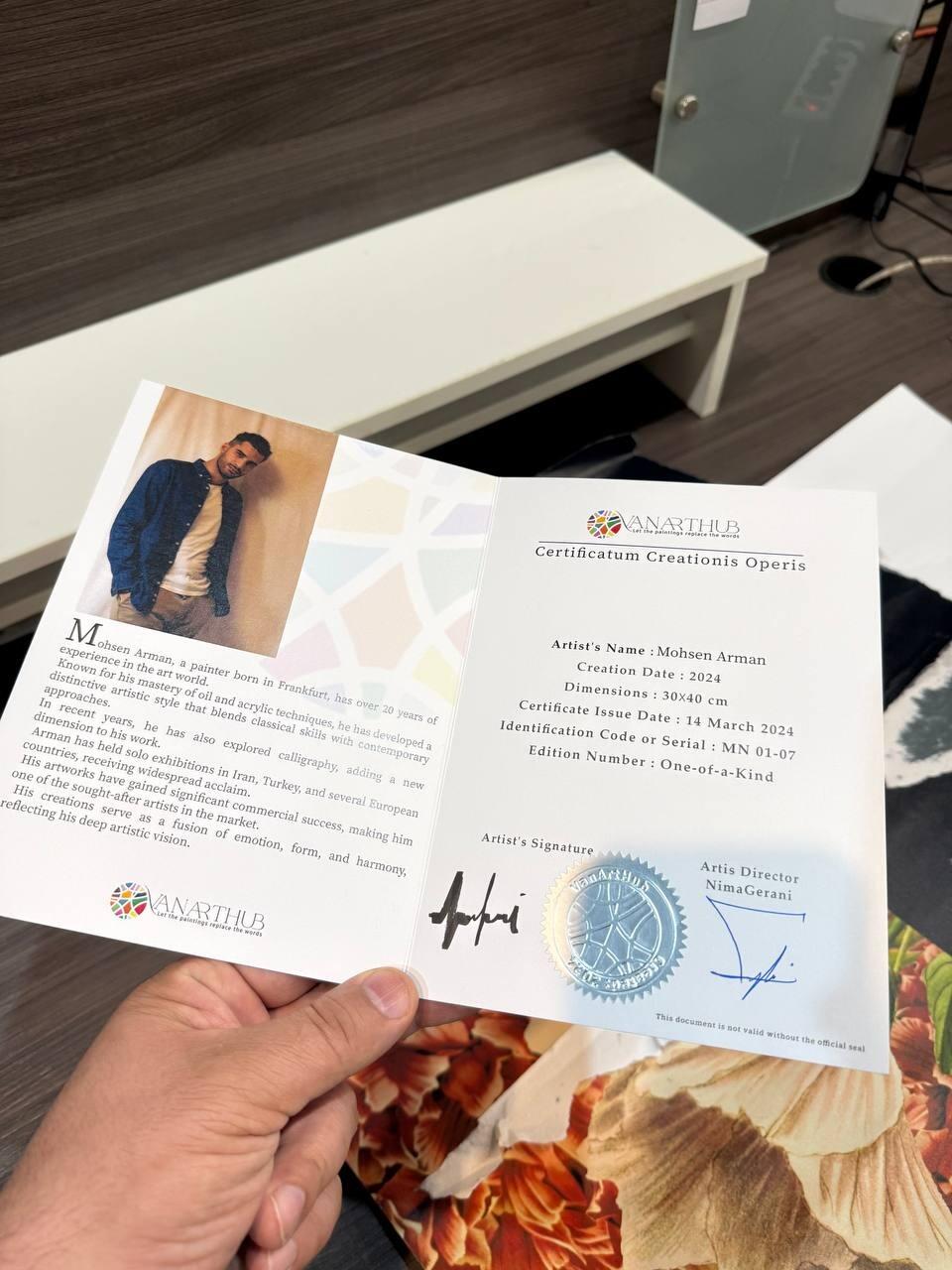
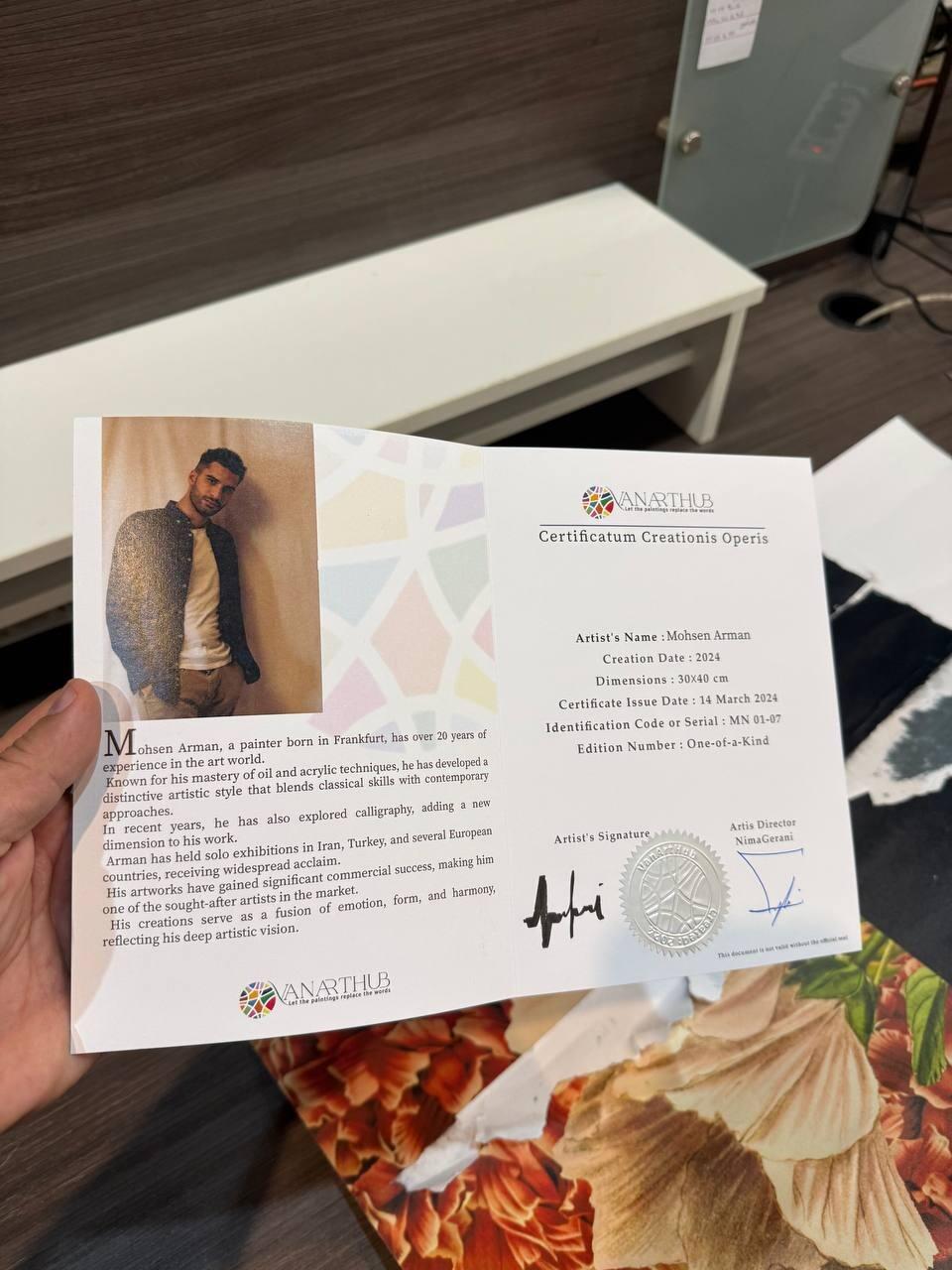
Every painting we ship is an original, signed and one of a kind, and it comes with a Certificate of Authenticity. Shipping is free and fully insured: 3 to 7 business days in Canada and 5 to 10 to the USA. The 14-day trial starts at delivery: return the work within 14 days for a full refund, and we pay the return shipping. The full terms are on our Buy with Confidence page.
Our gallery is at 1242 Davie Street in Vancouver's West End, and the opening hours are on our West End gallery page. Contact us before you come, so that we can confirm the work is at the gallery that day.
Each product page has one more option, Buy Print File: a high-resolution digital file of the image, which you print yourself. Nothing is shipped, we email the file within 48 hours, it is for personal printing only, and copyright stays with the artist. A print made from that file is a reproduction, and the painting itself still exists once.
Key Takeaways
- Frame a Persian miniature behind glazing that filters UV and touches nothing.
- A window mat covers 2 to 4 mm of each edge. If the painted border reaches the edge of the sheet, float it.
- On a 30 x 40 cm page, an 80 mm border with 96 mm at the bottom gives glass of 460 x 576 mm.
- No dry mounting, trimming, tape or cleaning. A later framer should be able to undo every step.
- Glass slows fading. Hang the work on an inside wall with no direct sun.
Frequently Asked Questions
How do I frame a Persian miniature painting?
Frame a Persian miniature behind glazing that filters ultraviolet, with a mat or a spacer that keeps the glazing off the paint and the gold. Ask for acid-free board behind the sheet and paper hinges that a later framer can undo. Keep every painted border visible, and hang the frame on an inside wall that direct sun never reaches.
Should the mat cover the painted border of a Persian miniature?
No. The painted border is part of the picture, so the window of the mat should show all of it. The Canadian Conservation Institute tells framers to let a mat overlap the work by at least 2 to 4 mm on each side. If plain paper surrounds the border, the mat can rest there. If the paint reaches the edge, ask for a float mount.
How wide should the mat be for a 30 x 40 cm miniature?
Eighty millimetres is the figure we take from our own mat border width guide for a page of 30 x 40 cm, with the bottom border cut deeper at 96 mm. Those borders make the glass 460 mm wide and 576 mm tall for a portrait page. Keep the mat wider than the moulding, and choose white, cream or buff board.
Which glass is best for a miniature that people study from close by?
Glazing with an anti-reflective coating and a UV filter is the best choice for a painting that people read from close by. Our glazing guide calls this museum grade. Avoid the older etched "non-glare" glass: the Canadian Conservation Institute says it looks hazy unless it lies on the artwork, and glazing must never touch a painting on paper.
How high should I hang a small Persian painting?
Set the centre of a small Persian painting at the eye height of the person who will read it. Our hanging guide gives 145 cm from the floor to the centre for a standing viewer, and 5 to 10 cm lower in a room where people sit. Leave the floor in front of the picture clear, so that a viewer can step up to it.
Does a Persian miniature from VanArtHub arrive in a frame?
Ask us before you buy. Our custom framing page says we will frame a piece you buy from us before it ships if you want us to. The product pages for the three works in this guide say the price carries "no framing charge", and none says whether the work arrives in a frame. Use the question form on the product page.
Where can I have a Persian miniature framed in Vancouver?
VanArtHub frames works in-house at the gallery, 1242 Davie Street, in Vancouver's West End. Framing is quoted per piece and has no online checkout. Tell us the medium, the year, and whether the paint reaches the edge of the sheet. Our custom framing page explains the service and says you do not have to buy the work from us first.
How do I get 10 percent off framing at your shop?
Enter your email address on one of our framing pages and a code appears on the screen. Show that code at the counter of our shop at 1242 Davie Street, and we take 10 percent off the framing job. The code does not expire, so you can collect it today and use it when your painting is ready to frame.
Should I frame a miniature before the 14-day trial ends?
Wait until you have decided to keep the painting, in our view. The 14-day trial starts at delivery: return the work within 14 days for a full refund, and we pay the return shipping. Use those days to choose the wall and to measure the sheet and the painted area. Handle the sheet with washed hands, away from the painted area, and as seldom as you can.
Can I buy a miniature from you in the USA and have it framed near home?
Yes. Shipping to the USA is free and fully insured and takes 5 to 10 business days. Take the seven decisions in this guide to a framer near you, and ask for a written answer on hinges, tape and the space behind the glass. Our custom framing page says we will frame a piece before it ships if you ask, so request a quote first.
Sources
- Canadian Conservation Institute, Framing Works of Art on Paper, CCI Notes 11/9, read October 2026.
- Canadian Conservation Institute, Matting Works on Paper, CCI Notes 11/5, read October 2026.
- Canadian Conservation Institute, Glazing Materials for Framing Works on Paper, CCI Notes 11/3, read October 2026.
- Canadian Conservation Institute, Caring for paper objects, read October 2026.
- Canadian Conservation Institute, Caring for photographic materials, read October 2026.
- Library of Congress, Preservation Guidelines for Matting and Framing, read October 2026.
- Library of Congress, Research Guides, Matting and Hinging Works of Art on Paper: Planning, read October 2026.
- Institute of Conservation (Icon), Caring for your collections: Art on Paper, read October 2026.
- American Institute for Conservation, AIC Wiki, Book and Paper Group: Matting and Framing, read October 2026.
- Chester Beatty, Conservation Blog, Part 1: The Nasir al-Din Shah Album, a Mughal Muraqqa', by Julia Poirier, read October 2026.
- Harvard Art Museums, Old Man with Cane in Rocky Landscape, folio from an album, 2002.50.16, read October 2026.
Sources read in October 2026. If you spot something out of date, tell us and we will correct this post.
About VanArtHub
VanArtHub is a gallery based in Vancouver, Canada. Every painting we ship is an original, signed and one of a kind, with a Certificate of Authenticity, free insured shipping and a 14-day trial. Persian art is also called Iranian art, and our guide to contemporary Persian painting introduces its painters and styles. You can also browse all artworks.