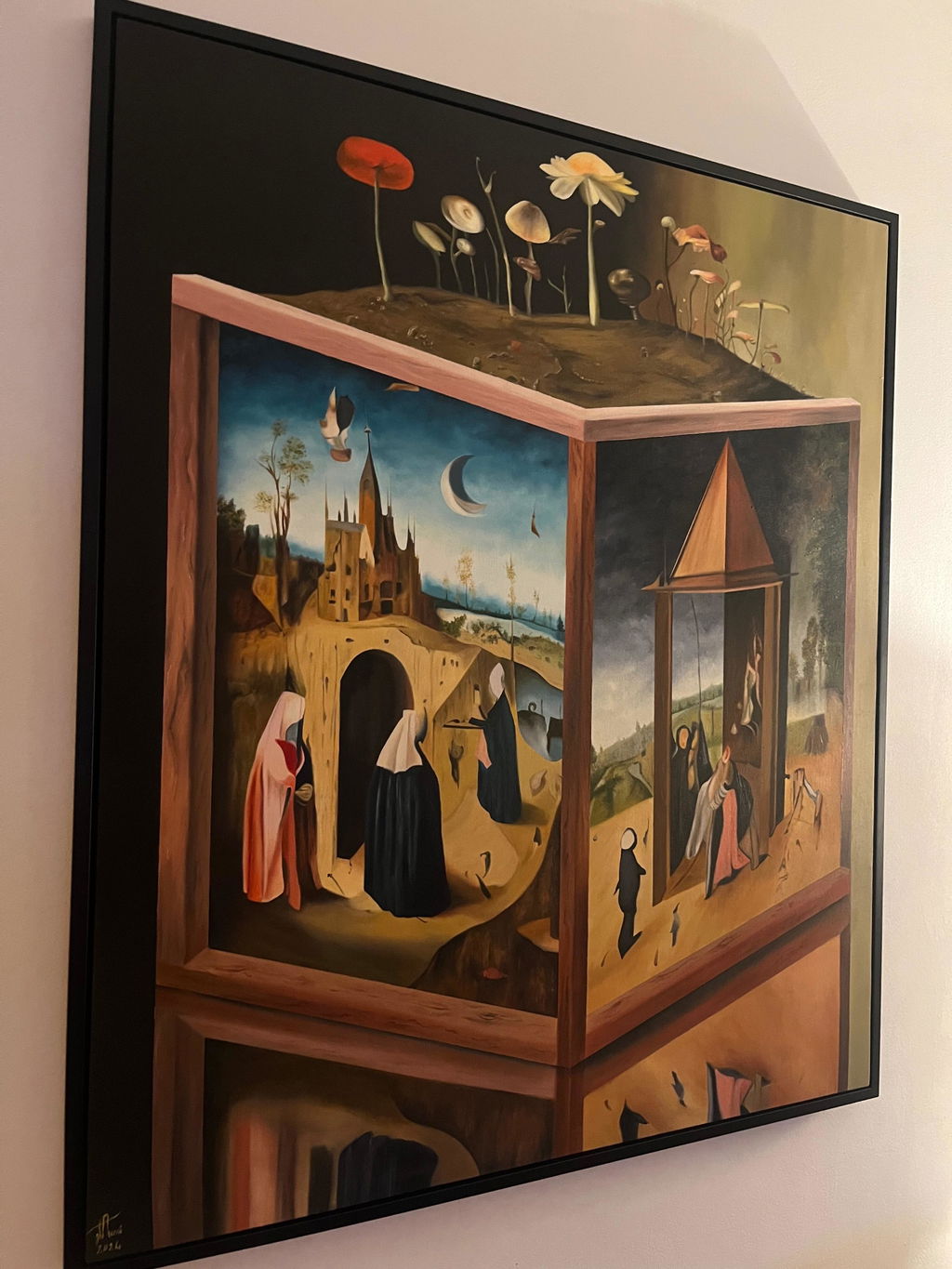
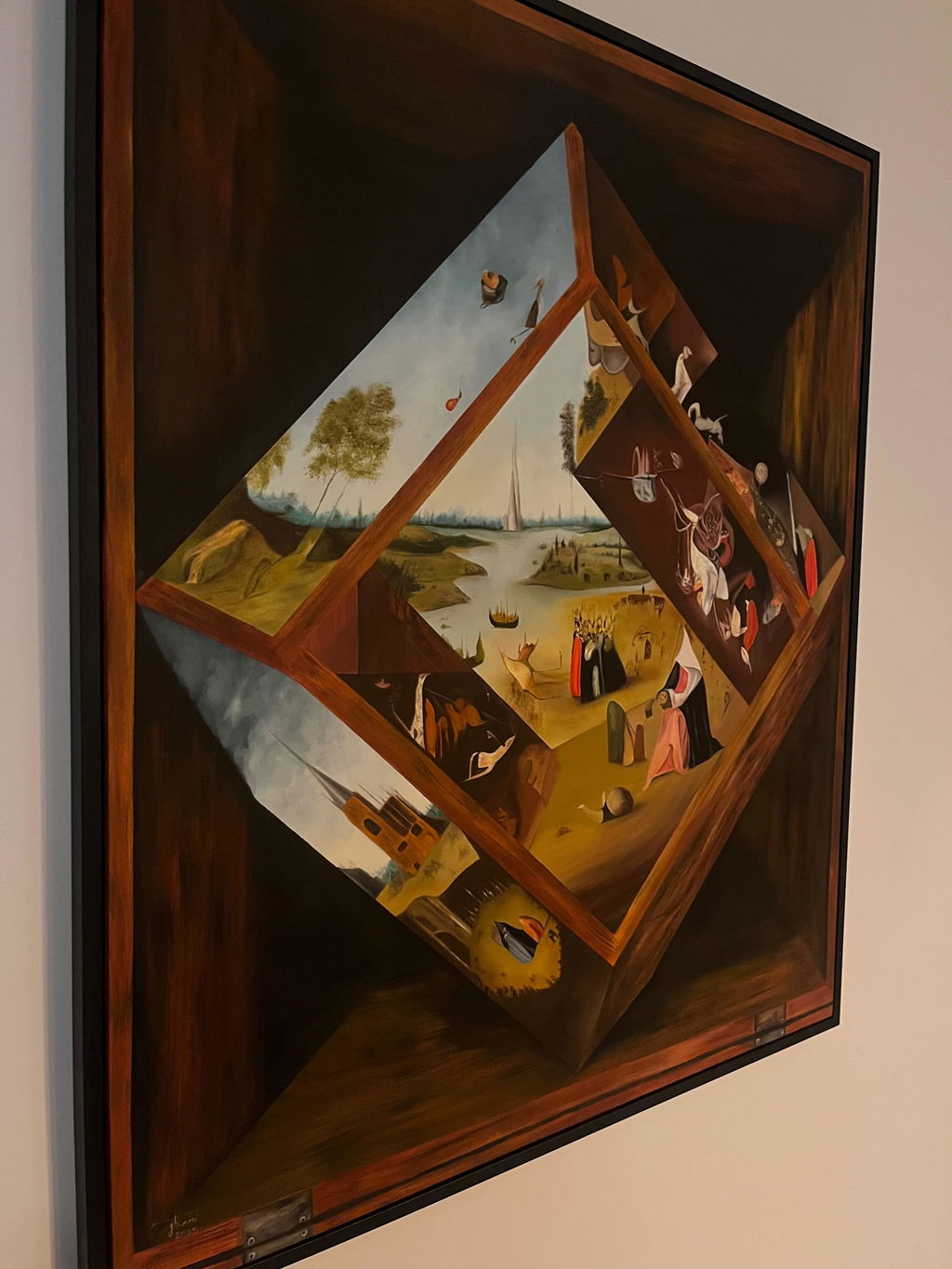
Art can hang in a kitchen or a bathroom. It needs to be framed for it, and a few things should not go in either room at all.
The thing to understand first is that the enemy is not moisture. It is change in moisture.
Why the swing is the problem
A bathroom goes from ordinary humidity to near saturation during a shower and back down over the following hour. That happens once or twice a day, every day.
Paper takes up moisture when the air is wet and gives it back when the air dries, expanding and contracting each time. Do that a few thousand times and a sheet cockles permanently, mat board warps, and any adhesive in the package starts to fail.
Worse, moist air that gets inside an unsealed frame condenses on the inside of the glazing, which is the coldest surface in the package. Liquid water then sits against the mat and sometimes against the artwork. That is how mould starts, and mould in paper fibres stains from within and cannot be cleaned off.
What framing for a damp room means
Seal the package
The back is sealed so moist air cannot move freely in and out. The humidity swing then happens outside the frame instead of inside it. This is the single most important measure.
Use a spacer, always
The glazing must be held off the artwork surface. If condensation does form, it forms on the glass, and a spacer means the glass is not touching the work. Without one, condensation on the glazing is condensation on the artwork.
Choose acrylic over glass
Acrylic conducts heat far less readily than glass, so it stays closer to room temperature and condensation forms on it less. It is also lighter and does not shatter, which matters on a hard-surfaced bathroom floor. See acrylic vs glass.
Prefer metal, or a well-finished wood frame
Wood moves with humidity. Metal does not. If the frame is wood, it should be fully finished on every surface, including the back and the rebate, so moisture cannot get in through raw timber. See wood vs metal frames.
Conservation board throughout
Damp accelerates acid migration considerably. Ordinary board in a damp room fails much faster than ordinary board in a dry one. See acid-free mats and backing.
Kitchens have a second problem
Cooking puts airborne grease into the air, and grease is worse than moisture in one specific way: it is sticky, so it collects dust and forms a film that has to be removed with solvents rather than wiped off.
A sealed frame handles this well, because the grease lands on the outside of the glazing where it can be cleaned. An unframed canvas in a kitchen does not, and over a few years the surface takes on a film that only a conservator can deal with.
So in a kitchen the recommendation inverts: a canvas is the piece that needs protecting, not the work on paper. Keep original canvases away from the cooking area, or accept that they will need attention eventually.
Where to hang it in the room
- As far from the shower or the hob as the room allows.
- Not on an outside wall, which is the coldest surface and where condensation concentrates.
- Not directly above a bath, a sink, or a kettle.
- Higher rather than lower in a kitchen, since grease-laden air is warm and rises but the worst of it is around the cooking surface.
And use the extractor fan. Ventilation reduces the size of the swing more than any framing decision can.
What should not go in a damp room
-
Pastel, charcoal and loose chalk. Moisture and loose pigment do not mix, and these cannot be sealed tightly enough to be safe.
-
Anything genuinely valuable or irreplaceable. Not because it would certainly be damaged, but because there is no reason to take the risk when other walls exist.
-
Unframed works on paper. Obviously, and it happens more than it should.
-
Photographs. Many photographic processes are more moisture-sensitive than paper is.
What is well suited
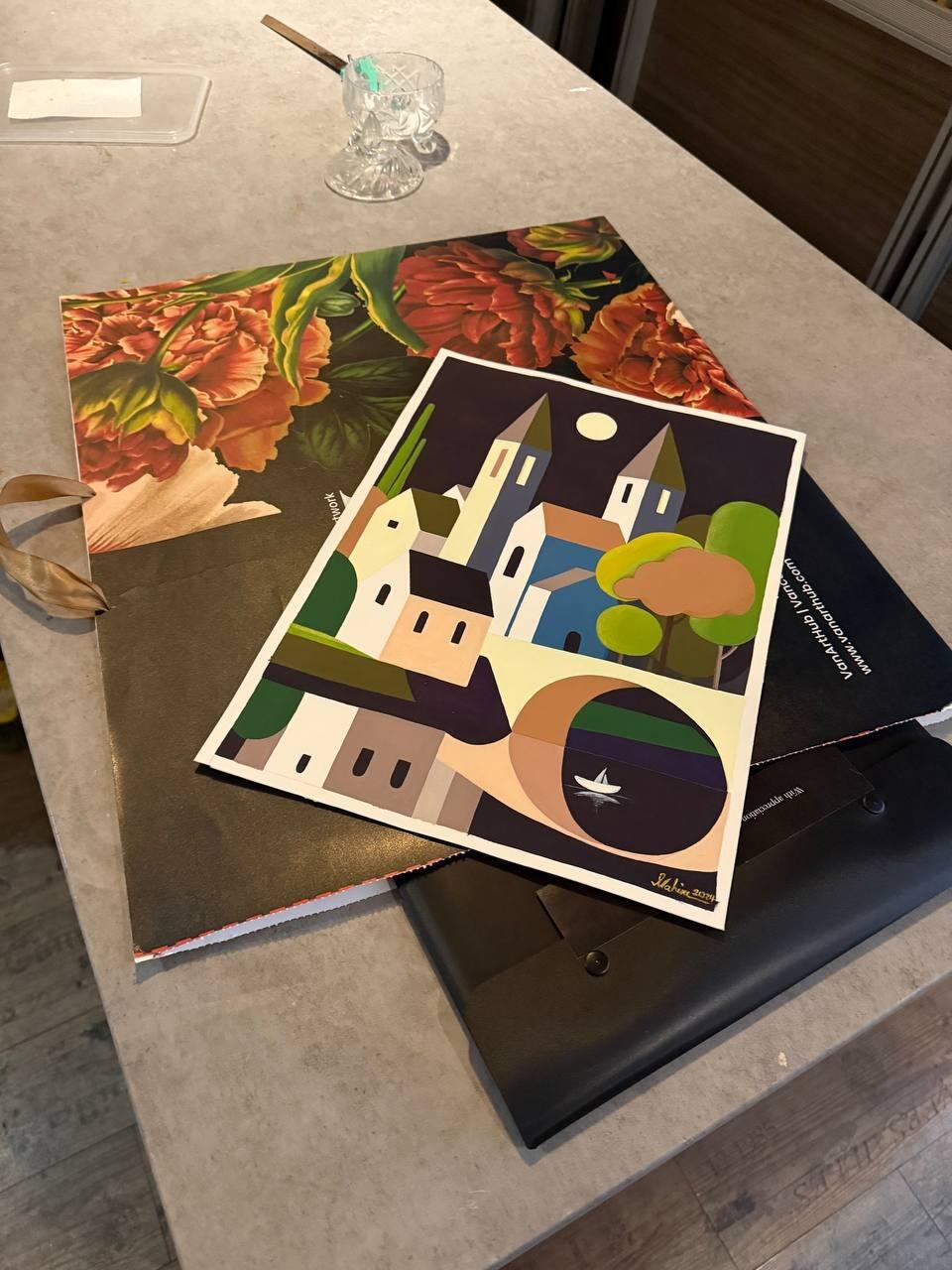
A properly sealed, spacered, acrylic-glazed work on paper in a metal frame will live happily in a normal bathroom for decades. So will an acrylic on canvas in a kitchen away from the hob, since acrylic paint is water-resistant once cured and tolerant of humidity. A piece like Crimson Command is exactly the kind of work that copes.
Common questions
Will a sealed frame trap moisture inside?
It seals at a moment in time, so it should be assembled in normal room conditions, not in a damp room. Done that way it holds a stable pocket of ordinary air. This is also why a frame that has been stored somewhere damp should be opened and checked before being resealed.
Can I hang a canvas in a bathroom?
An acrylic on canvas will usually cope, since cured acrylic is water-resistant. An oil is a worse idea: the paint film is more sensitive to humidity cycling, and an unvarnished one more so again. If it must be a canvas, choose acrylic and keep it away from the shower.
How do I know if a frame has a moisture problem?
Look for a bloom or fogging on the inside of the glazing, waviness in the mat or the artwork, and any brown or grey speckling, which is mould. Any of those means open it now. Caught early it is usually just a reframe; left alone it becomes conservation work.
What humidity level is considered risky for framed art?
Sustained relative humidity above about 60 percent, or frequent swings between very dry and very humid, is where risk rises for mould growth and material stress. A typical living room sits well below that most of the year; a bathroom without ventilation or a basement can exceed it regularly.
Does a dehumidifier make a room safe for framed art?
It helps a great deal if run consistently, keeping the room's humidity in a stable, moderate range rather than letting it swing. It does not replace good sealing practice inside the frame itself, since a dehumidifier controls the room, not the sealed air pocket already trapped inside an existing frame.
Can a work on paper ever hang safely in a humid room?
It is the riskier of the two mediums in that setting, since paper absorbs and releases moisture more readily than a varnished canvas. If it must hang somewhere humid, conservation glazing, a sealed backing, and a spacer between the mat and any wall condensation all reduce the risk, but a drier room is always the better choice.
Does humidity affect the frame itself, not just the art inside it?
Yes. Wood mouldings can swell slightly in high humidity and shrink back as it drops, which over repeated cycles can loosen a mitre joint at the corner. Metal frames are unaffected by humidity in this way, which is one reason metal is sometimes preferred for a piece going into a naturally damp room.
How often should a piece in a humid room be checked?
About once a year is a reasonable check-in, looking at the inside of the glazing for fogging and at the mat for any waviness or discolouration. A piece in a normal, dry room needs this far less often. Catching a moisture issue at the yearly check is much cheaper than catching it after visible mould has set in.