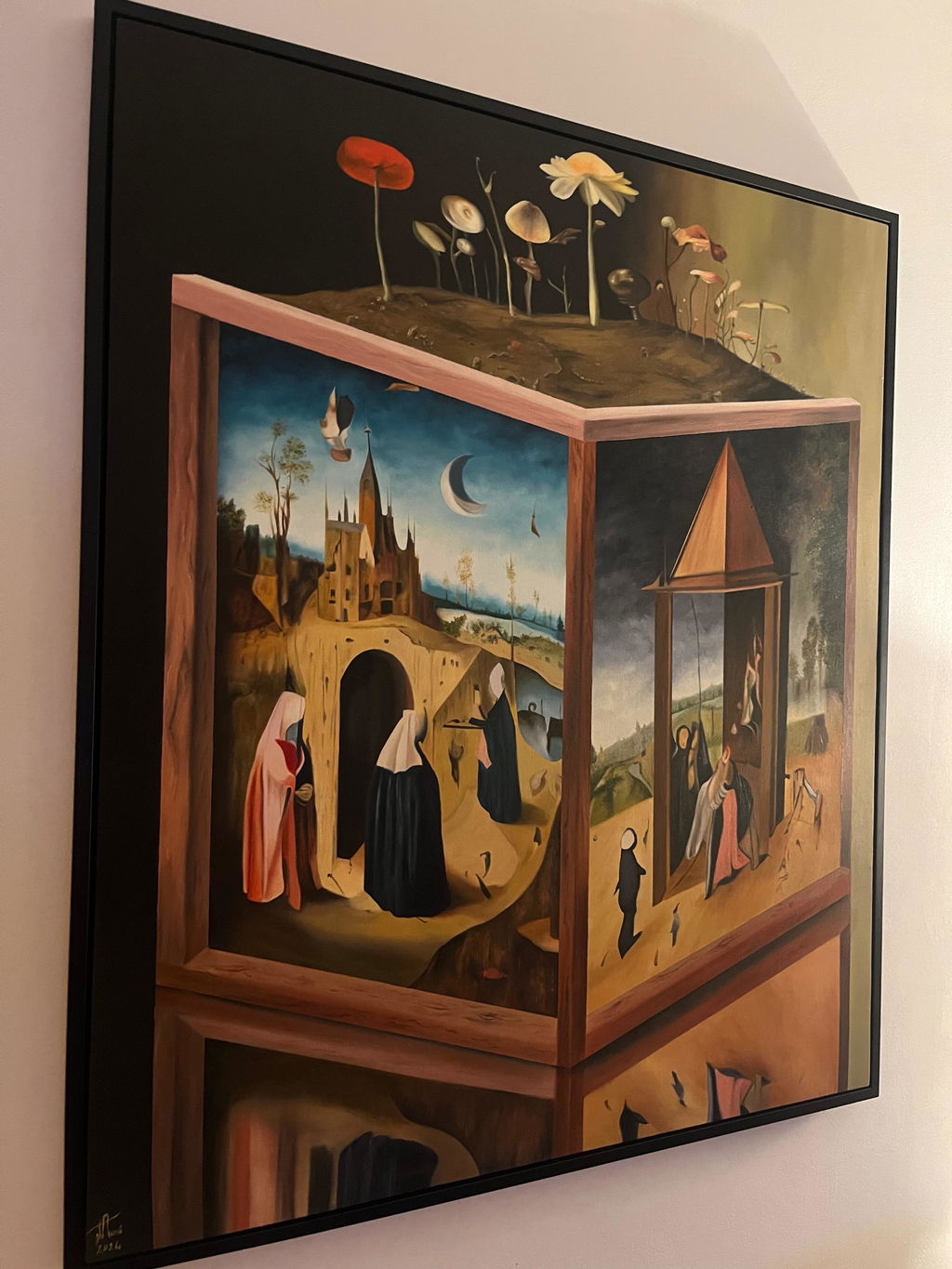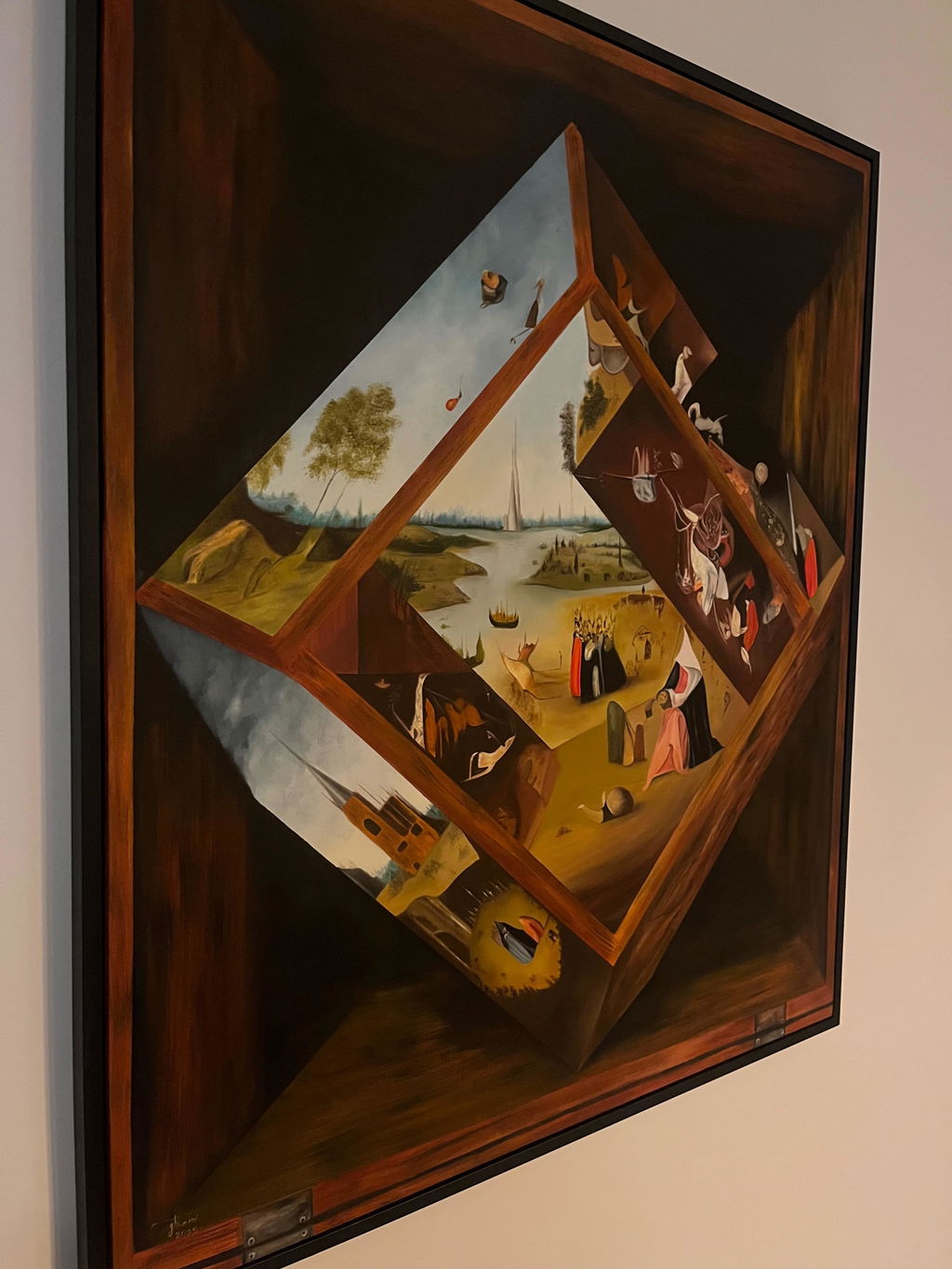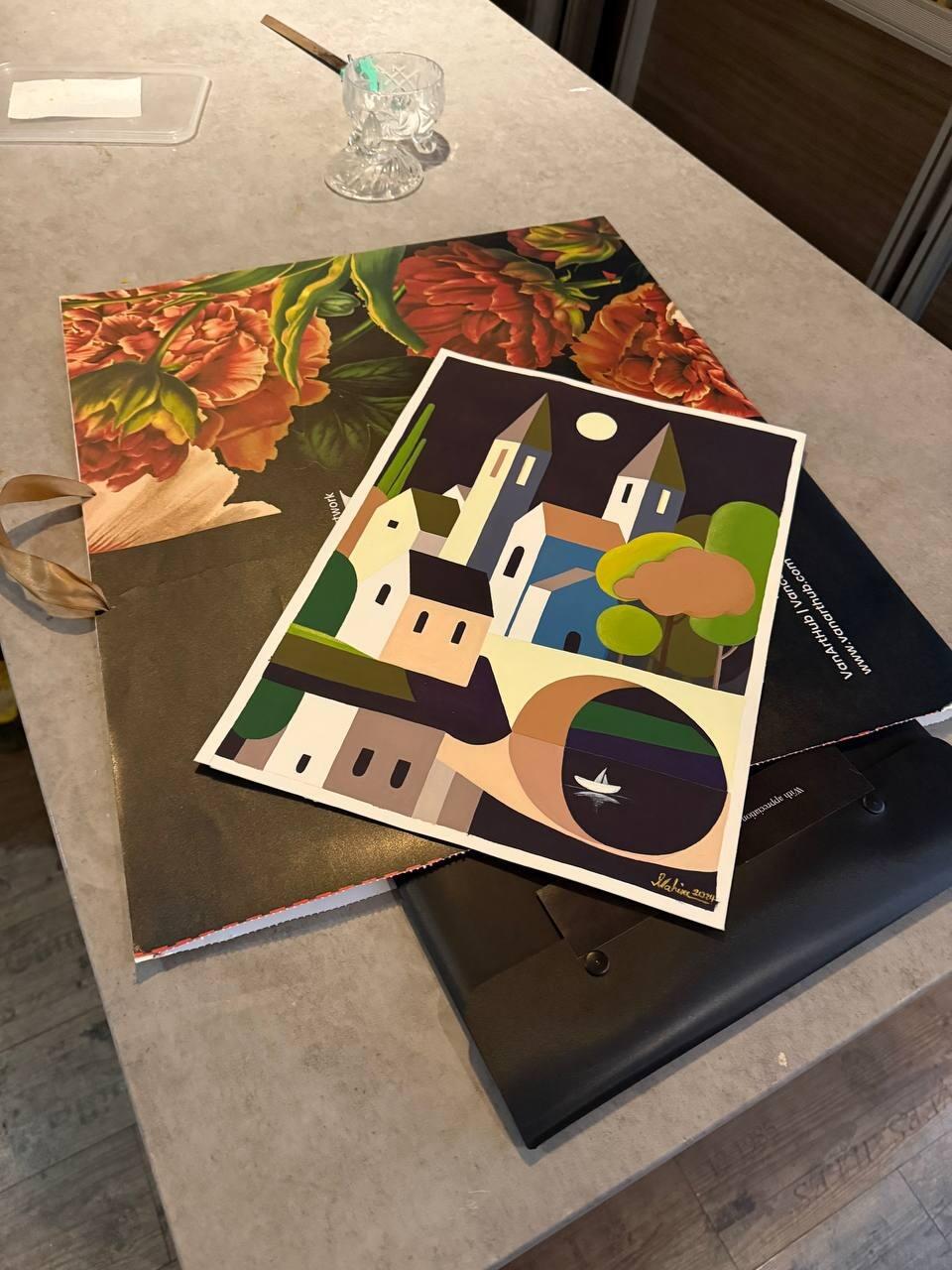
Close detail of the canvas surface of an original acrylic painting

Placement guide

Hanging and sizing art: height, scale and arrangement

Most paintings in homes are hung too high and bought too small. This guide gives you the measurements to avoid both, starting with the one number that settles the height question.

Start with height See all 7 guides

Measurements below are conventions used by galleries and designers, not building code. Where a figure comes from a published source, it is cited.

  • Signed originals only, never prints
  • Dimensions listed on every piece
  • 14-day return, we pay return shipping
  • Free fully insured shipping

Two decisions do most of the work when you put a painting on a wall: how high it sits, and how big it is relative to what is under it. Get those right and an inexpensive piece looks considered. Get them wrong and an expensive one looks stranded.

This guide covers both, plus the practical parts people discover too late: which fixing holds in the wall you actually have, how to space several pieces so they read as one group, and how to light a painting without cooking it. Each section below links to a full guide.

The short version

  • Hang so the centre of the painting is about 57 inches (145 cm) from the floor. This is a convention based on average eye height, widely used in galleries, not a published standard. Adjust it for your household.
  • Measure from the furniture, not the floor, when there is furniture below. Above a sofa or a headboard, the usual guidance is to leave roughly 15 to 20 cm between the top of the furniture and the bottom of the frame.
  • Aim for about two-thirds the width of the furniture below. A 210 cm sofa suits a piece, or a group, around 140 cm wide. Going smaller is the single most common mistake.
  • Lay a gallery wall out on the floor first. Keep a consistent gap, usually 5 to 8 cm, and align one shared line through the arrangement.
  • Match the fixing to the wall and the weight. A drywall anchor rated below the painting's weight is the reason paintings fall.
  • Keep light modest. The Canadian Conservation Institute puts most colours as readable at 50 lux, with detail in darker colours needing 150 lux, and says ultraviolet should not exceed 75 microwatts per lumen.

Height: the 57-inch convention, and the arithmetic behind it

The common instruction is to hang a painting so its centre is 57 inches (about 145 cm) above the floor. That figure approximates average standing eye height, which is why galleries adopted it. It is a convention rather than a rule: published guidance ranges from about 56 to 60 inches, and no museum or standards body appears to publish it as an official figure.

Because the number refers to the centre of the painting, you cannot measure it directly to the hook. The hook sits higher than the centre by an amount that depends on where the wire pulls taut. The arithmetic:

  1. Halve the height of the painting. A 90 cm tall canvas gives 45 cm.
  2. Add that to 145 cm. That puts the top of the painting at 190 cm.
  3. Measure the wire drop. Pull the hanging wire up toward the top of the frame as if it were on a hook, and measure from the taut wire to the top edge. Say it is 8 cm.
  4. Subtract the drop from the top. 190 minus 8 puts the hook at 182 cm from the floor.

Three situations override the convention entirely. Furniture below, which is covered next. A room where people are usually seated, such as a dining room, where lowering the centre by a few centimetres reads better. And a wall with a strong horizontal line already on it, such as a picture rail or a run of cabinets, which the eye will treat as the reference instead.

Full guide: how high to hang a painting →

Scale: the mistake is almost always buying too small

A painting that is too small for its wall does not look modest, it looks misplaced, and no amount of repositioning fixes it. The usual design guidance is to fill roughly two-thirds of the width of the furniture underneath, or somewhere between half and three-quarters of an empty wall.

What is belowGuide width for the artWorked example
Three-seat sofa, about 210 cmAbout two-thirds the sofa widthAround 140 cm, one piece or a group
Queen bed, 152 cm wideAbout two-thirds the bed widthAround 100 cm, centred on the bed
Console or sideboard, 120 cmBetween half and two-thirds60 to 80 cm
Empty wall, no furnitureHalf to three-quarters of the wallA 300 cm wall takes 150 to 225 cm

Two pieces hung together are measured as one unit: add their widths plus the gap between them, and compare that total to the furniture. This is why a pair of medium canvases often solves a wide sofa better than one painting that would have to be very large.

Full guide: how to size art to a wall →

Five mistakes that are worth one more measurement

Hanging at your own eye height

If you are tall, this puts the painting noticeably high for everyone else and leaves a gap over the sofa. Measure from the floor instead.

Measuring to the top of the frame

The convention refers to the centre. Measuring to the top puts the piece too high by half its height, which is a large error on a tall canvas.

Ignoring the wire drop

A wire that pulls up 8 cm moves the painting 8 cm. Measure the taut wire before marking the wall, not after the hook is in.

Using the hook that came in the drawer

Fixings are rated by weight and by wall type. A drywall anchor rated below the painting's weight is the usual reason a painting comes down.

Putting a spotlight too close

A light aimed from too steep an angle produces glare and a hot patch. Light damage also accumulates and never reverses.

Frequently asked questions

What are the two measurements that matter most when hanging art?

Height and scale settle most of the outcome. For height, place the centre of the painting about 145 cm from the floor, or measure from the furniture where furniture sits below. For scale, aim for roughly two thirds the width of the furniture, or half to three quarters of an empty wall. Everything else on this page, spacing, hardware and lighting, refines a result those two decisions have already largely determined.

Is the 57 inch hanging height an official standard?

No. Despite being widely described as a museum standard, no museum, gallery association or standards body was found publishing 57 inches as an official specification. It is a professional convention derived from average standing eye height, reported consistently enough across galleries and design practice to be useful, with figures between 56 and 60 inches all in circulation. Treat it as a reliable starting point rather than a rule.

When does furniture override the 145 cm rule?

Whenever a substantial object sits below the painting, including a sofa, a bed, a console, a sideboard or a mantel. In each case the furniture becomes the reference point and the floor measurement is set aside, because the eye reads the furniture and the art as one arrangement. The gap between them, usually 15 to 20 cm, then determines the height rather than any distance from the floor.

Why is buying art that is too small such a common mistake?

Because scale is hard to judge on a screen and impossible to correct afterwards. A painting hung slightly too high can be moved in ten minutes, but a piece too small for its wall stays too small, and adding smaller objects around it rarely rescues the arrangement. Cutting paper to the exact dimensions and taping it up before buying is the only reliable way to catch the error in advance.

How do I work out where to put the hook?

Take half the height of the painting and add it to 145 cm to find where the top edge should sit. Then pull the hanging wire taut toward the top of the frame, measure the distance from the wire to the top edge, and subtract that from your top edge figure. The result is the hook height. Skipping the wire measurement is why paintings often end up several centimetres higher than intended.

How much space should I leave between pictures in a gallery wall?

Keep a consistent gap of about 5 to 8 cm between frames in a gallery wall. What matters more than the exact figure is that the gap does not vary, because inconsistent spacing is what makes an arrangement look accidental. Lay the whole group out on the floor first and adjust it there, then transfer the layout to the wall one piece at a time, working outward from the centre.

What should I check before making a hole in the wall?

Identify what the wall is made of, then weigh the painting as it will hang including its frame and glazing. Those two facts determine the fixing, and getting them in the wrong order is how paintings end up on the floor. Drywall, plaster over lath, and concrete or brick each need a different class of fixing, and the only reliable weight rating is the one printed on the packaging.

Does where I hang a painting affect how long it lasts?

Yes, more than most owners expect. Light damage accumulates and never reverses, so a wall catching direct sun shortens the life of a painting regardless of how normal the room feels. The Canadian Conservation Institute also puts the safest relative humidity for paintings on canvas or wood at a stable 40 to 60 percent with temperature between 16 and 25 degrees Celsius, which rules out walls above radiators and working fireplaces.

Does hanging a painting in direct sunlight damage it?

Yes. Direct sun delivers far more light than any display level a conservator would recommend, and the damage accumulates permanently. The Canadian Conservation Institute also puts the safest relative humidity for paintings on canvas or wood at a stable 40 to 60%, with temperature between 16 and 25 degrees Celsius, so a wall that swings in temperature, such as one above a radiator, is a poor choice for a different reason.

Should a painting be centred on the wall or on the furniture?

Centre it on the furniture whenever furniture is the dominant object below, such as a sofa, a bed or a console. The eye reads the painting and the furniture as one arrangement, so an off centre painting above a centred sofa looks like an error even when it is perfectly centred on the wall. Centre on the wall only when the wall is empty or the furniture sits well off to one side.

References

Checked 5 September 2026. Where this page gives a measurement with no citation, it is a design convention rather than a published figure, and is described as one in the text.

  • Environmental Guidelines for Paintings, CCI Notes 10/4. Canadian Conservation Institute, Government of Canada. Published 1990, revised 2016. Source for the 50 and 150 lux figures, the 75 microwatts per lumen ultraviolet limit, the 40 to 60% relative humidity range and the 16 to 25 degrees Celsius temperature range.
  • Agent of deterioration: light, ultraviolet and infrared. Canadian Conservation Institute, Government of Canada. Source for the principle that light damage is cumulative and irreversible.
  • On the 57 inch figure: no museum, gallery association or standards body was found publishing it. Searches returned only decorating blogs, frame retailers and art sellers citing one another, so this guide presents it as a widely used convention derived from average eye height rather than attributing it to an institution.

See the paintings this guide is about

148 original signed paintings by Vancouver artists, with dimensions listed on every piece so you can measure before you buy. Free insured shipping, and 14 days to live with it.

Browse all originals Large wall art