Layla and Majnun in Persian Painting: What to Look For
UpdatedLayla and Majnun is a Persian love poem that Nizami of Ganja wrote in 1188, based on an older Arabic story. A boy named Qays and a girl named Layla (also written Laila and Leyli, the spellings museums use) fall in love at school, her father keeps them apart, and Qays loses his reason and lives in the desert among wild animals. People call him Majnun, which means "possessed". We are VanArtHub, a Vancouver gallery that sells original paintings, and two of our desert paintings share the setting of this story. Below you will find the story in order, four scenes to recognise, and paintings to look up in named museums.
Who wrote Layla and Majnun, and when?
The poet is Nizami of Ganja. The Metropolitan Museum of Art gives his dates as 1141 to 1209 and places Ganja in present-day Azerbaijan. Our post on Khosrow and Shirin, the other great love story of his Khamsa, introduces the poet and that set of five long poems. For the painted copies of the whole set, see our page on the Khamsa of Nizami in art.
Ali Asghar Seyed-Gohrab wrote the Encyclopaedia Iranica entry on the poem. He calls it the third of the five and dates it to 1188. Nizami wrote it at the request of a ruler, the Shirvanshah Akhsetan.
He was slow to accept. The Iranica says he "initially doubted" that the pain of "an Arab boy wandering in rough mountains and burning deserts" would suit his educated readers, and that his son persuaded him. Nizami also states that he would have finished the whole story in less than four months if he had not had other things to do.
The Arabic story before Nizami
The two lovers are older than the poem. Majnun, the Iranica says, is a name "given to the semi-historical character" Qays ibn al-Mulawwah (the Met writes Qais) of the tribe of the Banu Amir, and the story "originates in Arabia in the seventh century". One early Arabic book, the Kitab al-Aghani, mentions a poet of the Umayyad period who used the name Majnun to express his love for his cousin.
Before Nizami these were short, separate reports. The Iranica lists what they told: his marriage proposal and her father's refusal, a pilgrimage to Mecca, the help of a man named Nawfal (the Iranica writes Nowfal), "his swooning on seeing" Layla, his life in the desert "amongst wild beasts", her marriage to another man, and an exchange of letters. In Arabic, the Iranica adds, the story "did not develop as a unified whole" in the Middle Ages.
Nizami made one story of them, from Majnun's birth to his death, and he changed the legend in two ways that matter here. The old legend set the first meeting in the desert among the camels, and Nizami moved it to a school. His Nawfal is a different man too: the Arabic sources "portray Nowfal as an official", the Iranica says, and Nizami's is a chieftain "ready to risk his life to bring the two lovers together".
At school, and how Qays became Majnun
Qays and Layla meet as children at school. The Met describes the moment under its Herat page of 1431 to 1432: the two "meet for the first time as children at a mosque school". Harvard Art Museums puts it in one line: they "met and fell in love as schoolchildren".
Then the love becomes known. The Iranica gives the order of events. Layla's father "forbids any contact". Qays, separated from her, starts "singing of his love for her in public". He comes to judge everything by Layla, and people give him the name Majnun, "the possessed". The Met translates the name as "mad one", and the Aga Khan Museum in Toronto writes that he "loses his reason".
A marriage proposal follows, and it fails. Harvard writes that Layla's father "rejected Qays's marriage proposal and separated the pair".
Who keeps them apart? The sources differ by a word. The Iranica and Harvard name Layla's father. The Smithsonian's National Museum of Asian Art writes "their parents", and the Aga Khan Museum writes "their families".
In our view the new name matters more than any other event in this part of the poem. After it, the people around him treat him as a sick man.
The Kaaba, and Nawfal's battle
Majnun's father looks for a cure. The Los Angeles County Museum of Art (LACMA) tells the scene beside a page painted in Shiraz in 1517: the father "takes him on a pilgrimage to Mecca, seeking deliverance from his love for Layla".
At the Kaaba (also written Ka'ba), the shrine in Mecca, the son asks for the opposite. He takes hold of the door knocker and declares his devotion to Layla. LACMA quotes his words: "I can gain strength only through love. If love dies, so shall I."
Next a chieftain decides to help, and he goes to war for Majnun: the Smithsonian's page of the 15th century shows "the battle between the Arab chief Nawfal and the tribe of Layla".
The help fails. In the Iranica's summary Majnun "cannot obtain union even when other people intercede for him", and he turns away from society. The museum records say no more about the battle, so that is all we report.
Silence of the Desert by Phaedra is an oil on canvas, 50 x 70 cm. A wide, dry plain lies under a pale sky of beige and off-white, and three dark, cone-shaped structures that look like tents stand in a row at the lower right, with faint mountains at the horizon. It is a contemporary work that shares a setting with this part of the story: open desert, and the tents of a camp in the distance.

Layla and Ibn Salam
Layla's family now gives her to another man. In the Iranica's summary she "is betrothed against her will", and the entry names the husband: Ibn Salam. Harvard says she married on her father's orders. The Aga Khan Museum calls the husband "a rich merchant".
Nizami gives Layla more to do than the old reports did. The Iranica says he "allots a more active role" to her. She writes poems of her own. She "takes the initiative in arranging meetings with Majnun". When Ibn Salam approaches her, "she slaps him in the face". She does not share his bed.
She also obeys the rules of her society. The Iranica notes that she "remains obedient to her father and faithful to her husband", in a society with "no freedom of choice in selecting a marriage partner".
In our view Layla is the harder of the two to paint. Majnun's grief shows on his body. Hers stays hidden, because her meetings with him are secret.
Majnun in the wilderness
Majnun now leaves his tribe. In the Iranica's words he "roams naked in the desert among the beasts", he "cannot eat or sleep", and "his only activity is thinking of Leyli and composing love songs for her".
The animals accept him. Harvard writes that they "accepted his behavior and understood his agony".
People come to bring him home. Harvard's page of 1584 shows a visitor in the desert who "pleads with him to return to his former life and family". The page names this visitor in two ways: its title says his father, and its catalogue text says "Majnun's maternal uncle, Shaykh Salim".
The lovers still exchange words. The old Arabic reports already had them "exchanging letters". In Nizami's poem Layla arranges secret meetings. The Aga Khan Museum describes one: "an intermediary reunites the couple in a beautiful palm grove", and "they serenade each other from a distance".
Why from a distance? The Aga Khan Museum's reason is that the lovers are "weakened by love-sickness". The Iranica's is that Layla "reminds him that she is married".
Companion of the Wind by Nahira is an oil on canvas, 50 x 70 cm. A small robed figure with a staff walks beside a brown camel across brown and ochre ground, and a sky of soft clouds fills the upper two-thirds of the canvas. It is a contemporary work that shares a subject with this part of the story: one person alone in a wide desert.

The two deaths
Ibn Salam dies. The British Library's manuscript Or 6810 has a painting of the mourning, titled "Mourning the death of Layla's husband, Ibn Salam".
By law the two could now marry. In the Iranica's summary Majnun is by then "so focused on the ideal picture" of Layla that "he runs away to the desert".
Layla dies of grief, the Iranica says, and she is buried in her bridal dress. When Majnun hears the news, he "rushes to her grave where he instantly dies". They are buried side by side, and their graves become a place of pilgrimage. At the close of the poem someone dreams that the two are together in Paradise, "living as a king and queen".
Other poets retold the story after Nizami. The Aga Khan Museum names two of them, Amir Khusrau Dihlavi and Jami, and one painting in our table comes from a copy of Amir Khusrau's version.
In our view the ending is the plainest part of the poem. A man reaches a grave and dies there, and the story is over.
How painters show Layla and Majnun
Four scenes are worth learning first. Our page on Persian poetry in painting covers eight poets whom painters illustrated, Jami among them.
The school. The Aga Khan Museum calls the schooldays "among its most frequently illustrated themes in Nizami manuscripts". Look for a teacher and a room of children at work. In the Met's page of 1524 to 1525 the children are "burnishing paper, practicing their penmanship, and reading". The story happens in Arabia, and the Met calls the architecture "quintessentially Persian". In the Herat page of 1431 to 1432 the two children are framed in the prayer niche of the mosque, which the Met reads as a sign of "their mystical status". In a Smithsonian page of circa 1600 to 1610, the book in Majnun's hands reads: "by copying Layla's name, I calm my mind."
Majnun among the animals. The Iranica says that in pictures "Majnun is depicted as an emaciated ascetic", and the Met describes "a skeletal youth". Harvard's painter shows him "half naked, a piece of blue cloth tied around his waist, embracing and talking to a deer". Harvard notes that most of the animals come in pairs, which makes the man look more alone. In an Aga Khan Museum page of 1582 to 1583, made in Qazvin, they include "a lion", "several hares" and "a pair of gazelles".
The fainting. The British Library's Or 6810 has a painting titled "Layla and Majnun fainting". For the meeting itself, look for palm trees and a third person, who has brought the two together.
Majnun in chains at Layla's tent. The British Library's Or 2265 has "Majnun brought in chains by the old woman to Layla's tent", by Mir Sayyid Ali. The Walters Art Museum in Baltimore describes its own version, W.609.149B: "a shackled Majnun" is led by an old woman "in front of the encampment" of Layla's tribe. Look for an old woman, a chained man and a row of tents. Both records give the scene in a single line, and that line is all we repeat here.
We think the wilderness scene is the hardest to paint well. The painter has to make a starved man look gentle, and has to set a lion beside a gazelle with no fight between them. Our page on symbols in Persian painting explains the cypress, the rose with the nightingale, and other signs you will meet in Persian pictures.
Paintings of Layla and Majnun to look up
Each title links to the museum's or library's own page. We keep each institution's spelling, without accent marks.
| Scene | Painting to look up | Where it is held |
|---|---|---|
| The school | "Laila and Majnun at School", Herat, 1431 to 1432 | The Metropolitan Museum of Art, 1994.232.4 |
| The school | "Laila and Majnun in School", folio 129, painting by Shaikh Zada, Herat, dated 1524 to 1525 | The Metropolitan Museum of Art, 13.228.7.7 |
| The school | Layli and Majnun at School, fol. 135v, Shiraz, 1527 | Aga Khan Museum, AKM270 |
| Majnun at the Kaaba | Majnun at the Ka'aba, Shiraz, 1517 | LACMA, M.73.5.423 |
| Nawfal's battle | The battle between the Arab chief Nawfal and the tribe of Layla, 15th century | Smithsonian, F1931.22 |
| Majnun in chains, and Majnun among the animals | Majnun brought in chains by the old woman to Layla's tent, f. 157v, by Mir Sayyid Ali, and Majnun with the animals in the desert, f. 166r, by Mirak. Tabriz, 1539 to 1543 | British Library, Or 2265 |
| Majnun among the animals | Majnun in the Wilderness, a drawing, second half of the 16th century | The Metropolitan Museum of Art, 45.174.6 |
| A visitor in the desert | Majnun visited by his father in the desert, 1584 | Harvard Art Museums, 2002.50.152 |
| The palm grove | Layli and Majnun are Reunited in a Palm Grove, fol. 170v, Shiraz, 1527 | Aga Khan Museum, AKM270 |
| The fainting, and Majnun's death | Layla and Majnun fainting, f. 137v, and The death of Majnun on Layla's grave, f. 144v, both ascribed to Bihzad, 1490 to 1499 | British Library, Or 6810 |
| Majnun's death, in Amir Khusrau's version | Majnun throwing himself onto Layla's grave, ca. 1450 or earlier | Smithsonian, F1959.3 |
If you look up only one, we would make it the Met's school page of 1524 to 1525. When we read the Met's page in October 2026, it was listed as on view in Gallery 455.
One more Met work belongs here because of its material. Laila and Majnun, object number 1987.355.1, is an oil on canvas made in Shiraz in the mid-18th century. The Met says that oil painting on canvas "was introduced into Iran in the late seventeenth century". Both paintings we show in this post are oils on canvas too.
The Iranica counts no more than ten allusions to the pair in Persian poetry collections before Nizami's poem, and 106 in Rumi's Divan-e Shams alone. Our post on Rumi and Hafez paintings is about pictures made from the verse of those two poets.
Two later works are musical. California magazine, published by the Cal Alumni Association at UC Berkeley, reports that in 1908 the Azerbaijani composer Uzeyir Hajibeyli turned a version of the story by the poet Fuzuli into an opera. A post on the blog of the Bodleian Libraries at the University of Oxford says that the song Layla, on the album Layla and Other Assorted Love Songs by Derek and the Dominos, "was inspired by the all-consuming love in Nizami's poem". The same post names Eric Clapton as the album's singer and guitarist.
Key Takeaways
- Layla and Majnun is the third of the five poems in Nizami's Khamsa, written in 1188 from older Arabic reports about a poet named Qays.
- Qays and Layla fall in love at school, her father forbids contact, and Qays is given the name Majnun, "the possessed".
- His father takes him to the Kaaba, the chieftain Nawfal fights Layla's tribe for him, and Layla is married against her will to Ibn Salam.
- Majnun lives in the desert among animals. Layla dies of grief, he dies at her grave, and they are buried side by side.
- To recognise Majnun in a painting, look for a thin, half-naked man with a deer, a lion or gazelles close to him.
Frequently Asked Questions
What is the story of Layla and Majnun?
Layla and Majnun is the story of two young people who fall in love at school and are kept apart for life. Layla's father forbids contact and marries her to another man. Qays, called Majnun, lives in the desert among wild animals and makes poems about her. Layla dies of grief, and Majnun dies at her grave.
Is Layla and Majnun based on real people?
Partly, by the Encyclopaedia Iranica's account. Its entry calls Qays ibn al-Mulawwah, of the tribe of the Banu Amir, a semi-historical character and says the story originates in Arabia in the seventh century. Before Nizami the story existed as short Arabic reports with little connection between them. Nizami joined those reports into one poem in 1188.
What does the name Majnun mean?
Majnun means "possessed", in the translation of the Encyclopaedia Iranica. The Metropolitan Museum of Art gives "mad one", and the Aga Khan Museum gives "mad". The boy's own name is Qays. People start to call him Majnun after he sings of his love for Layla in public and judges everything by her.
Why could Layla and Majnun not marry?
Layla's father refused the match. The Encyclopaedia Iranica says he forbade any contact, and Harvard Art Museums says he rejected the marriage proposal, separated the pair and ordered Layla to marry another man. The Iranica names that husband as Ibn Salam. After his death the law allowed a marriage, and Majnun ran away to the desert.
How do Layla and Majnun die?
Layla dies of grief, and Majnun dies at her grave. The Encyclopaedia Iranica says that she is buried in her bridal dress. Majnun hears the news, hurries to the grave and dies there at once. The two are buried side by side.
How do I recognise Majnun in a Persian miniature?
Look for a thin man with few clothes and wild animals close to him. The Encyclopaedia Iranica says painters show him as an emaciated ascetic. Harvard Art Museums describes him half naked, with a blue cloth at his waist, holding a deer. An Aga Khan Museum page shows him with a lion, hares, gazelles and ibex.
Where can I see a painting of Layla and Majnun?
Paintings of Layla and Majnun are held by the Metropolitan Museum of Art, the British Library, the Smithsonian's National Museum of Asian Art, Harvard Art Museums and the Aga Khan Museum in Toronto. Each has a page online. The Met listed its school scene of 1524 to 1525 as on view when we read the page in October 2026.
Is Silence of the Desert a scene from Layla and Majnun, and will I receive the original?
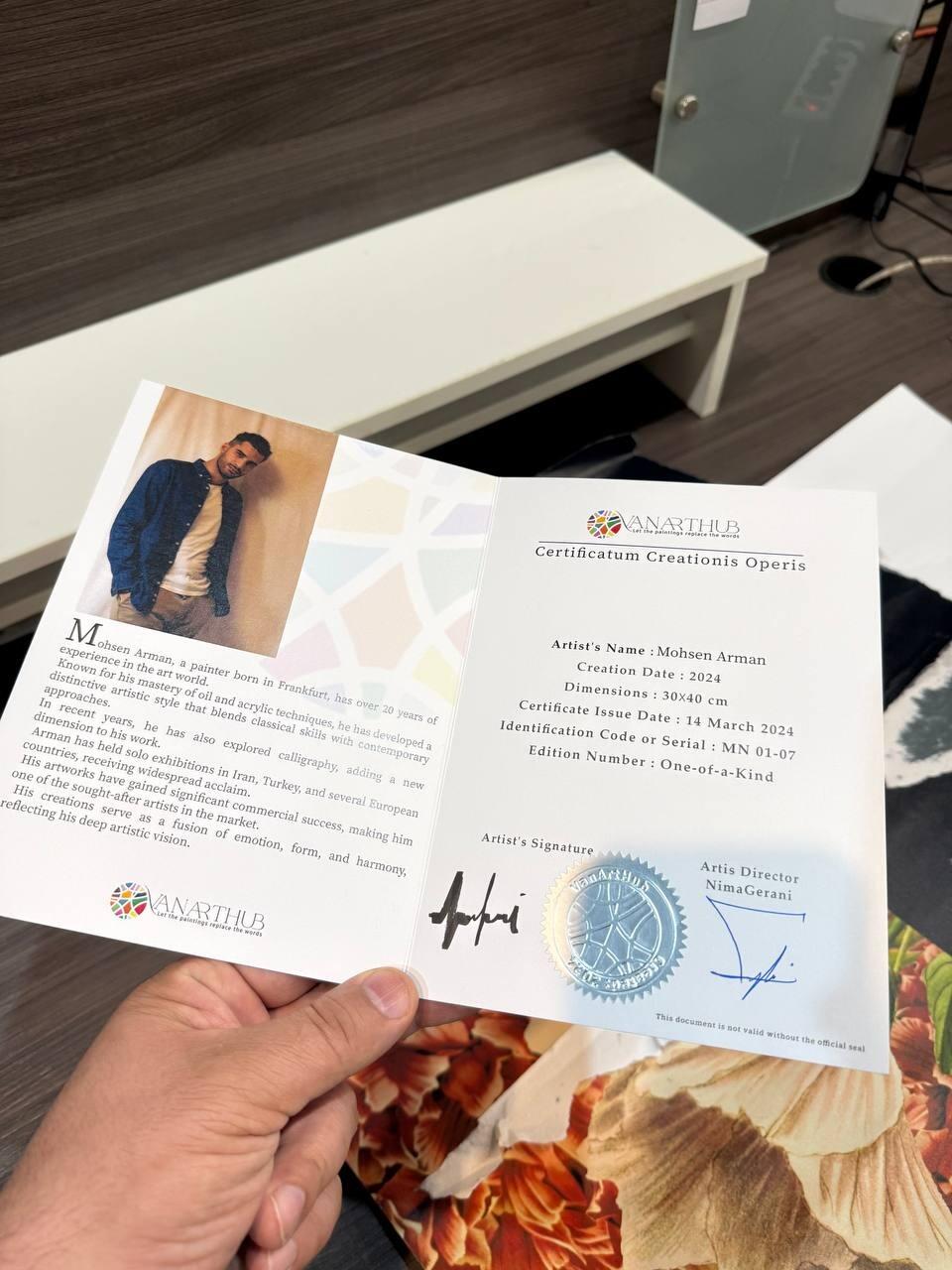
Silence of the Desert is a contemporary desert painting by Phaedra with a subject of its own: a wide plain and three tent-like shapes far off. We place it beside the story because the two share a setting. You receive the signed original, an oil on canvas of 50 x 70 cm (19.7 x 27.6 in), with a Certificate of Authenticity.
How many days does a painting take to reach an address in Canada or the United States?
Delivery takes 3 to 7 business days inside Canada and 5 to 10 business days to the United States. We send each painting from Vancouver, the shipping is free, and the work is fully insured on the way. Every painting we ship is an original, signed and one of a kind.
Do I get all my money back if I return a painting during the trial?
Yes, you get a full refund when you return the painting within 14 days of delivery, and we pay the return shipping. Every work comes with this 14-day trial. The terms are on our Buy with Confidence page, and our guide on how to buy Persian art answers other common questions.
Sources
- Encyclopaedia Iranica, Leyli o Majnun, by Ali Asghar Seyed-Gohrab, read October 2026.
- The Metropolitan Museum of Art, "Laila and Majnun in School", Folio 129 from a Khamsa (Quintet) of Nizami of Ganja, 13.228.7.7, read October 2026.
- The Metropolitan Museum of Art, "Laila and Majnun at School", Folio from a Khamsa (Quintet) of Nizami of Ganja, 1994.232.4, read October 2026.
- The Metropolitan Museum of Art, Majnun in the Wilderness, 45.174.6, read October 2026.
- The Metropolitan Museum of Art, Laila and Majnun, 1987.355.1, read October 2026.
- British Library, Archives and Manuscripts Catalogue, Or 2265, Shah Tahmasp's Khamsah of Nizami, read October 2026.
- British Library, Archives and Manuscripts Catalogue, Or 6810, ff 98v-146v, Layla u Majnun, read October 2026.
- Smithsonian's National Museum of Asian Art, Folio from a Khamsa (Quintet) by Nizami; Layla and Majnun at school, S1986.286, read October 2026.
- Smithsonian's National Museum of Asian Art, Folio from a Layla u-Majnun by Nizami; The battle between the Arab chief Nawfal and the tribe of Layla, F1931.22, read October 2026.
- Smithsonian's National Museum of Asian Art, Majnun throwing himself onto Layla's grave, folio from a Khamsa (Quintet) of Amir Khusraw Dihlavi, F1959.3, read October 2026.
- Harvard Art Museums, Majnun visited by his father in the desert, folio from a manuscript of the Layla and Majnun by Nizami, 2002.50.152, read October 2026.
- Aga Khan Museum, Layli and Majnun at School, Fol. 135v from a manuscript of the Khamseh of Nizami, AKM270, read October 2026.
- Aga Khan Museum, Layli and Majnun are Reunited in a Palm Grove, Fol. 170v from a manuscript of the Khamseh of Nizami, AKM270, read October 2026.
- Aga Khan Museum, Majnun in the wilderness, Folio from a manuscript of the Collected Works (Divan) of Sultan Ibrahim Mirza, AKM282.36, read October 2026.
- Los Angeles County Museum of Art, Majnun at the Ka'aba, Page from a Manuscript of the Khamsa (Quintet) of Nizami, M.73.5.423, read October 2026.
- The Walters Art Museum, Majnun, in Chains, is Led by the Old Woman to Layla's Tent, W.609.149B, read October 2026.
- Bodleian Libraries, University of Oxford, Nizami Ganjavi Library blog, Nizami Ganjavi, read October 2026.
- California magazine, Cal Alumni Association, UC Berkeley, Crazy Love, Fall 2016, read October 2026.
Sources read in October 2026. If you spot something out of date, tell us and we will correct this post.
About VanArtHub
VanArtHub is a gallery based in Vancouver, Canada. Every painting we ship is an original, signed and one of a kind, and it comes with a Certificate of Authenticity, free insured shipping and a 14-day trial. Persian art is also called Iranian art, and our guide to contemporary Persian painting is a good first page to read. You can also browse every original we have for sale.