Rumi and Hafez Paintings for Sale: What to Check First
UpdatedRumi paintings for sale, and most things sold as Hafez art or Persian poetry art, are one of three things: a printed quotation in decorative lettering, a painted scene from a poem in the manuscript tradition, or a contemporary painting that starts from a line or an idea in a poem. We are VanArtHub, a Vancouver gallery that sells original Persian miniatures and contemporary paintings that draw on Persian tradition. The four works in this guide belong to the third group.
Three things sold under these names, and who this guide is for
The first is a print: a line in ornamental letters on paper or canvas. It is a fair purchase when it is sold as a print, and we sell none.
The second is an illustration: one moment of one poem, with the people of the tale in it. Old ones are manuscript pages, sold by auction houses and specialist dealers. New ones are Persian miniatures, and ours are in the Kamal al-Din Ghotb collection. We sell no antiques.
The third is a contemporary painting that begins with a line or an idea from a poem. The four works here are all by Roshan, whose other work is in the Roshan collection.
This guide is for a buyer who must judge such a painting from a screen, and for anyone choosing a gift for a reader of these poets.
Rumi and Hafez in four short paragraphs
The Aga Khan Museum gives Rumi's name as Jalal al-Din Muhammad Balkhi and his dates as 1207 to 1273. Its 2023 exhibition followed his move from Central Asia to the Lands of Rum, present-day Türkiye. Jawid Mojaddedi writes in the Encyclopaedia Iranica that Rumi taught at a madrasa in Konya that had been his father's.
His great work is the Masnavi, a long teaching poem, and Mojaddedi says his main way of teaching was the teaching-story. In the best-known one, by Mojaddedi's account, Moses overhears a shepherd praying and criticises the way he speaks of God. God then rebukes Moses: the inner intention and state of the worshipper are what count.
Hafez (the Met writes Hafiz) was born in Shiraz and died there. Baha al-Din Khorramshahi, in the Iranica, gives ca. 1315 and ca. 1390, where "ca." marks a year as uncertain, and the Metropolitan Museum of Art gives ca. 1325 to 1390. Ehsan Yarshater, also in the Iranica, calls him "the most popular of Persian poets", and says a Persian home with one book of poetry is likely to have his Divan, his collected poems.
He is known almost only for his ghazals. A ghazal is a short lyric poem, usually 7 to 9 lines by Yarshater's description, with one metre, one rhyme and love as its main subject. Khanlari's edition has 486 ghazals, and in at least 170 of them, Yarshater says, Hafez mocks people who make a show of piety. The Divan is widely used for fal, telling a fortune from a book.
Beyond the Stone by Roshan is an oil on canvas, 101.6 x 101.6 cm (40 x 40 in). On a dark ground a glowing head and shoulders rise from a yellow and green cloud, beside a seated figure built from broken shapes of blue, green and yellow. The product page says the painter started from Rumi's idea that an old structure must fall before a new one can rise. The page gives a thought of the poet and describes no scene from a tale.

How the old painters handled the two poets
A ghazal has no single story. Yarshater calls its lines "generally self-contained", and Priscilla P. Soucek, also in the Iranica, says a ghazal often only mentions a person or an event that the long story poems tell in full. So painters chose a setting that a line names.
The most celebrated illustrated Divan, Soucek writes, was made in the 16th century for Sam Mirza, a son of Shah Esmail, and two of its four paintings are signed by Sultan Muhammad. One is known as "Worldly and Other-Worldly Drunkenness". The Met's record of a page with that title describes a tavern party with dancers, singers and drinkers, and angels on top of the pavilion. For the Met, wine as a Sufi symbol stands for heaven's divine light. Our page on symbols in Persian painting covers more.
The Met dates its page ca. 1531 to 1533. The Harvard Art Museums date a page titled "Earthly Drunkenness" c. 1530 and record that Harvard and the Met own it jointly. Soucek reports ca. 1527 for the manuscript. Copies made in Shiraz, she adds, show gatherings in mosques or taverns that she calls "seemingly generic".
The Masnavi is a different case: it holds many short tales. Mojaddedi's entry gives each tale's place in the poem.
| Tale | Where it is | What happens |
|---|---|---|
| Moses and the Shepherd | Book II, verses 1720 to 1800 | Moses criticises a shepherd's prayer, and God rebukes Moses |
| The deaf man and his sick neighbour | Book I, verses 3360 to 3409 | A deaf man feels smug about a visit he thinks is a good deed |
| The Grammarian and the Boatman | Book I, verses 2835 to 2865 | A grammarian shows contempt for a boatman. Then the boat starts to sink, and the grammarian cannot swim |
The Met's Masnavi, dated 1488 to 1489, has paintings of mounted hunters, receptions and feasts, and the Met's description names court life and no tale. The Aga Khan Museum in Toronto holds a page made in Tabriz, dated ca. 1530, in which a king tells his three sons about the joys and risks of exploring the world. Our page on Persian poetry in painting covers the other poets that painters illustrated.
The Secret of Creation by Roshan is acrylic on canvas, 101.6 x 101.6 cm (40 x 40 in). A figure with long purple hair sits at the upper left, partly hidden by waves of yellow and light blue. The product page says the painter drew on a verse of Hafez, and that the painting is about love as the origin of existence and reason as the force that orders it. Where the old painters showed a tavern, this page describes an idea and no scene from the verse.

What "inspired by a poem" means, and what to ask
A painting "inspired by" a poem shows the painter's response to it, and it need not show anything that is in the poem. So "inspired by Rumi" on a listing tells you where the painter began and leaves open what you will see. Ask the gallery which line the painter started from. Our answer for these four works: each product page gives the idea in one sentence, and one page also quotes a single line in English. None names the poem, and we have no record on those pages of which translation the line comes from. If the exact line matters to you, ask us through the form on the product page before you buy.
If you want a literal picture of a tale, buy a miniature: see our guides to buying a Persian miniature and choosing a Shahnameh scene. In our view both types are honest purchases when the seller says which one is on offer.
Beyond Rise and Fall by Roshan is acrylic on canvas, 71.1 x 101.6 cm (28 x 40 in). A woman is shown from the waist up, with closed eyes and a dark, thin cloth across the lower half of her face. Orange and blue strokes rise at her left, and yellow and green shapes like large wings stand at her right. The product page says the painter was inspired by a verse of Rumi and that the painting is about freedom through surrender. It states the idea and leaves the verse unnamed, the case this section describes.

What to check before you buy a Rumi or Hafez painting
Ask these eight things of any seller, and of us.
| What to check | A good answer | Ask more questions when |
|---|---|---|
| The line | The seller names the poem and the place in it | The only label is "Rumi quote" or "Hafez quote" |
| The translation | The translator is named | English words carry no translator's name |
| The starting point | The seller says which line or idea the painter began with, or says no record exists | "Inspired by Rumi" and nothing more |
| The writing in the picture | The seller types out the words, or says the letters are ornament | Nobody can say what the writing says |
| Painted or printed | "Original", with the paint named and one size on offer | "Print", "giclee" or a choice of sizes |
| The size | Width and height in centimetres | Only "large" or "medium" |
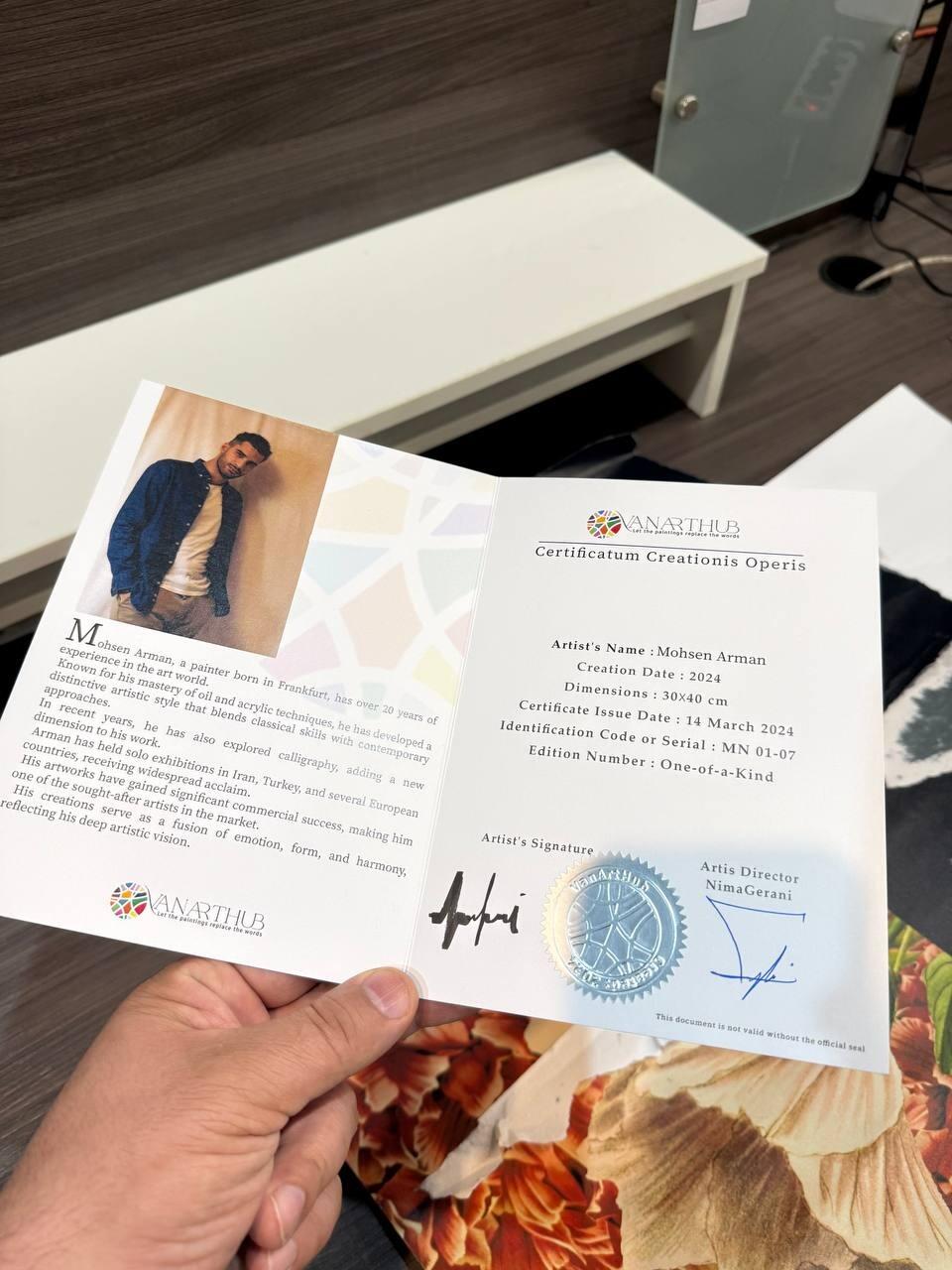
| The certificate | Signed, with the artist, title, medium and size | Unsigned, or no artist named |
| The return terms | Written, with the number of days and who pays the return shipping | "Final sale" |
The line. A poet's name on a line is a claim to check. Julie Scott Meisami writes in the Encyclopaedia Iranica that later versions of the Divan are generally assumed to have grown through "the addition of poems by other poets mistakenly or falsely attributed to Hafez". A careful seller says where the line is found. The Iranica cites Rumi by book and verse, and a ghazal of Hafez by its number in the edition by Khanlari.
The translation. Ask whose English you are reading. Of one group of prose translators of Hafez, Parvin Loloi writes in the Iranica that too many "have taken excessive liberties with the imagery of the original". On Rumi, a Met essay says a translation by the American writer Coleman Barks has had a wide reach, and that many 20th-century poetic translations of Sufi texts "dilute the original Islamic religious meanings". A full answer looks like this couplet from Moses and the Shepherd, in the English of Mojaddedi's Iranica entry: "Beyond all the religions stands love's nation; / God is their sole dogma and denomination" (Masnavi, Book II, verse 1774).
Return by Roshan is acrylic on canvas, 61 x 78.7 cm (24 x 31 in). A dark rectangular form hangs in a light blue sky with root-like shapes growing out of it, and many small dark figures cross a wavy ground toward stairs at the lower right. The product page says the painting is about the soul going back to the place it came from. The line the product page quotes, as a thought of Rumi, is: "Whoever is far from their origin seeks the day of reunion." The page names no poem and no translator, so this work is our own example of the first two checks.

The writing in the picture. Soucek writes that the calligraphy pictures Hossein Zenderoudi made from verses of Hafez are not all easy to read, and that most seem made for people who have memorised every verse. If you read no Persian, ask the seller to type out the words.
Painted or printed, and the size. Under a magnifier a printed picture breaks into a regular pattern of dots, and a brush stroke has none; the miniature guide linked above gives that check in full. Compare sizes in centimetres: the four works here run from 61 x 78.7 cm to 101.6 x 101.6 cm.
How buying from us works
Each of the four works is an original, signed and one of a kind, and it arrives with a Certificate of Authenticity. Shipping is free and fully insured: 3 to 7 business days in Canada and 5 to 10 to the USA. A stretched canvas ships flat in a rigid box. A work on unstretched canvas, or one too large to travel on its stretcher bars, ships rolled in a heavy tube, and we tell you before it ships which way it will travel. If a carrier asks you for a customs or brokerage fee, contact us before you pay it.
The 14-day trial starts at delivery. Send the work back within 14 days for a full refund, and we pay the return shipping. The full terms are on our Buy with Confidence page.
For a gift, find out which poet the person reads, plan the delivery close to the day you will give it, and write in the card what the seller told you about the line. See also our gift-worthy art collection.
Every product page has a form to ask us a question about that painting. Our gallery is at 1242 Davie Street in Vancouver's West End, and the opening hours are on our West End gallery page. Contact us before you come, so we can confirm the work is at the gallery that day. For ownership history and cross-border rules, read our guide on how to buy Persian art.
Each product page has one more option, Buy Print File: a high-resolution digital file of the image, which you print yourself. Nothing is shipped, we email the file within 48 hours, it is for personal printing only, and copyright stays with the artist. A print made from that file is a reproduction, and the painting itself still exists once.
Key Takeaways
- Art sold under the name of Rumi or Hafez is a printed quotation, an illustration of a tale, or a contemporary painting that starts from a line or an idea.
- A ghazal by Hafez has no single story, so old painters of the Divan showed a tavern or a mosque. Rumi's Masnavi holds short tales.
- A painting "inspired by" a poem need not show anything from the poem. Ask which line the painter started from.
- Ask where a quoted line is found and who translated it.
- Get the size in centimetres, the certificate and the return terms in writing before you pay.
Frequently Asked Questions
Where can I buy a Rumi painting?
A Rumi painting made by hand is sold by the painter or by a gallery that shows the painter. VanArtHub in Vancouver has originals by Roshan whose product pages name Rumi, among them Beyond the Stone, Beyond Rise and Fall and Return, with free and fully insured shipping in Canada and to the United States. For a printed quotation, go to a print seller.
Who was Rumi?
Rumi was a Persian poet and Sufi mystic. The Aga Khan Museum gives his dates as 1207 to 1273 and says he moved from Central Asia to the Lands of Rum, present-day Türkiye. The Encyclopaedia Iranica names the Masnavi, a long teaching poem built from stories, as his greatest work.
Who was Hafez, and what is the Divan?
Hafez was a Persian poet who was born in Shiraz and died there. The Encyclopaedia Iranica gives ca. 1315 for his birth and ca. 1390 for his death, and calls him the most popular of Persian poets. The Divan is the book of his collected poems. He is known almost only for his ghazals, short lyric poems about love, and one edition holds 486 of them.
Why do old paintings of Hafez show a tavern?
A tavern appears because a ghazal has no single story, so painters chose a setting that the verse names. The Encyclopaedia Iranica says copies made in Shiraz show gatherings in mosques or taverns. The Metropolitan Museum of Art describes one tavern party with angels on top of the pavilion, and adds that wine, as a Sufi symbol, stands for heaven's divine light.
Which museums hold painted pages of Rumi's Masnavi?
The Metropolitan Museum of Art in New York and the Aga Khan Museum in Toronto both hold painted pages of the Masnavi. The Met's copy is dated 1488 to 1489, and its paintings show mounted hunters, receptions and feasts. The Aga Khan Museum's page, made in Tabriz and dated ca. 1530, shows a king speaking to his three sons.
How do I check that a Rumi or Hafez line on a painting is real?
Ask the seller where the line is found and who translated it. A full answer names the book and verse of the Masnavi, or the number of the ghazal in a named edition of the Divan. The Encyclopaedia Iranica notes that later versions of the Divan are generally assumed to include poems by other poets mistakenly or falsely attributed to Hafez.
Does a painting inspired by a poem show a scene from the poem?
No, a painting inspired by a poem need not show any scene from it. The painter starts from a line or an idea and paints a response, so the picture can be abstract. Ask the gallery which line the painter began with. A buyer who wants the people and events of a tale should choose an illustration, such as a Persian miniature.
Are the Rumi and Hafez paintings at VanArtHub originals or prints?
Every one is an original. Every painting VanArtHub ships is signed and one of a kind. The four paintings by Roshan in this guide are oil or acrylic on canvas, from 61 x 78.7 cm to 101.6 x 101.6 cm, and each arrives with a Certificate of Authenticity. A print of a quotation has to come from another seller.
Do you ship these paintings across Canada and to the USA?
Yes, shipping is free and fully insured to both countries. Delivery takes 3 to 7 business days in Canada and 5 to 10 business days to the USA. A stretched canvas ships flat in a rigid box, and we tell you before a work ships which way it will travel. If a carrier asks you for a customs or brokerage fee, contact us before you pay it.
What if the person I give the painting to does not want it?
The painting can come back within 14 days of delivery for a full refund, and we pay the return shipping. The 14 days start on the day of delivery, so plan the delivery date close to the day of the gift. Keep the packing until the person has decided. Our Buy with Confidence page has the full terms.
Sources
- Encyclopaedia Iranica, Hafez i. An Overview, by Ehsan Yarshater, read October 2026.
- Encyclopaedia Iranica, Hafez ii. Hafez's Life and Times, by Baha al-Din Khorramshahi, read October 2026.
- Encyclopaedia Iranica, Hafez v. Manuscripts of Hafez, by Julie Scott Meisami, read October 2026.
- Encyclopaedia Iranica, Hafez x. Translations of Hafez in English, by Parvin Loloi, read October 2026.
- Encyclopaedia Iranica, Hafez xii. Hafez and the Visual Arts, by Priscilla P. Soucek, read October 2026.
- Encyclopaedia Iranica, Rumi, Jalal-al-Din viii. Rumi's Teachings, by Jawid Mojaddedi, read October 2026.
- The Metropolitan Museum of Art, Heilbrunn Timeline of Art History, Art of the Sufis, by Courtney Stewart, read October 2026.
- The Metropolitan Museum of Art, Masnavi of Jalal al-Din Rumi, 13.228.12, read October 2026.
- The Metropolitan Museum of Art, "Allegory of Worldly and Otherworldly Drunkenness", Folio from the Divan of Hafiz, 1988.430, read October 2026.
- Harvard Art Museums, Earthly Drunkenness, illustrated folio from a manuscript of Divan of Hafiz, 1988.460.2, read October 2026.
- Aga Khan Museum, Rumi, exhibition of May 13 to October 1, 2023, read October 2026.
- Aga Khan Museum, The King on His Throne Regarding his Three Sons, folio from a manuscript of the Masnavi, 2016.3.1, read October 2026.
Sources read in October 2026. If you spot something out of date, tell us and we will correct this post.
About VanArtHub
VanArtHub is a gallery based in Vancouver, Canada. Every work we sell is an original, signed and one of a kind, and comes with a Certificate of Authenticity, free insured shipping and a 14-day trial. Persian art is also called Iranian art, and our guide to contemporary Persian painting is the place to start reading. You can also browse all artworks.