Shahnameh Paintings for Sale: How to Choose a Scene
UpdatedA Shahnameh painting shows a scene from the Shahnameh, the Persian Book of Kings. What is sold today as a Shahnameh painting or as Shahnameh wall art is usually one of two things: a printed poster of an old manuscript page that a museum holds, or a new painting made by hand. We are VanArtHub, a Vancouver gallery that sells original Persian miniatures and contemporary paintings that draw on Persian tradition, and we sell only the second kind. This guide helps you choose a scene and check the work before you pay, whoever the seller is.
Poster or painting: what is on sale, and who this guide is for
One royal copy of the Shahnameh (also written Shahnama), made for Shah Tahmasp, holds 258 paintings. The Metropolitan Museum of Art owns seventy-eight of its painted pages and says the manuscript is now spread among private and public collections.
The Met lets anyone reuse its photographs of public-domain works. Its Open Access programme makes images of public-domain artworks available "for unrestricted use", and anyone can download, share and remix them. On its record for a fire-ordeal page dated 1482, the Met labels the image "Public Domain" and says such images are free for "unrestricted commercial and noncommercial use without permission or fee". So anyone may print that photograph and sell it as a poster.
The second kind is a new painting: made by hand, signed, and existing once. Old manuscript pages are a third, separate market, sold by auction houses and specialist dealers. We sell no antiques and no posters of museum pages, and we ship no printed copies. If a poster or an antique page is what you want, another seller is the right place for you.
The Shahnameh in three short paragraphs
The Shahnameh is a long poem by Ferdowsi, whose name the Met writes as Firdausi. The Met counts 50,000 rhyming couplets and says the poem tells the history of the ancient kings of Iran "from the mythical beginnings to the Arab conquest in 651 A.D." The Fitzwilliam Museum in Cambridge says it covers the reigns of fifty kings, in three sections: myths, legends and history. The legendary section, the museum adds, "contains the most famous stories".
For centuries the poem was copied and painted for kings. The Met says all the kings who ruled Iran kept ordering new copies, often "lavishly illustrated and illuminated", and Marianna Shreve Simpson writes in the Encyclopaedia Iranica that hundreds of illustrated volumes survive today. A scribe wrote the verses first, usually in six columns, and left spaces for the painter.
Printing reached the Shahnameh in the 19th century: Simpson dates the first printed volumes with pictures to Bombay in 1846 and 1849. The Iranica also describes coffeehouse storytellers who set up painted screens, with pictures "usually of episodes" from the Shahnameh, such as the tragedy of Rostam and Sohrab. Our page on the Shahnameh in art lists the great painted copies.
How to choose a Shahnameh scene
Choose the story first and the picture second. Guests will ask what the painting shows, so pick a story you are glad to tell.
| Scene | The story in one line | What the picture usually shows | The mood in a room | Our post |
|---|---|---|---|---|
| Zal and the Simorgh (also written Simurgh) | Sam leaves his white-haired baby on a mountain to die. A mythical bird raises the child and carries him back. | A great bird and a child on a mountain. Painters usually show Zal as an infant. | Gentle: a lost child comes home | Zal and the Simorgh |
| Tahmina comes to Rostam | A princess (the Fitzwilliam writes Tahmineh) visits the hero Rostam at night and asks to bear his child. | A palace room at night, Tahmina arriving with an attendant. | Quiet: a love scene | See the next row |
| Rostam and Sohrab | Rostam kills a young warrior in battle, then learns it is his own son. | Rostam beside the dying Sohrab, whose clothing is opened to show the jewel Rostam gave Tahmina. | Grief | Rostam and Sohrab |
| Siyavash and the fire | Prince Siyavash (the Met writes Siyavush), falsely accused by his stepmother, rides through fire to prove his innocence and comes out unhurt. | A rider in white on a black horse, inside the flames. | Hopeful: an innocent man is proved right | Siyavash and the fire |
| Rostam and the White Div | Rostam's seventh and last Peril: he kills the White Div, whose liver will cure the blinded King Kay Kavus. | A cave shown cut open, Rostam in a tiger-skin coat removing the liver, his guide tied to a tree. | Violent | No post yet |
| Zahhak | The Devil kisses King Zahhak's shoulders, snakes grow there, and they are fed daily with the brains of young men. | A king on a throne with a snake at each shoulder, courtiers staring. | Frightening: a picture about a tyrant | No post yet |
| A battle, a hunt or a court feast | No single story. The Fitzwilliam says the poem's kings and heroes are "constantly involved in battles, hunts and court receptions". | Two armies of riders, a hunting party, or a king receiving his court. | Movement and colour, no single victim | None |
Some of these scenes are violent or sad, and a small shop photo hides that. In Rostam and Sohrab a father kills his son. In the White Div scene the hero cuts out a liver. The Fitzwilliam describes two more hard stories: Iraj is murdered by his jealous brothers, and the prince Bahram Gur "cruelly punished his beloved, Azadeh". So read the story before you hang the scene in a family room or give it as a gift.
In our view the scenes that are easier to live with are Zal and the Simorgh, Tahmina's visit, and the battle, hunt and feast pages. Siyavash and the fire belongs with them, with one note: the Met says Siyavash "is later murdered by traitors". For a wedding or a new baby we would choose Zal and the Simorgh.
Siyavash Passing Through the Fire by Kamal al-Din Ghotb is a Persian miniature in oil and gold, 40 x 30 cm (15.7 x 11.8 in). Its title and product page name the scene: the trial by fire from the Shahnameh. The same rider appears three times, entering the fire at the left, crossing it with his arms open, and coming out at the right into a spring landscape. We show it here as the hopeful scene in the table.

What to check before you buy a Shahnameh painting
Ask these seven things of any seller, and of us.
| What to check | A good answer | Ask more questions when |
|---|---|---|
| Poster or painting | The listing says "original" and names a living painter | The listing names a museum, or says "print", "poster" or "giclee" |
| The scene | The listing names the episode | The only label is "Shahnameh style" |
| The verse panels | The seller says which lines they are, or says plainly that no translation is on file | The seller gives no answer |
| The size | Centimetres, checked against your wall | A book-page picture is offered at poster size |
| The gold | A short video shows the gold changing as the work is tilted | The gold looks the same in every photo |
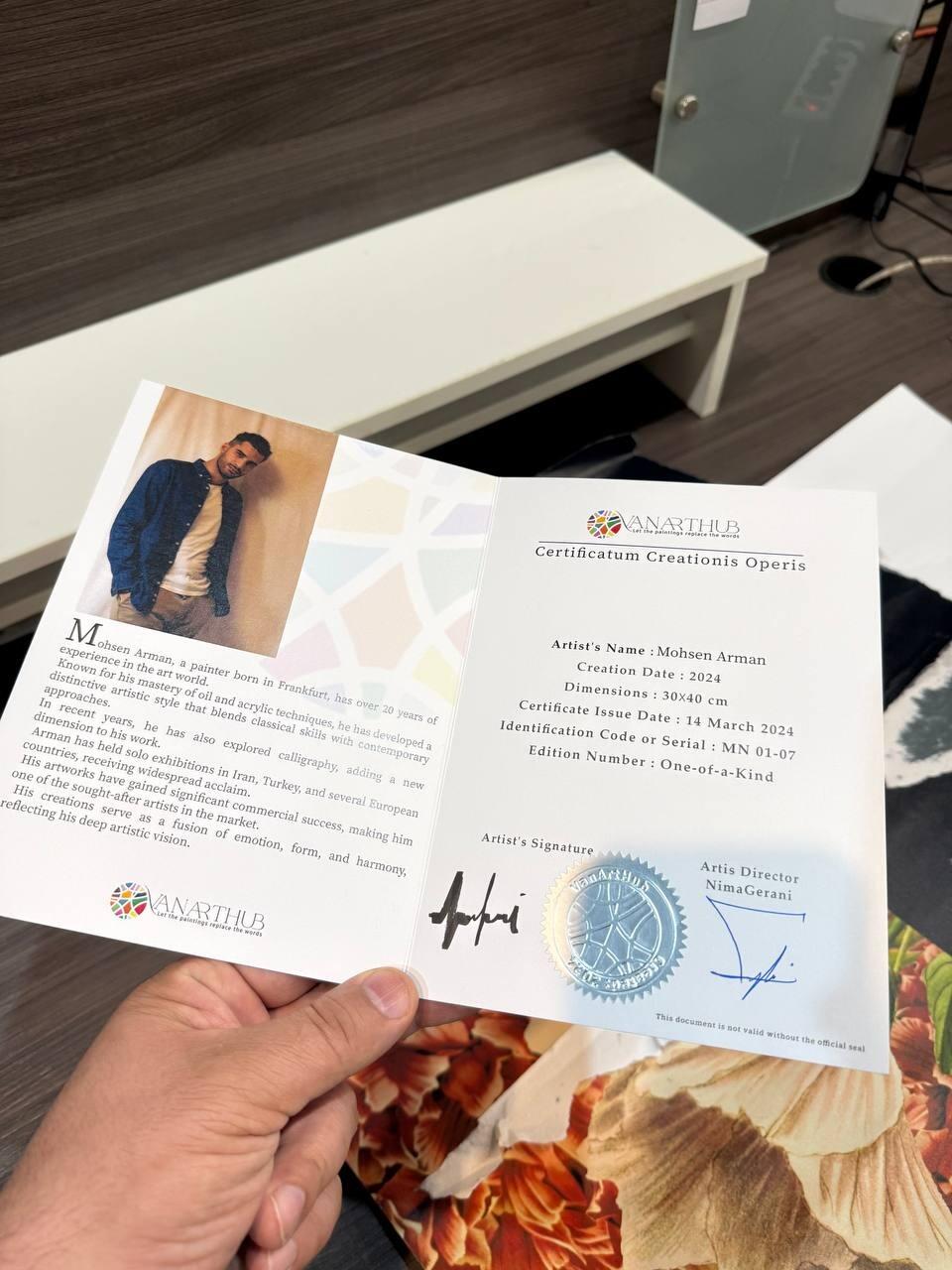
| The certificate | It is signed, and its title names the scene | It names no artist or no scene |
| The return terms | Written, with the number of days and who pays to send the work back | "Final sale" |
Poster or painting. A print is made of small dots that you can see with a magnifier, and a line made with a brush has none. Our guide to buying a Persian miniature gives that check in full. If a listing names a museum or a folio number, ask whether you are buying a print of that page.
The scene is named, and the picture matches. A careful seller names the episode, and museum pages give quick signs to check it. The Met says its fire-ordeal page follows the story closely because it shows Siyavash "dressed all in white on a black charger". The Fitzwilliam describes Rostam in "his habitual tigers-skin coat" and says the name Zal means white-haired. A Rostam with no tiger skin deserves a question, and so does the word "Shahnameh" on a picture with no episode named.
The verse panels. Simpson writes that a picture's subject seems to have been decided in part by the verses "located immediately above, below, or alongside" it. On an old page, then, the lines next to the picture usually tell the moment it shows. New paintings keep the panels as part of the page design, so ask the seller which lines they are. Our product pages for the two miniatures in this guide describe the verse panels and print no translation. If the words matter to you, ask us through the form on the product page before you buy.
Naghsh-e Khial by Kamal al-Din Ghotb is a Persian miniature in oil and gold, 30 x 40 cm (11.8 x 15.7 in). Two armies meet across a pale blue plain, and trumpeters raise long gold horns. In our shop it carries the tag Shahnameh, and its description names no episode, so we call it a battle scene in the manner of Shahnameh pages. It has the layout described above: a picture set inside columns of Persian verse.

Size, gold and paperwork
The size. Old Shahnameh pages are book pages, as our page on Persian miniature painting explains. The Met's page of 1482 is 31 cm high and 20.2 cm wide. In our view, drawing made to be read from 30 centimetres away looks coarse when a poster enlarges it to a metre. The two miniatures in this guide measure 40 x 30 cm and 30 x 40 cm, a size for a hallway or a study, where people stand close.
The gold. The Met gives the medium of its 1482 page as "Ink, watercolor, and gold on paper". Ask for a short video of the work tilted under a lamp. In our experience gold put on by hand goes bright at one angle and dark at another, and printed gold keeps one flat colour.
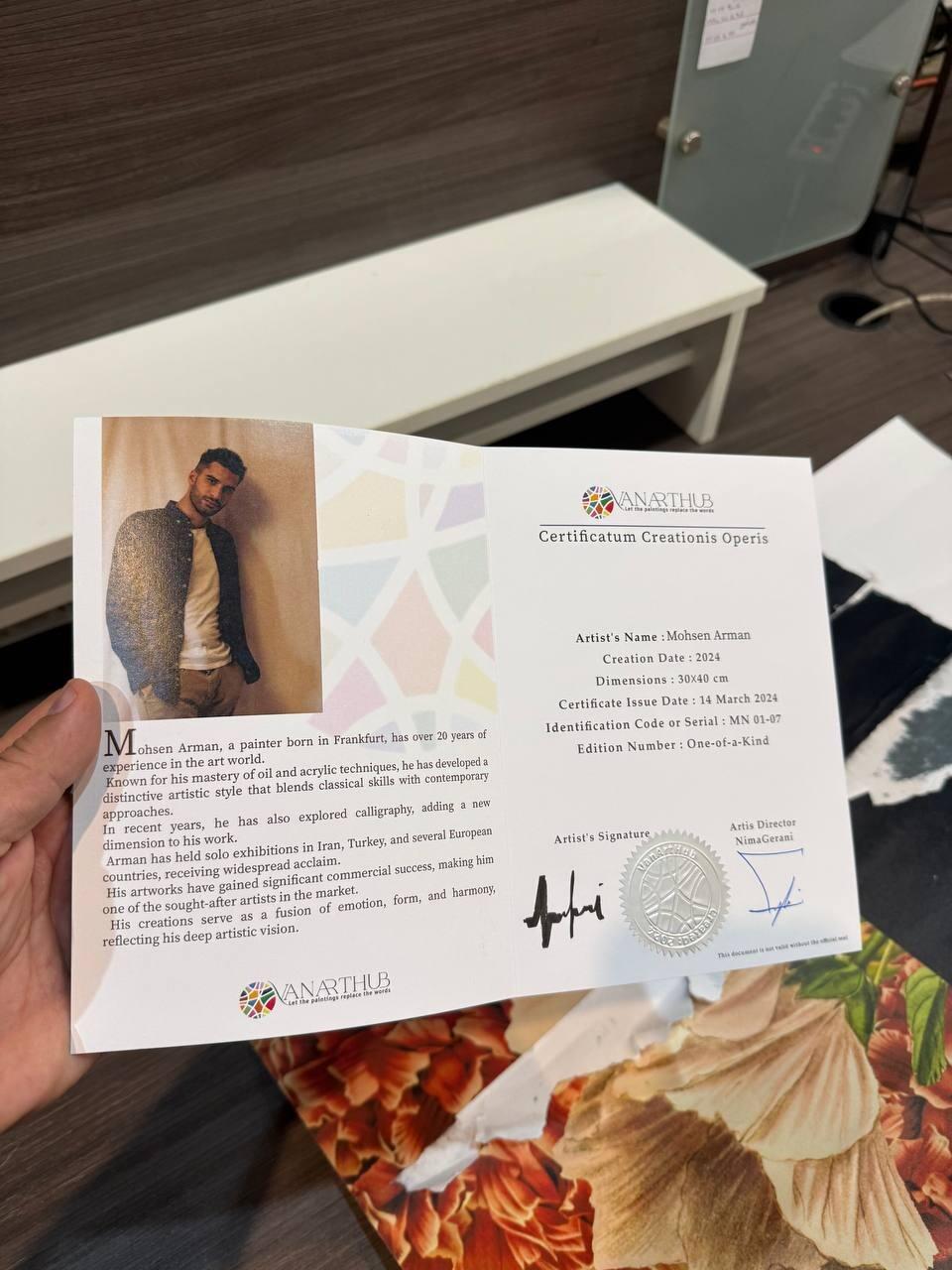
The certificate and the return terms. The certificate should carry the painter's name and a signature, and for a Shahnameh scene its title should name the scene. Return terms should be in writing.
A div on a large canvas
Two of the three works in this guide are miniatures from the Kamal al-Din Ghotb collection. The third is a large canvas.
A div is a demon, monster or fiend of Persian story, in the words of Mahmoud Omidsalar in the Encyclopaedia Iranica. Persian epic, he writes, describes divs with long teeth and claws on their hands, and in the Shahnameh the divs of Mazandaran have a king "with all the trappings of kingship".
The Monster (Div)Command by Amir Fazelian is acrylic on canvas, 139.7 x 139.7 cm (55 x 55 in). A horned, red-skinned figure with a long white beard wears a crown set with green jewels and holds three white dice, and chess pieces float in the swirling colour behind it. It is a contemporary painting of a div, and its product page names no episode of the poem. It suits a buyer who wants a figure from the Shahnameh at the size of a living-room wall. More of this painter's work is in the Amir Fazelian collection.

Buying a Shahnameh painting from us
Each work in our gallery is an original, signed and one of a kind, and it arrives with a Certificate of Authenticity. Shipping is free and fully insured: 3 to 7 business days in Canada and 5 to 10 to the USA. A stretched canvas ships flat in a rigid box. A work on unstretched canvas, or one too large to travel on its stretcher bars, ships rolled in a heavy tube, and we tell you before it ships which way it will travel. If a carrier asks you for a customs or brokerage fee, contact us before you pay it.
The 14-day trial starts at delivery. Send the work back within 14 days for a full refund, and we pay the return shipping. Use those days to tell the story to the people you live with. The full terms are on our Buy with Confidence page.
Every product page has a form to ask us a question about that painting. Our gallery is at 1242 Davie Street in Vancouver's West End. The opening hours are on our West End gallery page. Contact us before you come, so we can confirm the work is at the gallery that day. For ownership history and cross-border rules, read our guide on how to buy Persian art.
Each product page has one more option, Buy Print File: a high-resolution digital file of the image, which you print yourself. Nothing is shipped, we email the file within 48 hours, it is for personal printing only, and copyright stays with the artist. A print made from that file is a reproduction, and the painting itself still exists once.
Key Takeaways
- A Shahnameh picture on sale is usually a printed poster of a museum page or a new painting made by hand. The works we ship are new paintings.
- Choose the story first, and read it before you hang the scene in a family room or give it as a gift.
- Rostam and Sohrab, the White Div and Zahhak are hard scenes. Zal and the Simorgh and Tahmina's visit are easier to live with.
- Ask the seller to name the episode and to say what the verse panels are.
- Before you pay, get the size in centimetres, the certificate and the return terms in writing.
Frequently Asked Questions
What is a Shahnameh painting?
A Shahnameh painting is a picture of a scene from the Shahnameh, the Persian Book of Kings by Ferdowsi. The Metropolitan Museum of Art counts 50,000 rhyming couplets in the poem, which tells the history of Iran's ancient kings up to the Arab conquest in 651. Pictures of its stories were painted in handwritten books for centuries, and painters still make them today.
Which Shahnameh scenes are painted most often?
Tahmina's night visit to Rostam is one of the most frequently illustrated episodes, by the Fitzwilliam Museum's account. The same museum calls the death of Sohrab one of the most famous and tragic episodes in the poem. Other scenes shown in the museum's Shahnameh exhibition include Siyavash riding through fire, the Simorgh returning Zal to his father, and Rostam killing the White Div.
Which Shahnameh scene suits a living room?
A scene with a happy ending suits a shared room best, in our view. Zal and the Simorgh shows a bird returning a lost child, and the fire ride of Siyavash shows an innocent man proved right. Battle, hunt and feast pages also work, because no single victim is at the centre. Read the story of any scene before you hang it.
Is a Shahnameh painting a good gift?
Yes, when you choose the scene with care. Some famous scenes are sad or violent: in Rostam and Sohrab a father kills his son, and the White Div scene shows a killing. For a wedding or a new baby we would choose Zal and the Simorgh. Write the story in the card, so the person knows what the picture shows.
Where do Shahnameh posters come from?
A Shahnameh poster is a printed photograph of an old manuscript page, and museums are one source of those photographs. The Metropolitan Museum of Art makes its images of public-domain artworks available for unrestricted use, and says anyone can download, share and remix them. A poster is a fair purchase when it is sold as a poster. VanArtHub ships no posters and no printed copies.
What is a div in the Shahnameh?
A div is a demon or monster of Persian story. The Encyclopaedia Iranica says Persian epic describes divs with long teeth and claws on their hands, and that in the Shahnameh the divs of Mazandaran have their own king. Rostam kills the White Div in his seventh Peril. The Monster (Div)Command by Amir Fazelian is a contemporary painting of a div.
Where can I buy an original Shahnameh painting?
An original Shahnameh painting is sold by the painter who made it or by a gallery that shows that painter. VanArtHub in Vancouver has new originals, among them Siyavash Passing Through the Fire by Kamal al-Din Ghotb, with free and fully insured shipping in Canada and to the United States. For an antique manuscript page, go to an auction house or a specialist dealer.
Will a Shahnameh painting arrive rolled or flat?
Either, depending on the work. A stretched canvas ships flat in a rigid box. A work on unstretched canvas, or one too large to travel on its stretcher bars, ships rolled in a heavy tube, and we tell you before it ships which way it will travel. Shipping is free and fully insured, 3 to 7 business days in Canada and 5 to 10 to the USA.
Can I return a Shahnameh painting if the scene feels wrong at home?
Yes, within 14 days of delivery. Send the painting back in that time, and we refund the full amount and pay the return shipping. The 14-day trial gives you time to tell the story to the people you live with and to see the work in morning and evening light. Our Buy with Confidence page has the full terms.
Can I view a Shahnameh painting at your Vancouver gallery before buying?
Yes, by arrangement. Our gallery is at 1242 Davie Street, in the West End of Vancouver. Contact us before you come, so we can confirm the work is at the gallery that day. The opening hours are on our West End gallery page. Bring the measurements of your wall, and ask to see the gold under a lamp.
Sources
- The Metropolitan Museum of Art, Heilbrunn Timeline of Art History, The Shahnama of Shah Tahmasp, by Francesca Leoni, read October 2026.
- The Metropolitan Museum of Art, "The Fire Ordeal of Siyavush", Folio from a Shahnama (Book of Kings) of Firdausi, 45.150, read October 2026.
- The Metropolitan Museum of Art, Open Access at The Met, read October 2026.
- Encyclopaedia Iranica, Shah-nama ii. Illustrations, by Marianna Shreve Simpson, read October 2026.
- Encyclopaedia Iranica, Coffeehouse (qahva-kana), read October 2026.
- Encyclopaedia Iranica, Div, by Mahmoud Omidsalar, read October 2026.
- The Fitzwilliam Museum, University of Cambridge, The Shahnameh, Structure and Themes: Myth, Legend and History, read October 2026.
- The Fitzwilliam Museum, The Shahnameh, No. 45, The Simorgh restores Zal to Sam, read October 2026.
- The Fitzwilliam Museum, The Shahnameh, No. 48, Tahmineh comes to Rostam, read October 2026.
- The Fitzwilliam Museum, The Shahnameh, No. 36, Sohrab slain by Rostam, read October 2026.
- The Fitzwilliam Museum, The Shahnameh, No. 47, Rostam slays the White Div, read October 2026.
- The Fitzwilliam Museum, The Shahnameh, No. 4, Zahhak enthroned, read October 2026.
Sources read in October 2026. If you spot something out of date, tell us and we will correct this post.
About VanArtHub
VanArtHub is based in Vancouver, Canada. Every work we sell is an original, signed and one of a kind, and comes with a Certificate of Authenticity, free insured shipping and a 14-day trial. Persian art is also called Iranian art, and our guide to contemporary Persian painting is the place to start reading. For a present, see gift-worthy art, or browse all artworks.