Persian miniature painting is the tradition of small, finely detailed paintings made in Iran and the Persian-speaking world, first to illustrate handwritten books of poetry and history and later as single pages collected in albums. Painters worked on dyed or gold-sprinkled paper with pigments ground from minerals such as lapis lazuli and malachite, bound with gum arabic, and with gold applied by hand, using the finest brushes for the last details. The great schools grew up in the court workshops of Tabriz, Herat, Shiraz and Isfahan between the 14th and 17th centuries, and the tradition is still taught and practised today.
This page explains how a miniature was made, what distinguishes each school, who two of its most celebrated painters were, and where the great manuscripts are now. It ends with how painters work in the tradition today and how to tell a hand-painted miniature from a print. It is part of our collector's guide to contemporary Iranian and Persian painting.
Key takeaways
- The Metropolitan Museum of Art says Safavid court painters made pigments from lapis lazuli for blue and malachite for green, as well as gold, silver, sulphur and plant and insect dyes.
- The British Institute of Persian Studies says shell gold was made by pounding gold between layers of deerskin into thin leaf and grinding the leaf with honey.
- Kamal al-Din Behzad worked in Herat under Sultan Husayn Bayqara, who ruled from 1470 to 1506, and was buried in Tabriz after his death in 1535 or 1536, according to the Encyclopaedia Iranica.
- The paintings most widely accepted as Behzad's own illustrate a Bustan of Sa'di with a text dated 1488, now in the National Library of Egypt in Cairo.
- The Isfahan school runs from 1597 to 1598, when Isfahan became the Safavid capital, until 1722, and its most celebrated painter is Reza Abbasi, active from c. 1565 to 1635.
What a Persian miniature is
Most Persian miniatures were planned for the page of a book. The painter worked inside a frame of ruled lines, next to columns of handwritten verse, and the picture had to fit the space the text left for it. The Met's educator page on the Shah Tahmasp Shahnameh explains that the director of the royal workshop fixed the layout first, scribes wrote the text in the spaces assigned to it, and only then did the pages pass to the painters.
The British Institute of Persian Studies lists the conventions shared by almost every school: bright colours, even light with no shadow, three-quarter and round faces, several places and moments shown in one picture, and no single-point perspective. The curator Donna Honarpisheh describes the result as a visual field with multiple focal points that draw the eye across the image. Our page on surrealism and Persian painting looks at how later viewers compare this flattened space with dream painting.
Materials and how a miniature was made
Paper
Almost no page in an illustrated Persian manuscript is plain white. The British Institute of Persian Studies explains that paper was dyed with natural substances such as flowers, herbs and fruit juice, or sprinkled with gold or silver, and that some painting treatises warned that a white background could weaken the eyes over time. The Met adds that royal sheets were made from the pulp of linen and hemp rags and coated with a starchy solution to take ink and paint.
Pigments
Colours were water based. The British Institute of Persian Studies lists stones such as lapis lazuli and malachite, earths such as red ochre, and plants such as madder root, mixed with gum arabic for work on paper and with egg yolk for work on wood. The Met's list adds gold, silver, sulphur and dyes from insects.
Gold
Gold was made into shell gold: pounded between layers of deerskin into thin leaf, then ground with honey into a paint. After the paintings were finished, illuminators decorated borders, chapter headings and frames with gold, and the Met says the gilded pages were then burnished with a smooth, hard stone such as agate or rock crystal to give them a polished surface.
Drawing, colour and detail
The Met says painters sketched the whole composition with a light brush before working on specific areas. The British Institute of Persian Studies describes the order that followed: the outline in ink, the colours, a second outline of every detail with the finest brush, and finally pardakht, the rendering of fine detail, which it calls the stage that "requires the highest level of technical artistry". A border of ruled lines of different thicknesses framed the finished picture.
The great schools and their dates
The main schools of Persian miniature painting, their dates and key works
| School |
Period |
Patrons |
Key painters or works |
Source |
| Tabriz (Ilkhanid) |
1330s |
Ilkhanid court |
Great Mongol Shahnameh, 57 or 58 surviving illustrations |
Harvard Art Museums; Encyclopaedia Iranica |
| Shiraz |
From 1393 to 1394 onward |
Muzaffarid and Timurid princes |
A Shahnameh of 1393 to 1394 with 67 pictures; Shahnameh pages of 1575 to 1590 at Harvard |
Encyclopaedia Iranica; Harvard Art Museums |
| Herat (Timurid) |
15th century; Behzad under Sultan Husayn, 1470 to 1506 |
Timurid princes |
Baysonghor's Shahnameh of 1430; Behzad's Bustan of 1488 |
Encyclopaedia Iranica |
| Tabriz (early Safavid) |
From the early 1520s |
Shah Ismail and Shah Tahmasp |
Shah Tahmasp Shahnameh, 258 paintings; Sultan Muhammad, Mir Musavvir, Aqa Mirak |
Metropolitan Museum of Art |
| Isfahan |
1597 to 1598 until 1722 |
Shah Abbas and his successors, and middle-class collectors |
Reza Abbasi; his pupil Moin Mosavver |
Encyclopaedia Iranica |
The schools overlapped and exchanged artists. The British Institute of Persian Studies notes that when Shah Tahmasp stopped supporting painting in the mid-1540s, the painters of his library moved to courts that were still active, in Shiraz, Qazvin, Mashhad and Bukhara. The Met says the Shah Tahmasp Shahnameh itself joined the Turkmen style of Tabriz and Shiraz with the Timurid style of Herat.
Kamal al-Din Behzad
The Encyclopaedia Iranica, in an entry by Priscilla Soucek, calls Kamal al-Din Behzad a master painter "proverbial for his skill". It says he was orphaned young and trained by Mirak Naqqash, who directed the workshop of Mir Ali-Shir Navai and then that of Sultan Husayn Bayqara in Herat. Behzad's life after the Sultan's death in 1506 is poorly documented. The 16th-century writer Dust-Mohammad records that he died in the service of Shah Tahmasp and was buried in Tabriz, and a chronogram dates his death to 1535 or 1536.
Few works are firmly his. The entry names the illustrations in a Bustan, a book of moral poems by Sa'di, made for Sultan Husayn's library with a text dated 1488, as the most widely accepted. The manuscript has a double-page frontispiece and four illustrations, and Behzad signed them inside painted architectural inscriptions or on small objects in the scene. The Iranica praises their "carefully balanced compositions" and figures that convey mood and personality. In the 16th century, collectors were eager to include his paintings in their albums. His honorific, Kamal al-Din, is also part of the name of a painter in our gallery, Kamal al-Din Ghotb, who was born in 1969, according to his artist page.
Reza Abbasi and the single page
In Isfahan the painting on its own sheet became the main format. The Encyclopaedia Iranica entry on the Isfahan school says artists focused on individual drawings and paintings that no longer illustrated a text, and that many were assembled in albums with samples of calligraphy. Reza Abbasi, also called Aqa Reza, worked on and off at the court of Shah Abbas I and is "known for his remarkable use of line and harmonious color schemes". His subjects were idealized, elegantly dressed young men and women and older men in thought. His pupil Moin Mosavver was active from 1630 until the late 17th century. The Iranica adds that many Isfahan painters sold to middle-class collectors, who bought the cheaper single pages, and that works were now often signed and dated.
The muraqqa, or album
A muraqqa is an album that gathers paintings, drawings and calligraphy on decorated pages. The Encyclopaedia Iranica dates the format to the late 15th century. Its entry on Behzad describes an album of calligraphy from 1524 in the Freer Gallery in Washington that opens with a round painting by Behzad, praised in the preface as "the sun of the zenith of skill". Later, the Isfahan school made the album the usual home for single-page paintings.
Kamal al-Din Ghotb's Muraqqa': The Blue Robe is painted as an album page. Its product page describes a youth in a pale blue robe playing the panpipes, framed by couplets in nastaliq script, set among a gold-ground calligraphy panel, bands of marbled paper, a study of pink lilies and an ink drawing of a bird among blossoms. It measures 30 by 40 cm and is dated 2026. For the script itself, see our page on Persian calligraphy in painting.
Famous manuscripts and where they are held
-
The Great Mongol Shahnameh, Tabriz, c. 1335. Its pages are dispersed; Harvard Art Museums, the Metropolitan Museum of Art and the Smithsonian's Arthur M. Sackler Gallery each hold examples.
-
The Shah Tahmasp Shahnameh, Tabriz, from the early 1520s, with 258 paintings. The Met owns 78 of its painted pages. Our page on the Shahnameh in painting covers its stories.
-
Behzad's Bustan of Sa'di, Herat, 1488, in the National Library of Egypt, Cairo.
-
Attar's Mantiq al-Tayr (The Conference of the Birds), a manuscript of 1483 linked to Behzad, in the Metropolitan Museum of Art.
-
Two copies of Nizami's Khamsa linked to Behzad, in the British Library, London (Add. 25900 and Or. 6810).
-
The Shahnameh of Shah Ismail II, Qazvin, c. 1576. The Aga Khan Museum in Toronto holds its page showing Zahhak consulting his physicians, attributed to the painter Naqdi.
How miniatures are painted and taught today
The tradition continued into the modern period. The Asia Society writes that after the Second World War "Safavid revival style miniature painting" was one of the dominant movements in Iranian high art. The Encyclopaedia Iranica records that the modernist Faramarz Pilaram learned traditional miniature painting from Mahmoud Farschian at Tehran's School of Decorative Arts for Boys, founded in 1951.
Painters still train in the classical method. On his artist page, the gallery describes Kamal al-Din Ghotb as having practised Persian painting for 41 years, with training at the School of Fine Arts, a bachelor's degree in painting from Azad University, and Iran's Grade One Artistic Degree. He paints in oil and gold on paper, with hand-drawn illumination and figures painted at fingernail scale. His Naghsh-e Khial, 30 by 40 cm and dated 2026, shows two armies meeting on a pale blue plain, with trumpeters raising long gold karnay horns under a gold and lapis cartouche. Its product page says dozens of figures fill the panel, many no larger than a fingernail. See the Kamal al-Din Ghotb collection.
Other contemporary painters change the form. The Middle East Institute's 2025 exhibition Maximal Miniatures included Elham Pourkhani's Zahhak's Castle Is Calm of 2023, in "watercolor, gouache, and 24k gold leaf on paper", and Farah Ossouli's battle scenes in gouache on cardboard, which place women at the centre.
How to tell a hand-painted miniature from a print
These are the checks we use in our own gallery before we accept a miniature for sale.
-
Use a magnifier. A printed image breaks into a regular pattern of dots. A painted line is continuous and varies in width along its length.
-
Tilt the page under a lamp. Applied gold reflects light as a metal surface when the page moves. Gold printed as ink stays flat and does not change.
-
Look at the edges of colour. In a hand-painted miniature each colour area has a visible edge where one layer meets the next, and the fine outlines sit on top of the colour.
-
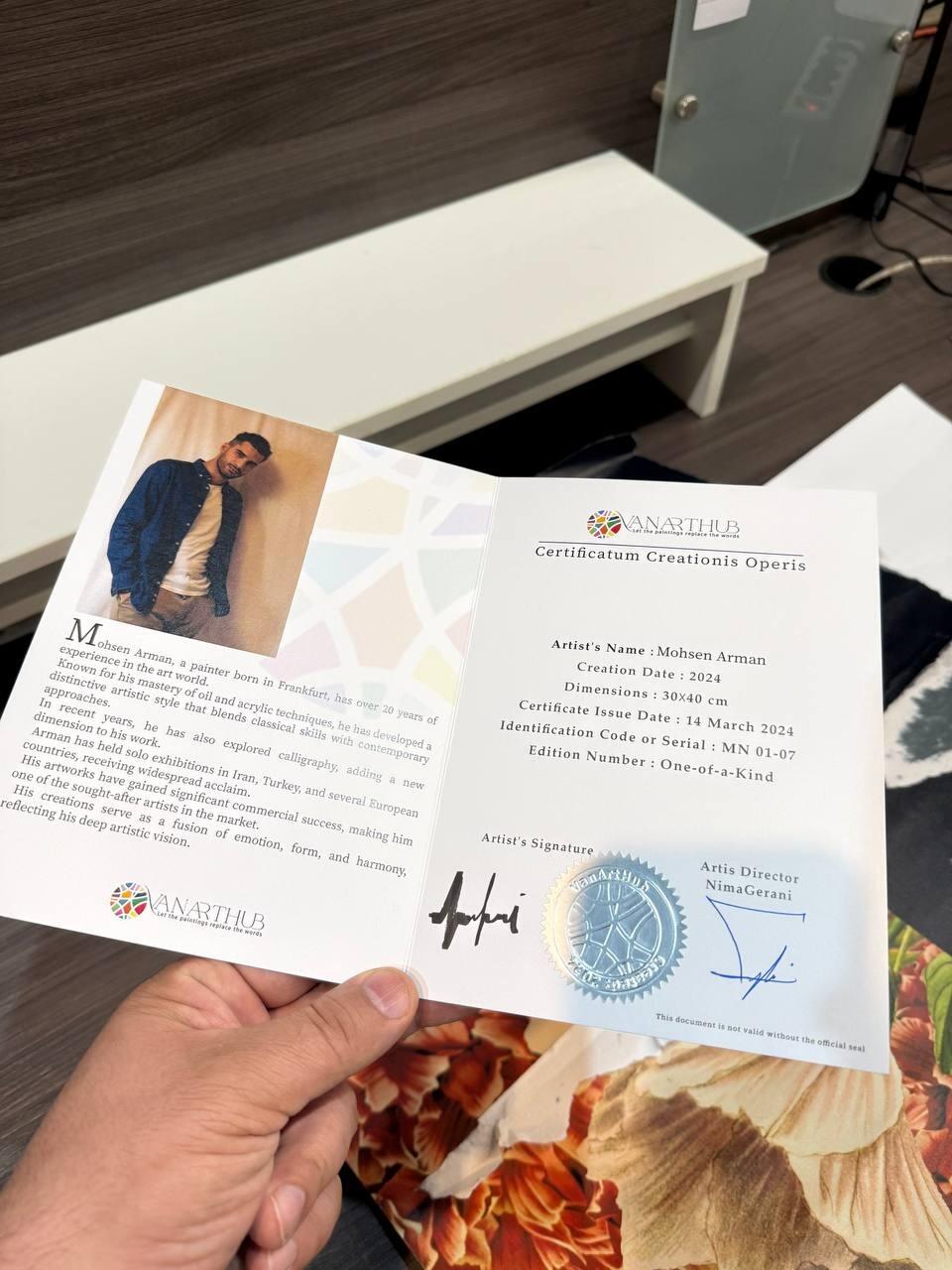
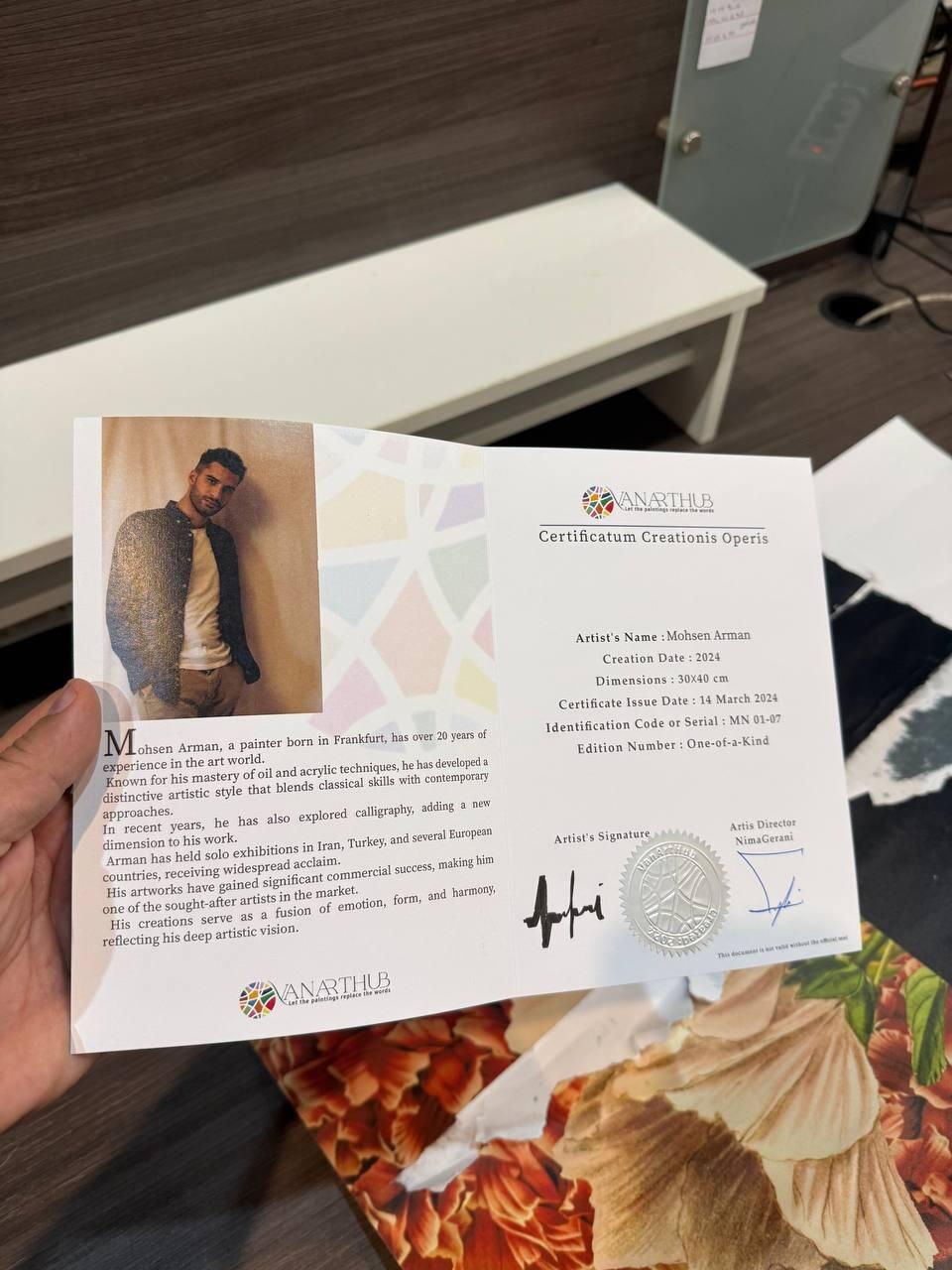
Ask for the documents. A living painter's work should come with a signed Certificate of Authenticity from the artist or the gallery that represents them.
Our guide on how to tell if a painting is real explains the wider set of checks, including raking light and provenance.
Frequently asked questions
What materials are used in Persian miniature painting?
Persian miniature painting uses paper, water-based pigments, gold and fine brushes. The British Institute of Persian Studies lists pigments from stones such as lapis lazuli and malachite, earths such as red ochre and plants such as madder root, mixed with gum arabic for paper. Royal paper was made from linen and hemp rags, according to the Metropolitan Museum of Art.
How was gold applied in Persian miniatures?
Gold in Persian miniatures was applied as shell gold, made by pounding gold between layers of deerskin into thin leaf and grinding it with honey, according to the British Institute of Persian Studies. The Metropolitan Museum of Art says the gilded pages were then burnished with a smooth, hard stone such as agate or rock crystal.
Who was Kamal al-Din Behzad?
Kamal al-Din Behzad was the most famous Persian painter, active in Herat under Sultan Husayn Bayqara, who ruled from 1470 to 1506, and later at the Safavid court in Tabriz. The Encyclopaedia Iranica says he was trained by Mirak Naqqash and dates his death by chronogram to 1535 or 1536.
Where is Behzad's best-accepted work held?
Behzad's most widely accepted paintings illustrate a Bustan of Sa'di, with a text dated 1488, held in the National Library of Egypt in Cairo. The Encyclopaedia Iranica says the manuscript has a double-page frontispiece and four illustrations, signed inside painted architectural inscriptions or on small objects in the scenes.
Who was Reza Abbasi?
Reza Abbasi, also called Aqa Reza, was the most celebrated painter of the Isfahan school, active from c. 1565 to 1635 and working on and off at the court of Shah Abbas I. The Encyclopaedia Iranica credits his "remarkable use of line and harmonious color schemes". Moin Mosavver was his most prolific pupil.
What was the Isfahan school of painting?
The Isfahan school of painting is the art made in Isfahan from 1597 to 1598, when it became the Safavid capital, until 1722. The Encyclopaedia Iranica says its painters turned from book illustration to single drawings and paintings, often signed and dated, which were collected in albums alongside samples of calligraphy.
What is a muraqqa?
A muraqqa is an album that gathers paintings, drawings and calligraphy on decorated pages. The Encyclopaedia Iranica dates the format to the late 15th century and describes a 1524 album in the Freer Gallery that opens with a round painting by Behzad. Kamal al-Din Ghotb's Muraqqa': The Blue Robe is painted as an album page.
What does pardakht mean in Persian painting?
Pardakht means the rendering of fine detail, one of the last stages of a Persian painting. The British Institute of Persian Studies calls pardakht the stage that "requires the highest level of technical artistry" and says it came after the ink outline, the colours and a second outline made with the finest brush.
How can I tell a hand-painted Persian miniature from a print?
A hand-painted Persian miniature shows continuous painted lines under a magnifier, while a print breaks into a regular dot pattern. Applied gold reflects light as metal when the page is tilted, and printed gold stays flat. A living painter's work should also come with a signed Certificate of Authenticity.
What is negargari?
Negargari is the Persian name for the classical miniature tradition. VanArtHub's page for Kamal al-Din Ghotb describes it as detailed painting on paper built from fine line work, flat luminous colour and applied gold, often set beside columns of Persian verse. Ghotb has practised Persian painting for 41 years.
How are Persian miniatures painted today?
Persian miniatures are painted today both in the classical method and in new forms. Kamal al-Din Ghotb paints in oil and gold on paper with figures at fingernail scale. Elham Pourkhani's Zahhak's Castle Is Calm of 2023, shown by the Middle East Institute, uses watercolour, gouache and 24k gold leaf on paper.
Why is the paper in Persian manuscripts rarely white?
Paper in Persian manuscripts is rarely white because it was dyed or sprinkled with gold or silver. The British Institute of Persian Studies says some painting treatises warned that a white background could weaken the eyes over time, and that paper was dyed with flowers, herbs and fruit juice by soaking.
References
-
A Note Persian Miniature Painting: Materials and Techniques. British Institute of Persian Studies. Undated. Accessed 26 September 2026. The conventions of the schools, paper, pigments and binders, shell gold, the order of painting, pardakht, borders and the move of Tahmasp's painters in the mid-1540s.
-
Making a Royal Manuscript. The Metropolitan Museum of Art, educator resources. Undated; Internet Archive copy of 5 March 2026. Accessed 26 September 2026. The workshop layout, rag paper, mineral pigments, the light-brush sketch and burnishing with agate or rock crystal.
-
The Shahnama of Shah Tahmasp (Heilbrunn Timeline of Art History). Francesca Leoni, The Metropolitan Museum of Art. Published June 2008; Internet Archive copy of 25 December 2024. Accessed 26 September 2026. The 258 paintings, the painters, the Turkmen and Timurid styles and the Met's 78 pages.
-
BEHZAD, KAMAL-AL-DIN. Priscilla Soucek, Encyclopaedia Iranica. Published 15 December 1989; Internet Archive copy of 29 August 2026. Accessed 26 September 2026. Behzad's life, the Bustan of 1488 in Cairo, the 1524 Freer album, and the manuscripts in the Met and the British Library.
-
ISFAHAN xi. School of Painting and Calligraphy. Encyclopaedia Iranica. Published 15 December 2007; Internet Archive copy of 5 December 2025. Accessed 26 September 2026. The dates of the school, albums, Reza Abbasi, Moin Mosavver and middle-class collectors.
-
SHAH-NAMA ii. Illustrations (English: Book of Kings). Marianna Shreve Simpson, Encyclopaedia Iranica. Published 21 April 2009; Internet Archive copy of 25 August 2026. Accessed 26 September 2026. The 58 Great Mongol illustrations, the Shiraz Shahnameh of 1393 to 1394 and Baysonghor's Shahnameh of 1430.
-
DEMOTTE SHAH-NAMA (English: the Demotte Book of Kings). Priscilla P. Soucek, Encyclopaedia Iranica. Published 15 December 1994; Internet Archive copy of 21 September 2026. Accessed 26 September 2026. The dispersal of the Great Mongol Shahnameh and the pages in the Arthur M. Sackler Gallery.
-
Bahram Gur Fights the Horned Wolf, illustrated folio from a manuscript of the Great Ilkhanid Shahnama. Harvard Art Museums. Undated. Accessed 26 September 2026. The Tabriz origin, the date of c. 1335 and the 57 surviving illustrations.
-
Rustam Mourns Sohrab and Carries His Coffin, folio from a manuscript of the Shahnama by Firdawsi. Harvard Art Museums. Undated. Accessed 26 September 2026. Shahnameh pages made in Shiraz between 1575 and 1590.
-
Zahhak Consults the Physicians, Folio from the Book of Kings (Shahnameh) of Shah Ismail II, AKM71. Aga Khan Museum. Undated. Accessed 26 September 2026. The Qazvin page of c. 1576 attributed to Naqdi.
-
Iran Modern. Asia Society Museum. Published 2013. Accessed 26 September 2026. Safavid revival style miniature painting after the Second World War.
-
PILARAM, FARAMARZ. Encyclopaedia Iranica. Published 1 August 2014; Internet Archive copy of 25 November 2025. Accessed 26 September 2026. Pilaram's training in miniature painting with Mahmoud Farschian at a school founded in 1951.
-
Maximal Miniatures: A Contemporary Take on a Centuries-Old Persian Art Form. Donna Honarpisheh, Middle East Institute. Published 4 March 2025. Accessed 26 September 2026. The works of Elham Pourkhani and Farah Ossouli and their media, and the miniature's multiple focal points.
-
Kamal al-Din Ghotb. VanArtHub. Undated. Accessed 26 September 2026. The gallery's description of his training, technique, birth year and the meaning of negargari.
-
Muraqqa': The Blue Robe, Original Persian Miniature in Oil and Gold by Kamal al-Din Ghotb. VanArtHub. Undated. Accessed 26 September 2026. The subject, size and year of the painting.
-
Naghsh-e Khial, Original Persian Miniature in Oil and Gold by Kamal al-Din Ghotb. VanArtHub. Undated. Accessed 26 September 2026. The subject, size, year and figures of the painting.
Checked 26 September 2026. If something here is out of date, write to us and we will correct it.