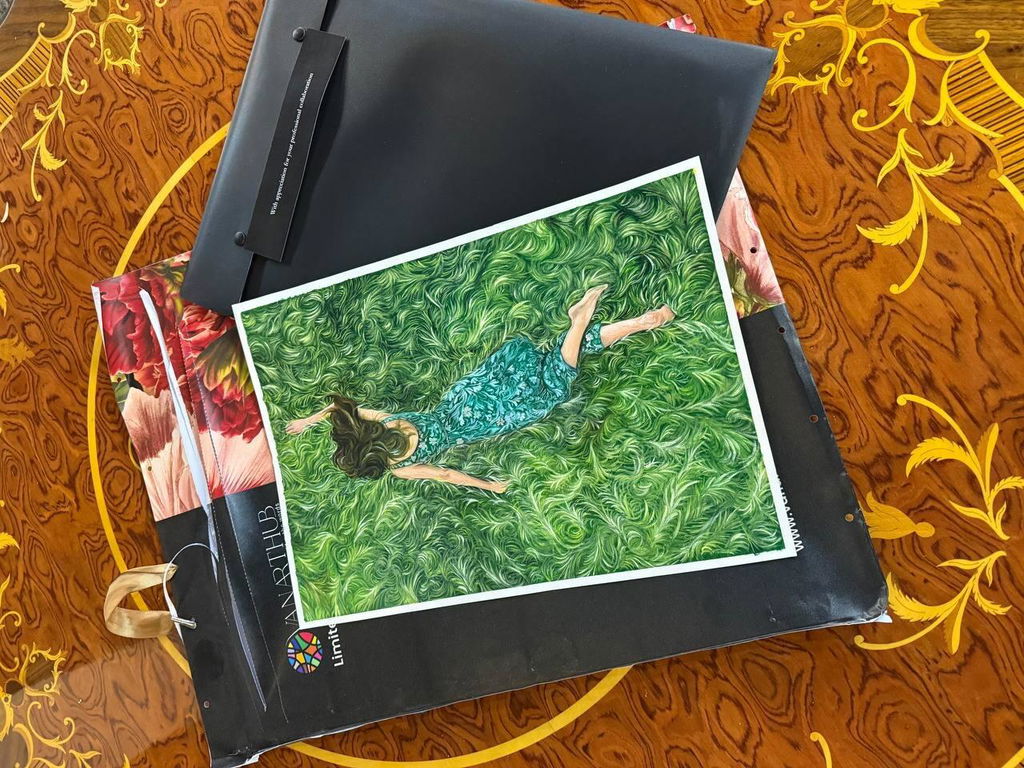
Surrealism and Persian painting share a set of visual habits that make a picture feel like a dream: flattened space seen from more than one angle at once, figures whose size follows importance instead of distance, scenes that could never happen, and an enclosed garden world set apart from ordinary life. Persian manuscript painting developed these habits centuries before surrealism, for its own reasons, in books of poetry and epic. We found no source that records the Paris surrealists studying Persian painting, so this page treats the link as a comparison that later viewers, curators and painters have made, and says which parts the museum sources support.
The comparison matters in our gallery, because several of our painters name Persian painting, Persian mythology or the great surrealists among their inspirations. The second half of this page looks at how three of them combine the two traditions, in the gallery's own words and in paintings you can see. The page is part of our guide to surrealist paintings.
Key takeaways
- The Shahnameh, or "Book of Kings", is an epic of 50,000 rhyming couplets completed by the poet Firdausi in 1010, according to the Metropolitan Museum of Art and the Queensland Art Gallery.
- The copy made for Shah Tahmasp in Tabriz from the early 1520s holds 258 paintings, and the Met calls it perhaps the most luxuriously illustrated copy of the epic ever produced.
- An Asia Society text on a painting from that manuscript says its skewed perspective shows the most important side of each object and "creates a sense of flattened space".
- A 2024 study published by the Courtauld finds that in the Shah Tahmasp manuscript "about half the paintings still involve no break at all" in their ruled frame, while the rest let figures, rocks or flags cross into the margin.
- The Aga Khan Museum explains that the English word "paradise" comes from the Persian for "walled garden".
What Persian manuscript painting is
Persian painting, often called Persian miniature painting, is mostly book painting: pictures painted to illustrate poems and histories, bound into manuscripts with the text. The Queensland Art Gallery describes its own set of pages from a Shahnameh made in Shiraz, each dated to circa 1570, as "opaque watercolour and gold on paper", set between leaves of handwritten text with colourful borders.
The Shahnameh, or "Book of Kings", is the text Persian painters illustrated most famously. The Met's essay by Francesca Leoni says the poem has 50,000 rhyming couplets and tells the history of the kings of Iran from mythical beginnings to the Arab conquest. The Queensland Art Gallery says the poet Firdausi completed it in 1010. Its heroes fight demons, called divs, and supernatural creatures, so painters of the Shahnameh had to picture things no one had seen. The Met says every king who ruled Iran, local or foreign, went on commissioning new copies, which were often lavishly illustrated.
The most famous copy was made for Shah Tahmasp. The Met says it was begun in the royal workshop at Tabriz in the early 1520s and carried on for at least twenty years, with 759 pages of text in the flowing nastaliq script and 258 paintings, by artists who included Sultan Muhammad, Mir Musavvir and Aqa Mirak. The Met calls it perhaps "the most luxuriously illustrated copy of Firdausi's epic ever produced". It left Iran as a gift to the Ottoman sultan Selim II, and its pages are now held by several collections, including the Met and the Museum für Islamische Kunst in Berlin.
Four features that later viewers compare with surrealism
Flattened space and more than one viewpoint
A Persian painting shows objects from more than one viewpoint. An Asia Society text on a painting from the Shah Tahmasp manuscript, written by Grace Norman, says "the skewed perspective allows us to see the most important aspect of each object. This creates a sense of flattened space." Rachel Alban, writing in the Courtauld's journal Immediations in 2024, describes the early Safavid style as using "flat planes of colour" and "compositions that create a planar design rather than the effect of recession", meaning the picture is built across the surface instead of into depth. The curator Donna Honarpisheh describes the miniature as "an uninterrupted visual field with multiple focal points of action" that draw the eye across the image.
The surrealist parallel is de Chirico. Tate's display text says the "distorted perspective and shadows" of his The Uncertainty of the Poet of 1913 undermine the usual rules of pictorial space and time. The purposes differ: the Asia Society text says the Persian approach shows the most important side of each object, while Tate says de Chirico's distortions undermine the conventions of pictorial space and time.
Size that follows importance
The same Asia Society text notes that "the figures are out of scale to the architecture, but this is not important, as they work to create a whole and gripping composition". In that painting, size follows the needs of the composition. Surrealist painters use changes of scale to produce the uncanny, the feeling Tate describes as familiar things in unexpected places. To a viewer who knows surrealist painting, the two effects can look alike.
Impossible scenes, painted as fact
Epic and legend give Persian painters scenes that cannot happen, and they paint them with the same care as a court reception. The Met's list of paintings from the Shah Tahmasp manuscript includes "Kai Kavus Ascends to the Sky" and "Tahmuras Defeats the Divs". The Museum für Islamische Kunst in Berlin owns a page from the same manuscript showing the Simurgh, a giant mythical bird, returning to her nest, where the young hero Zal, abandoned as a child for his white hair and raised by the bird, sits beside her chicks. The museum bought the painting in 1977.
This is the closest point to surrealist dream painting: an impossible event painted with total conviction. The difference is the source. The Persian painter illustrates a known story, and the surrealist paints a private dream.
The frame that the picture escapes
Persian paintings sit inside ruled lines, called the jadval, that frame the picture on the page. Alban's study finds that in the Shah Tahmasp manuscript "about half the paintings still involve no break at all", while the others let figures, rocks, trees or flags cross the jadval into the margin, some in small ways and some across two or more sides. She reads these breaks as a deliberate game with the limits of the painted image. The Aga Khan Museum describes a courtier in one Safavid garden painting as "seemingly propped up against the lower text panel", as if the text were a wall in the scene. The nearest surrealist parallel we know is Magritte's play with the difference between picture and reality.
Features of Persian manuscript painting and the surrealist parallels later viewers draw
| Feature |
Persian example and source |
Surrealist parallel |
| Flattened space, several viewpoints |
Shah Tahmasp Shahnameh, Tabriz, from the early 1520s; Asia Society, Courtauld |
De Chirico's distorted perspective in The Uncertainty of the Poet, 1913, Tate |
| Size set by importance |
Figures out of scale to the architecture; Asia Society |
Changes of scale that create the uncanny; Tate |
| Impossible scenes painted as fact |
The Simurgh with Zal in her nest, Museum für Islamische Kunst, Berlin |
Dream images painted in realistic detail; Tate Modern display |
| Picture escaping its frame |
Figures and rocks crossing the ruled frame; Courtauld study of 2024 |
Magritte's games between picture and reality, as in The Treachery of Images, 1929, LACMA |
| A garden world set apart |
Garden reception scenes; the walled garden behind the word "paradise"; Aga Khan Museum |
Dream settings closed off from ordinary life |
The garden world
The Aga Khan Museum explains that the English word "paradise" comes from the Persian for "walled garden", and that the classic Persian garden plan, the chahar bagh or "four garden", is a walled park divided by water channels. One Safavid garden page in the museum's collection shows a bazm, a festive court reception held outdoors with music, wine and feasting. The Queensland Art Gallery describes a reception scene where a garden is "glimpsed through breaks in the patterned tiling". The garden in these pictures is a world closed off from ordinary life, which is also what a surrealist dream setting is.
Contemporary painters who combine the two
The clearest evidence for the comparison comes from painters working now. In 2025 the Middle East Institute showed Maximal Miniatures, 13 contemporary Iranian artists who reinvent the Persian miniature. The exhibition text says their works move beyond representation into the surreal, the abstract and the otherworldly, and the curator, Donna Honarpisheh, describes Arghavan Khosravi's paintings as "colorful, playful, and surrealist depictions" in which a woman is much larger than everything around her. She describes Mahsa Tehrani's A Land of Magnets and Miracles of 2023 as an "unsettling and dreamlike tableau" with animals at an unnatural scale.
Three painters in our own collection work in the same space, each in a different way.
Phaedra
On her artist page, the gallery describes Phaedra as a painter working at the boundary of the figurative and the surreal, and lists her inspirations as surrealist cinema, Persian miniature painting, Vancouver's coastal light, and the tension between urban isolation and natural vastness. Her large oil Ecstasy in a Temporary Paradise, 140 by 180 cm and dated 2026, shows a woman floating among foxgloves, monarch butterflies and white rabbits above dark water, with snakes and a blue frog at the bottom edge. The painting fills its whole surface with flowers and creatures, and the title uses the same word, paradise, that the Persian garden gave to English. See the Phaedra collection.
Amir Fazelian
On his artist page, the gallery says Amir Fazelian "reimagines Persian mythology for the algorithmic age", and that his Div series turns the demons of Persian legend into pictures of modern anxiety about data, surveillance and the self in digital systems. The page describes a palette that moves between "earthy Persian miniature tones and cold digital blues", and lists Persian miniature-inspired detail work among his techniques and the Shahnameh among his inspirations. His The Thinking Monster (Div Andish), in watercolour and ink on cardboard, shows a horned, furry creature in a crown, with blue eyes and tusks, while a ringed hand moves pieces on a chessboard in front of him. Divs appear in the Shahnameh, and this painting places one at a chessboard, in a game of strategy. See the Amir Fazelian collection, and our article on Persian mythology in contemporary art for more on the div.
Nima Sayadian
On his artist page, the gallery describes Nima Sayadian as a painter working "at the intersection of symbolism, surrealism, and psychological portraiture", and lists his inspirations as Persian mythology, Jungian psychology, surrealist painting (Magritte and de Chirico), philosophical texts and "the architecture of dreams". His compositions, the page says, often place solitary figures in ambiguous settings. In his Searching for Monad, an acrylic on canvas of 120 by 80 cm dated 2025, four figures in white hooded protective suits bend over pale boxes in a field of dark plants under a heavy grey sky. No face is visible and the task is never explained, which recalls de Chirico's ordinary scenes made strange by what they leave out. See the Nima Sayadian collection.
How to look at a painting that draws on both
Use the five steps on our page about how to read a surrealist painting, and add two questions from the Persian side. First, is the space built across the surface, like a manuscript page, or into depth, like a window? Second, is the strange event a private dream, or a story the painter expects you to know, such as a div or the Simurgh? The answer changes how you read everything else. For the European side of the timeline, see our short history of surrealist painting.
Frequently asked questions
Was surrealism influenced by Persian miniature painting?
No source we checked records the Paris surrealists studying Persian miniature painting, so the link is best treated as a comparison made by later viewers and painters. The two traditions share flattened space, size set by importance and impossible scenes painted as fact. Contemporary Iranian artists shown in Maximal Miniatures in 2025 combine the two directly.
What is the Shahnameh?
The Shahnameh, or "Book of Kings", is a Persian epic of 50,000 rhyming couplets that tells the history of the kings of Iran from mythical beginnings to the Arab conquest. The poet Firdausi completed it in 1010. Its heroes fight demons called divs and supernatural creatures, and the Met says every king who ruled Iran went on commissioning new, often lavishly illustrated copies.
How many paintings are in the Shahnameh of Shah Tahmasp?
The Shahnameh of Shah Tahmasp contains 258 paintings, with 759 pages of text, according to the Metropolitan Museum of Art. It was begun in the royal workshop at Tabriz in the early 1520s by artists including Sultan Muhammad, Mir Musavvir and Aqa Mirak. The Met calls it perhaps the most luxuriously illustrated copy of the epic ever produced.
Why does space look flat in Persian paintings?
Space looks flat in Persian paintings because the painter shows each object from the angle that reveals it best. An Asia Society text on the Shah Tahmasp Shahnameh says the skewed perspective "allows us to see the most important aspect of each object" and "creates a sense of flattened space". A 2024 Courtauld study describes planar design instead of recession.
What is the Simurgh in Persian painting?
The Simurgh is a giant mythical bird from Persian legend who, in the Shahnameh, raises the abandoned child Zal in her nest. The Museum für Islamische Kunst in Berlin owns a painting from the Shah Tahmasp Shahnameh showing the Simurgh at her nest with Zal beside her chicks, which the museum bought in 1977.
Where does the word paradise come from?
The word paradise comes from the Persian for "walled garden", according to the Aga Khan Museum in Toronto. The classic Persian garden, the chahar bagh or "four garden", is a walled park divided by water channels. Gardens and outdoor court receptions called bazm appear often in Persian painting, as in a Safavid garden page in the museum's collection.
Why do figures break the frame in some Persian paintings?
Figures break the frame in some Persian paintings as a deliberate game with the limits of the painted image, according to Rachel Alban's 2024 study in the Courtauld's journal Immediations. She writes that in the Shah Tahmasp Shahnameh "about half the paintings still involve no break at all" in the ruled frame, called the jadval, while the rest let figures, rocks or flags cross into the margin.
Which contemporary artists combine Persian miniature painting and surrealism?
Contemporary artists who combine Persian miniature painting and surrealism include Arghavan Khosravi and Mahsa Tehrani, both shown in Maximal Miniatures at the Middle East Institute in 2025. The curator, Donna Honarpisheh, called Khosravi's paintings "colorful, playful, and surrealist depictions". In our gallery, Phaedra, Amir Fazelian and Nima Sayadian draw on both traditions.
What is Amir Fazelian's Div series?
Amir Fazelian's Div series turns the demons of Persian legend, called divs, into pictures of modern anxiety about data, surveillance and the self in digital systems, according to his artist page at VanArtHub. The page describes a palette moving between earthy Persian miniature tones and cold digital blues. The Thinking Monster (Div Andish) is in watercolour and ink on cardboard.
Which painters inspire Nima Sayadian?
Nima Sayadian's inspirations include the surrealist painters René Magritte and Giorgio de Chirico, according to his artist page at VanArtHub, which also lists Persian mythology, Jungian psychology, philosophical texts and "the architecture of dreams". The page says his acrylic paintings often place solitary figures in ambiguous settings, as in Searching for Monad of 2025.
What does Phaedra's Ecstasy in a Temporary Paradise show?
Phaedra's Ecstasy in a Temporary Paradise shows a woman floating among foxgloves, monarch butterflies and white rabbits above dark water, with snakes and a blue frog at the lower edge. The oil on canvas measures 140 by 180 cm and is dated 2026. Her artist page lists Persian miniature painting and surrealist cinema among her inspirations.
References
-
The Shahnama of Shah Tahmasp (Heilbrunn Timeline of Art History). Francesca Leoni, The Metropolitan Museum of Art. Published June 2008; Internet Archive copy of 25 December 2024. Accessed 26 September 2026. The length and subject of the Shahnameh, the Shah Tahmasp manuscript, its 258 paintings, its artists, its gift to Selim II, and the titles of its paintings.
-
The Shahnameh: Persian miniatures. Queensland Art Gallery | Gallery of Modern Art. Undated. Accessed 26 September 2026. The completion of the poem in 1010, the materials of Shahnameh paintings, and the garden glimpsed in a reception scene.
-
Shahnama: The Book of Kings. Grace Norman, Asia Society. Published 20 August 2008. Accessed 26 September 2026. The skewed perspective, flattened space, out-of-scale figures and bright colour of a painting from the Shah Tahmasp manuscript.
-
The Edge of Artifice: The Shāhnāmeh of Shah Tahmāsp and Interrogating the Edge in Early Safavid Manuscript Painting. Rachel Alban, Immediations no. 21, The Courtauld. Published 2024. Accessed 26 September 2026. Flat planes and planar design, the jadval, and the share of paintings with and without frame breaks.
-
A painting from the Shahnameh: The Persian Book of Kings. Museum für Islamische Kunst, Staatliche Museen zu Berlin. Published 2025. Accessed 26 September 2026. The Simurgh and Zal painting from the Shah Tahmasp manuscript and its purchase in 1977.
-
Princely Entertainment in a Garden, Folio from a manuscript of the Collected Works (Divan) of Sultan Ibrahim Mirza (fol. 19), AKM282.19. Aga Khan Museum. Undated. Accessed 26 September 2026. The bazm scene and the courtier propped against the text panel.
-
Paradise Garden: The Wagner Garden Carpet. Aga Khan Museum. Undated. Accessed 26 September 2026. The Persian origin of the word paradise and the chahar bagh garden plan.
-
Maximal Miniatures: A Contemporary Take on a Centuries-Old Persian Art Form. Donna Honarpisheh, Middle East Institute. Published 4 March 2025. Accessed 26 September 2026. The miniature's visual field and focal points, and the work of Arghavan Khosravi and Mahsa Tehrani.
-
Maximal Miniatures: Contemporary Art from Iran. Middle East Institute. Published 2025. Accessed 26 September 2026. The 13 artists and the curator's description of their work as surreal and otherworldly.
-
International Surrealism. Tate Modern display text. Undated. Accessed 26 September 2026. De Chirico's distorted perspective and the realistic painting of dream images.
-
The uncanny. Tate. Undated. Accessed 26 September 2026. The uncanny as familiar things in unexpected contexts.
-
René Magritte, The Treachery of Images (This is Not a Pipe), 1929. Los Angeles County Museum of Art. Undated. Accessed 26 September 2026. The date and museum of the painting used as a parallel.
-
Phaedra. VanArtHub. Undated. Accessed 26 September 2026. The gallery's description of Phaedra and her listed inspirations.
-
Ecstasy in a Temporary Paradise: Original Oil Painting on Canvas, 140×180 cm. VanArtHub. Undated. Accessed 26 September 2026. The medium, size, year and subject of the painting.
-
Amir Fazelian. VanArtHub. Undated. Accessed 26 September 2026. The gallery's description of the Div series, palette, techniques and inspirations.
-
The Thinking Monster (Div Andish): Original Watercolor and Ink on Cardboard by Amir Fazelian. VanArtHub. Undated. Accessed 26 September 2026. The medium and subject of the painting.
-
Nima Sayadian. VanArtHub. Undated. Accessed 26 September 2026. The gallery's description of Nima Sayadian's work and listed inspirations.
-
Searching for Monad: Original Artwork by Nima Sayadian. VanArtHub. Undated. Accessed 26 September 2026. The medium, size, year and subject of the painting.
Checked 26 September 2026. If something here is out of date, write to us and we will correct it.