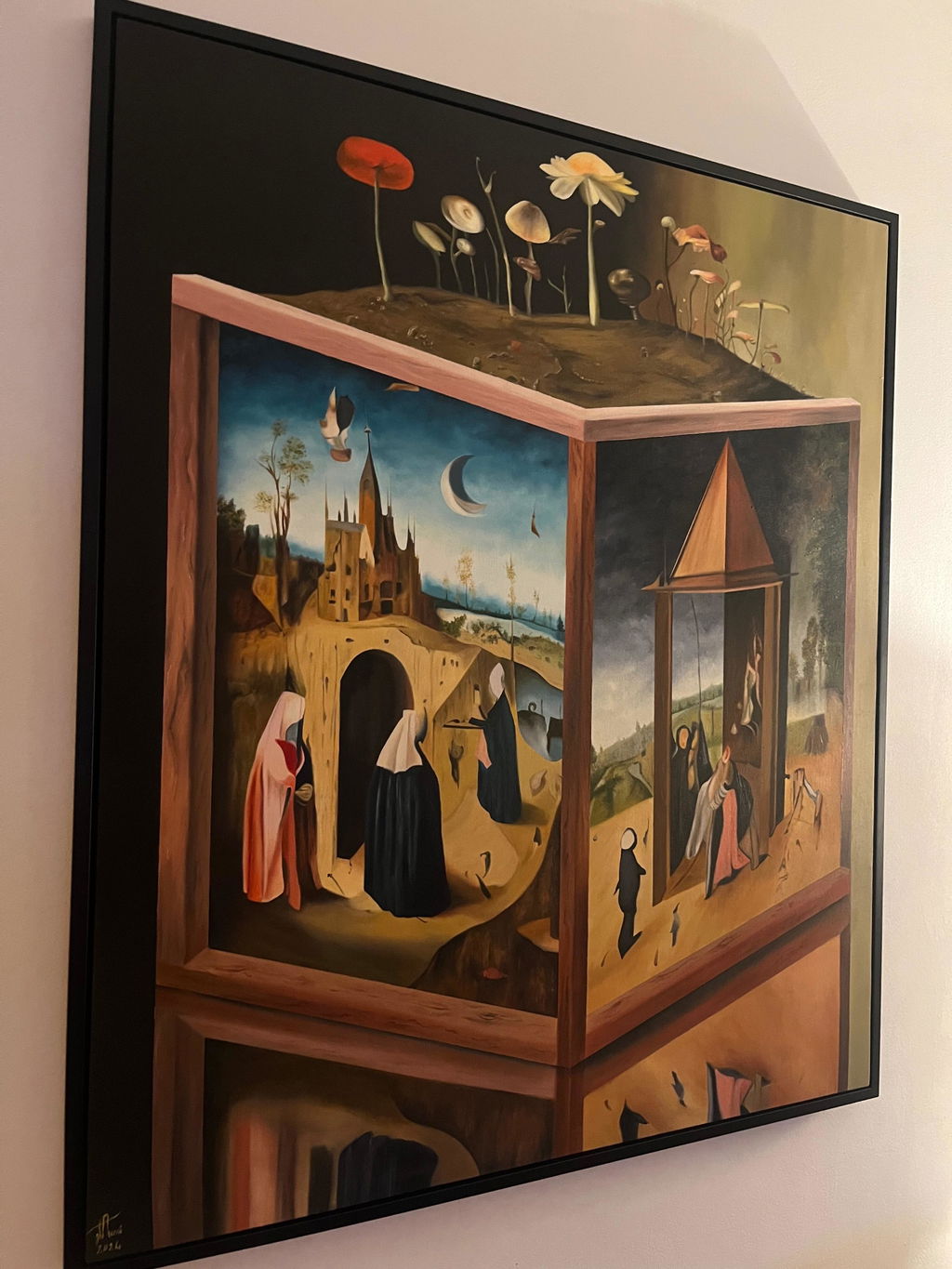
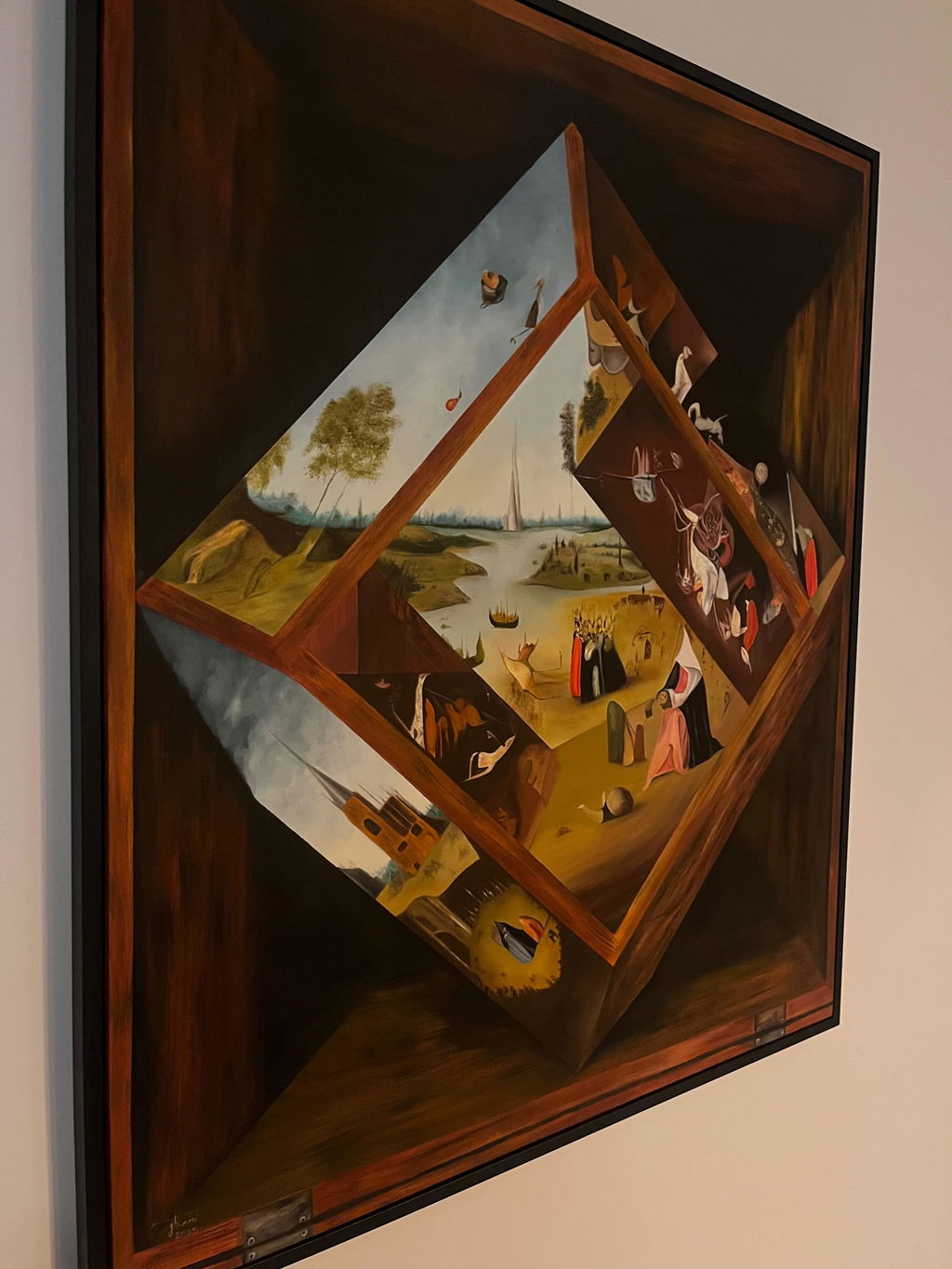
To collect contemporary surrealism well, judge each painting on four things: the drawing, the invention, the finish and the condition of the surface. Then check the paperwork that proves where the painting came from, and ask the seller a short list of questions before you pay. A precise surrealist painting works only if its impossible scene is convincing, so these checks matter more for this style than for a quiet abstract or a still life.
This page takes each check in turn, explains how the medium affects the price of a painting as a general principle, and compares buying from a gallery with buying at auction. It is part of our guide to surrealist paintings. We sell contemporary surrealist paintings ourselves, and we say where our interest lies.
Key takeaways
- Tate describes the dream-image approach in surrealism as depicting "the imagery of dreams in highly realistic detail", so drawing and finish carry most of the weight when you judge such a painting.
- Tate says oil paint "continues to dry, getting harder with age over many decades", while acrylic paint, first made in the 1950s, dries quickly and is waterproof once dry.
- ASTM International's standard for artists' coloured pencils tests coloured pencils under daylight through window glass to give each pencil a lightfastness rating.
- MoMA's Provenance Research Project investigates the ownership history of works in its collection, and the Dalí catalogue raisonné traces The Persistence of Memory from the Galerie Pierre Colle in Paris to the museum in 1934.
- Christie's charges a buyer's premium of 28% of the hammer price on each lot up to US$2,000,000, under rates effective from 1 September 2026.
Check the drawing first
A surrealist painting of the dream-image kind asks you to believe something impossible for a moment. Tate's display text at Tate Modern describes these painters as depicting dream imagery "in highly realistic detail", and that realism is only as good as the drawing under it. If a hand is wrong or a building leans without reason, the viewer's eye stops at the error and the illusion fails.
Look at the hardest parts first: hands, faces seen at an angle, the ellipse of a cup or a wheel, the perspective of a floor. Then look at how the impossible part is drawn. A floating figure should still have weight, with a shadow that agrees with the light.
Check the invention
The second question is whether the impossible idea belongs to the painter. Surrealism has famous images that are easy to borrow. MoMA's text on Salvador Dalí's The Persistence of Memory of 1931 describes its limp watches as "the camembert of time", and MoMA calls clouds, pipes, bowler hats and green apples some of the most recognisable icons of René Magritte. A new painting with a melting clock or a man in a bowler hat is quoting one of those painters.
Quotation is allowed, and some good contemporary paintings answer Dalí or Magritte on purpose. Ask what the new painting adds. Our firm view is that a painting built only from borrowed icons is decoration in the surrealist manner, and that you should pay for invention: an image you have not seen before, which the painter can explain from their own life or ideas. Our page on the history of surrealist painting shows the original images, which helps you recognise a borrowed one.
Check the finish
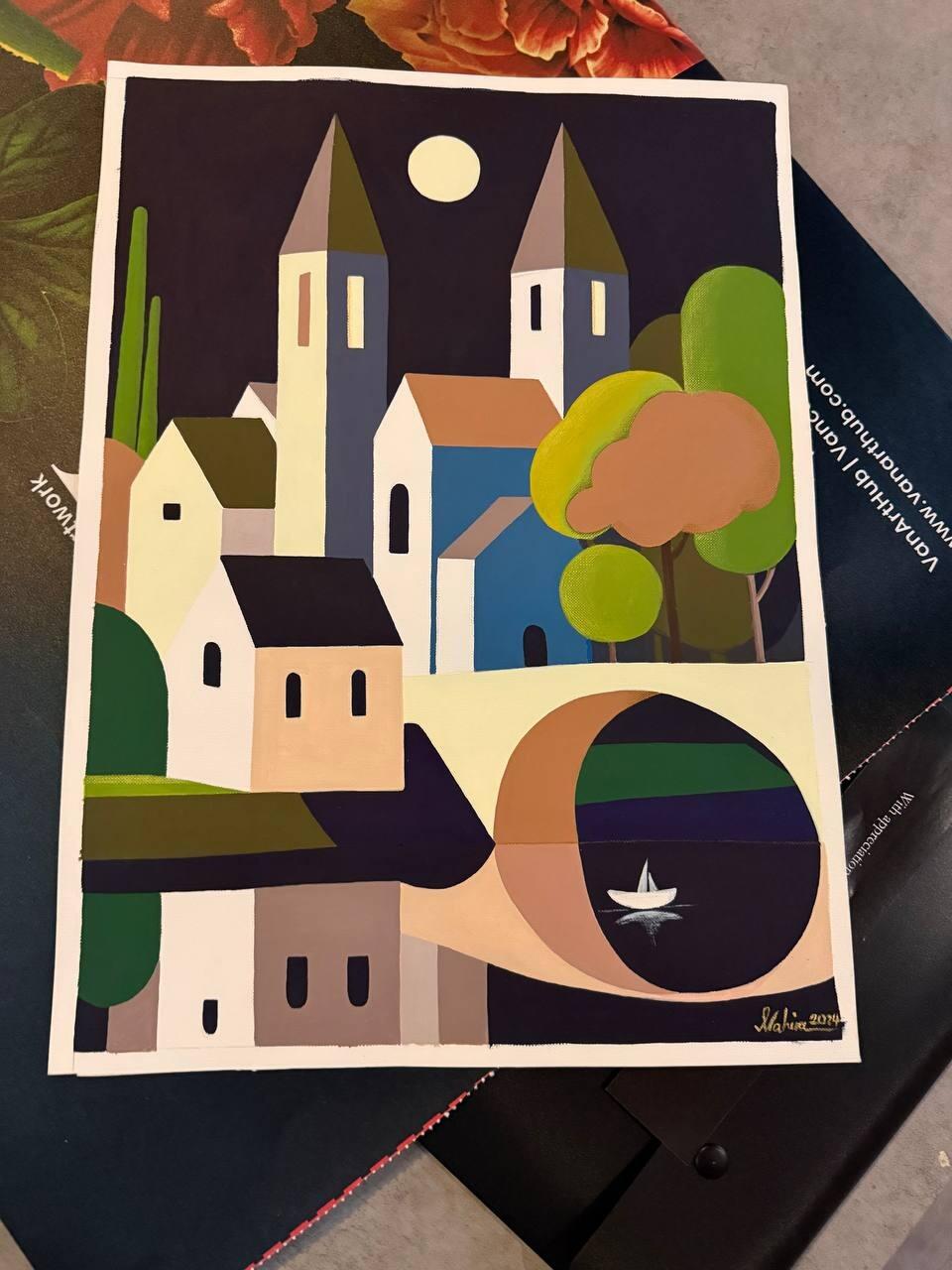
Finish means how the paint or pencil surface looks up close. In precise surrealist painting, a smooth, even finish makes the impossible look real, and uneven patches or muddy colour weaken it. In surrealist work that uses chance, such as scraped or blotted paint, the finish is the image itself, and the question becomes whether the painter developed the chance marks with judgement or left them raw.
Look at the painting in raking light, with a lamp held to one side, so the texture shows. Check the edges of the canvas, the corners, and the areas the painter would expect you to look at least: the dark background, the lower corners. Care in those areas is a good sign of care everywhere.
Check the condition of the surface
A new painting should be in perfect condition, but it is still a physical object that changes. Tate explains that oil paint dries slowly, that thin layers become touch-dry in a few days while thicker layers take longer, and that oil paint "continues to dry, getting harder with age over many decades". Acrylic paint, in Tate's description, is water-based, dries quickly and is waterproof once dry.
Look for cracks, for areas where paint lifts from the canvas, and for cupping, where small islands of paint curl at their edges. The Canadian Conservation Institute shows a painting by Cornelius Krieghoff that cracked and cupped after a century of daily humidity changes. On a painting that is only a year or two old, any cracking is a warning sign that deserves a question. Check the back too: the canvas should be tight on its stretcher bars, and the corners should be neat. Our page on living with surrealist art covers the light and humidity that keep a painting in good condition once it is yours.
How the medium affects the price
Prices change, so this guide explains the principles that set them. In our experience, size and the artist's reputation matter most, and medium comes next, because it changes how long a painting takes to make and how long it lasts.
How medium affects the making, the durability and the price of a surrealist painting, as general principles
| Medium |
How it is made |
What the sources say about durability |
General effect on price |
| Oil on canvas |
Slow-drying paint lets the painter build layers and correct over weeks |
Tate says oil paint keeps hardening over many decades; the Canadian Conservation Institute's older guidelines put oil paint surfaces in the 150 lux group |
Usually the highest for a given size and artist, because of the time involved |
| Acrylic on canvas |
Fast-drying, water-based paint that can be used thin or thick |
Tate says acrylic is waterproof once dry; the same 150 lux group as oil |
Often lower than oil for the same size and artist, though a detailed acrylic can take as long as an oil |
| Coloured pencil on board or paper |
Built up by hand, one layer of pencil at a time |
ASTM tests each pencil's lightfastness; works on paper sit in the more sensitive 50 lux group |
Usually lower than a painting of the same size; large, dense works narrow the gap |
| Watercolour and ink |
Washes and lines on paper or board |
Watercolours are in the 50 lux group in the older guidelines |
Depends on size and detail; framing under glazing adds to the total cost |
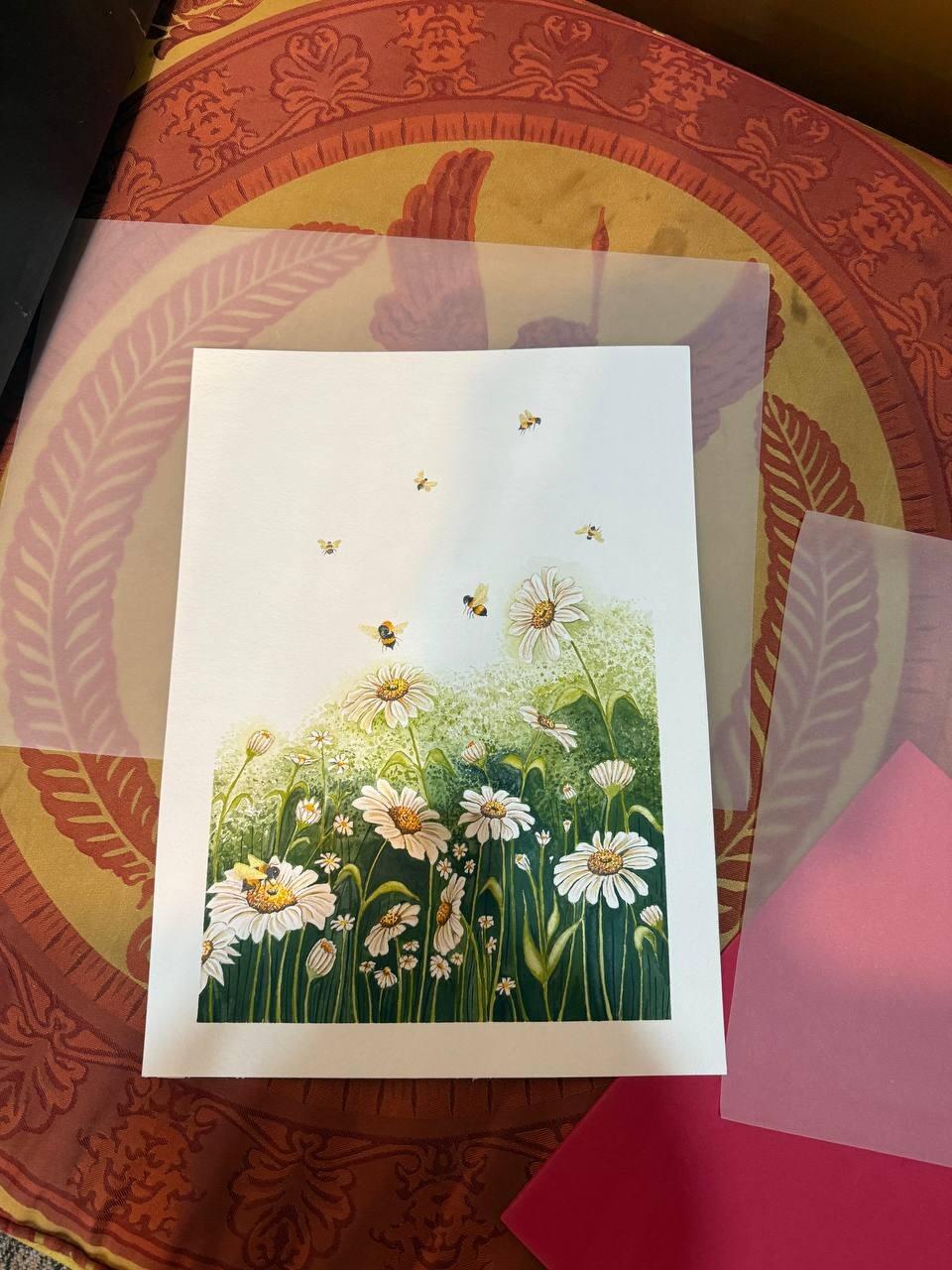
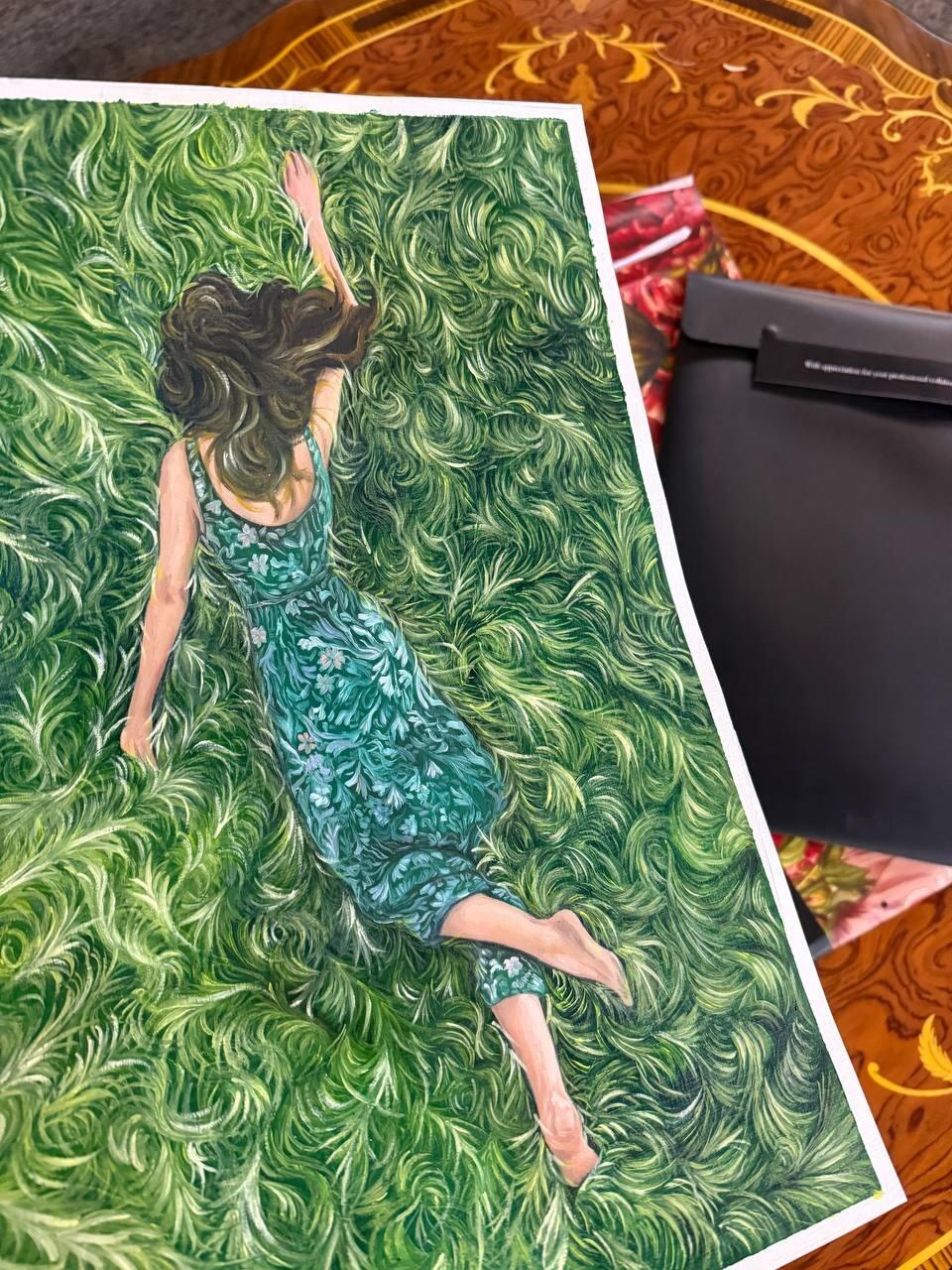
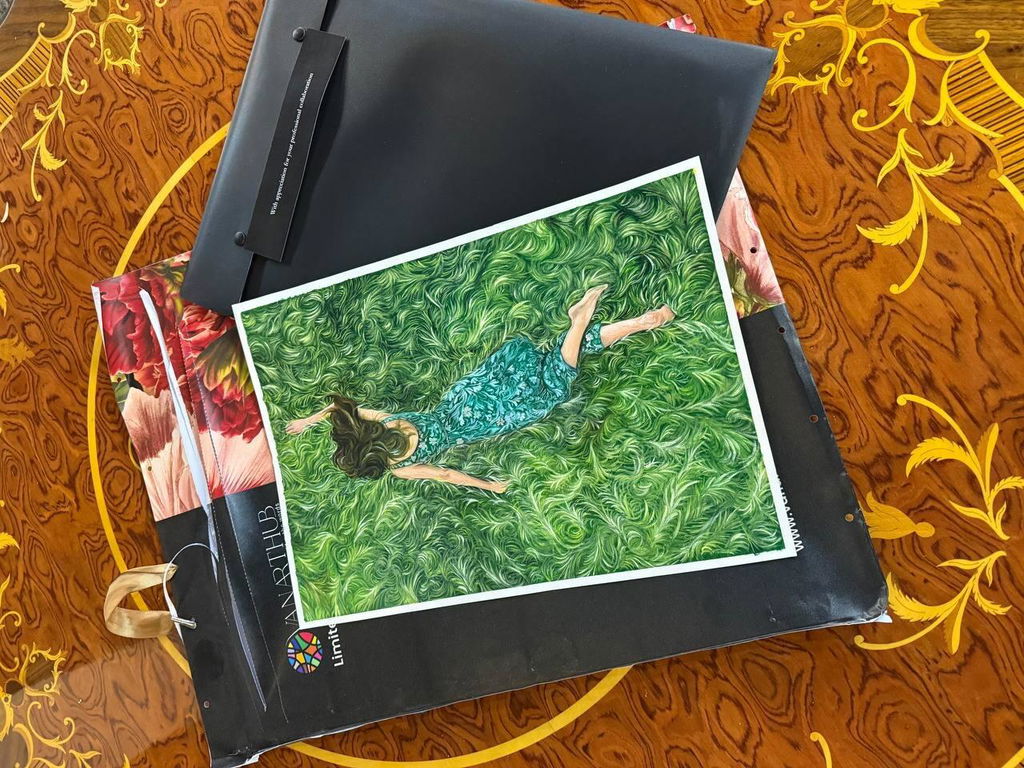
The last column is our general experience of how galleries price work, and exceptions are common. One artist can work in several media at different price levels. On her artist page, the gallery lists Phaedra as working in oil, coloured pencil and mixed media, and the Phaedra collection holds both large oils on canvas and coloured pencil works on artboard. Comparing works by one artist is the clearest way to see what medium alone does to a price. For the practical differences between the two main paints, see our guide to oil versus acrylic paintings.
Provenance and certificates
Provenance is the ownership history of a painting. MoMA runs a Provenance Research Project that investigates the ownership history of works in its collection. For a famous painting, the record can be long. The Dalí catalogue raisonné traces The Persistence of Memory from the Galerie Pierre Colle in Paris to the Julien Levy Gallery in New York, and then to Helen Resor, who bought it from Levy in 1934 as a gift, the year MoMA received it.
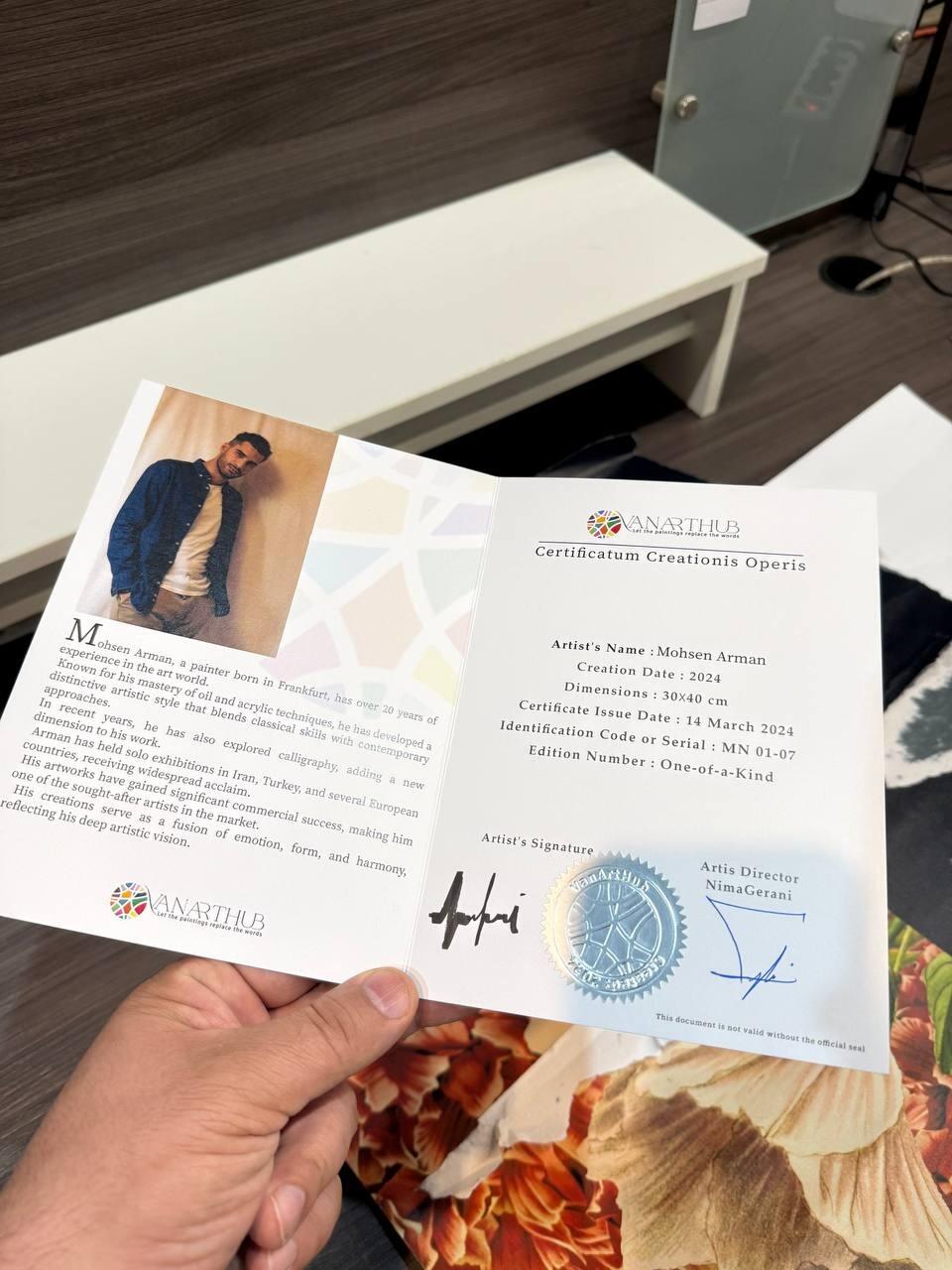
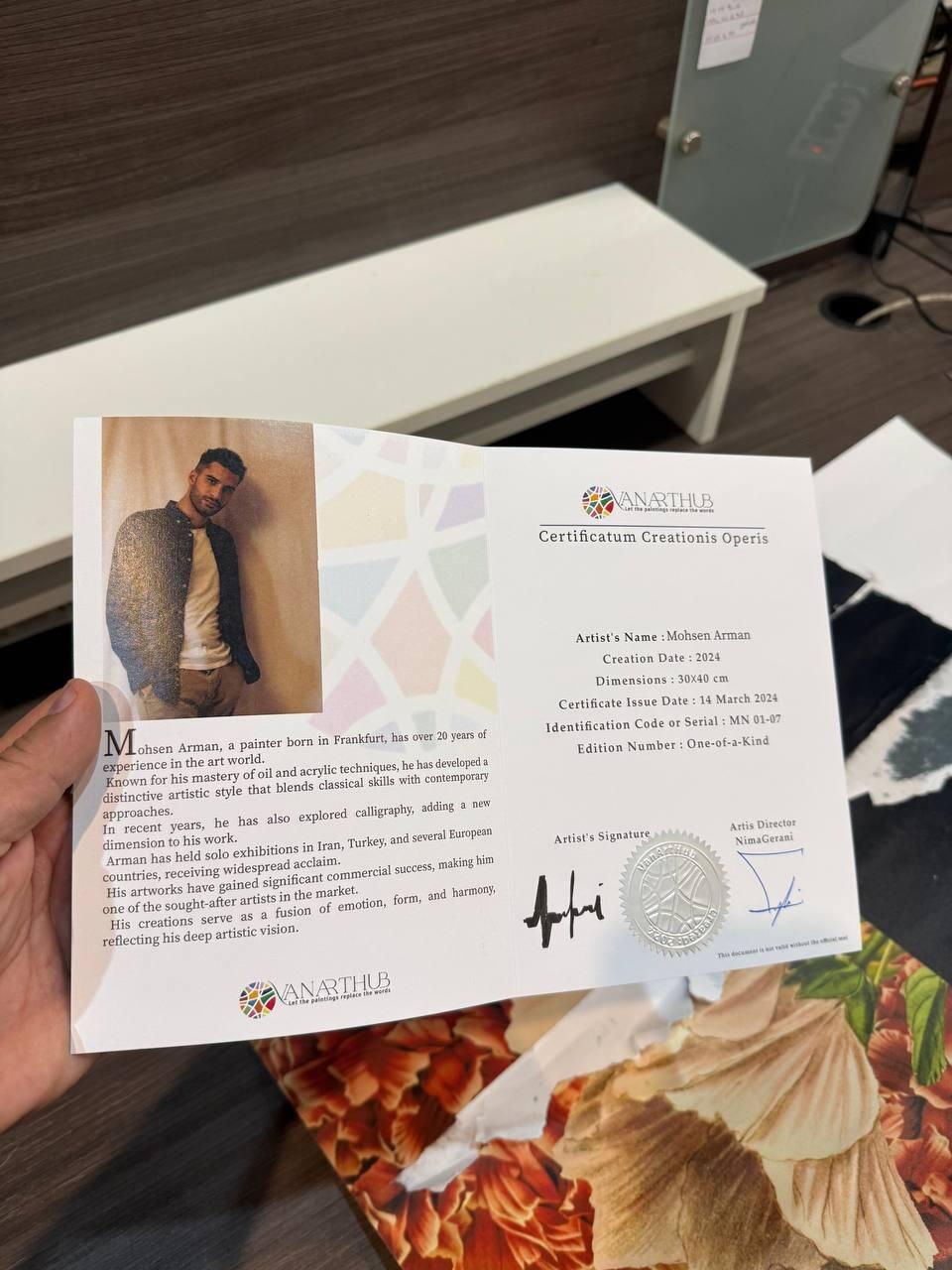
A contemporary painting bought from a gallery has a short provenance: the artist, the gallery, and you. The first entries are the paperwork you receive at purchase, so keep the invoice and the certificate of authenticity together. Our page on the certificate of authenticity for art explains what a useful certificate records and whose signature matters, and our guide on how to tell if a painting is real gives the physical checks.
Questions to ask before you buy
Ask these before paying for any contemporary surrealist painting, from us or anyone else:
- Who painted it, and can you show me other work by the same artist?
- When was it finished, and in what medium, on what support?
- What does the image mean to the artist? Is there a written statement?
- Has it been varnished, or will it need varnishing later?
- Is it one of a kind, and are there prints or reproductions of it?
- Does it come with a certificate of authenticity, and who signs it?
- What are the exact dimensions with and without the frame, and how is it hung?
- How is it packed and insured in transit, and what happens if it arrives damaged?
- Can I return it if it does not suit the room?
Our own answers to the last questions are on our buy with confidence page: every piece is a signed original with a certificate of authenticity, ships free and fully insured, and comes with a 14-day trial and a Lifetime Trade-Back for store credit.
Buying at auction or from a gallery
A new painting by a living artist is sold for the first time by the artist or by a gallery. That first sale is where you can ask the artist about the image, see the work in person, and get paperwork straight from the source.
Auction prices also carry an extra charge that a first-time buyer can miss. Christie's, for example, charges a buyer's premium, a fee paid by the successful bidder in addition to the hammer price. Under rates effective from 1 September 2026, the premium is 28% of the hammer price of each lot up to US$2,000,000, with lower rates above that. Our article on buying art at auction versus from a gallery goes through condition reports, returns and provenance in each setting. Our view is that for a first surrealist painting by a living artist, a gallery that lets you see the work in your room and speak to the artist is the better start.
Frequently asked questions
How do I judge the quality of a contemporary surrealist painting?
Judge the quality of a contemporary surrealist painting on drawing, invention, finish and surface condition, in that order. Tate describes the dream-image approach as depicting dreams "in highly realistic detail", so weak drawing breaks the effect. Then ask whether the impossible idea belongs to the painter, whether the surface is even and careful, and whether it shows any cracking.
Is a painting with melting clocks just a copy of Dalí?
A painting with melting clocks is quoting Salvador Dalí, whose The Persistence of Memory of 1931 shows the limp watches MoMA quotes him calling "the camembert of time". Quotation can be deliberate and interesting, so ask what the new painting adds. We advise paying for invention, meaning an image you have not seen before that the painter can explain.
How does the medium affect the price of a surrealist painting?
The medium affects the price of a surrealist painting mainly through the time it takes to make. Tate explains that slow-drying oil paint lets a painter build and correct layers over time, while acrylic dries quickly. In our experience, oil costs more than acrylic, and coloured pencil less than paint, for the same size and artist, though dense work narrows the gap.
Are coloured pencil artworks durable?
Coloured pencil artworks are durable when made with lightfast pencils and kept out of strong light. ASTM International's standard for artists' coloured pencils tests coloured pencils under daylight through window glass to give each pencil a lightfastness rating. The Canadian Conservation Institute's older guidelines put works on paper in the most sensitive group, at 50 lux, so frame them behind ultraviolet-filtering glazing.
Does oil paint keep changing after a painting is finished?
Oil paint keeps changing after a painting is finished, because it dries by hardening in air. Tate says thin layers become touch-dry in a few days, thicker layers take longer, and oil paint "continues to dry, getting harder with age over many decades". Acrylic paint, by contrast, dries quickly and is waterproof once dry.
What is provenance for a contemporary painting?
Provenance for a contemporary painting is its short ownership history: the artist, the gallery, and you. MoMA's Provenance Research Project investigates the ownership history of works in its collection, and the Dalí catalogue raisonné traces The Persistence of Memory through two galleries to MoMA in 1934. For a new painting, keep the invoice and the certificate of authenticity together.
What should I check on the surface of a surrealist painting before buying?
Check the surface of a surrealist painting for cracks, lifting paint and cupping, then look at the back for a tight canvas and neat corners. The Canadian Conservation Institute shows a Cornelius Krieghoff painting that cracked and cupped after a century of daily humidity changes. On a painting only a year or two old, any cracking deserves a question.
What is Christie's buyer's premium in 2026?
Christie's buyer's premium in 2026 is 28% of the hammer price of each lot up to US$2,000,000, under rates effective from 1 September 2026, with lower percentages on the part of the price above that. The buyer's premium is a fee the successful bidder pays in addition to the hammer price, so it belongs in any auction budget.
Should I buy contemporary surrealism at auction or from a gallery?
Contemporary surrealism by living painters is best bought from a gallery, in our view, because a new painting is first sold by the artist or a gallery, where you can see the work and ask about the image. Auctions also add a buyer's premium, which Christie's sets at 28% of the hammer price up to US$2,000,000 from 1 September 2026.
Does one artist's work vary in price by medium?
One artist's work can vary in price by medium. On her artist page, VanArtHub lists Phaedra as working in oil, coloured pencil and mixed media, and her collection holds both large oils on canvas and coloured pencil works on artboard. Comparing works by one artist in different media is the clearest way to see what medium alone does to a price.
References
-
International Surrealism. Tate Modern display text. Undated. Accessed 26 September 2026. The dream-image approach depicted in highly realistic detail.
-
Oil paint. Tate. Undated. Accessed 26 September 2026. The slow drying of oil paint, touch-dry times, and hardening over many decades.
-
Acrylic paint. Tate. Undated. Accessed 26 September 2026. Acrylic first made in the 1950s, fast drying, and waterproof once dry.
-
Agent of Deterioration: Incorrect Relative Humidity. Stefan Michalski, Canadian Conservation Institute, Government of Canada. Undated online edition. Accessed 26 September 2026. The Krieghoff painting cracked and cupped by daily humidity changes.
-
Agent of Deterioration: Light, Ultraviolet and Infrared. Stefan Michalski, Canadian Conservation Institute, Government of Canada. Undated online edition. Accessed 26 September 2026. The 50 lux and 150 lux groups in older museum guidelines.
-
Standard Specification for Artists' Colored Pencils (D6901-15R21). ASTM International. Reapproved 2021. Accessed 26 September 2026. Lightfastness testing of each coloured pencil under daylight through window glass.
-
Salvador Dalí. The Persistence of Memory. 1931. The Museum of Modern Art. Undated; Internet Archive copy of 21 September 2026. Accessed 26 September 2026. The limp watches and "the camembert of time".
-
René Magritte. The Menaced Assassin. Brussels 1927. The Museum of Modern Art. Undated; Internet Archive copy of 21 June 2026. Accessed 26 September 2026. Magritte's most recognisable icons.
-
Joan Miró. The Birth of the World. Montroig, late summer-fall 1925. The Museum of Modern Art. Undated; Internet Archive copy of 28 January 2026. Accessed 26 September 2026. MoMA's Provenance Research Project and its investigation of ownership history.
-
The Persistence of Memory (catalogue raisonné, cat. no. P 265). Fundació Gala-Salvador Dalí. Undated. Accessed 26 September 2026. The provenance of the painting from the Galerie Pierre Colle to MoMA.
-
How to buy at Christie's: Financial information. Christie's. Rates effective 1 September 2026. Accessed 26 September 2026. The buyer's premium rates and thresholds.
-
Phaedra. VanArtHub. Undated. Accessed 26 September 2026. The media Phaedra works in and the works listed on her page.
Checked 26 September 2026. If something here is out of date, write to us and we will correct it.