Persian painting is the painting tradition of Iran and the wider Persian-speaking world, best known through the small, finely detailed pictures made for handwritten books of poetry and history from the 13th century onward, in ink, opaque watercolour and gold on paper. Contemporary Iranian painting is the work of living artists from Iran and its diaspora. It ranges from painters who still work in the manuscript tradition, with mineral colours and gold, to abstract painters who draw on the forms of Persian calligraphy and the subjects of Persian poetry. Both belong to one history that runs from the court workshops of Tabriz, Herat, Shiraz and Isfahan, through the modernists of 1960s Tehran, to studios in Tehran, Toronto and Vancouver today.
This guide is written for collectors in Canada and the United States who want to understand that history before they buy. It covers the classical traditions, the modern movements, the symbols that recur in the pictures, and the practical questions of provenance, price and sanctions law. Each section links to a deeper page in the guide.
We are a gallery in Vancouver. Several painters we work with name Persian painting, Persian poetry or the Shahnameh among their sources, and one of them paints in the classical miniature tradition itself. Where this guide mentions them, it repeats what each artist's page on our site says, and nothing more.
Key takeaways
- The Encyclopaedia Iranica records that the poet Ferdowsi finished the Shahnameh, the Persian "Book of Kings", on 8 March 1010, after work that the Iranica dates to 977.
- The Metropolitan Museum of Art owns 78 painted pages from the Shahnameh made for Shah Tahmasp, a manuscript with 258 paintings begun in Tabriz in the early 1520s.
- The Isfahan school of painting runs from 1597 to 1598, when Shah Abbas made Isfahan his capital, to 1722, and its best-known painter is Reza Abbasi.
- Five Tehran Biennials held from 1958 to 1966 showed the work of more than 100 Iranian artists, according to the Metropolitan Museum of Art.
- Christie's first sale in Dubai, on 24 May 2006, made $8.5 million, and in April 2008 a bronze by Parviz Tanavoli sold there for $2.8 million, a record for an Iranian artist at the time.
- In the 2021 Canadian census, 200,465 people reported Iranian as an ethnic or cultural origin.
What Persian painting is
For most of its history, Persian painting was book painting. Painters worked in a court workshop alongside calligraphers, illuminators and binders, and a picture shared the page with the text it illustrated. Harvard Art Museums describes its Shahnameh pages from Shiraz, dated 1575 to 1590, as "ink, opaque watercolor and gold on paper". The Metropolitan Museum of Art explains that painters in the Safavid royal workshop made their pigments from natural minerals, including lapis lazuli for blue and malachite for green, as well as gold, silver, sulphur and dyes from plants and insects. The British Institute of Persian Studies adds that almost no manuscript paper was left white: it was dyed or sprinkled with gold or silver.
The pictures are small. The Met gives an approximate page size of 48 by 32 cm for the Shah Tahmasp Shahnameh, and the painted figures inside it are a fraction of that height. Our page on Persian miniature painting explains the materials, the schools and the great painters in detail.
The British Institute of Persian Studies lists the conventions shared by almost all the schools: bright colours, even light with no shadow, three-quarter and round faces, several places and moments in one picture, and no single-point perspective. Picture and words were planned together. The Encyclopaedia Iranica notes that in Behzad's paintings of 1488 the text panels are so carefully built into each page that painter and calligrapher must have worked side by side.
From manuscript painting to modern and contemporary work
The court workshops, 1300s to 1700s
The British Institute of Persian Studies dates the first flowering of Persian book painting to the patronage of the Ilkhanids, the Mongol rulers of Iran, in the 13th century. Harvard Art Museums calls the Great Mongol Shahnameh, made in Tabriz in c. 1335, "one of the most complex masterpieces of Persian art". Harvard Art Museums counts 57 surviving illustrations from it; the Encyclopaedia Iranica counts 58.
Under the Timurids, the dynasty founded by Timur, the city of Herat became a centre of painting. Kamal al-Din Behzad worked there for Sultan Husayn Bayqara, who ruled from 1470 to 1506, and the Encyclopaedia Iranica says his name became "synonymous with the high level of artistic skill" of that time. Shiraz, in southern Iran, produced its own long line of illustrated books: the Iranica lists a Shahnameh of 1393 to 1394 from Shiraz with 67 pictures.
The Safavid dynasty (1501 to 1722) brought painters from these older workshops together at Tabriz. The Met says the Shah Tahmasp Shahnameh combines the Turkmen style of Tabriz and Shiraz with the Timurid style of Herat. The Met's essay on the Safavids records that Qazvin became the capital after 1555. After 1597, when Shah Abbas moved his capital to Isfahan, painters turned from books to single pages of idealized, elegantly dressed men and women, which collectors gathered into albums, and Reza Abbasi became the leading master.
Popular painting and the coffeehouse, to the 1960s
Alongside the court tradition, a popular one grew. The Encyclopaedia Iranica describes storytellers in coffeehouses who set up a painted screen and explained the story to customers. A study published by the University of Michigan in 2025 calls Hossein Qollar-Aghasi (died 1966) and his pupil Mohammad Modabber (died 1967) the two great masters of coffeehouse painting, and says the genre gained new appreciation in their lifetimes. Our page on coffeehouse painting in Iran tells that story.
The modernists, 1950s to 1979
The Metropolitan Museum of Art records that five Tehran Biennials between 1958 and 1966 showed more than 100 Iranian artists to an international audience. Out of them came the Saqqakhaneh movement, which drew on the objects and signs of everyday religious and folk culture. The Asia Society calls it "the first culturally specific modernist group of note". Its two major artists, in the Asia Society's words, were Charles Hossein Zenderoudi and Parviz Tanavoli, and both turned letters and words into images. The Asia Society also describes a second group, the naqqashi-khat or painting-calligraphy movement, whose members, such as Mohammad Ehsai, were trained calligraphers who made large works in oil on canvas. The Tehran Museum of Contemporary Art opened in 1977. Our history of modern Iranian art from the Saqqakhaneh movement to today follows the period in detail, and our page on Persian calligraphy in painting covers the artists who made writing their subject.
After 1979, and the market
The Met describes the 1979 revolution as "a rupture in artistic production". Monir Shahroudy Farmanfarmaian, for one, spent the next 26 years in New York, according to the Guggenheim Museum. International sales grew after 2006, when Christie's held its first auction in Dubai. The Art Newspaper reported that the sale made $8.5 million against an estimate of $5 million, and that at the April 2008 Dubai sale seven of the top ten lots were by Iranian painters. Painters working now continue to rework the classical forms: in 2025 the Middle East Institute in Washington showed 13 contemporary Iranian artists who reinvent the Persian miniature.
The main traditions and movements at a glance
Traditions and movements in Persian and Iranian painting, with dates and sources
| Tradition or movement |
Dates |
Where |
What defines it |
Source |
| Ilkhanid book painting |
13th and 14th centuries; Great Mongol Shahnameh in the 1330s |
Tabriz |
Large illustrated histories with Chinese landscape motifs |
British Institute of Persian Studies; Harvard Art Museums |
| Timurid painting (Herat school) |
15th century; Behzad active under Sultan Husayn, 1470 to 1506 |
Herat |
Balanced compositions and precise drawing |
Encyclopaedia Iranica |
| Shiraz painting |
From the late 14th century; a Shahnameh of 1393 to 1394 |
Shiraz |
A long line of illustrated epics and poetry |
Encyclopaedia Iranica; Harvard Art Museums |
| Early Safavid court painting |
From the early 1520s |
Tabriz, later Qazvin |
The Shah Tahmasp Shahnameh, with 258 paintings |
Metropolitan Museum of Art |
| Isfahan school |
1597 to 1598 until 1722 |
Isfahan |
Single-page paintings and drawings gathered in albums; Reza Abbasi |
Encyclopaedia Iranica |
| Coffeehouse painting |
Masters active until the 1960s |
Tehran and other cities |
Large canvases of epic and religious stories |
Encyclopaedia Iranica; University of Michigan |
| Saqqakhaneh movement |
Named in 1962 or 1963; early phase 1962 to 1964 |
Tehran |
Folk and votive objects and letters used in modern painting and sculpture |
Encyclopaedia Iranica; Metropolitan Museum of Art |
| Naqqashi-khat (painting-calligraphy) |
1960s and 1970s onward |
Tehran |
Trained calligraphers making large works in oil on canvas |
Asia Society |
| Contemporary Iranian painting |
1979 to today |
Iran and the diaspora |
A wide range, including reworked miniatures |
Middle East Institute |
The stories and symbols in the pictures
The text Persian painters illustrated most often is the Shahnameh. The Met's essay on the Shah Tahmasp copy, whose 759 pages of text in nastaliq script accompany its 258 paintings, says the poem has 50,000 rhyming couplets and tells the history of the kings of Iran from mythical beginnings to the Arab conquest in 651. Its best-known episodes, such as the fight between Rostam and his son Sohrab or the prince Siyavash riding through fire to prove his innocence, appear again and again. Our page on the Shahnameh in painting summarises them and lists the great illustrated copies.
The pictures also carry a vocabulary of images that Persian poetry made familiar: the cypress, the rose and the nightingale, the enclosed garden, and the Simorgh, a giant mythical bird. The Encyclopaedia Iranica says the rose and the nightingale together are "the types of beloved and lover par excellence". Our page on symbols in Persian painting explains each one with its source.
Women in modern and contemporary Iranian art
Women artists took part in the first wave of Iranian modernism. Behjat Sadr exhibited at the Venice Biennale and won the Royal Grand Prize at the third Tehran Biennial in 1962, according to the Encyclopaedia Iranica. The Guggenheim Museum gave Monir Shahroudy Farmanfarmaian its first United States museum exhibition of her mirror works in 2015. Our page on Iranian women artists covers their careers and the painters working now.
What to look for as a collector
We suggest five questions for any Persian or Iranian painting you are thinking of buying.
-
Is it painted by hand? Under a magnifier a printed reproduction shows a regular dot pattern. In our own checks, hand-painted pigment and applied gold show as separate layers on the surface. Our page on Persian miniature painting lists the checks we use.
-
What is the medium and support? Classical miniatures use opaque watercolour and gold on paper. Contemporary painters also use oil, acrylic and mixed media.
-
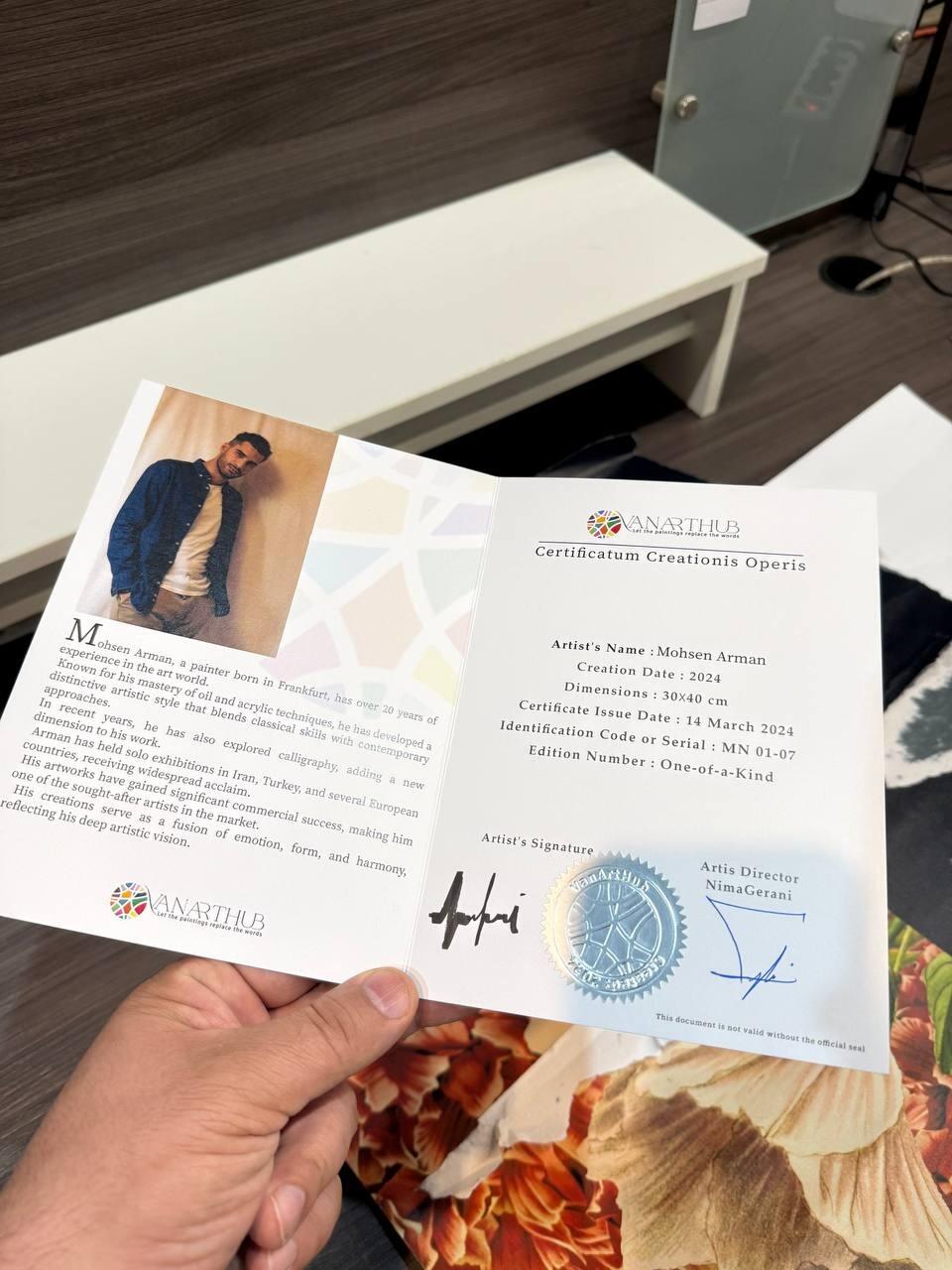
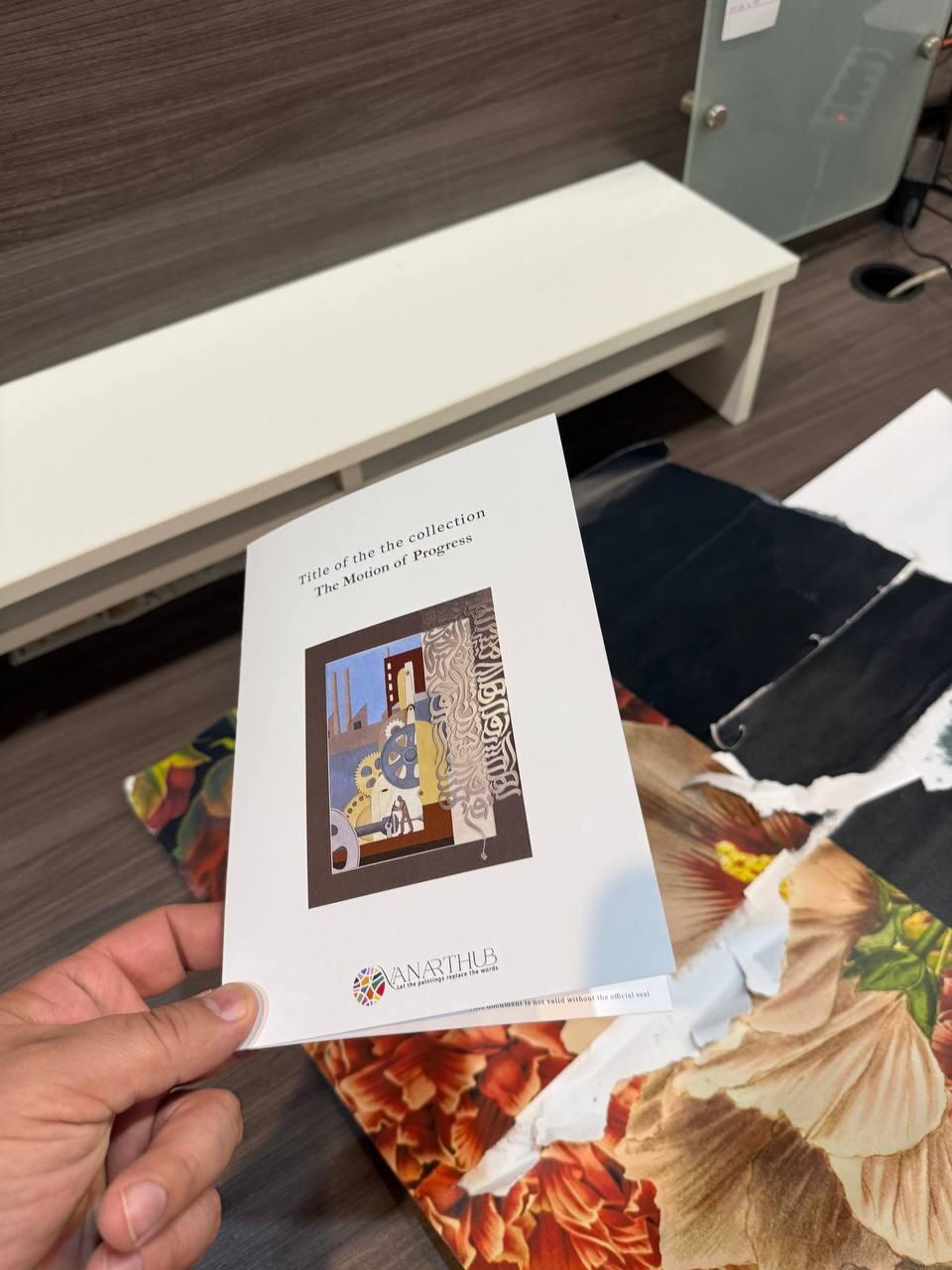
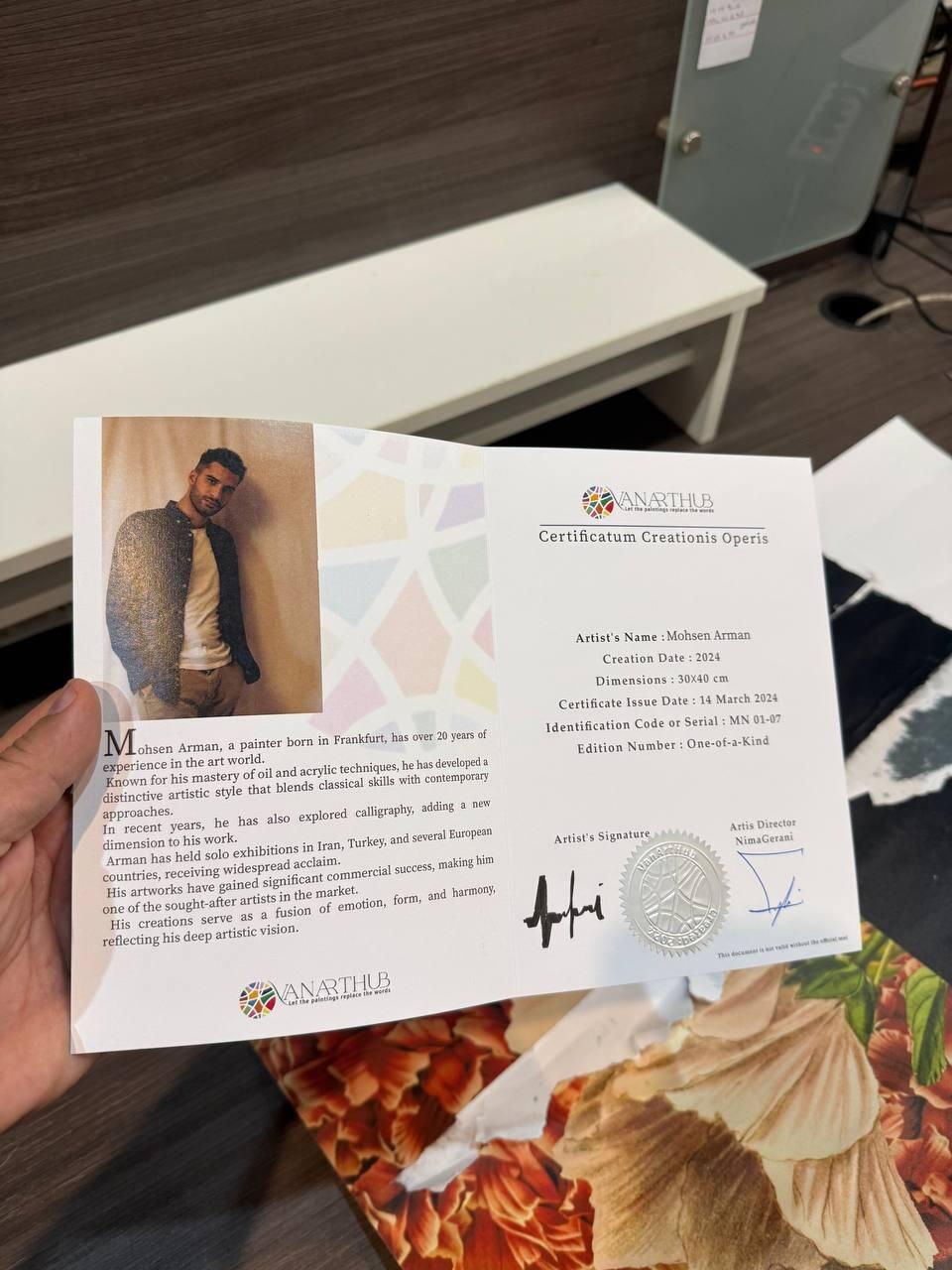
Who made it, and is that documented? A signed Certificate of Authenticity from the artist or the gallery that represents them is the first document to ask for.
-
Where has it been? The ownership history, or provenance, matters more for older works. The Encyclopaedia Iranica reports that some auction houses withdrew works attributed to the modernist Faramarz Pilaram because of forgery concerns.
-
Where is it shipped from? For buyers in the United States, where a painting was made and where it ships from can matter under the sanctions rules on Iran. Our page on how to buy contemporary Iranian art sets out what the regulations say.
Where our gallery's work fits
We sell original paintings only, each signed and sold with a Certificate of Authenticity, and we ship free and fully insured from Vancouver to buyers in Canada and the United States.
Kamal al-Din Ghotb works in the classical tradition. His artist page says he has spent 41 years practising Persian painting and works in negargari, the Persian word for the miniature tradition, painting in oil and gold on paper. His Siyavash Passing Through the Fire, painted in 2026 and 40 by 30 cm, shows the prince riding through the flames three times across one page, as older manuscripts do. See the Kamal al-Din Ghotb collection.
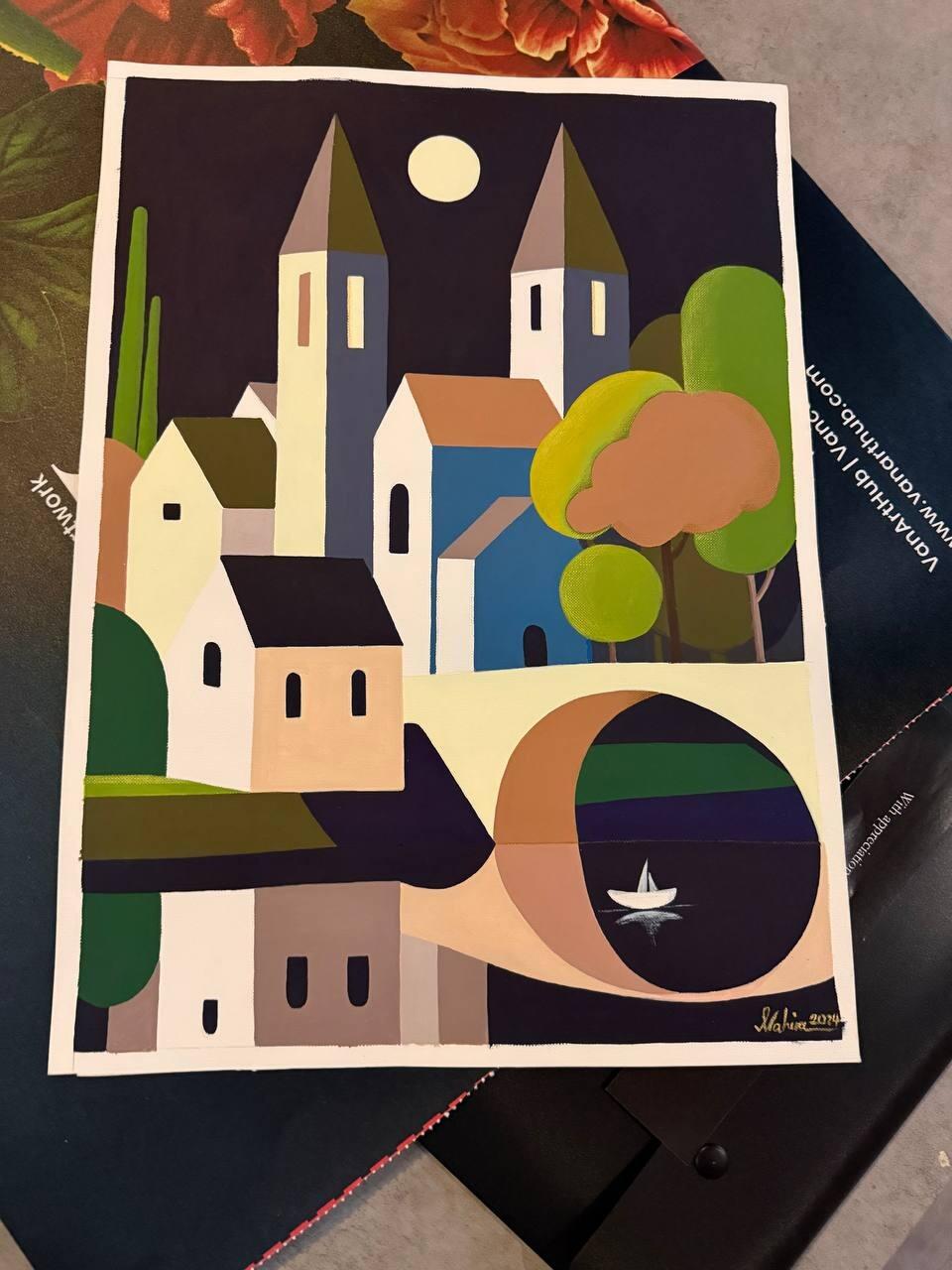
Other painters in our gallery work in contemporary styles and name Persian sources on their pages. The page for Amir Fazelian, a Vancouver watercolour and mixed-media artist, says his Div series "reimagines Persian mythology for the algorithmic age" and lists the Shahnameh among his inspirations. The page for Melina Ghaemi describes her as an Iranian-Canadian abstract expressionist and lists "Persian calligraphic gesture" among her inspirations. Our page on Persian-Canadian artists places this work in the context of the Iranian community in Canada.
Iranian art in Canada
In the 2021 census, 200,465 people in Canada reported Iranian as an ethnic or cultural origin, 88,915 of them in the Toronto metropolitan area and 45,815 in the Vancouver metropolitan area. A further 80,340 people in Canada reported Persian as an origin; because a person may report more than one origin, Statistics Canada warns that the categories cannot be added together. Toronto's Aga Khan Museum, which opened on 18 September 2014, holds Persian manuscript paintings such as a Shahnameh page made for Shah Ismail II and dated to c. 1576, and in 2017 it showed 27 works by 23 contemporary Iranian artists, according to CBC Arts.
Frequently asked questions
What is Persian painting?
Persian painting is the painting tradition of Iran and the Persian-speaking world, best known through detailed pictures made for handwritten books of poetry and history from the 13th century onward. Painters worked in ink, opaque watercolour and gold on paper, with pigments made from minerals such as lapis lazuli and malachite, according to the Metropolitan Museum of Art.
How does contemporary Iranian painting differ from classical Persian painting?
Contemporary Iranian painting differs from classical Persian painting mainly in its range: living artists work in oil, acrylic, mixed media and abstraction as well as in the miniature tradition. Classical painting was mostly book illustration made in court workshops. In 2025 the Middle East Institute showed 13 contemporary Iranian artists who rework the Persian miniature in new forms.
When did Persian painting begin?
Persian book painting began to flourish under the Ilkhanids, the Mongol rulers of Iran, in the 13th century, according to the British Institute of Persian Studies. The Great Mongol Shahnameh, made in Tabriz in the 1330s, is one of the most complex masterpieces of Persian art, according to Harvard Art Museums, with 57 or 58 illustrations known today depending on the source.
What are the main schools of Persian painting?
The main schools of Persian painting are named after the cities where court workshops worked: Tabriz, Herat, Shiraz and Isfahan. Herat is linked with Behzad in the late 15th century, early Safavid Tabriz with the Shah Tahmasp Shahnameh from the 1520s, and Isfahan with Reza Abbasi, from 1597 to 1722.
Which subjects appear most often in Persian painting?
The Shahnameh, Ferdowsi's "Book of Kings", is the text Persian painters illustrated most often, along with romances and mystical poems. The Met counts 50,000 rhyming couplets in the Shahnameh, covering the kings of Iran from mythical beginnings to the Arab conquest in 651. Single figures of elegantly dressed men and women became common subjects in 17th-century Isfahan.
Who are the best-known modern Iranian artists?
The best-known modern Iranian artists include Charles Hossein Zenderoudi and Parviz Tanavoli of the Saqqakhaneh movement, Monir Shahroudy Farmanfarmaian, Behjat Sadr, Marcos Grigorian and the calligrapher-painter Mohammad Ehsai. In April 2008 Tanavoli's bronze The Wall (Oh Persepolis) sold for $2.8 million at Christie's Dubai, then a record for an Iranian artist.
Where can I see Persian paintings in American museums?
The Metropolitan Museum of Art in New York holds 78 painted pages from the Shahnameh of Shah Tahmasp and pages from the Great Mongol Shahnameh. Harvard Art Museums holds Shahnameh pages from Tabriz and Shiraz, and the Smithsonian's Arthur M. Sackler Gallery in Washington holds Great Mongol Shahnameh pages bought by the collector Charles Vever.
How many people in Canada report Iranian origin?
In the 2021 census, 200,465 people in Canada reported Iranian as an ethnic or cultural origin, and 80,340 reported Persian. Statistics Canada notes that people can report more than one origin, so the two figures overlap. The Toronto metropolitan area counted 88,915 people of Iranian origin and the Vancouver area 45,815.
How long has calligraphy been part of Persian painting?
Calligraphy has shared the page with Persian painting since the illustrated manuscripts of the 14th century. The Shah Tahmasp Shahnameh pairs 759 pages of text in nastaliq script with 258 paintings. In the 1960s and 1970s, painters of the naqqashi-khat movement, such as Mohammad Ehsai, made calligraphy itself the subject of large oil paintings.
What should a collector check before buying Iranian art?
A collector should check that the work is painted by hand, who made it, what documents come with it, and where it ships from. The Encyclopaedia Iranica reports that some auction houses withdrew works attributed to Faramarz Pilaram over forgery concerns, which shows why a documented ownership history matters for sought-after modern names.
Does VanArtHub sell Persian miniature paintings?
VanArtHub sells original Persian miniature paintings by Kamal al-Din Ghotb, whose artist page says he has practised Persian painting for 41 years and works in oil and gold on paper. His Siyavash Passing Through the Fire, painted in 2026, measures 40 by 30 cm and shows a scene from the Shahnameh.
Which VanArtHub painters draw on Persian traditions?
Several VanArtHub painters name Persian sources on their artist pages. Kamal al-Din Ghotb paints classical miniatures, Amir Fazelian's Div series draws on the Shahnameh, and Melina Ghaemi, described as an Iranian-Canadian abstract expressionist, lists Persian calligraphic gesture among her inspirations. Other painters list Persian poetry or Persian miniature painting as influences.
References
-
FERDOWSI, ABU'L-QASEM i. Life. Djalal Khaleghi-Motlagh, Encyclopaedia Iranica. Published 15 December 1999; Internet Archive copy of 10 September 2026. Accessed 26 September 2026. The start of work on the Shahnameh, dated by the author to 977, and its completion on 8 March 1010.
-
The Shahnama of Shah Tahmasp (Heilbrunn Timeline of Art History). Francesca Leoni, The Metropolitan Museum of Art. Published June 2008; Internet Archive copy of 25 December 2024. Accessed 26 September 2026. The 50,000 couplets, the 651 end date, the 258 paintings and 759 text pages, the page size, the Turkmen and Timurid styles, and the Met's 78 pages.
-
Making a Royal Manuscript. The Metropolitan Museum of Art, educator resources. Undated; Internet Archive copy of 5 March 2026. Accessed 26 September 2026. Pigments made from lapis lazuli, malachite, gold, silver, sulphur and plant and insect dyes.
-
A Note Persian Miniature Painting: Materials and Techniques. British Institute of Persian Studies. Undated. Accessed 26 September 2026. The Ilkhanid beginning of Persian miniature painting and the dyed and gold-sprinkled papers.
-
Rustam Mourns Sohrab and Carries His Coffin, folio from a manuscript of the Shahnama by Firdawsi. Harvard Art Museums. Undated. Accessed 26 September 2026. The Shiraz date of 1575 to 1590 and the medium of ink, opaque watercolour and gold on paper.
-
Bahram Gur Fights the Horned Wolf, illustrated folio from a manuscript of the Great Ilkhanid Shahnama. Harvard Art Museums. Undated. Accessed 26 September 2026. The Tabriz origin, the date of c. 1335, the description as one of the most complex masterpieces of Persian art, the Chinese landscape conventions and the 57 surviving illustrations.
-
SHAH-NAMA ii. Illustrations (English: Book of Kings). Marianna Shreve Simpson, Encyclopaedia Iranica. Published 21 April 2009; Internet Archive copy of 25 August 2026. Accessed 26 September 2026. The 58 surviving illustrations of the Great Mongol Shahnameh and the Shiraz Shahnameh of 1393 to 1394 with 67 pictures.
-
BEHZAD, KAMAL-AL-DIN. Priscilla Soucek, Encyclopaedia Iranica. Published 15 December 1989; Internet Archive copy of 29 August 2026. Accessed 26 September 2026. Behzad's work in Herat under Sultan Husayn Bayqara, 1470 to 1506.
-
ISFAHAN xi. School of Painting and Calligraphy. Encyclopaedia Iranica. Published 15 December 2007; Internet Archive copy of 5 December 2025. Accessed 26 September 2026. The dates of the Isfahan school, album paintings and Reza Abbasi.
-
Artists of the Saqqakhana Movement (Heilbrunn Timeline of Art History). Maryam Ekhtiar and Julia Rooney, The Metropolitan Museum of Art. Published April 2014; Internet Archive copy of 16 December 2024. Accessed 26 September 2026. The five Tehran Biennials from 1958 to 1966, the Saqqakhaneh artists and the 1979 rupture.
-
SAQQA-KANA ii. School of Art (English: saqqakhaneh, a public water fountain). Hamid Keshmirshekan, Encyclopaedia Iranica. Published 15 August 2009; Internet Archive copy of 25 May 2025. Accessed 26 September 2026. The naming of the movement in 1962 and its early phase from 1962 to 1964.
-
Iran Modern. Asia Society Museum. Published 2013. Accessed 26 September 2026. The description of Saqqakhaneh as the first culturally specific modernist group and the naqqashi-khat movement.
-
Tehran Museum of Contemporary Art (TMoCA). Alexandra Cubbon, Routledge Encyclopedia of Modernism. Published 2019. Accessed 26 September 2026. The opening of the museum in 1977.
-
Christie's hails success of "first" Middle East sale. The Art Newspaper. Published 1 July 2006. Accessed 26 September 2026. The first Dubai sale on 24 May 2006 and its $8.5 million total.
-
Iranian artists triumph at Christie's Dubai as contemporary market hits its stride. The Art Newspaper. Published 1 June 2008. Accessed 26 September 2026. The $2.8 million Tanavoli record and the seven Iranian lots among the top ten.
-
GOL O BOLBOL (English: rose and nightingale). Layla Diba, Encyclopaedia Iranica. Published 15 December 2001; Internet Archive copy of 29 March 2026. Accessed 26 September 2026. The rose and the nightingale as beloved and lover.
-
SADR, BEHJAT. Hengameh Fouladvand, Encyclopaedia Iranica. Published 1 January 2000; Internet Archive copy of 23 May 2026. Accessed 26 September 2026. Behjat Sadr's Venice showing and the Royal Grand Prize at the third Tehran Biennial in 1962.
-
Monir Shahroudy Farmanfarmaian: Infinite Possibility. Mirror Works and Drawings, 1974 to 2014. Solomon R. Guggenheim Museum. Published 2015. Accessed 26 September 2026. The first United States museum exhibition of her mirror works.
-
PILARAM, FARAMARZ. Encyclopaedia Iranica. Published 1 August 2014; Internet Archive copy of 25 November 2025. Accessed 26 September 2026. Auction houses withdrawing works attributed to Pilaram over forgery concerns.
-
Maximal Miniatures: A Contemporary Take on a Centuries-Old Persian Art Form. Donna Honarpisheh, Middle East Institute. Published 4 March 2025. Accessed 26 September 2026. The 13 contemporary artists who rework the Persian miniature.
-
Census Profile, 2021 Census of Population: Canada. Statistics Canada. Modified 5 June 2026. Accessed 26 September 2026. The 200,465 people reporting Iranian origin, the 80,340 reporting Persian origin, and the note on multiple origins.
-
Census Profile, 2021 Census of Population: Toronto census metropolitan area. Statistics Canada. Modified 5 June 2026. Accessed 26 September 2026. The 88,915 people reporting Iranian origin in the Toronto area.
-
Census Profile, 2021 Census of Population: Vancouver census metropolitan area. Statistics Canada. Modified 5 June 2026. Accessed 26 September 2026. The 45,815 people reporting Iranian origin in the Vancouver area.
-
Our History. Aga Khan Museum. Undated. Accessed 26 September 2026. The opening of the museum on 18 September 2014.
-
DEMOTTE SHAH-NAMA (English: the Demotte Book of Kings). Priscilla P. Soucek, Encyclopaedia Iranica. Published 15 December 1994; Internet Archive copy of 21 September 2026. Accessed 26 September 2026. The Great Mongol Shahnameh pages bought by Charles Vever and now in the Smithsonian's Arthur M. Sackler Gallery.
-
The Art of the Safavids before 1600 (Heilbrunn Timeline of Art History). Suzan Yalman, based on original work by Linda Komaroff, The Metropolitan Museum of Art. Published October 2002; Internet Archive copy of 18 January 2025. Accessed 26 September 2026. Qazvin as the Safavid capital after 1555.
-
COFFEEHOUSE. Ali Al-e Dawud, Encyclopaedia Iranica. Published 15 December 1992; Internet Archive copy of 23 May 2025. Accessed 26 September 2026. Storytellers who set up a painted screen in the coffeehouse.
-
Naqqashi-ye qahveh-khaneh (coffeehouse painting). Chaeri Lee, in The Emamzadeh Yahya at Varamin, edited by Keelan Overton, University of Michigan. Published 15 January 2025. Accessed 26 September 2026. Qollar-Aghasi and Modabber as the two great masters, their death dates and the appreciation of the genre in their lifetimes.
-
Zahhak Consults the Physicians, Folio from the Book of Kings (Shahnameh) of Shah Ismail II, AKM71. Aga Khan Museum. Undated. Accessed 26 September 2026. A Shahnameh page dated to c. 1576 in the museum's collection.
-
'Self-expression over silence': Iranian artists share their perspectives in this revelatory exhibit. Chris Hampton, CBC Arts. Published 10 February 2017. Accessed 26 September 2026. The 2017 Aga Khan Museum exhibition of 27 works by 23 Iranian artists.
-
Kamal al-Din Ghotb. VanArtHub. Undated. Accessed 26 September 2026. The gallery's description of his 41 years of practice and his work in oil and gold.
-
Siyavash Passing Through the Fire: Original Persian Miniature in Oil and Gold by Kamal al-Din Ghotb. VanArtHub. Undated. Accessed 26 September 2026. The subject, size, year and composition of the painting.
-
Amir Fazelian. VanArtHub. Undated. Accessed 26 September 2026. The gallery's description of the Div series and his inspirations.
-
Melina Ghaemi. VanArtHub. Undated. Accessed 26 September 2026. The gallery's description of her as an Iranian-Canadian abstract expressionist and her listed inspirations.
Checked 26 September 2026. If something here is out of date, write to us and we will correct it.