Women artists have been part of Iranian modern art since the 1950s, when Behjat Sadr's paintings were selected for the Venice Biennale. They include Monir Shahroudy Farmanfarmaian, who turned Safavid mirror mosaic into abstract sculpture and was given her first United States museum exhibition of mirror works by the Guggenheim in 2015; Behjat Sadr, a pioneer of abstract painting who won the Royal Grand Prize at the Tehran Biennial in 1962; Farideh Lashai, whose career as a painter of gestural abstractions Artforum measures at "nearly five decades"; and Shirin Neshat, a photographer and video artist whose largest exhibition was shown by The Broad in Los Angeles in 2019 and 2020. A new generation of painters, including Farah Ossouli and Elham Pourkhani, is reworking the Persian miniature today.
This page summarises each career from museum and scholarly sources, and says where to see the work. It is part of our guide to contemporary Iranian and Persian painting.
Key takeaways
- The Guggenheim's exhibition of Monir Shahroudy Farmanfarmaian's mirror works and drawings, from 13 March to 3 June 2015, was her first United States museum exhibition of this work.
- The Encyclopaedia Iranica records that Behjat Sadr, born in Arak in 1924, won the Royal Grand Prize at the third Tehran Biennial in 1962 and taught at Tehran University until 1980.
- Artforum's 2013 obituary of Farideh Lashai credits her with "nearly five decades of artmaking" as a painter of gestural abstractions.
- The Broad's exhibition Shirin Neshat: I Will Greet the Sun Again, from 19 October 2019 to 16 February 2020, showed more than 230 photographs and eight video installations.
- At Christie's Dubai in April 2008, Shirin Aliabadi's photograph Miss Hybrid #4 sold for $55,000 against an estimate of $7,000 to $10,000, according to The Art Newspaper.
Monir Shahroudy Farmanfarmaian
The Guggenheim describes Monir Shahroudy Farmanfarmaian as born in Qazvin, Iran, in 1924; the University of Michigan's entry on coffeehouse painting gives 1922 and her death as 2019. She spent her formative years in New York from 1945 to 1957, where, the Guggenheim says, she met Milton Avery, Willem de Kooning, Joan Mitchell, Louise Nevelson, Barnett Newman and later Andy Warhol. Back in Iran she encountered traditional craftsmanship, Turkoman jewellery and clothing, coffeehouse paintings and reverse-glass painting.
The Metropolitan Museum of Art explains that she rebuilt two Iranian art forms in a modern idiom: mirror mosaics of the Safavid period and later, and reverse-glass painting of the Qajar period. After the 1979 revolution she spent 26 years in New York, working on drawing, collage, commissions and carpet and textile design, and in 2004 she re-established her studio in Iran with some of the craftsmen she had worked with in the 1970s. The Guggenheim exhibition Infinite Possibility, first presented at the Serralves Museum in Porto, showed her plaster and mirror reliefs, large mirror sculptures she called "geometric families", and works on paper. Our page on coffeehouse painting in Iran explains one of the popular forms that shaped her.
Behjat Sadr
The Encyclopaedia Iranica entry by Hengameh Fouladvand calls Behjat Sadr a "pioneer modernist painter and educator". She was born in Arak on 29 May 1924, entered the Faculty of Fine Arts at Tehran University in 1948 and graduated in 1954. A scholarship took her to Rome in 1956, where the painter Roberto Melli became her mentor, and her work was selected for the Venice Biennale. In 1962 she exhibited at the Venice Biennale, the São Paulo Biennial and the third Tehran Biennial, where she won the Royal Grand Prize.
Sadr taught at the Faculty of Fine Arts from 1960, became chair of the Department of Visual Arts at Tehran University in 1968 and taught there until 1980. The Iranica describes her canvases as built from thick strokes of paint, layer on layer, in "semi-disciplined grids of color". The Asia Society notes geometric abstractions that refer to modern industrial materials such as blinds and aluminium. She died in Corsica on 11 August 2009; her last exhibition in Tehran was a group show at the Tehran Museum of Contemporary Art in 2007.
Farideh Lashai
Farideh Lashai lived from 1944 to 2013. Media Farzin's obituary in Artforum says her "nearly five decades of artmaking" confirm her reputation "as one of Iran's most prolific artists, a deft and capable painter of gestural abstractions". She was also a writer; her autobiographical book, published in 2003, is titled Shal Bamu (The Jackal Came). In her last years she made stop-motion animations projected over her painted landscapes, drawing on Goya's The Disasters of War, Chaplin's The Great Dictator and Lewis Carroll's Alice's Adventures in Wonderland.
Two exhibitions followed her death. In November 2015 the Tehran Museum of Contemporary Art opened an exhibition of 41 works built around her paintings, placing them beside works by Rothko, Pollock and the Iranian painter Sohrab Sepehri, according to NPR. In 2025 the Middle East Institute showed two untitled works on paper of 1989, in oil on paper, which the curator reads as a portrayal of Rudabeh, the mother of the hero Rostam in the Shahnameh.
Shirin Neshat
Shirin Neshat is a photographer and video artist. The Broad in Los Angeles describes its exhibition Shirin Neshat: I Will Greet the Sun Again, shown from 19 October 2019 to 16 February 2020, as the largest exhibition to date of her career, with more than 230 photographs and eight video installations. The title comes from a poem by the Iranian poet Forugh Farrokhzad. The exhibition began with her early photographic series Women of Allah and included the videos Rapture, Turbulent and Passage and the photographic installation The Book of Kings. The Art Newspaper reported that her photograph I Am Its Secret, from an edition of 250, sold for $48,000 at Christie's first Dubai sale in 2006.
Shirin Aliabadi
Shirin Aliabadi worked in photography. The Art Newspaper's report on Christie's Dubai sale of 30 April 2008 singled out "edgy, contemporary photography", including her Miss Hybrid #4, which sold for $55,000 against an estimate of $7,000 to $10,000.
Iranian women artists, their media and a verified fact for each
| Artist |
Dates in the sources |
Main media |
Verified fact |
Source |
| Monir Shahroudy Farmanfarmaian |
Born 1924 (Guggenheim, Met); 1922 to 2019 (University of Michigan) |
Mirror mosaic, reverse-glass painting, drawing |
First US museum exhibition of her mirror works, Guggenheim, 2015 |
Guggenheim; Met |
| Behjat Sadr |
1924 to 2009 |
Painting |
Royal Grand Prize, third Tehran Biennial, 1962 |
Encyclopaedia Iranica |
| Farideh Lashai |
1944 to 2013 |
Painting, animation, writing |
Centre of a 41-work exhibition at the Tehran Museum of Contemporary Art, 2015 |
Artforum; NPR |
| Shirin Neshat |
Not stated here |
Photography, video and film |
More than 230 photographs and eight video installations at The Broad, 2019 to 2020 |
The Broad |
| Shirin Aliabadi |
Not stated here |
Photography |
Miss Hybrid #4 sold for $55,000 at Christie's Dubai, 2008 |
The Art Newspaper |
| Farah Ossouli |
Not stated here |
Gouache on cardboard |
Battle scenes with women at the centre, shown in Maximal Miniatures, 2025 |
Middle East Institute |
| Elham Pourkhani |
Not stated here |
Watercolour, gouache and gold leaf on paper |
Zahhak's Castle Is Calm, 2023 |
Middle East Institute |
Painters working now
The Middle East Institute's 2025 exhibition Maximal Miniatures showed 13 contemporary artists who rework the Persian miniature, several of them women painters. The curator, Donna Honarpisheh, describes Farah Ossouli's paintings in gouache on cardboard, such as Delacroix and I and David and I (2), both of 2014, which "reimagine pivotal battle scenes while placing women as the central actors and heroines". Elham Pourkhani's Zahhak's Castle Is Calm of 2023, in watercolour, gouache and 24k gold leaf on paper, fills the tyrant's castle with skeletal figures. Mahsa Tehrani's A Land of Magnets and Miracles of 2023, oil on canvas, sets friends eating watermelon and lovers walking arm in arm beside a shattered porcelain vase and animals at an unnatural scale. Soraya Sharghi's The Loom of Fates of 2024 surrounds a central female figure with mythological beings, and Bahar Sabzevari's Party of 2019 is a self-portrait that joins the artist to mythological figures. Our page on Persian miniature painting explains the tradition these painters build on.
For the generation before them, see our history of modern Iranian art from the Saqqakhaneh movement to today.
A painter we work with: Melina Ghaemi
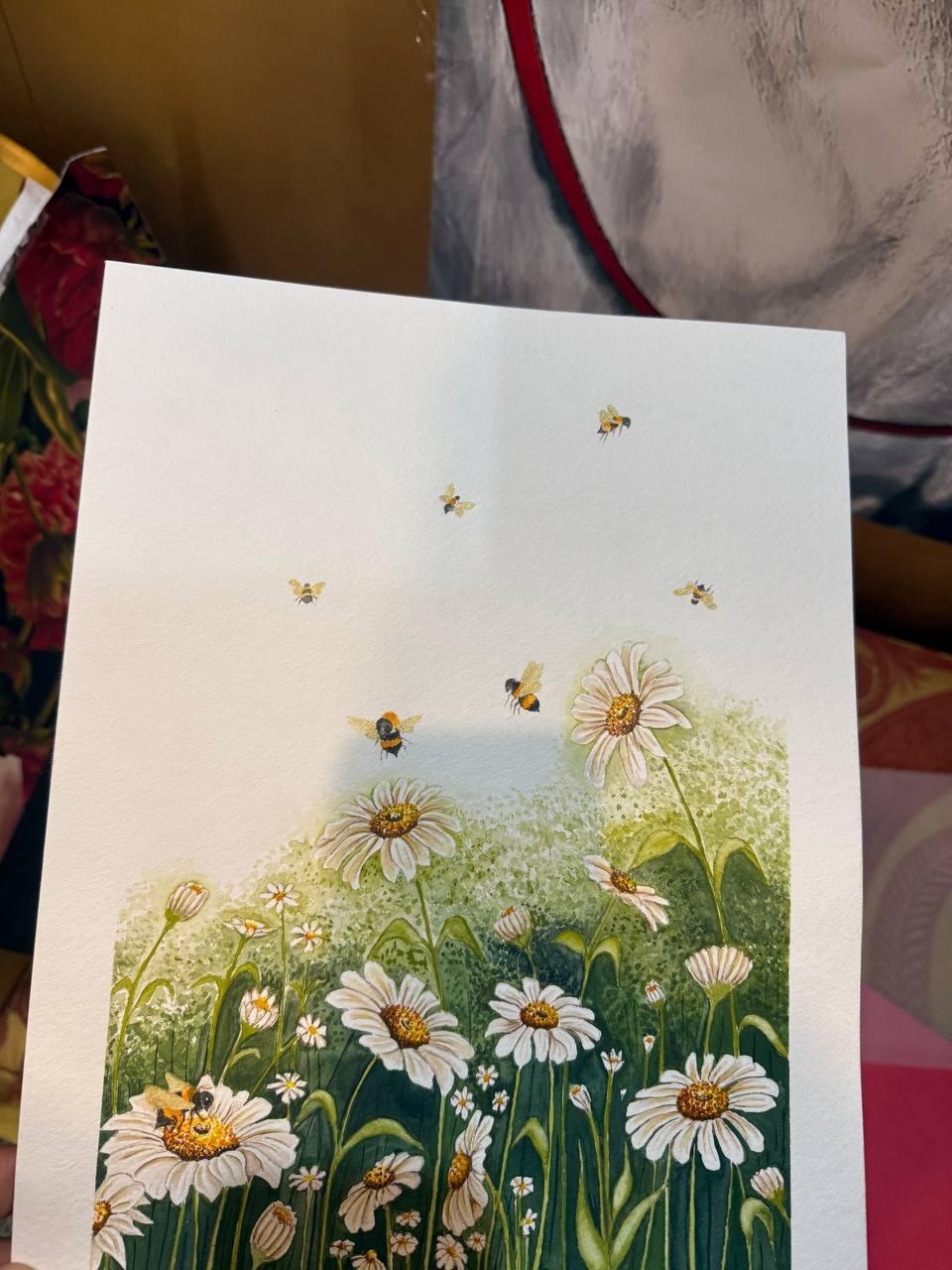
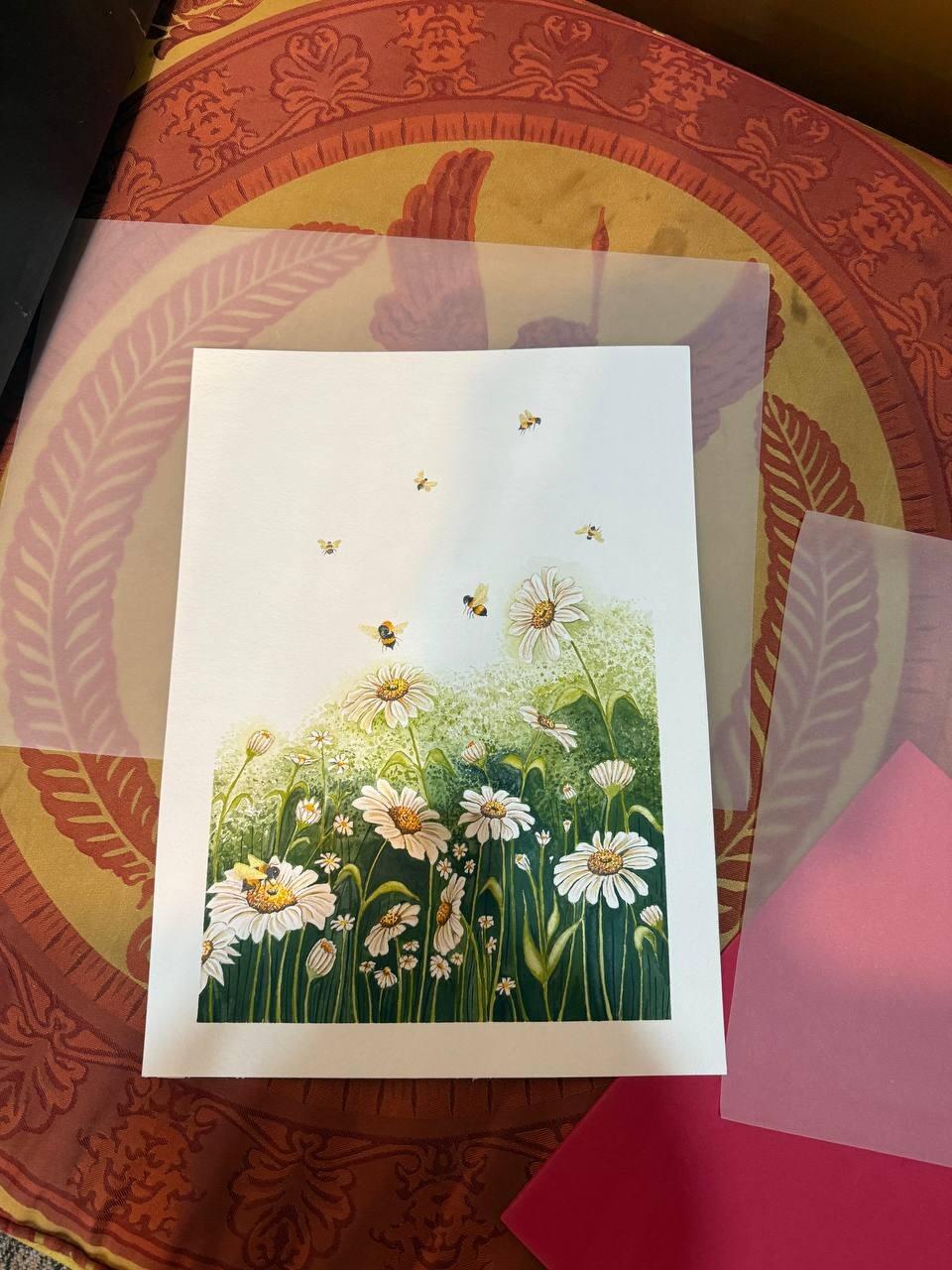
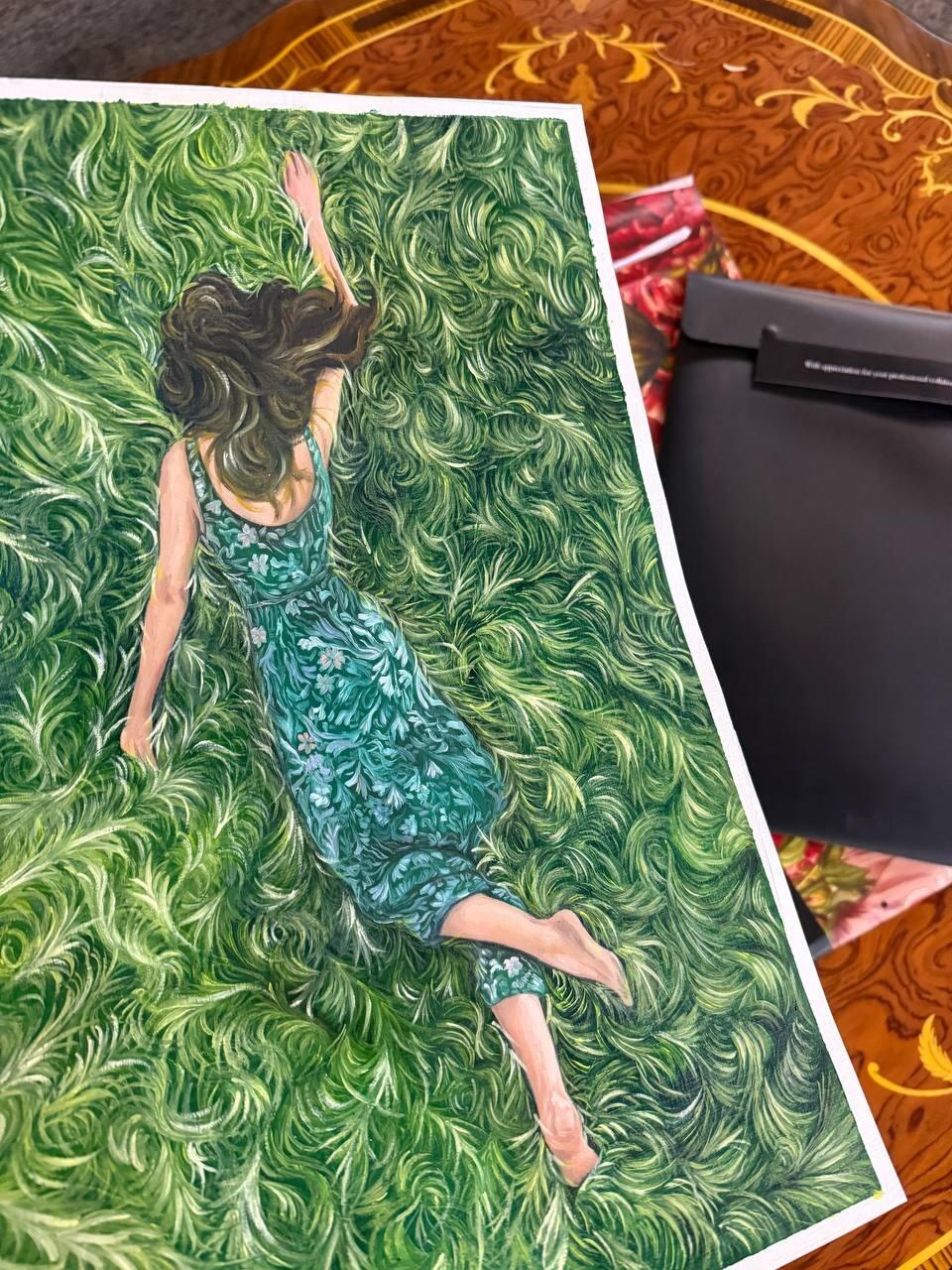
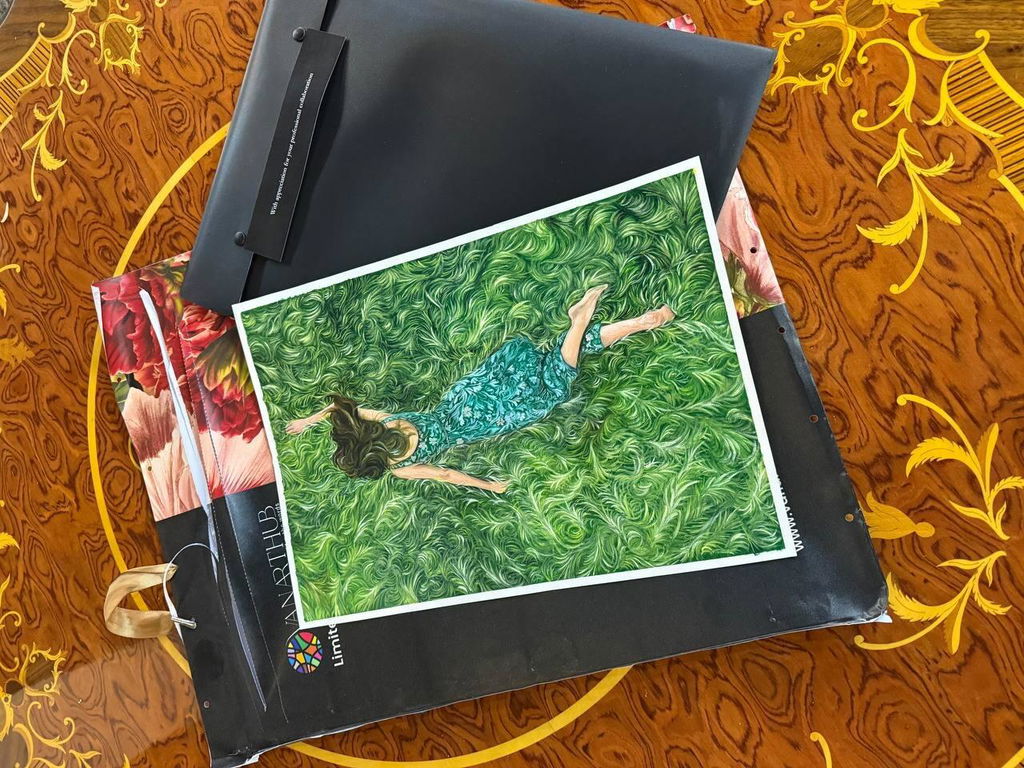
On her artist page, the gallery describes Melina Ghaemi as "an Iranian-Canadian abstract expressionist whose canvases transmit rather than depict", with "gestural brushwork, heavy impasto, and layered colour". She works in acrylic, oil and mixed media, with dripping and the palette knife, on large canvases, in palettes that range from high-contrast blacks and reds to softer earth tones. Her page lists her inspirations as the abstract expressionists Joan Mitchell and Helen Frankenthaler, Persian calligraphic gesture, Vancouver's rain and light, and music. Her themes, the page says, include emotional expression, freedom, identity and transformation. Her work, like all of ours, is original, signed and sold with a Certificate of Authenticity; see the Melina Ghaemi collection. Our page on Persian-Canadian artists places her among painters working in Canada.
For the history of gesture and writing in Iranian art, our page on Persian calligraphy in painting traces how Iranian artists turned the movement of the pen into abstract painting.
Frequently asked questions
Who was Monir Shahroudy Farmanfarmaian?
Monir Shahroudy Farmanfarmaian was an Iranian artist, born in Qazvin in 1924 according to the Guggenheim, who turned Safavid mirror mosaic and Qajar reverse-glass painting into modern abstract art. She lived in New York from 1945 to 1957 and again for 26 years after 1979, before re-establishing her studio in Iran in 2004.
When did the Guggenheim show Monir Farmanfarmaian's mirror works?
The Guggenheim Museum showed Monir Shahroudy Farmanfarmaian's mirror works and drawings from 13 March to 3 June 2015, in the exhibition Infinite Possibility. It was her first United States museum exhibition of this work, and included plaster and mirror reliefs, large mirror sculptures she called geometric families, and drawings.
Who was Behjat Sadr?
Behjat Sadr was a pioneer of Iranian modernist painting and a teacher, born in Arak on 29 May 1924 and died in Corsica on 11 August 2009, according to the Encyclopaedia Iranica. She studied in Tehran and Rome, painted abstractions built from thick layered strokes, and taught at Tehran University until 1980.
What prize did Behjat Sadr win at the Tehran Biennial?
Behjat Sadr won the Royal Grand Prize at the third Tehran Biennial in 1962, according to the Encyclopaedia Iranica. In the same year she exhibited at the Venice Biennale and the São Paulo Biennial, and a touring exhibition including her work introduced American audiences to Iranian modern art.
Who was Farideh Lashai?
Farideh Lashai was an Iranian painter and writer who lived from 1944 to 2013. Artforum's obituary credits her with nearly five decades of artmaking as a painter of gestural abstractions. In her last years she projected stop-motion animations over her painted landscapes, drawing on Goya, Chaplin and Lewis Carroll.
Is Shirin Neshat a painter?
Shirin Neshat is a photographer and video artist, and her best-known works are photographs and video installations. The Broad's exhibition I Will Greet the Sun Again, from 19 October 2019 to 16 February 2020, showed more than 230 photographs and eight video installations, starting with her early series Women of Allah.
Who was Shirin Aliabadi?
Shirin Aliabadi was an Iranian artist who worked in photography, known for the series Miss Hybrid. The Art Newspaper reported that her photograph Miss Hybrid #4 sold for $55,000 at Christie's Dubai on 30 April 2008, against an estimate of $7,000 to $10,000, as contemporary photography sold well there.
Which Iranian women painters rework the Persian miniature today?
Iranian women painters who rework the Persian miniature today include Farah Ossouli, Elham Pourkhani, Mahsa Tehrani, Soraya Sharghi and Bahar Sabzevari, all shown in the Middle East Institute's 2025 exhibition Maximal Miniatures. Ossouli's battle scenes in gouache on cardboard place women at the centre as heroines.
Which North American institutions have shown Iranian women artists?
North American institutions that have shown Iranian women artists include the Guggenheim in New York, which showed Monir Shahroudy Farmanfarmaian's mirror works in 2015, The Broad in Los Angeles, which showed Shirin Neshat in 2019 and 2020, and the Middle East Institute in Washington, which showed Maximal Miniatures in 2025.
Who is Melina Ghaemi?
Melina Ghaemi is a painter whom VanArtHub's artist page describes as an Iranian-Canadian abstract expressionist, working in acrylic, oil and mixed media with heavy impasto and gestural brushwork. The page lists Joan Mitchell, Helen Frankenthaler and Persian calligraphic gesture among her inspirations, along with Vancouver's rain and light.
References
-
Monir Shahroudy Farmanfarmaian: Infinite Possibility. Mirror Works and Drawings, 1974 to 2014. Solomon R. Guggenheim Museum. Published 2015. Accessed 26 September 2026. Her birth year and place, New York years, influences, exile and return, the exhibition dates and contents, and the Serralves origin of the show.
-
Artists of the Saqqakhana Movement (Heilbrunn Timeline of Art History). Maryam Ekhtiar and Julia Rooney, The Metropolitan Museum of Art. Published April 2014; Internet Archive copy of 16 December 2024. Accessed 26 September 2026. Farmanfarmaian's use of Safavid mirror mosaic and Qajar reverse-glass painting.
-
Naqqashi-ye qahveh-khaneh (coffeehouse painting). Chaeri Lee, in The Emamzadeh Yahya at Varamin, edited by Keelan Overton, University of Michigan. Published 15 January 2025. Accessed 26 September 2026. The dates 1922 to 2019 given for Farmanfarmaian.
-
SADR, BEHJAT. Hengameh Fouladvand, Encyclopaedia Iranica. Published 1 January 2000; Internet Archive copy of 23 May 2026. Accessed 26 September 2026. Sadr's life, training, exhibitions, prize, teaching, style, death and last Tehran exhibition.
-
Iran Modern. Asia Society Museum. Published 2013. Accessed 26 September 2026. Sadr's geometric abstractions and industrial materials.
-
Media Farzin on Farideh Lashai (1944 to 2013). Media Farzin, Artforum. Published 19 May 2013. Accessed 26 September 2026. Lashai's dates, career, book and late animations.
-
Hidden For Decades, Pollocks, Rothkos And More Go On Display In Iran. NPR, republished by WKAR Public Media. Published 2 December 2015. Accessed 26 September 2026. The 2015 exhibition of 41 works around Lashai's paintings.
-
Maximal Miniatures: A Contemporary Take on a Centuries-Old Persian Art Form. Donna Honarpisheh, Middle East Institute. Published 4 March 2025. Accessed 26 September 2026. The 13 artists and the works of Ossouli, Pourkhani, Tehrani, Sharghi, Sabzevari and Lashai.
-
Shirin Neshat: I Will Greet the Sun Again. The Broad. Published 2019. Accessed 26 September 2026. The exhibition dates, size, title source and works.
-
Christie's hails success of "first" Middle East sale. The Art Newspaper. Published 1 July 2006. Accessed 26 September 2026. The sale of Neshat's I Am Its Secret for $48,000.
-
Iranian artists triumph at Christie's Dubai as contemporary market hits its stride. The Art Newspaper. Published 1 June 2008. Accessed 26 September 2026. The sale of Aliabadi's Miss Hybrid #4 for $55,000.
-
Melina Ghaemi. VanArtHub. Undated. Accessed 26 September 2026. The gallery's description of her work, technique, themes and inspirations.
Checked 26 September 2026. If something here is out of date, write to us and we will correct it.