Gold Leaf in Persian Painting: What to Check Before You Buy
UpdatedGold in a Persian painting is one of two things: gold leaf, which is gold beaten into a thin sheet and laid on the page, or gold ground to a powder and used as paint, which is called shell gold. A listing that says "gold" can also mean imitation leaf, bronze powder or gold-coloured paint, and only the seller can tell you which. We are VanArtHub, a Vancouver gallery that sells original Persian miniatures and contemporary paintings that draw on Persian tradition. This guide shows what to ask and what to check before you pay any seller.
Who this guide is for
You are looking at a Persian painting with gold in it, or you searched for "Persian painting gold leaf" or "Persian miniature gold". You want to know whether the gold is real, whether it will last, and how to care for it at home.
We sell new works by living painters and no antiques, and we ship no printed copies or posters. For an antique page you need a specialist dealer, as our guide to buying a Persian miniature explains.
How the old painters used gold
Two forms of metal colour are recorded in Persian painting: "ground particles in a binding medium and metallic foil applied on a binding medium". The words come from a study by Nancy Purinton and Mark Watters, published in 1991 in the Journal of the American Institute for Conservation. In the 19 paintings they examined, at the Los Angeles County Museum of Art, the gold was "in the form of ground particles in a medium". The powder began as leaf, pounded with glue into a paste. Anahita Alavi, writing for the British Institute of Persian Studies, says the leaves were "ground with honey to make the shell gold".
The gold paint was brushed on and then burnished, which means rubbed until it shines. The study says it was burnished directly for "a glossy finish", or through a thin piece of paper for a less polished look. Some painters then marked the surface: the study found "delicate punchwork", a pattern of tiny impressions, in the gold areas of some paintings.
Painters used more than one tone of gold. The study reports gold mixed with copper for a warmer colour and with silver for a cooler one, and Priscilla Soucek, in the Encyclopaedia Iranica, describes 16th-century margins "painted with various shades of gold with silver accents". Silver aged badly. It "is now only seen as black in the paintings because it is tarnished", the study says.
Our page on Persian illumination explains the gold ornament painted around text and pictures, including the sunburst medallion called a shamseh, and our page on Persian miniature painting covers the pigments.
Muraqqa': The Gold Shamseh by Kamal al-Din Ghotb is a Persian miniature in oil and gold on paper, 30 x 40 cm (11.8 x 15.7 in). It is an album page built around a gold shamseh, with a calligraphy panel on a dense gold ground and a falconry party painted on gold. We show it here as a new work built around that medallion.

Six things a listing may mean by "gold"
In a listing, the word "gold" names a colour until the seller names a material. We know of six.
| Name | What it is | Under a lamp | How it ages |
|---|---|---|---|
| Gold leaf | Gold hammered into thin sheets and laid on the page (FM) | A bright burnished surface when polished (FM) | Pure gold does not corrode (CCI) |
| Shell gold | Powdered gold mixed with glue and brushed on (FM, PW) | Glossy where it was burnished (PW) | As leaf. Gold mixed with silver or copper can darken (CCI) |
| Imitation leaf | Leaf of another metal, such as brass, which is copper and zinc (AICCM, CCI) | Polished brass is a lighter yellow than tarnished brass (CCI) | Darkens, and green spots can appear (CCI) |
| Bronze powder paint | Paint made with metal powders that contain no gold (Icon) | Granular and streaky beside gold leaf (Icon) | Can turn brown or green (Icon). Darkens within a few years (AICCM) |
| Modern gold-coloured paint | Titanium oxide pigments in acrylic and gouache, developed in the twentieth century (AICCM) | No museum page we read describes it | Ask the seller for the name of the paint |
| Printed gold | Ink from a printer or a press | One flat tone, in our experience | As the print ages |
In our view an imitation is a fair purchase when the listing names it. If a listing uses a name for the gold that you do not know, ask which metal it is.
Your eye has limits. Purinton and Watters warn that identifying the pigments of a Persian painting "by simple visual examination is highly unreliable". No photo proves that a metal is gold, so the name of the metal has to come from the seller, in writing. For printed gold, read our guide to telling an original Persian painting from a print.
What to check before you buy
These eight checks work for any seller, including us. In our view the second one matters most.
| What to check | A good answer | Ask more questions when |
|---|---|---|
| The medium line | Names the paint, the gold and the support | "Mixed media" or "gold effect" |
| What the seller says the gold is | In writing: leaf or powder, and which metal | "Real gold" with no detail |
| A tilted video | Bright at one angle, dark at another | One flat tone from every angle |
| Flat or raised | The seller says which, and what lies under raised gold | Cracks or lifting edges in the close photo |
| Tarnish and green spots | Even colour in a close daylight photo | Brown patches or green spots |
| What covers the gold | The seller says whether a varnish lies over it | The seller cannot say |
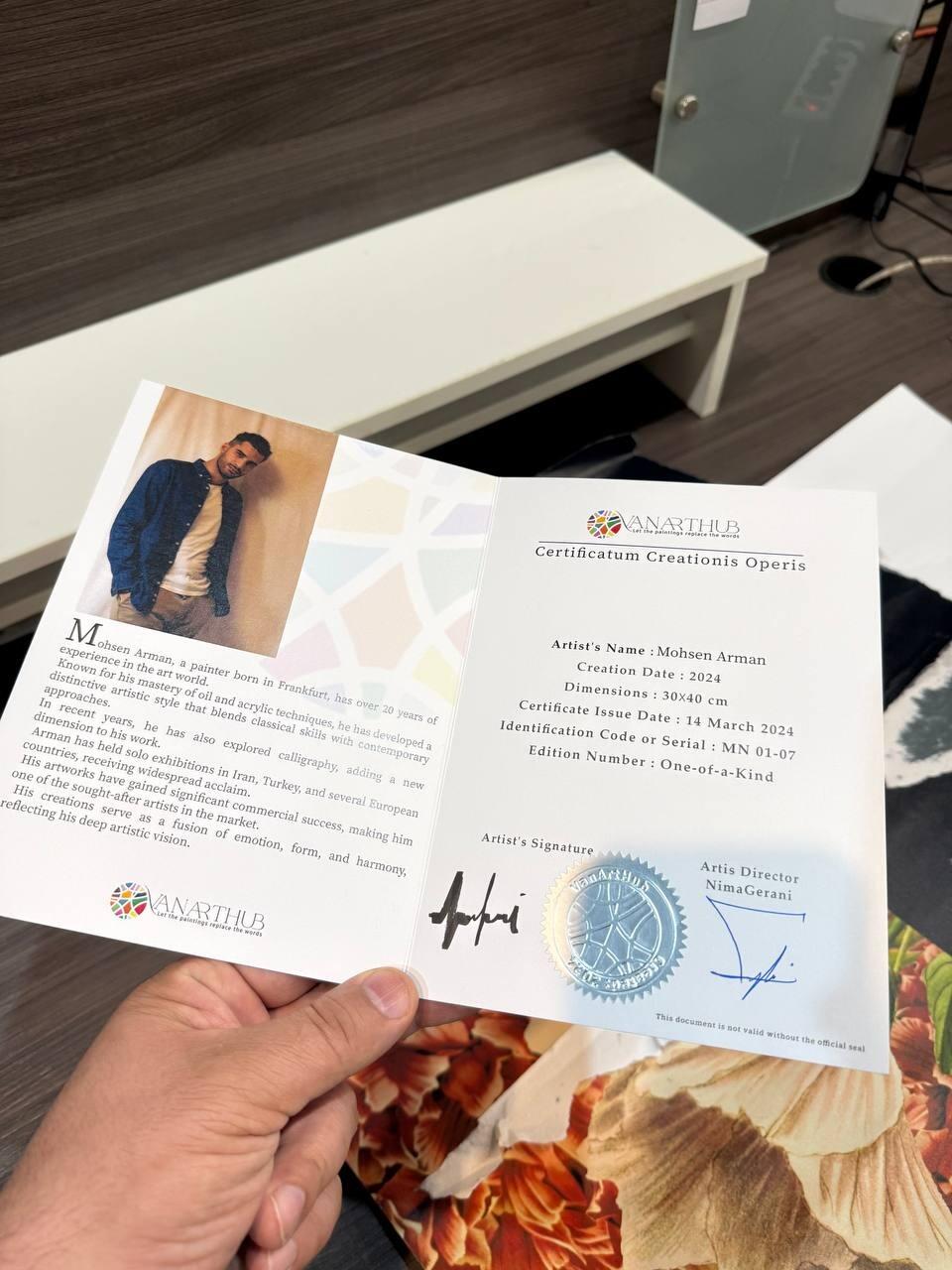
| The certificate | Signed, and it repeats the medium line | It leaves the gold out |
| The return terms | A stated number of days and a full refund | "Final sale", or no written terms |
The medium line. A museum label can say "gold" and no more. The Metropolitan Museum of Art gives the medium of a page from the Shahnameh of Shah Tahmasp as "Opaque watercolor, ink, silver, and gold on paper". That line names each metal and leaves open whether it is leaf or paint.
What the seller says. Ask three things in writing. Is it leaf or powder? Is the metal gold, brass, bronze or another metal? Does a varnish cover it? "I do not know, and I will ask the painter" is a good answer too.
The tilt. Ask for a video of the work under one lamp while the camera moves from straight above to a low angle. In our gallery, gold put on by hand goes bright at one angle and dark at another, and printed gold keeps one flat tone. The tilt has a limit: polished brass is yellow too. A bright reflection shows metal on the surface, and it cannot name the metal.
Celestial Garden by Darya is a Persian negargari (miniature painting) in oil and gold on paper, 30 x 40 cm (11.8 x 15.7 in): striped and marbled planets inside sweeping bands of ornament, around a large gold spiral. Its product page says "the gold detailing shifts with the light as you move past it". That is the tilt check, so ask us for a video and judge it yourself.

The condition of the gold: raised gold, tarnish and varnish
Flat or raised. In our experience gold paint lies flat, as the other colours do. Leaf can sit on a base: the Fitzwilliam Museum says European illuminators put layers of a red earth called bole under it "to create the illusion of thick gold". AICCM says changes in temperature and humidity "can cause cracking and flaking across layers" of a gilded surface. If the gold stands above the paper, ask what lies under it.
Tarnish and green spots. The Canadian Conservation Institute is plain: "Pure gold does not corrode." It adds that the silver and copper in a gold alloy "will darken as they tarnish", and that green spots can appear on copper alloys such as brass. Icon says paints made with metal powders other than gold "can oxidise and change to brown or green". AICCM adds that gold "retains its bright lustre for centuries", and bronze paint "darkens within a few years". Brown patches or green spots on a new painting are a reason to ask which metal it is.
What covers the gold. A varnish can change what you see. Icon notes that leaf of another metal is sometimes used, "most commonly silver which may be varnished to look like gold". Ask whether the gold colour is in the metal or in the coating. Some Persian objects carry gold under varnish by design, and our page on Persian lacquer painting describes them.
Gold at home: light, framing, cleaning and hanging
Light. Light harms the paper and the colours beside the gold: the Canadian Conservation Institute says visible light "fades colours often found on paper objects and artworks". In our view gold also looks better in low light. Vivek Gupta, writing for the British Library, notes that early readers saw illuminated books beside lamps, away from "the harsh lighting of today's modern libraries". Choose a wall that direct sun never reaches.
Framing. Frame the work behind glass. The same institute advises framing paper objects "behind UV-filtering glazing, where appropriate". For pastel and charcoal it names "a window mat or spacer" to prevent "contact with the glazing". Applying that to gold is our own choice: ask the framer to keep the glazing clear of the gold. Framing is done at our gallery and quoted per piece at the counter, as our custom framing page explains.
Cleaning. Do not clean the gold yourself. AICCM warns that gold on a water-gilded surface can be removed by accident "with a damp cloth or sprays", and Icon's advice is that "it is best not to attempt any repair or consolidation yourself". Keep your fingers off the gold too: Icon says oil or moisture from hands damages a gilded finish. If the gold looks dull or loose, leave it and ask a conservator.
Hanging. Icon advises keeping gilded objects "away from direct heat sources such as radiators or fires". Our own product pages add: "Keep the work out of direct sunlight and away from damp."
What our product pages say about the gold, and what they leave out
The three works in this guide come from the Kamal al-Din Ghotb collection and the Darya collection. All three are new works in oil, where the Met's Shah Tahmasp page is in opaque watercolour.
For the two miniatures by Kamal al-Din Ghotb, the product page gives the medium as "Oil and gold on paper, Persian miniature (negargari)", and the shop tags include "Gold Leaf". For Celestial Garden by Darya, the product page gives "Oil paint and gold on paper" and describes the technique as "gilded and ornamental detailing". None of the three pages states the purity of the gold, and none says in its description whether the gold is leaf or powdered gold. Measured against our own table, these pages pass the first check and leave the second one open. If the type of gold matters to you, ask us through the form on the product page before you buy.
Siyavash Passing Through the Fire by Kamal al-Din Ghotb is a Persian miniature in oil and gold on paper, 40 x 30 cm (15.7 x 11.8 in). Prince Siyavash rides in white through a mountain of burning wood, under an arch that carries a band of verse on gold. We show it as the example for the medium line. Our post on Siyavash and the fire tells the story.

How buying from us works
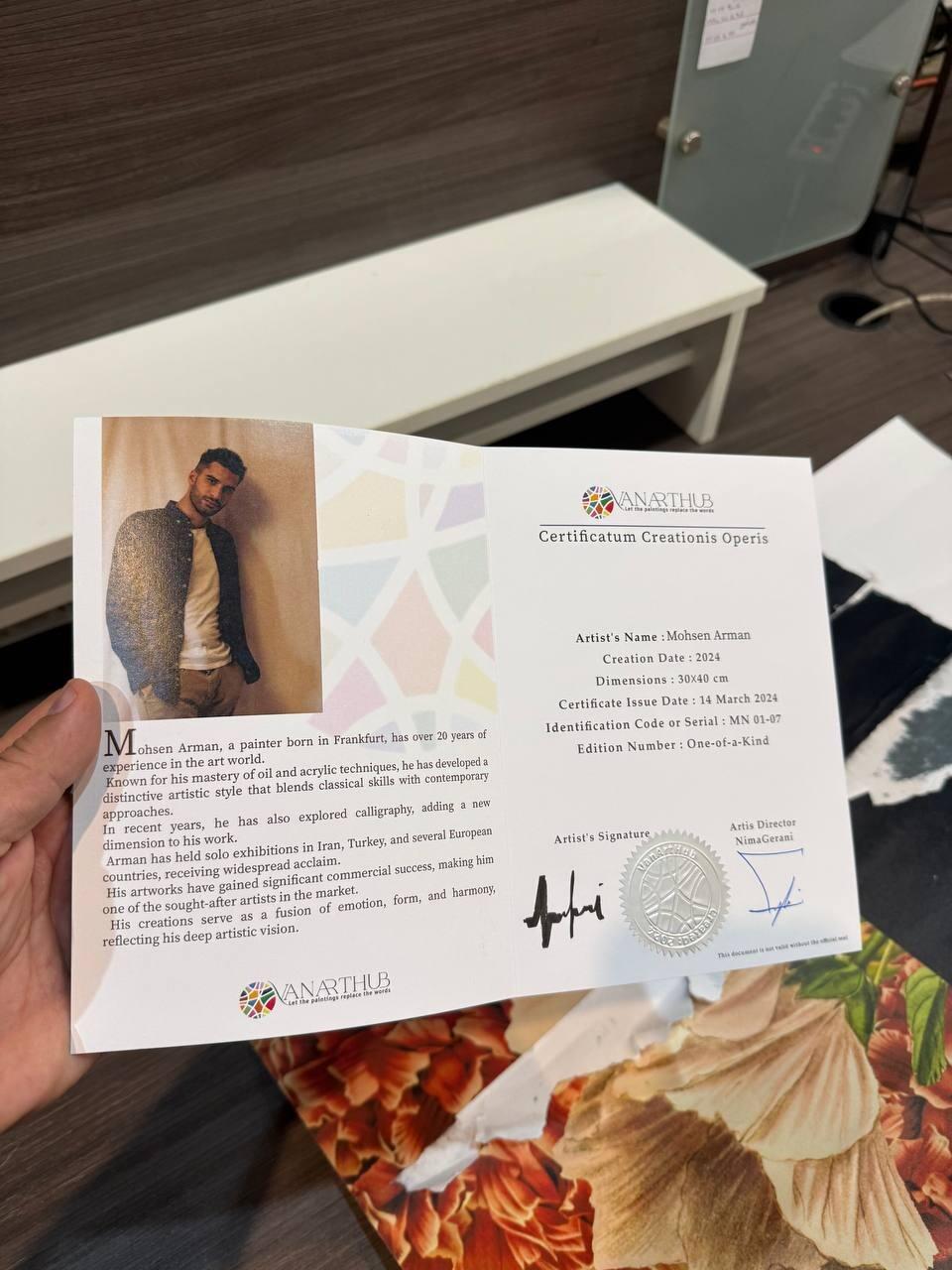
Every work we sell is a signed original with a Certificate of Authenticity. Shipping is free and fully insured: 3 to 7 business days in Canada and 5 to 10 to the USA. If a carrier asks you for a customs or brokerage fee, contact us before you pay it. The 14-day trial starts at delivery: return the work within 14 days for a full refund, and we pay the return shipping. The full terms are on our Buy with Confidence page.
Every product page has a form to ask us a question about that painting. Our gallery is at 1242 Davie Street in Vancouver's West End, and the opening hours are on our West End gallery page. Contact us before you come, so we can confirm the work is at the gallery that day.
Each product page has one more option, Buy Print File: a high-resolution digital file of the image, which you print yourself. Nothing is shipped, we email the file within 48 hours, it is for personal printing only, and copyright stays with the artist. A print made from that file is a reproduction, and the painting itself still exists once.
Key Takeaways
- Gold in Persian painting is gold leaf or shell gold, which is powdered gold used as paint.
- A listing that says "gold" may mean six materials. Ask in writing whether it is leaf or powder, and which metal.
- Pure gold does not corrode. Silver went black on old pages, and brass and bronze can turn brown or green.
- A tilted video shows metal on the surface. It cannot name the metal.
- Never clean gold yourself. Frame the work behind glass, away from sun, heat and damp.
- Our product pages name gold and leave out its purity and form, so ask us before you buy.
Frequently Asked Questions
Is the gold in a Persian painting real gold?
Sometimes, and the listing alone cannot tell you. Old Persian painters used gold metal, as leaf or as a powder mixed into paint, and a technical study of 19 paintings in the Los Angeles County Museum of Art found gold paint in them. A new painting may carry gold, imitation leaf, bronze powder or gold-coloured paint. Ask the seller in writing which one it is.
What is shell gold?
Shell gold is gold ground to a powder, mixed with glue and used as paint. The British Institute of Persian Studies says Persian painters ground thin gold leaves with honey to make it. The Fitzwilliam Museum in Cambridge explains the name: mussel and oyster shells often held the mixture. After brushing it on, Persian painters burnished it until it was glossy.
Did Persian miniature painters use gold leaf?
Gold leaf reached the workshop, and one study found the gold on the paintings as paint. The Metropolitan Museum of Art lists gold leaf among the materials supplied to the royal Safavid workshop. A 1991 study in the Journal of the American Institute for Conservation records leaf and powder as the two known forms, and found only powdered gold in the 19 paintings it examined.
Does the gold on a painting tarnish?
Pure gold does not corrode, according to the Canadian Conservation Institute. Gold mixed with silver or copper can darken as those metals tarnish. Imitation gold changes faster: the Institute of Conservation says paints made with metal powders other than gold can turn brown or green, and the Australian Institute for the Conservation of Cultural Material says bronze paint darkens within a few years.
How can I check the gold in a Persian painting from photos?
Ask for a video of the work tilted under one lamp, and a close photo taken in daylight. Gold put on by hand goes bright at one angle and dark at another, in our experience, and printed gold keeps one flat tone. The close photo should show even colour, free of brown patches and green spots. No photo can name the metal, so ask the seller in writing.
What does "oil and gold on paper" tell me about the gold?
The line tells you that gold is named as a material, and it leaves the form and the purity open. Museums write the same way: the Metropolitan Museum of Art gives one royal Persian page as opaque watercolor, ink, silver and gold on paper. Ask the seller whether the gold is leaf or powder, which metal it is, and whether a varnish covers it.
Are the Persian miniatures at VanArtHub made with gold leaf?
Our product pages name gold in the medium line, and the shop tags on the two miniatures by Kamal al-Din Ghotb include "Gold Leaf". The descriptions leave open whether the gold is leaf or powdered gold, and no page states its purity. Ask us through the form on the product page before you buy, and keep our written answer with your certificate.
Can I clean the gold on a painting myself?
No. Leave the gold as it is and ask a conservator. The Australian Institute for the Conservation of Cultural Material warns that gold on a water-gilded surface can be removed by accident with a damp cloth or a spray, and the Institute of Conservation advises owners to attempt no repair themselves. Fingers leave oil and moisture, so hold the work by its frame.
What if the gold looks different once the painting is on my wall?
You can send the painting back. Every work we sell comes with a 14-day trial: return it within 14 days of delivery for a full refund, and we pay the return shipping. Use those days to look at the gold in daylight and by lamp, from the front and from the side. Shipping to you is free and fully insured.
Can I look at the gold at your Vancouver gallery before I pay?
Our gallery is at 1242 Davie Street in Vancouver's West End, and the opening hours are on our West End gallery page. Contact us before you come, so we can confirm the work is at the gallery that day. If you live far away, use the form on the product page to ask for a video of the gold under a lamp.
Sources
- Journal of the American Institute for Conservation, A Study of the Materials Used by Medieval Persian Painters, by Nancy Purinton and Mark Watters, section 3, Pigment Analysis, read October 2026.
- Journal of the American Institute for Conservation, A Study of the Materials Used by Medieval Persian Painters, by Nancy Purinton and Mark Watters, section 5, The Classical Technique, read October 2026.
- British Institute of Persian Studies, A Note Persian Miniature Painting: Materials and Techniques, by Anahita Alavi, read October 2026.
- The Metropolitan Museum of Art, Making a Royal Manuscript, read October 2026.
- The Metropolitan Museum of Art, "Siyavush Stands Accused by Sudaba before Kai Kavus", Folio 163v from the Shahnama (Book of Kings) of Shah Tahmasp, 1970.301.23, read October 2026.
- Encyclopaedia Iranica, Afshan, by Priscilla P. Soucek, read October 2026.
- British Library, Asian and African studies blog, Emanating light: Illumination in Islamic manuscripts, by Vivek Gupta (archived copy), read October 2026.
- The Fitzwilliam Museum, University of Cambridge, Illuminated: Manuscripts in the Making, Painting with metals, read October 2026.
- Canadian Conservation Institute, Caring for metal objects, read October 2026.
- Canadian Conservation Institute, Caring for paper objects, read October 2026.
- Institute of Conservation (Icon), Caring for your collections: Frames and gilding, read October 2026.
- Australian Institute for the Conservation of Cultural Material, Gilded objects, read October 2026.
Sources read in October 2026. If you spot something out of date, tell us and we will correct this post.
About VanArtHub
VanArtHub is a gallery based in Vancouver, Canada, that sells original, signed, one-of-a-kind works, each with a Certificate of Authenticity, free insured shipping and a 14-day trial. Persian art is also called Iranian art, and our guide to contemporary Persian painting introduces its painters and styles. You can also browse all artworks.