A natural wood frame is one where the grain is still visible, finished with oil, wax, or a clear lacquer rather than paint. It is the most common request we get and the one where the choice is genuinely between species rather than between colours.
Four woods cover almost everything.
Oak
Open, obvious grain and a warm pale colour. Oak is the most recognisable of the four and the most assertive: you always know you are looking at oak. That works for landscape and for anything with natural light in it, and it works badly with very fine, delicate work, where the grain competes at close range.
Oak yellows noticeably with age, more than the others. In five years an oak frame is warmer than the day it was made.
Ash
Similar grain pattern to oak but paler and calmer, with less contrast between the grain and the background. Ash is the safest of the four against a white or off-white wall, because it adds warmth without adding weight. It is our usual recommendation when someone wants natural wood but does not want the frame to announce itself.
Maple
Fine, almost closed grain and a very even pale colour. Maple reads as clean rather than rustic, which makes it the natural wood that works best in a modern interior. It is also hard, so it takes a crisp corner and holds it.
It suits precise work. A tightly rendered coloured pencil piece like Golden Serenade is better in maple than in oak, because the frame stays quiet at the close viewing distance the work invites.
Walnut
Dark, close grain, with a slightly purple or grey cast in daylight that separates it from any stained wood pretending to be walnut. It gives a painting weight without going all the way to black, which is the reason people choose it.
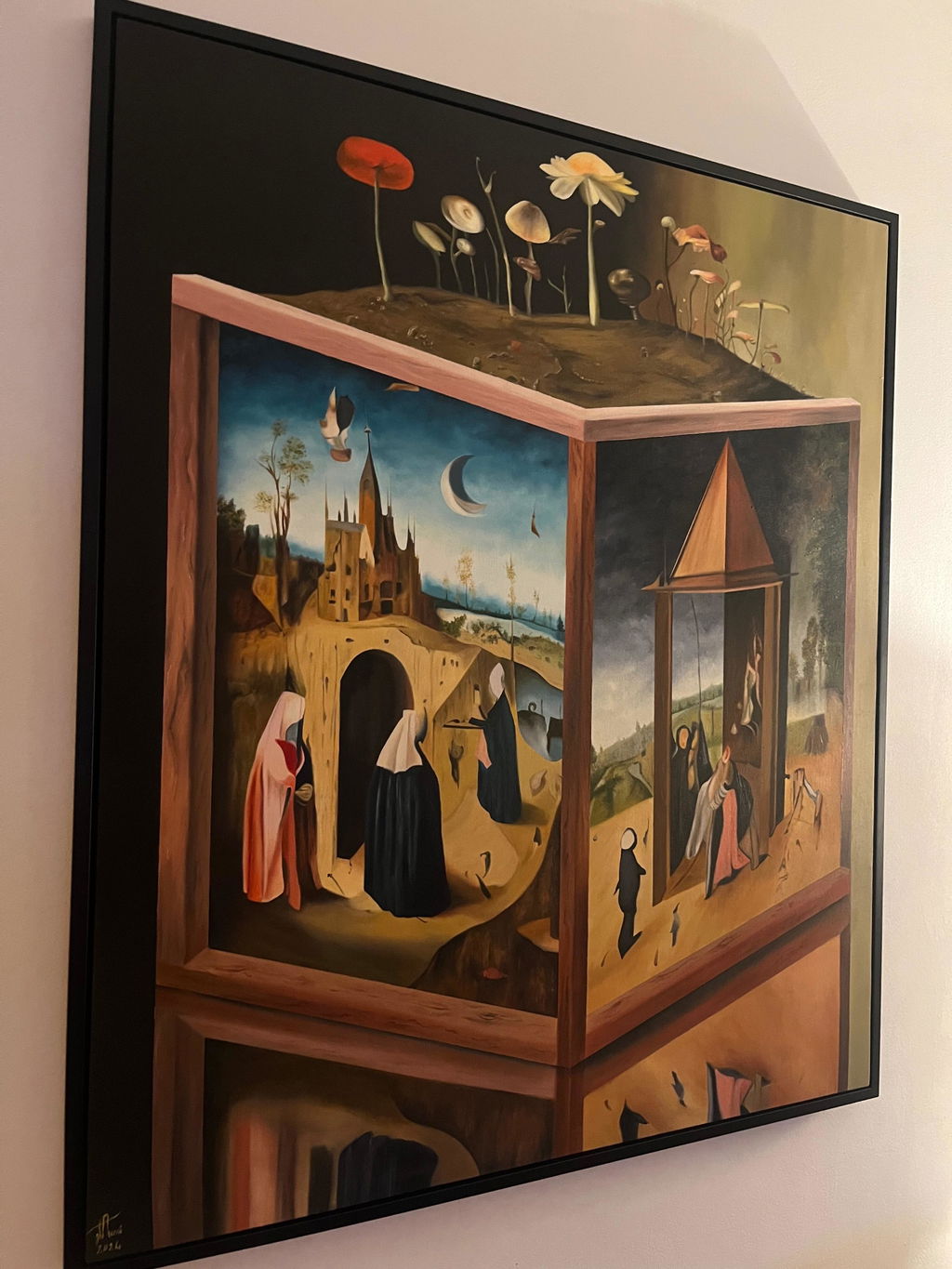
It is the one to reach for when a work needs holding but black would be too hard. A dense, dark oil like Beyond the Stone sits well in walnut, where black would flatten the darks in the painting itself.
Walnut lightens with age, the opposite of oak. Direct sun accelerates it noticeably.
Choosing between them
| Wood |
Grain |
Tone |
Ages |
Suits |
| Oak |
Open, strong |
Warm pale |
Yellows |
Landscape, natural subjects |
| Ash |
Open, soft |
Very pale |
Slight yellowing |
Anything on a white wall |
| Maple |
Fine, closed |
Even pale |
Very stable |
Detailed work, modern rooms |
| Walnut |
Fine, close |
Dark, cool |
Lightens |
Dark or heavy paintings |
Two things worth knowing before you choose
Grain scale should match the work
A big open grain around a small, finely detailed drawing is a mismatch you feel before you can name it. The frame is at a coarser resolution than the art. Fine work wants fine grain; that is most of the choice.
Every length is different
Because the grain is real, no two frames are identical, and the four sides of one frame will not match perfectly either. A good framer sorts the lengths so the strongest figure runs where it helps and the corners meet sensibly. It is not something you can specify from a photograph, and it is one of the reasons to look at the actual moulding before it is cut.
Cost and availability across the four woods
Oak, walnut, maple, and ash are not priced or stocked the same way, and the differences are worth knowing before you pick one on grain alone.
Oak is the most widely available of the four and usually the least expensive, because it is farmed at scale across North America and Europe. Red oak and white oak both mill well into frame moulding and the supply is steady, so oak is a safe default when you need a profile in stock rather than special-ordered.
Ash sits close to oak on price and is often the best value of the group, but supply has tightened in North America because of the emerald ash borer, an insect that has killed a large share of the continent's ash trees since the early 2000s. Where ash is available it is a strong, pale, straight-grained wood, but do not assume a specific profile is always in stock the way oak is.
Maple costs more than oak or ash, generally 20 to 40 percent more for an equivalent profile, because it is denser and harder to mill without tear-out, which slows production. It rewards that cost with a very smooth, tight grain that takes a clear or pale finish better than any of the other three.
Walnut is the most expensive of the four, often close to double the price of oak in the same profile, because good walnut is graded hard for colour consistency and the tree grows more slowly than oak or maple. If budget is the deciding factor, oak or ash for value, walnut only when the dark tone is doing real work in the room.
Common questions
Will a natural wood frame change colour?
Yes, all of them, and it is normal. Oak and ash warm up, walnut lightens, maple moves least. It happens over years, not months, and it happens faster in direct sun. If a frame has to stay exactly the tone it is now, a painted or stained finish is more stable than a clear one.
Is solid wood better than a veneered moulding?
For a frame, not necessarily. A good veneer over a stable core moves less than solid timber and can carry better figure than a solid length of the same price. What matters more is the quality of the corner joint and the finish. Solid is preferable on wide profiles and on anything that may be recut later.
Which wood goes with a mid-tone wall?
Walnut, most often. Pale woods lose definition against a mid-tone wall and start to look washed out, whereas walnut keeps a clear edge. If the wall is warm, ash also holds up. See frame colour by room.
What is the difference between an oiled and a lacquered wood finish?
An oiled finish soaks into the grain and leaves the surface matte and touchable, and it can be refreshed later with more oil. A lacquered finish sits on top of the wood as a hard, sealed film, usually with more sheen, and it resists moisture and fingerprints better. Oil shows the wood's texture more honestly; lacquer protects it more.
Does natural wood framing suit a work on paper as well as canvas?
Yes. A wood moulding takes a mat, glazing and backing the same way any other profile does, and the rebate depth just needs to account for the extra layers. Natural wood pairs especially well with warm-toned works on paper such as sepia drawings or aged prints.
Can I request a specific wood species?
Within what our suppliers stock, yes. Oak, ash, walnut and maple are the most common species we work with, each with a different grain pattern and base tone. Less common species can sometimes be sourced but add lead time and cost. Tell us the look you want and we will confirm what is available.
Is a natural wood frame more fragile than a painted one?
No, the structure is identical either way; only the surface treatment differs. A clear oil or lacquer finish shows a dent or scratch more plainly than an opaque paint would, simply because there is no solid colour to hide it. Handling care matters equally for both.
Do knots or grain marks affect the price?
A moulding run selected for consistent, clean grain generally costs a little more than one with visible character marks, because more of the raw timber is rejected to get it. Some buyers prefer visible knots and figure for the character it adds. Either is a legitimate choice and we price the moulding you pick, not a hidden grade.