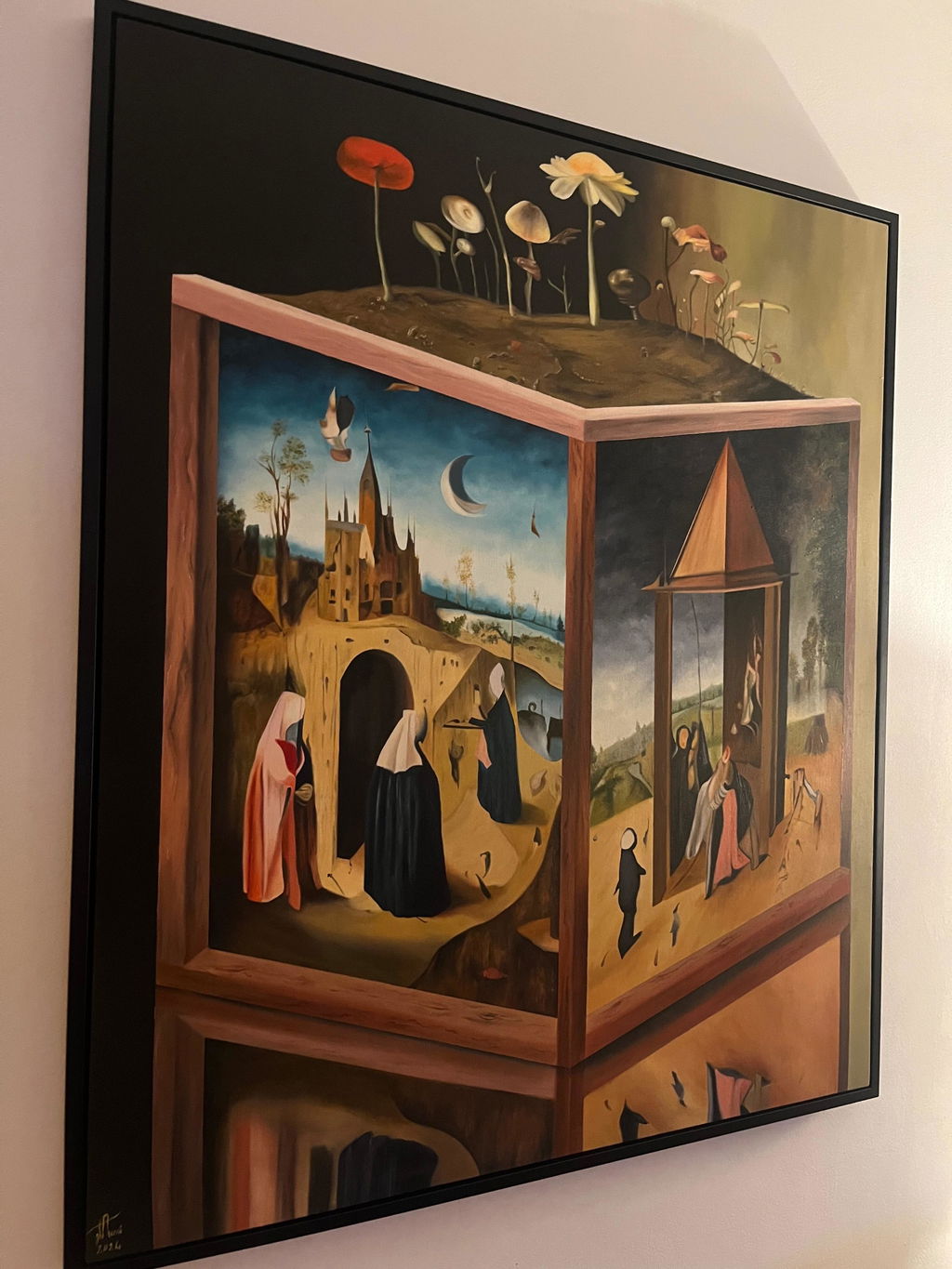
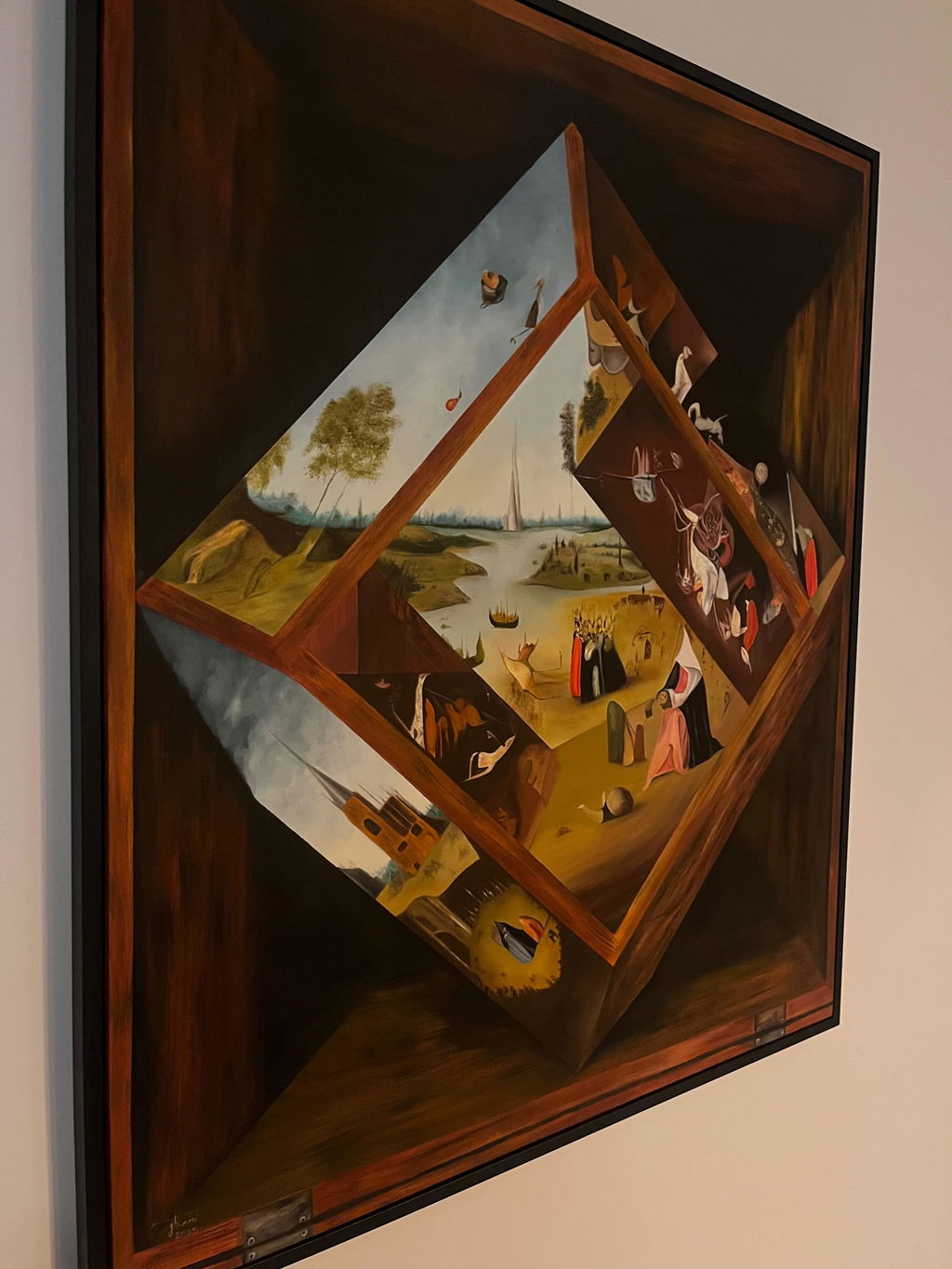
A painting on canvas has thickness and texture, so its frame is built differently from a frame for paper. We build floater frames and traditional frames around the painting you bring in.
We frame original oil and acrylic paintings, on stretched canvas and on board, in our own workshop inside the gallery at 1242 Davie Street. A painting needs a frame for two reasons. The edges and corners of a canvas are the parts that get knocked when it is carried or hung, and a frame protects them. A frame also puts a clear border between the picture and the wall, so the painting is the first thing you look at.
Floater frame or traditional frame
A floater frame is an open tray. The canvas is fixed into it from behind, and a narrow gap is left between the canvas and the inside wall of the frame. The whole painted front stays visible, and so do the edges. It suits most modern paintings, and any painting where the artist has carried the picture around the sides. Our guide to floater frames for canvas shows how the gap works.
A traditional frame has a lip that overlaps the front edge of the painting and holds it from the front. It covers the tacking edge, which is the side of the canvas where the staples or tacks are. That helps when the sides are rough or unpainted. Portraits, landscapes and older paintings often suit one. Our guide to matching the frame to the painting compares the two types.
Why most canvas paintings have no glass
Glazing means the sheet of glass or acrylic at the front of a frame. Oil and acrylic paintings on canvas are usually framed with none. The paint has brush marks and thickness that you see best with nothing in front of them, and a finished painting is normally protected by varnish, a clear coat brushed over the dry paint.
Glazing is worth adding in a few cases: a painting with no varnish, a surface that marks easily, or a wall in a kitchen or a busy hallway. When we add it, a spacer (a thin strip hidden under the frame edge) keeps the sheet off the paint. Our guide on when an oil painting does need glazing explains each case.
Most paintings on canvas hang with no glazing in front of the paint. Whisper of the Mist, an oil on canvas of a misty field with thin trees, 50 by 70 cm, is one of the originals in our gallery and would be framed that way.
Stretcher bars are the wooden bars a canvas is pulled over, and they are made in different depths. A thin bar and a deep bar need different frames. When the frame is shallower than the bars, the back of the canvas sticks out behind the frame and the painting leans forward from the wall. We measure the depth of your painting at the counter and choose a moulding, the shaped length of wood or metal the frame is cut from, that is deep enough to hold it. A painting on board is thin, so it takes a slimmer frame.
Fresh paint and varnish
Acrylic paint dries fast and can usually be framed soon after the painting is finished. Oil paint keeps hardening under the surface long after it feels dry to the touch, and thick paint takes longer than thin paint. If your oil painting is recent, tell us when it was finished and how thick the paint is. We check that the surface is firm before anything touches the edges, and we tell you if it needs more time. If the artist gave you advice about varnishing, bring that advice with you.
Acrylic paint dries fast, so an acrylic painting can usually go into a frame soon after it is finished. Blue Thought is an acrylic on canvas, 70 by 100 cm, with a face painted in dark blue on a pale background.
Four things change the cost: the size of the painting, the moulding you choose, the depth the frame needs, and whether you add glazing. A wide or carved moulding costs more than a plain one, and a larger painting uses a longer length of it. We quote for your painting at the counter once those four things are known, before any work starts. Our page on custom framing cost explains each part.
What to bring or send
Bring the painting. If it is too large to carry, or you live outside Vancouver, send the height, the width and the depth, a photograph of the front, and a photograph of one corner taken from the side. Tell us the wall colour if you know it. A canvas that has gone loose on its bars can be tightened or re-stretched first, and our canvas stretching service does that in the same workshop.
Walk in with the painting at 1242 Davie Street during opening hours. No appointment is needed. Enter your email on this page to get a 10% framing code to show at the shop, and see custom framing for everything else we frame.
How it works
1
Bring it in, or send photographs
Walk in to 1242 Davie Street during opening hours. If you are not in Vancouver, send the dimensions and a photograph and we will work from that.
2
We look at the actual piece
What it is made of, what condition it is in, and where it is going to hang all change the answer. You get a straight recommendation and a price for your piece, not a rate card.
3
It is made by hand and fitted
Cut to the piece, using conservation materials, and finished with hanging hardware rated for the actual weight.
Common questions
Should my canvas painting go in a floater frame or a traditional frame?
A canvas painting with painted or clean sides usually suits a floater frame, and a painting with rough or stapled sides usually suits a traditional frame. A floater frame leaves a narrow gap around the canvas, so the whole front and the edges stay visible. A traditional frame has a lip that covers the outer edge of the painting. Bring the painting and we hold both types against it.
Can a painting on a wood panel or canvas board be framed?
Yes, a painting on a wood panel or canvas board can be framed in a floater frame or a traditional frame. A panel is thin and stiff, so the frame can be shallower than one made for a stretched canvas. We measure the thickness at the counter and choose a moulding that holds the board securely. Include the thickness if you send measurements from outside Vancouver.
What happens if my canvas is deeper than the frame I like?
A canvas that is deeper than the frame sticks out behind it and leans forward from the wall, so we look for the same style in a deeper moulding first. If that style is made in one depth only, we show you the closest deeper option, or a floater frame built to the depth of your canvas. We measure the depth at the counter before you choose.
Can you replace the frame on a painting that is already framed?
Yes, we replace the frame on a painting that is already framed. Bring it in its current frame. We take it out at the workshop, check the edges and the stretcher bars, and fit the new frame to the real size of the painting. Our reframing service page explains what we look for inside an old frame.
My painting has staples showing on the sides. Can a frame hide them?
Yes, a frame can hide staples on the sides of a painting. A traditional frame covers the sides completely. A floater frame hides them from the front and from most angles, because the wall of the frame stands beside the canvas edge. If you want no frame at all and the canvas has enough spare cloth, it can be re-stretched with the staples moved to the back.
Is a recently finished acrylic painting ready to frame?
A recently finished acrylic painting is usually ready to frame once the surface feels dry and firm, because acrylic paint dries faster than oil paint. Thick layers take longer than thin ones. Tell us when the painting was finished, and we check the surface at the counter before we fit anything against the edges of the canvas.
What do you need to quote for framing a painting I cannot carry in?
To quote for framing a painting you cannot carry in, we need its height, width and depth, and two photographs: one of the front and one of a corner seen from the side. The corner photograph shows the depth of the bars and how the edges are finished. Send them through our contact page and say whether you prefer a floater frame or a traditional frame.
10% off your custom framing when you show this code at our shop
We frame, stretch canvas and reframe by hand, in our own workshop inside the gallery at
1242 Davie Street. Enter your email and your code appears right here. Show it at the
counter and we take 10% off the job. The code does not expire.
Send the measurements, what it is made of, and a photograph. We will tell you what it actually needs, including when the answer is that it needs less than you expected.
Choosing a selection results in a full page refresh.
Opens in a new window.
In-shop offer · 1242 Davie Street, Vancouver
Get 10% off your framing at our shop
Add your name and email and your code appears on the next screen. Show it at the counter
and we take 10% off any framing, stretching or reframing job you bring us. It does not
expire.
Exceptional Service and a Truly Memorable Art Purchase
I had a wonderful experience with Van Art Hub Gallery. I came across two pieces by Melina Ghaemi — *Mad Mirrors* and *Small World in the Hands of a Stranger* — and immediately fell in love with them.
I contacted Van Art Hub Gallery, and they were incredibly helpful throughout the entire process, from arranging the payment to organizing the shipping. At first, I was a little skeptical and nervous about how everything would work, especially since the paintings were still in Iran and it was shortly after the war. But the gallery handled everything with such professionalism and care that my concerns quickly disappeared. Amazingly, they were able to get the paintings to Canada in just two days!
The pieces are absolutely captivating. Even when I picked them up from the frame maker and was simply carrying them to my car, several people stopped and asked me about the paintings. That says a lot about how striking and special Melina Ghaemi’s work is.
A big thank you to Van Art Hub Gallery for making this experience so smooth and enjoyable. I truly appreciated their professionalism, communication, honesty, and integrity throughout the entire process. I would happily work with them again and highly recommend them to anyone interested in purchasing art through the gallery.
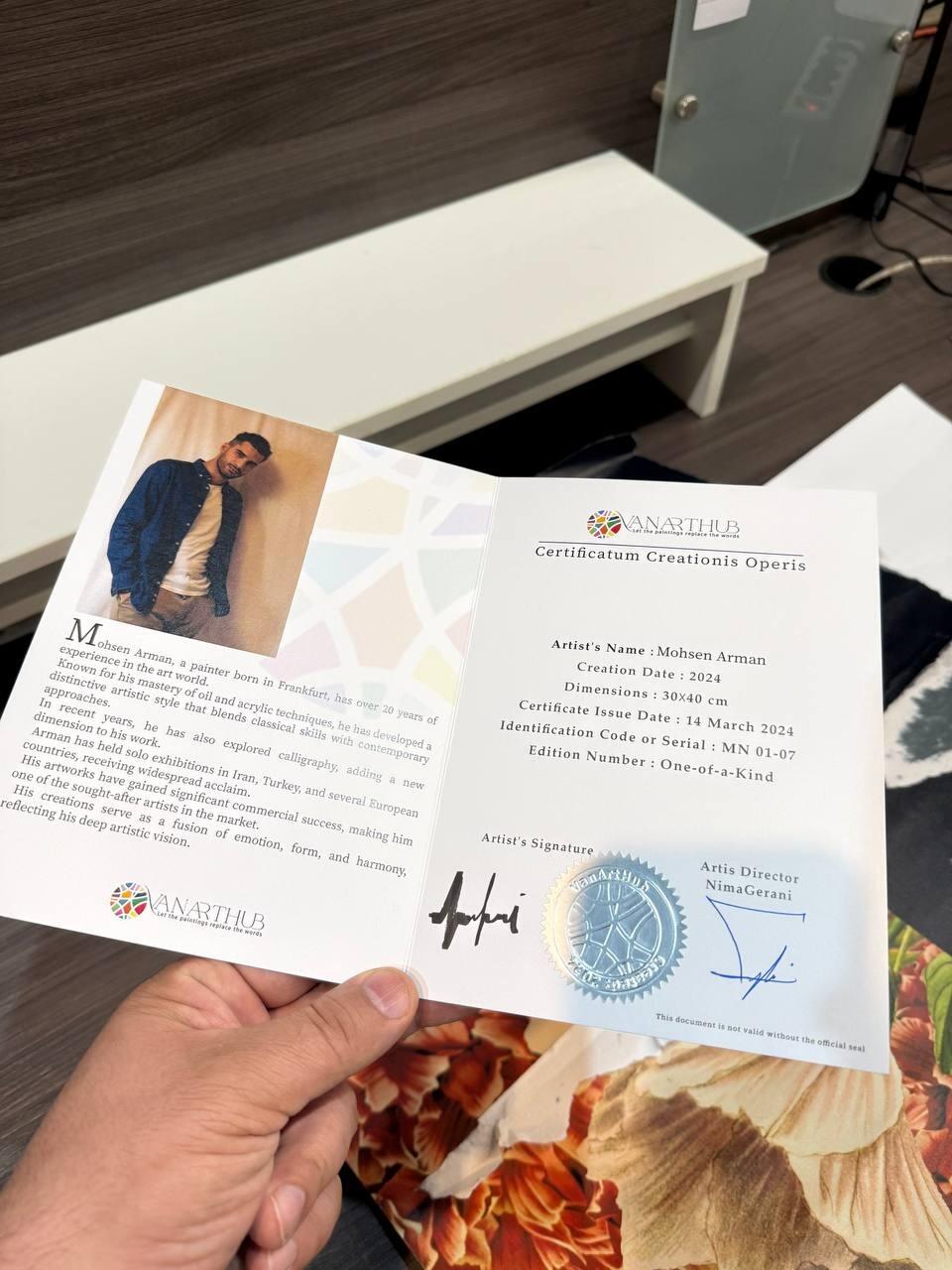
I got my order today and your work is really good. I didn’t expect to get a certificate for this painting, it was a surprise. Thanks for caring about small details.
The support team was really helpful and followed up nicely, wich I really appreciated. The painting is just like the photo – great quality and very detalied. I just wish it arrived a bit sooner, but honestly it was worth the wait.
I received my painting today. The support team was great and very responsive. The artwork is exactly what I was hoping for – even more beautifull in person. Truly a valuable piece. I’ll definetely order again. Thank you!