Conservation framing does no harm to the piece inside and can be taken apart again. Bring the piece, or a frame you already own, and we tell you what it needs.
Conservation framing is a way of building a frame so that it does no harm to the piece inside and can be taken apart again, leaving the piece as it was. Some shops call it museum framing or archival framing. We do this work in-house at 1242 Davie Street. It has four rules, and you can ask any framer about each one.
The four rules
Every material that touches the work is acid-free. Ordinary card and wood-based board turn acidic as they age, and they stain paper and cloth brown. Acid-free mat board, backing board and hinges are made to stay neutral.
Every mount can be undone. Paper hangs from hinges, small tabs of thin paper at its top edge. Cloth is stitched to a support. An object rests in a support shaped to it. Glue, tape and heat mounting are kept off the piece.
The glazing filters ultraviolet light. Glazing means the sheet of glass or acrylic at the front of the frame. Ultraviolet is the part of daylight that fades colour fastest.
The glazing never touches the surface. A mat, a border of card with an opening, or a spacer, a thin strip hidden under the frame edge, holds an air space in front of the piece.
All four rules apply to anything that cannot be replaced: original watercolours and drawings, signed prints, old photographs, letters and family documents, textiles and clothing, and anything inherited.
A poster or a reproduction that you could buy again is a different case. Acid-free backing is still worth having, because the backing touches the piece for years. Plain glazing is a reasonable saving on a piece like that, and we will say so. A painting on canvas usually has no glazing, so the first two rules are the ones that apply: an acid-free board behind the canvas, and nothing fixed to the canvas that cannot be removed.
An original painting exists only once. End and Beginning, an oil on canvas of a figure with red feathered wings between two waterfalls, 70 by 100 cm, would get an acid-free board behind the canvas and fixings that come off again.
We look at what the piece is made of, how it was held before, and where it will hang. Then you make three choices.
Mat or floated sheet. A mat covers the edges of the paper. A floated sheet shows all of it.
The glazing. UV glass, UV acrylic for a large frame or a child's room, or UV glazing with an anti-reflective coating, which many shops call museum glass. Our guide to museum glass and conservation glass compares them.
The moulding. This is the shaped wood or metal that the frame is cut from. It stays clear of the work, so a lower-cost moulding does the piece no harm.
A frame stops new damage. A tear, a stain or a brown line that is already there stays as it is. Mending or cleaning the piece itself is the work of a conservator, which is a separate trade.
An original drawing gets all four rules. The Silence Before the Bell is a coloured pencil drawing on artboard, 30 by 40 cm, of a woman seen from behind with long hair and a lace dress, and it would go behind a mat and UV glazing. It comes from our gallery.
The cut edge of the mat. On acid-free board the slanted cut edge stays white or cream. A yellow or brown cut edge means ordinary board.
A brown line on the picture along the inside of the mat opening.
The back. Brown cardboard or a thin sheet of wood directly behind the picture is acidic.
Contact. The picture touches the glass, or has shiny patches where it has stuck to it.
Other signs, such as tape on the back of the picture, show only when the frame is open. Bring the frame in. We open it at the counter, tell you what is inside, and wait for your decision before we change anything. Our reframing service page explains what happens next.
What changes the cost
Size and glazing change the cost most. UV glazing costs more than plain glazing, and an anti-reflective coating adds to that. Acid-free board adds little. Stitching a textile by hand or shaping a support for an object adds labour. We quote at the counter with the piece in front of us.
What to bring or send
Bring the piece as it is, in its old frame if it has one. Leave old tape and backing in place, because pulling them off at home can tear the paper. Tell us which wall it will hang on. If you live outside Vancouver, send the size, a note of what the piece is, and photographs of the front and the back.
Walk in at 1242 Davie Street during opening hours. Enter your email on this page for a 10% framing code to show at the shop, and see custom framing for everything else we frame.
How it works
1
Bring it in, or send photographs
Walk in to 1242 Davie Street during opening hours. If you are not in Vancouver, send the dimensions and a photograph and we will work from that.
2
We look at the actual piece
What it is made of, what condition it is in, and where it is going to hang all change the answer. You get a straight recommendation and a price for your piece, not a rate card.
3
It is made by hand and fitted
Cut to the piece, using conservation materials, and finished with hanging hardware rated for the actual weight.
Common questions
What is conservation framing in plain words?
Conservation framing is framing that does no harm to the piece and can be undone. Four rules define it. Every material that touches the piece is acid-free. The piece is held by hinges, stitches or shaped supports, with no glue on it. The glass or acrylic filters ultraviolet light. An air space separates the glass or acrylic from the surface. A frame that follows all four rules is a conservation frame.
Which pictures need conservation framing?
Pictures that cannot be replaced need conservation framing: original watercolours and drawings, signed prints, old photographs, letters, certificates and anything inherited. Textiles and clothing need it too, because dyes fade and fibres stain. A poster or a reproduction that you could buy again needs less. Acid-free backing is still worth having on it, and plain glazing is a reasonable choice there.
Does conservation framing repair damage that is already there?
Conservation framing stops further damage, and damage that is already there stays as it is. A new acid-free mat stops a brown line from spreading, and UV glazing slows fading. The marks and the lost colour remain. Mending a tear, removing a stain or cleaning a surface is the work of a conservator, which is a separate trade. A mat can cover a damaged edge if you want it hidden.
Can my existing frame be rebuilt with conservation materials?
Yes, an existing frame can be rebuilt with conservation materials when the frame itself is sound. The frame is opened, and the old mat, backing and glass are replaced with acid-free board and UV glazing. The picture is hinged to the new board. A spacer needs depth, so the depth of the old frame is checked first. Ask us at the counter about old tape that is stuck to the picture.
Does conservation framing look different from ordinary framing?
Conservation framing looks the same as ordinary framing from across a room. Close up, two things differ. The slanted cut edge of an acid-free mat stays white or cream, and ordinary board shows a yellow or brown edge after some years. The picture also has an air space between it and the glazing. The larger difference appears over years, in how much the paper browns and the colour fades.
Do objects and textiles get conservation framing too?
Yes, objects and textiles are framed to the same conservation rules as paper. A textile is stitched by hand to an acid-free support, and an object rests in a support shaped to it, so no glue touches either one. The frame is a shadow box, built deep enough for the glazing to clear the highest point. UV glazing matters for cloth, because dyes fade in daylight.
Where should a conservation framed picture hang?
A conservation framed picture should hang on a wall away from direct sun, heat and damp. UV glazing filters ultraviolet light, and ordinary visible light still fades colour slowly. A wall above a radiator or a fireplace dries paper, and a bathroom or an outside wall is damp. An inside wall that gets daylight and no direct sun, such as a hallway, is a good place.
10% off your custom framing when you show this code at our shop
We frame, stretch canvas and reframe by hand, in our own workshop inside the gallery at
1242 Davie Street. Enter your email and your code appears right here. Show it at the
counter and we take 10% off the job. The code does not expire.
Send the measurements, what it is made of, and a photograph. We will tell you what it actually needs, including when the answer is that it needs less than you expected.
Choosing a selection results in a full page refresh.
Opens in a new window.
In-shop offer · 1242 Davie Street, Vancouver
Get 10% off your framing at our shop
Add your name and email and your code appears on the next screen. Show it at the counter
and we take 10% off any framing, stretching or reframing job you bring us. It does not
expire.
Exceptional Service and a Truly Memorable Art Purchase
I had a wonderful experience with Van Art Hub Gallery. I came across two pieces by Melina Ghaemi — *Mad Mirrors* and *Small World in the Hands of a Stranger* — and immediately fell in love with them.
I contacted Van Art Hub Gallery, and they were incredibly helpful throughout the entire process, from arranging the payment to organizing the shipping. At first, I was a little skeptical and nervous about how everything would work, especially since the paintings were still in Iran and it was shortly after the war. But the gallery handled everything with such professionalism and care that my concerns quickly disappeared. Amazingly, they were able to get the paintings to Canada in just two days!
The pieces are absolutely captivating. Even when I picked them up from the frame maker and was simply carrying them to my car, several people stopped and asked me about the paintings. That says a lot about how striking and special Melina Ghaemi’s work is.
A big thank you to Van Art Hub Gallery for making this experience so smooth and enjoyable. I truly appreciated their professionalism, communication, honesty, and integrity throughout the entire process. I would happily work with them again and highly recommend them to anyone interested in purchasing art through the gallery.
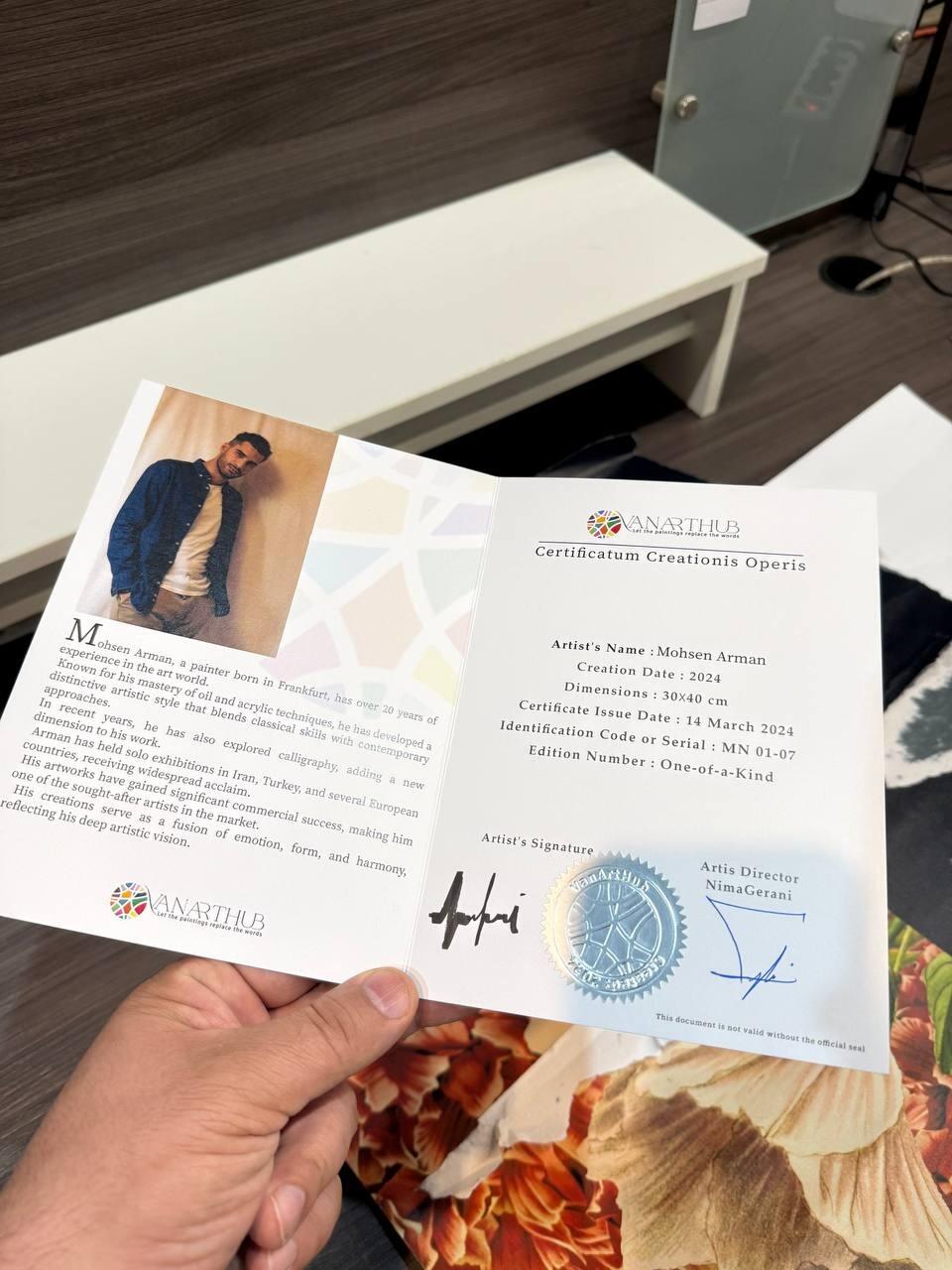
I got my order today and your work is really good. I didn’t expect to get a certificate for this painting, it was a surprise. Thanks for caring about small details.
The support team was really helpful and followed up nicely, wich I really appreciated. The painting is just like the photo – great quality and very detalied. I just wish it arrived a bit sooner, but honestly it was worth the wait.
I received my painting today. The support team was great and very responsive. The artwork is exactly what I was hoping for – even more beautifull in person. Truly a valuable piece. I’ll definetely order again. Thank you!