Craquelure: What the Cracks in an Old Painting Mean
Updated By VanArtHub Curatorial TeamShare
Somebody looks closely at an old oil painting for the first time, sees a fine net of lines across the whole surface, and assumes the thing is falling apart. It usually is not. That network has a name, craquelure, and on a painting with a few decades behind it the surprise would be finding none. The useful skill is telling the ordinary kind apart from the kind that means paint is about to come off.
What conservators actually mean by the word
The CCI glossary of condition terms defines cracks as surface or deep checks in one or more of the varnish, paint, or ground layers, and lists craquelure and crackle as the other names for the same thing. So craquelure is simply the technical word for the cracks. It carries no judgement about severity.
The same entry gives the cause: a combination of mechanical forces and the response of the paint, ground, and support layers to fluctuations in relative humidity, to periods of low relative humidity, and to low temperatures.
The CCI note on painting structure puts the conclusion plainly: some cracking of the paint and ground layers in response to environmental changes over time is inevitable and does not necessarily suggest instability. A painting is a stack of different materials, each one swelling and shrinking at its own rate, glued together for a century. Cracking is what that stack does.
Drying cracks: from the paint itself, and usually stable
The first family comes from inside the paint. The glossary describes drying cracks as cracks occurring during drying that can be wide, exposing the paint or ground layers below, with rounded or sloping edges and no cleavage. Cleavage means separation between layers, so no cleavage is the important part: the paint is still firmly attached.
Then the sentence that should calm most owners down. Although frequently disfiguring, drying cracks are usually stable and do not spread.
When drying cracks form a pattern like the skin of certain animals, the glossary calls them alligator cracks. That is a description of a shape, and it is the same underlying thing.
Drying cracks come from how the paint was applied: a layer too rich in oil, a fast drying layer over a slow one, or a heavy passage that skinned over while the paint underneath was still moving. That happened when the painting was young. It is history, and history that stopped.
Mechanical cracks: from force, and the ones that carry information
The second family comes from outside. Mechanical cracks are caused by movement or excessive stress in the layers of a painting, and they have sharp edges. That word sharp is your field test: sloping and rounded reads as drying, sharp and clean reads as mechanical.
The glossary adds that they may be spread over a whole painting, or restricted to one area where there was a blow or pressure on the back or the front. Then the useful part: these cracks are often described by the pattern they create.
Concentric cracks, also called cobweb cracks, are mechanical cracks in a roughly circular or cobweb-shaped pattern caused by a blow to or pressure on a painting. If you find a cobweb on a canvas, something hit it. A knee, a corner of furniture during a move, a door handle.
Feather cracks run in a pattern like a feather and are caused by a line of contact against the back of the painting, for example a scrape, or by a glancing contact on the canvas with a hammer during keying out. That last one is a hammer blow from somebody trying to tighten the canvas.
Spiral cracks are mechanical cracks shaped like a spiral, caused by the release of stresses in the paint layers. And a stretcher mark is a line of cracks or deformation following the inside edges of the wooden bars behind the canvas, from repeated contact with sharp-edged or badly bevelled bars, or from the different environment behind the canvas at those edges.
The pattern tells you the story, in one table
| Name | What it looks like | What caused it |
|---|---|---|
| Drying cracks | Wide, rounded or sloping edges, no separation between layers | The paint film drying. Usually stable and does not spread |
| Alligator cracks | Drying cracks in a pattern like animal skin | Same as drying cracks. A shape, not a separate problem |
| Concentric or cobweb cracks | Roughly circular, radiating from one point | A blow to the painting or pressure on it |
| Feather cracks | A feather or fishbone shape | A line of contact against the back, or a hammer touching the canvas during keying out |
| Spiral cracks | A spiral | Release of stress inside the paint layers |
| Stretcher mark | A straight line following the inner edge of a wooden bar | Contact with a sharp or poorly bevelled bar |
Photograph any pattern you cannot name and keep it with the date. If the pattern is identical a year later, you have evidence it is stable. That record beats any single opinion, including ours.
The warning signs: when cracks stop being cosmetic
The crack itself is rarely the problem. The problem is what happens at the edge of the crack when paint starts lifting away from what is underneath.
The glossary names the stages. Cleavage is a separation between layers of paint, between paint and ground, or between ground and support. Incipient cleavage is separation that is imminent and often begins along the edges of cracks. Blind cleavage is separation you cannot see, showing only as a slight bulge.
Cupping is lifting in which islands of paint separated by cracks develop concave centres with raised edges, like shallow cups. Lifting is the partial detachment and elevation of fragments of paint or paint and ground. Flaking is the partial or complete detachment of fragments, and the glossary is blunt about where that goes: untreated flaking will result in the loss of paint and ground. Tenting is paint forced upward into a tent shape by compression, from a shrinking canvas or wood support.
The CCI illustrates this directly: cracks with cupped, lifting edges can be vulnerable to flaking and paint loss. So the question is never how many cracks. It is whether the edges are flat or raised.
Hold a light almost flat against the surface so it rakes across. Level cracks in a stable film nearly disappear at that angle. Raised edges throw small shadows. If you see shadows, or any loose flake, stop touching it and call a paintings conservator. That is the whole decision rule.
What makes cracking worse in a normal home
Cracking is driven by the environment, so you have real control here. The CCI recommends a stable 40 to 60 percent relative humidity, with 50 percent as the usual central value.
Two specific numbers matter for cracks. Below 35 percent relative humidity, the size, ground, and paint layers become more brittle and are more likely to develop cracks, which then leads to lifting paint and paint loss. And swings larger than 10 percent create stresses in the layers that can eventually cause cracking. The same note lists where those swings happen: seasonally, in day to night cycles, and near drafts, air vents, radiators, heating ducts, and working fireplaces.
That list is a map of the walls to avoid. A canvas hung above a working fireplace or directly over a baseboard heater is being cycled hard every day.
Temperature splits by medium. Acrylic paint increases dramatically in stiffness at 5 to 10 degrees Celsius, while oil does not reach that change until minus 5 to minus 10. A Canadian winter makes an acrylic painting in a cold car genuinely fragile.
What we will and will not tell you about a crack
Our position, stated plainly: a fine, stable network of cracks on an older oil painting is not a reason to walk away, and buyers over-weight it. We would rather own a hundred-year-old painting with honest craquelure than one that has been aggressively restored to look new.
Now the limit. We sell contemporary originals, so most of what we ship has no age cracking at all, and we are not a conservation practice. We can describe what we see and name the pattern. Whether a specific crack is moving takes a conservator with the painting in front of them. If you are spending serious money on an older work, pay for that assessment before you buy.
One more thing we will not do: sell you a product to fix it. Consumer varnishes and restoring preparations applied over lifting paint make the conservator's job harder.
Key Takeaways
- Craquelure is the conservator's word for cracks. It carries no judgement about severity on its own.
- The CCI states that some cracking over time is inevitable and does not necessarily suggest instability.
- Drying cracks have rounded edges and no separation between layers, and are usually stable and do not spread.
- Mechanical cracks have sharp edges. Cobweb patterns mean a blow, feather patterns mean contact along a line.
- The warning signs are cupping, lifting, and flaking. Raised edges, not the cracks themselves, mean call a conservator.
- Below 35 percent relative humidity and swings over 10 percent both make new cracking more likely.
Frequently Asked Questions
Does craquelure mean a painting is damaged?
Usually not. The Canadian Conservation Institute states that some cracking of paint and ground in response to environmental changes over time is inevitable and does not necessarily suggest instability. What matters is whether the edges of the cracks are flat and stable or raised and lifting.
How do I tell drying cracks from mechanical cracks?
Look at the edges. Drying cracks are wide with rounded or sloping edges and no separation between layers. Mechanical cracks have sharp edges. Drying cracks come from the paint film itself and are usually stable. Mechanical cracks come from movement, stress, a blow, or pressure.
What are cobweb cracks?
Concentric cracks, in a roughly circular or cobweb-shaped pattern. The CCI glossary attributes them to a blow to or pressure on a painting. If you find one on a canvas, something struck it, often a corner of furniture or a knee during a move. They are worth pointing out to a seller.
When should I call a conservator about cracks?
When the paint at the edge of a crack is raised rather than flat. The terms for the stages are cupping, where islands of paint develop concave centres with raised edges, lifting, and flaking. The CCI notes that untreated flaking results in permanent loss of paint and ground.
Can I fix flaking paint at home?
No. Do not touch it, do not press it back down, and do not apply any consumer varnish or restoring preparation. Save any flakes that fall off in a small envelope for the conservator, since original paint is better than new fill.
Do acrylic paintings crack too?
Acrylic is more flexible than oil and seems less prone to cracking, though the CCI notes it has not had the test of time. Acrylic becomes far stiffer at 5 to 10 degrees Celsius. Cold handling is the acrylic risk.
What humidity keeps cracking from getting worse?
A stable 40 to 60 percent relative humidity, with 50 percent as the usual central value. Below 35 percent the layers become brittle and crack more readily. Swings larger than 10 percent also build stress. Stability matters more than hitting an exact number.
Are these prints or original paintings?
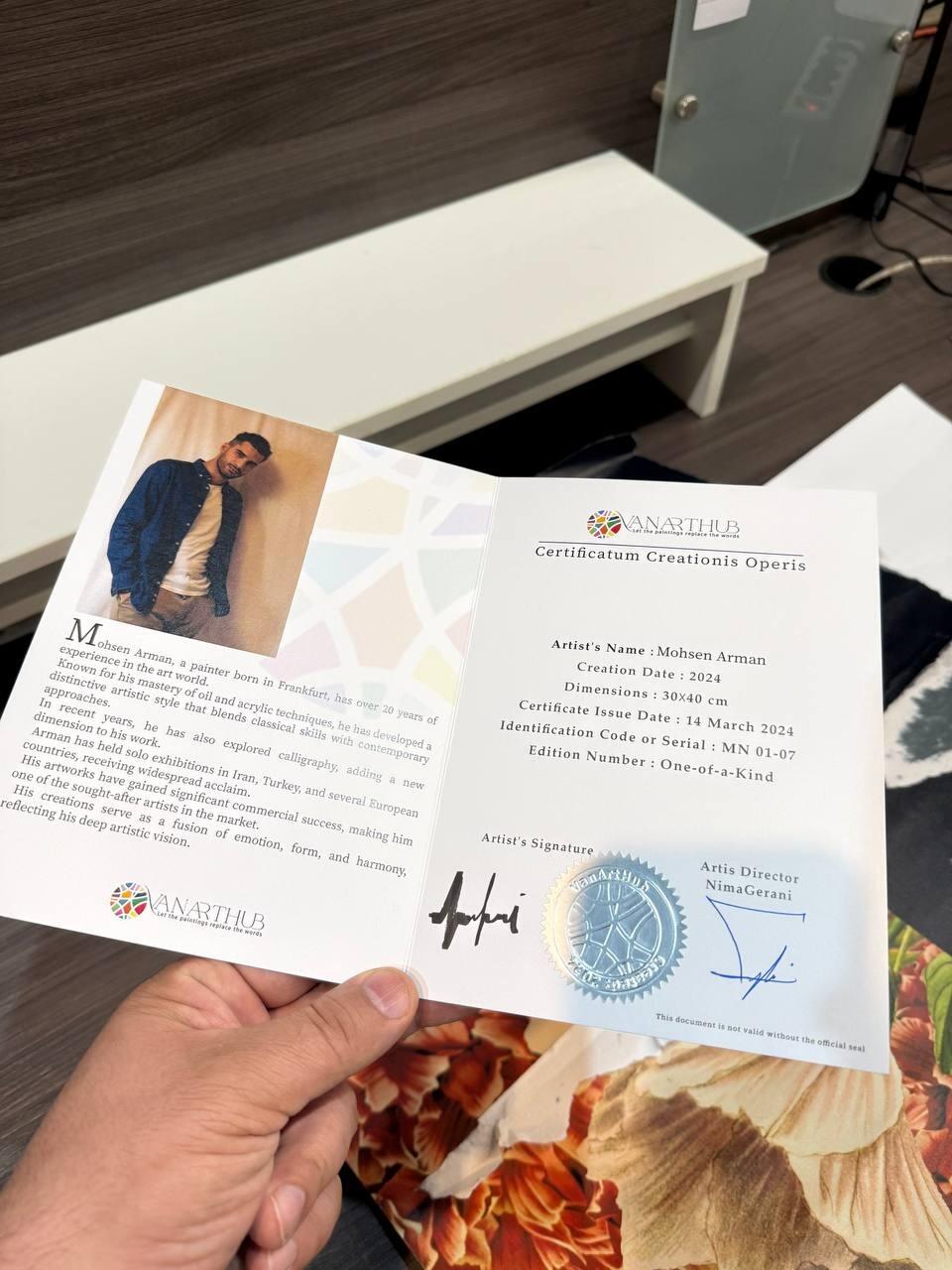
Originals only. Every piece on the site is a one-of-a-kind work, signed by the artist, and once it sells nobody can buy that exact painting again. We do not sell prints, giclees, or reproductions of any kind.
Sources
- Canadian Conservation Institute, Condition Reporting, Paintings Part III: Glossary (CCI Notes 10/11)
- Canadian Conservation Institute, Know Your Paintings: Structure, Materials and Aspects of Deterioration (CCI Notes 10/17)
- Canadian Conservation Institute, Environmental Guidelines for Paintings (CCI Notes 10/4)
Sources checked 1 September 2026. If you spot something out of date, tell us and we will update the guide.
About VanArtHub
VanArtHub is an online gallery in Vancouver selling original, signed, one-of-a-kind paintings by independent artists. No prints and no reproductions. Every piece ships with a Certificate of Authenticity, free fully insured delivery to Canada and the USA, and a 14-day trial so you can decide at home. Browse current original oil paintings, read our guide to caring for original paintings, or see why most cleaning advice online is dangerous. Our full policy lives on the Buy with Confidence page.