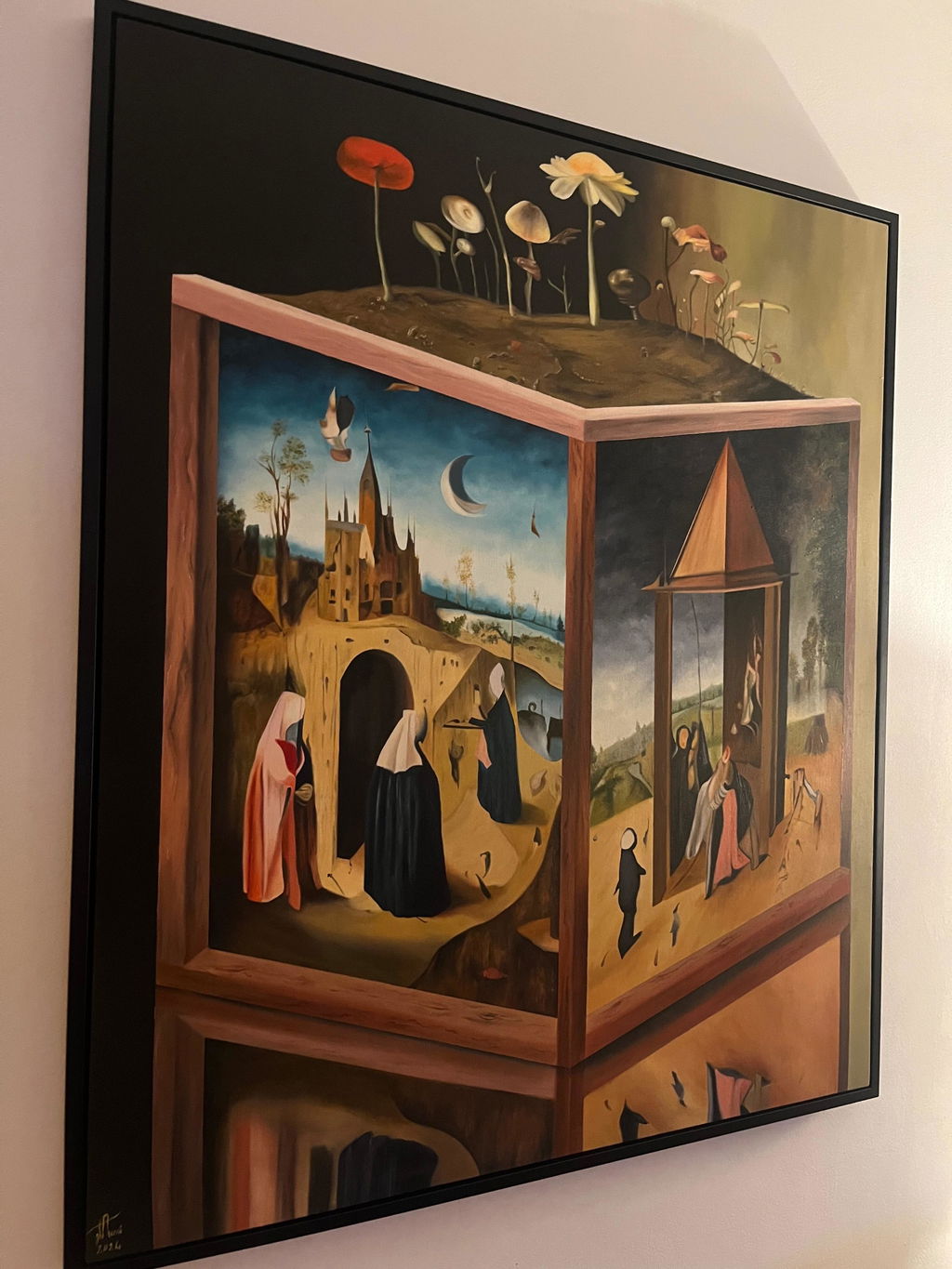
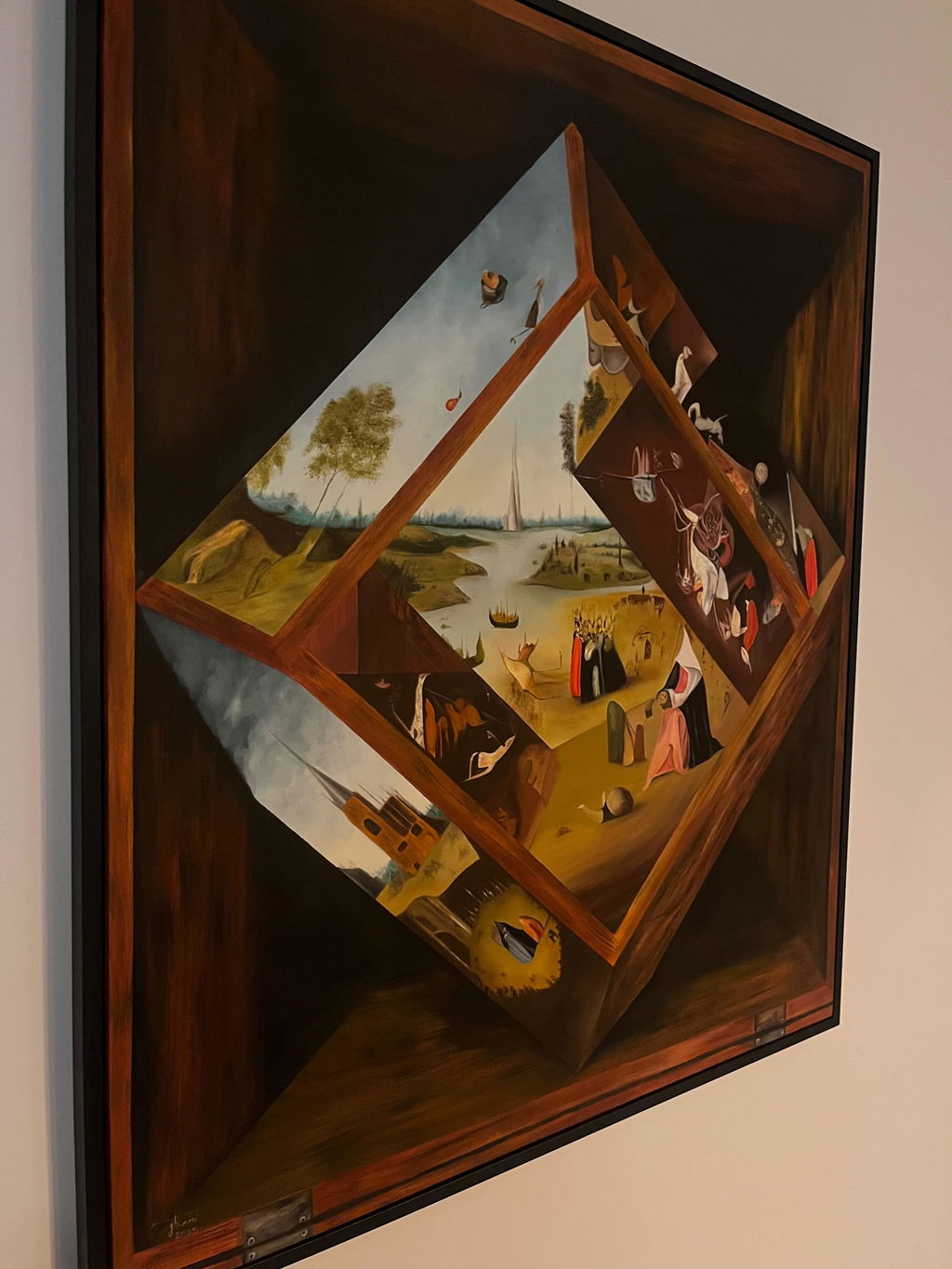
A diptych or triptych is one artwork that happens to be on more than one panel. Everything about framing it follows from that: the framing has to make the panels read as a single object, and there is one measurement that decides whether it does.
The gap is the whole thing
The gap between panels must be smaller than the width of the frame moulding.
That is the rule, and it is close to absolute. Your eye groups things by proximity. When the gap between two panels is narrower than the frames themselves, the eye reads the frames as internal divisions within one work. When the gap grows wider than the moulding, the grouping breaks and you see separate paintings hanging near each other.
In practice: with a 30 mm moulding, a gap of 20 to 25 mm holds it together. Push it to 60 mm and it has come apart. For unframed canvases, use the depth of the stretcher as the reference instead, and keep the gap under that.
The gap must also be identical at every join. On a triptych, 25 mm on one side and 30 mm on the other is visible to anyone, even if they cannot say what is wrong.
The frames must be identical
Same moulding, same width, same finish, same mat if there is one. This is the one place in framing where matching exactly is required rather than merely tidy.
Two consequences worth planning for:
-
Order all the moulding at once, from one batch. Wood varies between batches, and a walnut frame cut in March will not match one cut in October.
-
If one panel is damaged later, you may need to reframe all of them. Keep a note of exactly what was used.
When panels are different sizes
Many triptychs have a wider centre panel. The rule that holds it together is one shared horizontal axis: align the centres, or align the tops, and be consistent. Aligning centres is the more common and generally the stronger choice.
The mat borders may then differ between panels so the outer frames align correctly. That is fine. Alignment of the outer edges matters more than internal consistency of the borders.
Hanging it
This is where diptychs and triptychs go wrong after the framing is perfect.
-
Measure the full assembly first. Total width is all panels plus all gaps. Find the centre of that total, and centre the whole thing on the wall, not the middle panel.
-
Mark a single level line across the wall with a spirit level or a laser, and hang every panel to that one line. Do not level each panel independently, because small errors accumulate.
-
Use two fixing points per panel. Wire is the enemy here: a wire lets a panel tilt, and one tilted panel in a triptych is immediately obvious. D-rings straight onto two hooks keep each panel fixed and level.
-
Use a spacer block cut to the exact gap width to position each panel, rather than measuring each gap by hand.
If the piece is heavy or you want it to behave as one object, a French cleat running the full width lets all the panels hang from a single rail, which guarantees they stay level together. See hanging hardware for framed art.
Vertical and grid arrangements
The same rules apply, with one addition: in a grid, the vertical and horizontal gaps should be equal. Unequal gaps make a grid look like it is drifting, and it is one of those things that reads as wrong long before anyone works out why.
Related but different: a series
A set of separate works by the same artist, meant to hang together but each complete on its own, is a series rather than a polyptych. There the gaps can be wider and the frames need only be consistent, not identical. Works such as the Echoes of the Unseen pieces are individual paintings that happen to sit well as a group, which gives you far more freedom in spacing than a true triptych does.
Common questions
Can panels be framed as one, in a single frame with dividers?
Yes, and it is a legitimate approach for smaller works: one frame, one sheet of glazing, with mat windows for each panel. It guarantees alignment permanently. The drawbacks are weight, cost of a large sheet of glazing, and that the whole thing must be reframed if one panel needs attention.
What if the wall is not wide enough for the full assembly?
Then it is the wrong wall. Squeezing the gaps to fit changes the proportions and it will look compressed. A triptych needs its full width plus breathing room on both sides, ideally at least the width of one panel at each end.
Does the gap change with viewing distance?
Slightly. A very large triptych seen from across a room can take a marginally wider gap, because the whole assembly subtends a smaller angle. The moulding-width rule still holds as the upper limit.
How wide should the gap be between panels in a triptych?
A common starting point is a gap close to the width of the frame moulding itself, often 2 to 5 cm, so the panels read as one composition split by frames rather than as three unrelated pieces. Too wide a gap breaks the visual connection between panels.
Do all panels in a diptych need to be exactly the same frame?
Yes, this is one place where an exact match matters more than usual, since any visible difference in profile, colour or width between panels draws attention to the mismatch rather than to the composition. We frame diptych and triptych panels from the same moulding run at the same time to guarantee this.
How do I keep multiple panels level with each other?
Measure and mark the centre height once for the whole group, then work out from that centre line to each panel's position rather than levelling each frame independently against the last one hung. Small errors compound fast if each panel is levelled only against its neighbour.
Can a diptych be split across two different walls?
It can be done, but it works against the point of the piece, since a diptych or triptych is composed as one continuous image across its panels. If the panels must be separated, choosing to hang them close together on adjoining sections of the same wall preserves the visual connection far better than opposite walls.
Does a triptych need identical hanging hardware on every panel?
Yes, matched hardware at the same height on the frame's reverse on every panel, so each one hangs at the identical distance from its own top edge to the wall hook. Mismatched hardware placement is a common, avoidable cause of a triptych that looks slightly uneven once it is up.