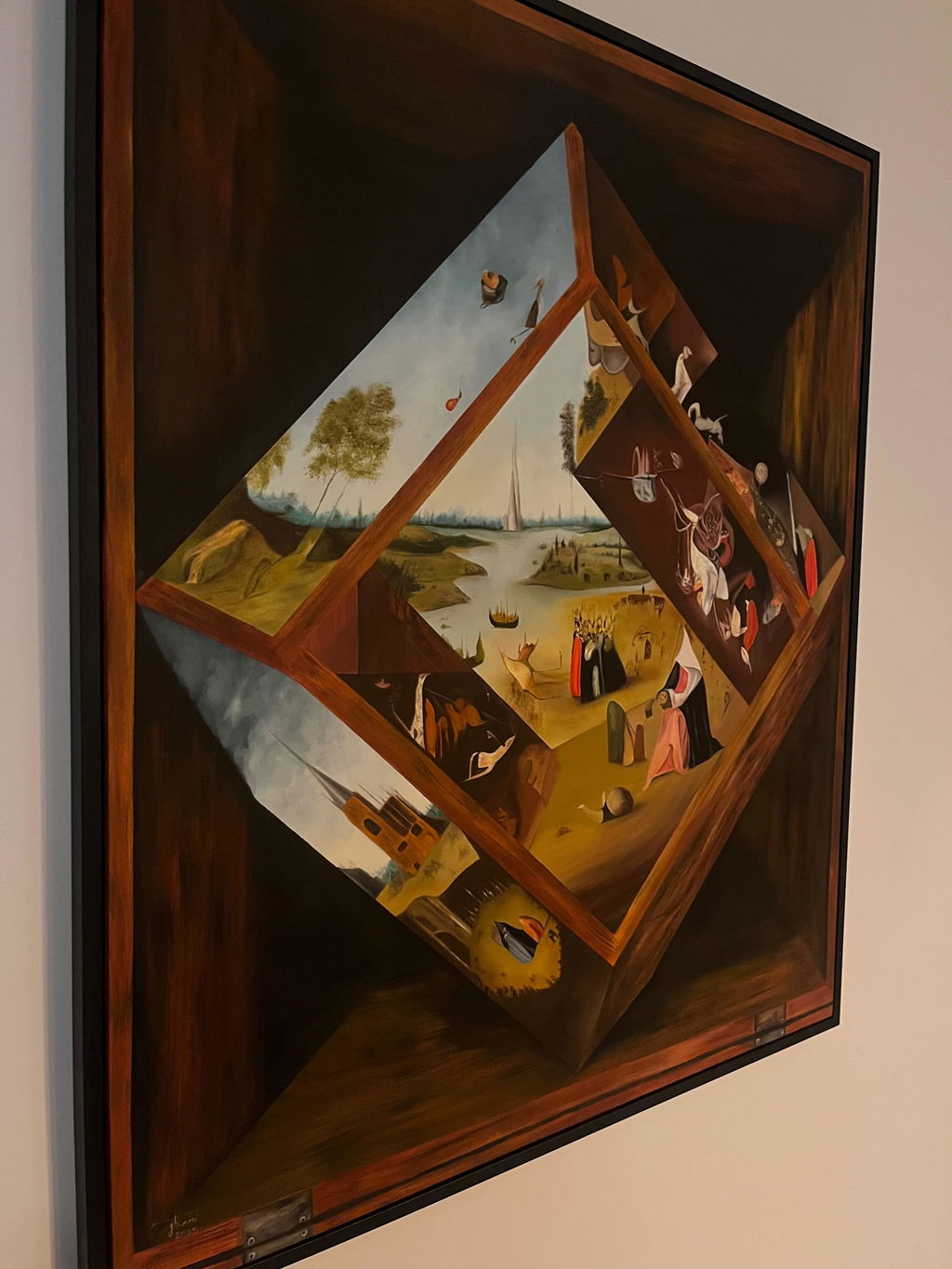
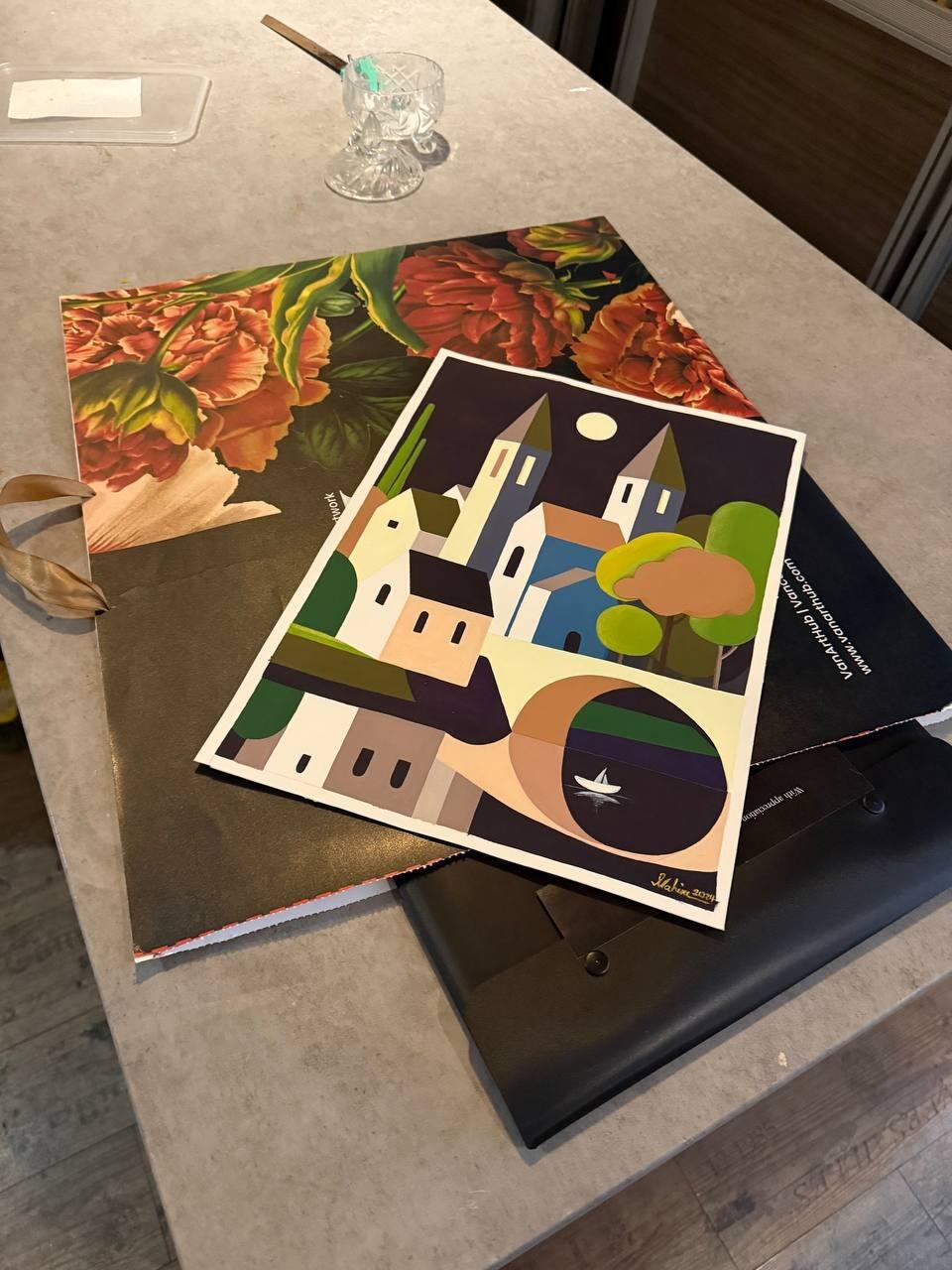
A double mat is two mats stacked, with the lower one cut slightly larger so a thin line of it shows inside the window. That line is called the reveal, and it is one of the most effective small moves in framing.
A fillet does the same job with a different material: a narrow strip of moulding, often gilded or dark wood, set into the window opening.
What the reveal does
It gives the eye a defined edge to arrive at. A single mat presents a large field of cream and then, suddenly, the artwork. A reveal adds a step in between, which does two useful things: it holds the image slightly more firmly, and it introduces a controlled accent colour without committing the whole mat to it.
It is also a way to pick up a colour from the painting. If a coloured pencil piece like Golden Harmony has a warm gold running through it, a thin warm reveal echoes it in a way a fully coloured mat never could, because a fully coloured mat would be shouting the same note across a hundred millimetres.
How wide the reveal should be
3 mm to 6 mm. That is essentially the whole range.
Below 3 mm it reads as a cutting error rather than a decision. Above about 8 mm it stops being a line and becomes a second border, at which point you have two mats fighting rather than one mat with an accent.
The reveal should be consistent on all four sides, including the weighted bottom of the outer mat. The outer mat's bottom border is deeper; the reveal is not.
Choosing the reveal colour
-
A darker tone of the outer mat. The safest and often the best: a warm grey reveal under a cream mat, for instance. It defines the edge without introducing a new colour at all.
-
A colour drawn from the artwork. Pick a quiet colour, never the dominant one. The reveal should agree with the picture, not compete with it.
-
Black. Strong and modern, excellent with photography and graphite. It can be hard on soft, pale work.
-
Gold or a warm metallic fillet. Traditional, and it works when the artwork has warmth or metal in it already.
Fillet or second mat?
|
Double mat |
Fillet |
| Material |
Board |
Wood or composite moulding |
| Effect |
Flat line of colour |
Line with physical relief and shadow |
| Cost |
Small addition |
More, priced by the length |
| Suits |
Contemporary work, photography |
Traditional and formal work |
| Depth |
Adds a board thickness |
Adds real depth; may need a deeper rebate |
A fillet also does something practically useful: because it has depth, it holds the glazing further off the artwork, which is helpful on anything with texture.
When to leave it out
-
The artwork already has a strong border. A picture with a printed or painted edge does not need another line around it.
-
The image is busy. A dense composition and a reveal and a frame is three edges competing.
-
Very small work. On a small piece a reveal takes up a real proportion of the visible field and can crowd the image.
-
You are hanging a set. Reveals multiply across a group. What looks refined on one piece looks fussy on six.
Triple mats
They exist. They are almost always too much. Two reveals turn the mat into a set of concentric frames and the eye starts counting borders instead of looking at the picture. There are cases, mostly formal and historical, but treat a triple mat as a decision that has to be argued for rather than a natural next step.
Choosing a colour for the reveal
The reveal is the thin strip of the bottom mat visible around the opening once the top mat is cut, usually 5 to 10 mm wide, and it does more visual work per millimetre than almost anything else in the frame package. Because it sits directly against the image, its colour reads as part of the artwork's edge, not as a neutral border.
The safest starting point is to pull the reveal colour from inside the painting itself: a muted version of the darkest or most saturated colour in the composition creates a frame the eye reads as continuous with the image, rather than a hard stop. This works especially well on work with a clear dominant colour, where a top mat in cream or white and a reveal in that colour ties the two together without the reveal shouting for attention.
Avoid pure white or pure black reveals unless the painting itself has strong whites or blacks at the edge, since a stark reveal against a warmer top mat creates a visible ring that competes with the image rather than framing it. A reveal that is too bright relative to the top mat also draws the eye to the mat's edge instead of the painting, which defeats the purpose of matting in the first place.
Keep the reveal narrower than the top mat's border, generally no more than a fifth of the top mat's width, so it reads as an accent line rather than a second mat competing for attention. See mat border width guide for how the two widths relate.
Common questions
Does a double mat cost much more?
Not much. It is a second sheet of board and a second cut, so it adds a modest amount to a job where the glazing and the moulding are the significant costs. A fillet costs more, because it is moulding priced by the length. See custom framing cost.
Should the reveal be acid-free too?
Yes, and this is easy to overlook because the inner mat is the one actually touching the edge of the artwork. Some cheap coloured boards are the worst offenders for acid content. Both layers should be conservation grade. See acid-free mats and backing.
Can I add a reveal to a frame I already have?
Usually, but the mat has to be recut, since the window on the existing mat will be the wrong size once a second layer goes underneath. It is straightforward and it is a good time to check what board is in there.
What does the reveal actually look like?
It is a thin strip of the under-mat colour showing evenly around the inner edge of the top mat's window, usually 3 to 6 mm wide. It reads as a fine line of colour framing the artwork one step in from the main mat, and it is what gives a double mat its layered look.
How is a fillet different from a second mat?
A fillet is a thin strip of moulding, not board, set into the mat window against the edge of the artwork, and it usually has its own small profile, such as a rounded or stepped edge, sometimes gilded. A double mat achieves a similar layered look with flat board instead, at a lower cost.
Can I use more than two mats?
Technically yes, a triple mat exists, but past two layers the effect usually starts working against the artwork rather than for it, since each added layer draws more attention to the framing and less to the piece. Two mats is the practical ceiling for almost every painting or print we frame.
Does a double mat need a wider outer border to work?
Not necessarily, but it often looks better with slightly more room, since the reveal needs to sit within the mat's width without crowding the window. On a very narrow mat, adding a reveal can look cramped. We check the proportions before recommending a double mat on a smaller piece.
Is a fillet ever used without any mat at all?
Yes, directly against the frame's rebate around the artwork, most often on a canvas with a wood frame rather than a floater, giving a small decorative line right at the edge of the painting. It is a less common look than a matted double reveal but a legitimate one for certain traditional setups.