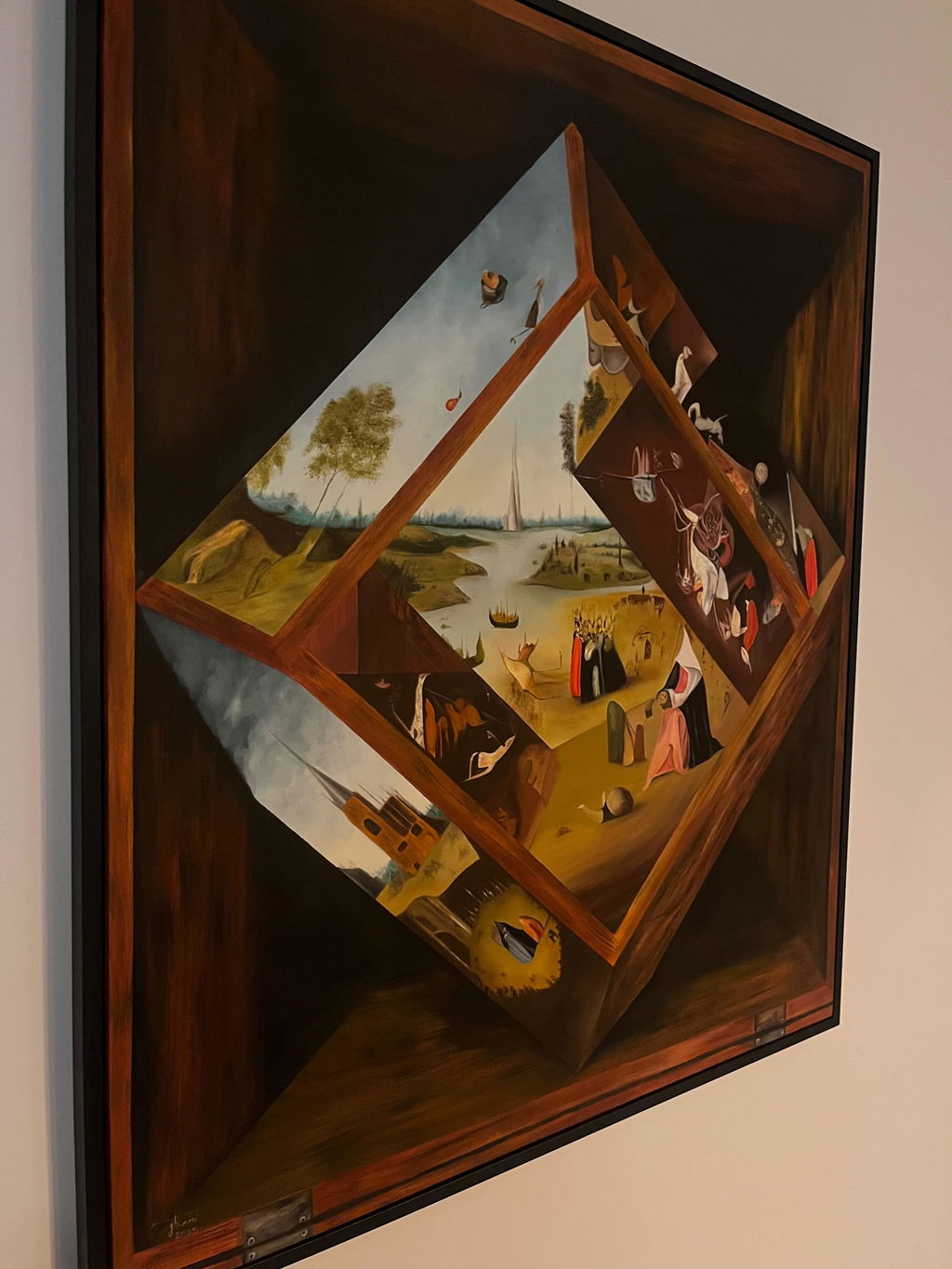
US customs paperwork for a painting shipped from Canada comes down to one document and one filing: a commercial invoice that describes the painting, and a customs entry filed with US Customs and Border Protection, usually by a broker working for the courier. A shipment worth $2,500 or less can normally use the shorter informal entry, and a more valuable one uses a formal entry. The customs processing fee on an automated informal entry is $2.69 until 30 September 2026 and $2.77 from 1 October 2026, and the carrier can add its own clearance fee on top.
We prepare the commercial invoice for every painting we ship. This page explains what that invoice has to say, how the entry is filed, and what the published fees are, so that you know what a carrier bill can contain before one arrives. The tariff side, including why a hand-made painting carries no duty, is on our page about whether paintings from Canada are subject to US tariffs.
Key takeaways
- Federal regulation 19 CFR 141.86 requires a commercial invoice to describe the goods in detail, give the purchase price and currency, and state the country of origin, all in English.
- Under 19 CFR 143.21, shipments worth $2,500 or less may use informal entry, with some exceptions, and US Customs can require a formal entry for any shipment.
- US Customs says goods sent by courier are usually cleared by a customs broker hired by the courier, and brokers are licensed by US Customs without being its employees.
- For fiscal year 2026 the formal entry processing fee is 0.3464 percent of value, with a minimum of $33.58 and a maximum of $651.50.
- FedEx lists a clearance entry fee of $42.25 for a Canada-to-US Ground shipment valued at $1,250.01 to $2,000, in its fee schedule effective 5 January 2026.
The commercial invoice: what it has to say
A commercial invoice is the document that tells US Customs what is in the box. It travels with the shipment and supports the customs entry. The rule for what goes on it is 19 CFR 141.86. In plain words, it asks for the items in the table below.
What 19 CFR 141.86 requires on a commercial invoice, and what that means for a painting
| Required item |
What it means for a painting |
| Port of entry the goods are headed to |
The US entry point on the shipping route. |
| Who sold the goods, to whom, when and where |
The gallery, the buyer, the date and place of sale. |
| A detailed description, with the name the item is known by, its grade or quality, and its marks and numbers |
An original painting, with the artist, title, medium and size. |
| Quantity in weights and measures |
One painting, with its dimensions. |
| Purchase price of each item in the currency of the purchase |
The price you paid, in the currency you paid in. |
| All charges on the goods, itemized, such as freight, insurance, commission and packing |
Shipping, insurance and packing charges. Packing and inland freight to the port of export can stay unitemized if they are included in the price and marked as included. |
| Rebates, drawbacks and bounties allowed on export |
Usually none for a painting. |
| Country of origin |
Canada, for a painting made in Canada. |
| Goods or services supplied for making the item and not included in the price |
Usually none for a painting. |
| Language |
English, or an accurate English translation attached. |
| Packing detail |
What each package contains. |
Our invoice names the piece as an original work of art, painted by hand, made in Canada, with its true sale value. That wording matters because the duty code for paintings, heading 9701, covers work "executed entirely by hand". A description that says only "art" or "decor" gives the broker less to work with.
Informal entry and formal entry
An entry is the filing that asks US Customs to release goods into the country. There are two kinds. Informal entry is the shorter process, and 19 CFR 143.21 lets shipments worth $2,500 or less use it, with some exceptions. Formal entry is the full process, used above $2,500. A CBP rule published in June 2026 says informal entry procedures are "generally ... less burdensome and complex" than formal ones, and that US Customs "may require formal entry for any merchandise" when it considers it necessary.
Before 29 August 2025, a shipment worth $800 or less could pass free of duty through a simpler route called the de minimis exemption. That route is suspended. Under the June 2026 rule, merchandise worth $800 or less arriving by any route other than the postal network must use formal or informal entry. So every painting we send with a carrier outside the postal network goes through one of the two entries below, even though its duty is zero.
Informal and formal customs entry for a painting, with US Customs processing fees for fiscal years 2026 and 2027
|
Informal entry |
Formal entry |
| Value of the shipment |
$2,500 or less, with some exceptions |
Above $2,500, or whenever US Customs requires it |
| Processing fee, automated filing, until 30 September 2026 |
$2.69 |
0.3464 percent of value, minimum $33.58, maximum $651.50 |
| Processing fee, automated filing, from 1 October 2026 |
$2.77 |
0.3464 percent of value, minimum $34.58, maximum $670.86 |
| Who usually files it for a courier shipment |
The courier's customs broker |
The courier's customs broker |
The merchandise processing fee, worked through
The merchandise processing fee is what US Customs charges to process an entry. The base amounts sit in 19 CFR 24.23, and US Customs adjusts them for inflation each fiscal year, which starts on 1 October. For an informal entry the fee is a flat amount. In fiscal year 2026 it is $2.69 when the entry is filed through the electronic system, $8.06 when it is filed manually by someone outside US Customs, and $12.09 when US Customs staff prepare it. From 1 October 2026 those become $2.77, $8.30 and $12.45.
For a formal entry the fee is 0.3464 percent of the value, held between a minimum and a maximum. Take a painting valued at US$3,000. The percentage gives $10.39, which is below the minimum, so the fee is $33.58 on an entry filed before 1 October 2026 and $34.58 after it.
The same regulation, in paragraph (c)(3), says the fee does not apply to goods that originate under the trade agreement between the United States, Mexico and Canada, or that qualify for its preferential treatment. Whether a particular entry claims that treatment is decided by the filer on that entry, so the fee on your shipment may be zero.
Who files the entry, and who is responsible for it
US Customs describes the usual courier route in its guidance on internet purchases: goods shipped by courier or express service "usually are expedited through CBP by a customs broker hired by that commercial service". It adds that customs brokers are not CBP employees, and that the charges on a courier shipment can include the fees the service charges for clearing the goods.
A customs broker is a person or company licensed by US Customs to file entries for other people. The party named on the entry as responsible is called the importer of record. US Customs says that, even when a broker files, the importer of record "is ultimately responsible for the correctness of the entry documentation presented to CBP and all applicable duties, taxes and fees." It also says people importing goods for their own use may make entry on their own, without a broker.
What carriers charge to clear a box
Carriers set their own clearance fees, separate from anything US Customs charges. FedEx publishes a schedule for FedEx International Ground shipments from Canada to the United States. Its fee schedule effective 5 January 2026 lists these clearance entry fees, by the value declared for duty:
- $0 to $200: $9.75
- $200.01 to $800: $19.50
- $800.01 to $1,250: $30.50
- $1,250.01 to $2,000: $42.25
- $2,000.01 and up: $42.25, plus $1.95 for each additional $1,000
The same schedule lists a disbursement fee of the greater of $15 or 2 percent of duty, tax and merchandise processing fee charges. FedEx says its clearance service fees are subject to change and may be billed to shippers, recipients or designated third parties. We quote FedEx because its schedule is public; the carrier on your order may be a different one, with different fees. Our post on what it costs to ship a large canvas covers the shipping side of the bill, such as size-based pricing and crates.
If a carrier sends you a bill
If a carrier sends you a bill for customs clearance on a painting you bought from us, write to us before you pay it. Send a copy of the bill and the tracking number through our contact page, and we will go through the line items with you.
When you read the bill, look at each line. A duty line, or a 10 percent tariff line, on a hand-made painting from Canada is a sign that the entry needs checking, because heading 9701 is Free and artworks are exempt from the Section 301 tariff under heading 9903.05.92. A processing fee line and a carrier service line are the two kinds of charge that can legitimately appear.
For the other costs, our page on paying for Canadian art in US dollars covers card fees and state use tax, and the complete guide to buying original art from Canada puts every step in order. The base duty rule is also covered in our guide to shipping original art from Canada to the USA.
Frequently asked questions
What must a commercial invoice for a painting show?
A commercial invoice for a painting must show who sold it to whom, a detailed description, the purchase price in the currency of the purchase, all charges such as freight and insurance, and the country of origin. Federal regulation 19 CFR 141.86 sets these requirements. VanArtHub prepares the commercial invoice for every painting shipped to the United States.
Does a commercial invoice have to be in English?
A commercial invoice for US Customs has to be in English, or it must have an accurate English translation attached. Paragraph (d) of 19 CFR 141.86 sets this rule for the invoice and all attachments, and says the translation must contain enough information for US Customs to examine the goods and set the duty.
What is the difference between informal and formal customs entry?
Informal customs entry is the shorter filing used for lower-value shipments, and formal entry is the full process used for the rest. A US Customs rule of June 2026 calls informal procedures generally less burdensome and complex. US Customs can still require formal entry for any shipment when it considers that necessary, under 19 CFR 143.22.
At what value does a painting need a formal customs entry?
A painting needs a formal customs entry when the shipment is worth more than $2,500. Federal regulation 19 CFR 143.21 lets shipments of $2,500 or less use informal entry, with some listed exceptions. The formal entry processing fee in fiscal year 2026 is 0.3464 percent of value, with a minimum of $33.58.
Who files the US customs entry for a painting sent by courier?
A customs broker hired by the courier usually files the US customs entry for a painting sent by courier. US Customs says in its guidance on internet purchases that courier and express shipments are usually cleared this way, and that brokers are not US Customs employees. A buyer importing for personal use may also file the entry without a broker.
How much is the processing fee on an informal customs entry?
The processing fee on an automated informal customs entry is $2.69 until 30 September 2026 and $2.77 from 1 October 2026. A manual entry not prepared by US Customs staff costs $8.06, rising to $8.30. US Customs adjusts these amounts each fiscal year and publishes them in the Federal Register.
How is the processing fee on a formal customs entry calculated?
The processing fee on a formal customs entry is 0.3464 percent of the value, held between a minimum and a maximum. For fiscal year 2026 the minimum is $33.58 and the maximum is $651.50. A painting valued at US$3,000 gives $10.39 at that percentage, so the minimum of $33.58 applies.
What does FedEx charge to clear a package from Canada to the US?
FedEx charges a clearance entry fee on FedEx International Ground shipments from Canada to the US that rises with the declared value. The FedEx schedule effective 5 January 2026 lists $9.75 up to $200, $42.25 for $1,250.01 to $2,000, and $1.95 more for each additional $1,000 above $2,000. FedEx says these fees are subject to change.
What should I do if a carrier bills me for a painting from VanArtHub?
A buyer who gets a carrier bill for a painting from VanArtHub should contact us with the bill and tracking number before paying it. We will go through each line with you. A duty or 10 percent tariff line on a hand-made painting is a sign that the entry needs checking, because heading 9701 is Free.
Who is responsible for the accuracy of a US customs entry?
The importer of record is responsible for the accuracy of a US customs entry, even when a broker files it. US Customs says in its tips for new importers that the importer of record is ultimately responsible for the correctness of the entry documentation and for all applicable duties, taxes and fees.
Which price goes on the commercial invoice for a painting?
The commercial invoice for a painting shows the purchase price of the item in the currency of the purchase. Federal regulation 19 CFR 141.86 also requires every charge on the goods, such as freight, insurance and packing, to be itemized by name and amount, with a narrow allowance for packing and inland freight already included in the price.
References
-
19 CFR 141.86 Contents of invoices and general requirements. Electronic Code of Federal Regulations, National Archives. Undated current text. Accessed 26 September 2026. Every required invoice item, the English-language rule and the packing detail rule.
-
19 CFR 143.21 Merchandise eligible for informal entry. Electronic Code of Federal Regulations, National Archives. Undated current text. Accessed 26 September 2026. The $2,500 limit for informal entry and its exceptions.
-
19 CFR 24.23 Fees for processing merchandise. Electronic Code of Federal Regulations, National Archives. Undated current text. Accessed 26 September 2026. The informal and formal processing fees, the annual adjustment and the exemption in paragraph (c)(3).
-
Customs User Fees To Be Adjusted for Inflation in Fiscal Year 2026 CBP Dec. 25-10. US Customs and Border Protection, Federal Register. Published 23 July 2025. Accessed 26 September 2026. Fiscal year 2026 fees: $2.69, $8.06 and $12.09 for informal entry; $33.58 minimum and $651.50 maximum for formal entry.
-
Customs User Fees To Be Adjusted for Inflation in Fiscal Year 2027. US Customs and Border Protection, Federal Register. Published 31 July 2026. Accessed 26 September 2026. Fees from 1 October 2026: $2.77, $8.30 and $12.45 for informal entry; $34.58 minimum and $670.86 maximum for formal entry; the 0.3464 percent rate.
-
Indefinite Suspension of the De Minimis Exemption for Merchandise Arriving Through All Modes Other Than the International Postal Network. US Customs and Border Protection, Federal Register. Published 24 June 2026. Accessed 26 September 2026. The suspension since 29 August 2025, the requirement to use formal or informal entry, and the comparison of the two procedures.
-
Internet Purchases. US Customs and Border Protection. Last modified 6 March 2024. Accessed 26 September 2026. Courier shipments cleared by a broker hired by the courier, and the fees that can apply.
-
Tips for New Importers and Exporters. US Customs and Border Protection. Last modified 27 August 2024. Accessed 26 September 2026. Brokers are licensed by CBP without being its employees, the importer of record's responsibility, and entry without a broker.
-
2026 changes to FedEx surcharges & fees. FedEx. Effective 5 January 2026. Accessed 26 September 2026. FedEx International Ground Canada-to-US clearance entry fees and the disbursement fee.
-
Clearance Fees. FedEx. Undated. Accessed 26 September 2026. Clearance service fees are subject to change and may be billed to shippers, recipients or third parties.
-
CSMS # 69326983 - GUIDANCE: Section 301 Forced Labor Import Duties. US Customs and Border Protection. Published 23 July 2026. Accessed 26 September 2026. The artworks exemption under heading 9903.05.92.
-
Harmonized Tariff Schedule of the United States, heading 9701. US International Trade Commission. Undated online edition. Accessed 26 September 2026. Heading 9701 covers work executed entirely by hand, at a general rate of Free.
Checked 26 September 2026. If something here is out of date, write to us and we will correct it.