Omar Khayyam in Painting: The Rubaiyat and Its Illustrators
UpdatedOmar Khayyam was a Persian mathematician, astronomer and poet who lived in Nishapur in the 11th and 12th centuries. The four-line poems under his name are called the Rubaiyat, and Edward FitzGerald's English version of 1859 made them famous and led to the illustrated editions. We are VanArtHub, a Vancouver gallery that sells original paintings, and we show two of our paintings beside the sky and the moon of his work. Below are his life, his science, the quatrains, FitzGerald's version and the pictures to look up.
Who Omar Khayyam was: Nishapur, the name and the dates
The Encyclopaedia Iranica prints his full name as Abu'l-Fath Omar b. Ebrahim Khayyam Nishapuri, that is, Khayyam of Nishapur, a city in present-day Iran (MacTutor, the history of mathematics archive at the University of St Andrews, writes Umar).
His dates are uncertain. Hosayn Ma'sumi Hamadani, who wrote the Iranica entry on the life, calls both a matter of dispute. A writer named Bayhaqi recorded Khayyam's horoscope, and the scholar Govinda Tirtha calculated a birth date of 18 May 1048 from it. For the death, Nezami Aruzi reports a visit to the grave in Nishapur in 1136, and the manuscripts of his book disagree: some place the visit four years after the death, and others say "some years". The Iranica's heading gives ca. 1048 and ca. 1123. MacTutor prints 18 May 1048 and 4 December 1131.
In 1074 to 1075 the Seljuq sultan Malik Shah (the Iranica writes Malekshah) called a group of astronomers, Khayyam among them, to build an observatory. Our page on Persian art history covers the Seljuq period in which he worked.
One fact matters for the poems: no Persian verse of his is quoted until almost a century after his death, the same entry says.
The mathematician: the treatise on algebra and the cubic equations
Three of his mathematical works survive, Bijan Vahabzadeh writes in the Iranica: a commentary on Euclid's Elements, an essay on dividing a quarter of a circle, and a treatise on algebra.
In the treatise Khayyam sorts the equations of the first, second and third degree into 25 kinds. A cubic equation is one that holds the cube of the unknown number. Fourteen of his cubics cannot be reduced to a simpler equation, and he solves each with geometry: he draws two curves and studies the points where they cross. The curves are conic sections, the shapes made by cutting a cone. MacTutor describes the result as "a complete classification of cubic equations with geometric solutions".
He and the mathematicians before him found no way to solve these equations by calculation alone, and he wrote that "possibly someone else will come to know it after us". The rules were found in the 16th century, Vahabzadeh adds, by two Italian mathematicians.
The astronomer: a calendar for Malik Shah
The lunar year and the old Persian year of 365 days were both in use, and neither added extra days as a correction. Younes Karamati writes in the Iranica that this was inconvenient, above all for collecting the land tax. So Malik Shah gathered astronomers to observe the sun and find the moment of the spring equinox.
The historian Ebn al-Athir names Khayyam among them, and says the observations went on until the sultan died in 1092. Reza Abdollahy, in the Iranica entry on calendars, gives the purpose and the start of the new Jalali calendar: Nowruz, the new year, was fixed at the spring equinox, and the calendar was adopted on 15 March 1079. Karamati finds it surprising that early sources say so little about Khayyam's own part.
In this calendar each season began when the sun passed an equinox or a solstice, Abdollahy writes. The winter solstice brings the longest night of the year, the subject of our page on Yalda night and Persian art.
Celestial Garden by Darya is a Persian negargari in oil and gold, 30 x 40 cm (11.8 x 15.7 in). Striped and marbled spheres that recall Jupiter, Saturn, the Earth and a deep blue Neptune sit inside bands of ornament filled with small flowers and scrolling vines, around a gold spiral. It is a contemporary work with no stated link to Khayyam, shown here because it shares a subject with the astronomer: the planets.

The quatrains: what a roba'i is, and how many are his
A roba'i is a poem of four lines, and Rubaiyat is the plural: the quatrains. The first, second and fourth lines rhyme, and sometimes the third does too.
How many did Khayyam write? Sayyed Ali Mirafzali explains in the Iranica why nobody knows. The earliest book that quotes a Persian quatrain under his name is by Fakhr al-Din Razi, who died in 1210. An anthology of the middle of the 13th century holds 33 of his quatrains. A collection published in 1941 by Govinda Tirtha holds 1,096.
Many of these are also credited to other poets. The scholar Valentin Zhukovskii took the 464 quatrains of one printed edition and found 82 of them under other poets' names. Scholars since then have each accepted a smaller set: the Iranica lists 143 for Sadeq Hedayat, 179 for Mohammad Ali Foroughi and 74 for Ali Dashti. One test that Mirafzali supports is the rhyme: a quatrain in which all four lines rhyme is more likely to be the original form.
What the quatrains say, and five images a painter can use
Mirafzali names complaint against fate as one of the main subjects, and one quatrain shows the questions the poems ask. The Iranica prints it in English from Hamid Algar's translation of an old book that quotes the poem: "Why did the Maker adorn the forms of creation / And then cast them down to decay and decrease?"
Readers have disagreed about such poems since the 13th century, and we report the sources without choosing. Najm al-Din Razi quoted that quatrain and called its author "that sightless wanderer". Shams of Tabriz, the teacher in our post on Rumi in painting, described Khayyam as a confused thinker. Ma'sumi Hamadani compares these arguments to the later ones about the poet of our post on Hafez in painting. Austin O'Malley writes in the Iranica that most translators from the Persian present Khayyam as a hedonist and a sceptic, while others, such as Nicolas and Graves, argue for a mystical reading. FitzGerald took the wine literally and called it "the veritable juice of the grape".
Here are five images, as FitzGerald's first edition of 1859 gives them. Representative Poetry Online, a site hosted by the University of Toronto Libraries, prints it in full.
- The wine cup. The speaker asks more than once for the cup to be filled. One stanza names the magic cup of the mythical king Jamshid.
- The potter and the clay. A part headed Kuza-Nama, "Book of Pots", is set in a potter's shop, where some of the pots can speak. One asks: "Who is the Potter, pray, and who the Pot?"
- The turning sky. One stanza calls the sky an upside-down bowl that rolls on over the people who live and die beneath it.
- The moon. The closing stanzas address a person as a moon while the real moon rises: "Ah, Moon of my Delight who know'st no wane, / The Moon of Heav'n is rising once again". The Toronto notes identify this person as the saki, the cupbearer who pours the wine.
- The garden. In the same stanza the moon will rise again and look through the same garden for the speaker, who will be gone.
In our view the potter's shop is the easiest of the five to paint, because it is already a room with objects. The turning sky is the hardest: the poem says the sky moves, and a painting holds still.
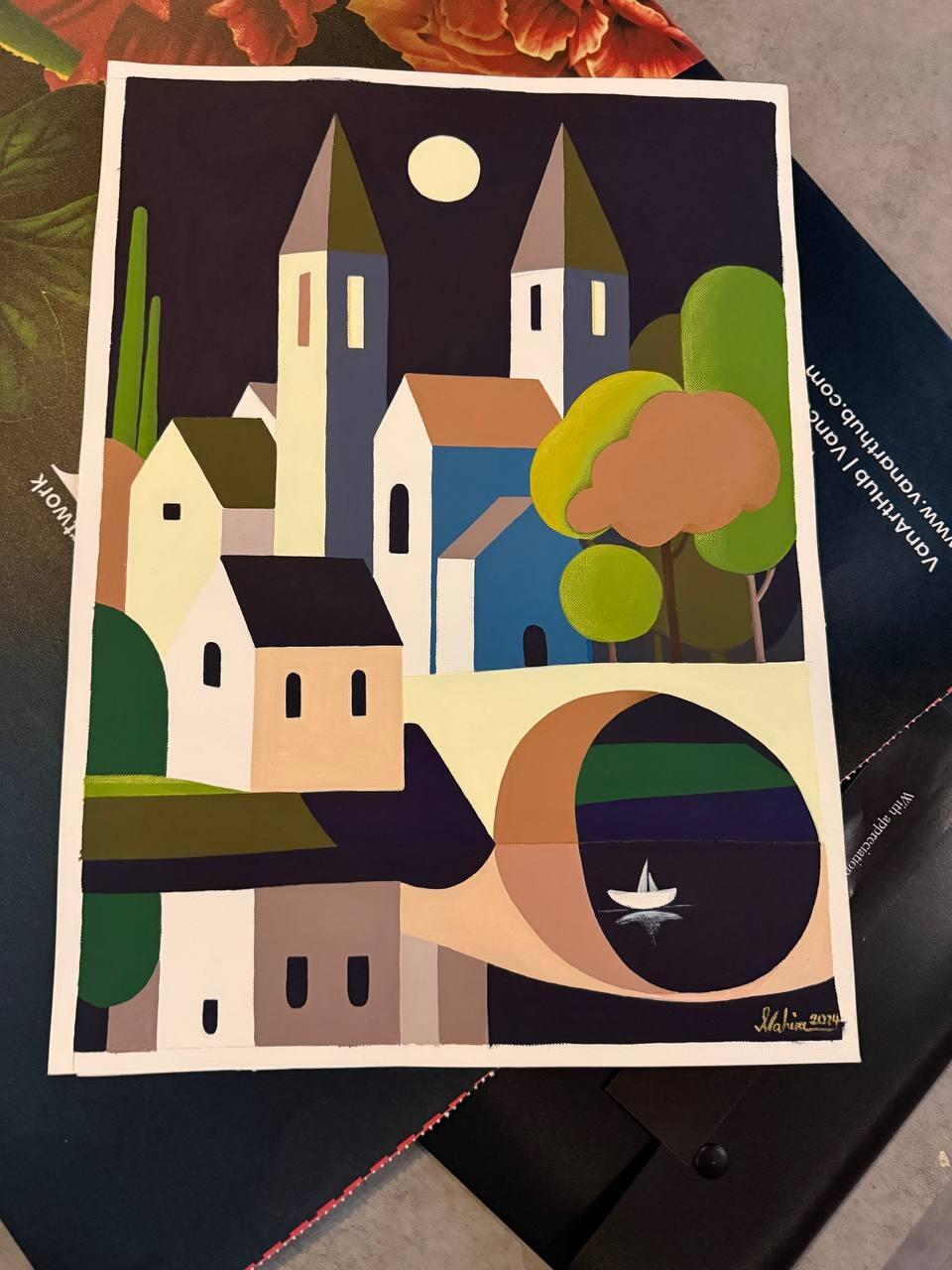
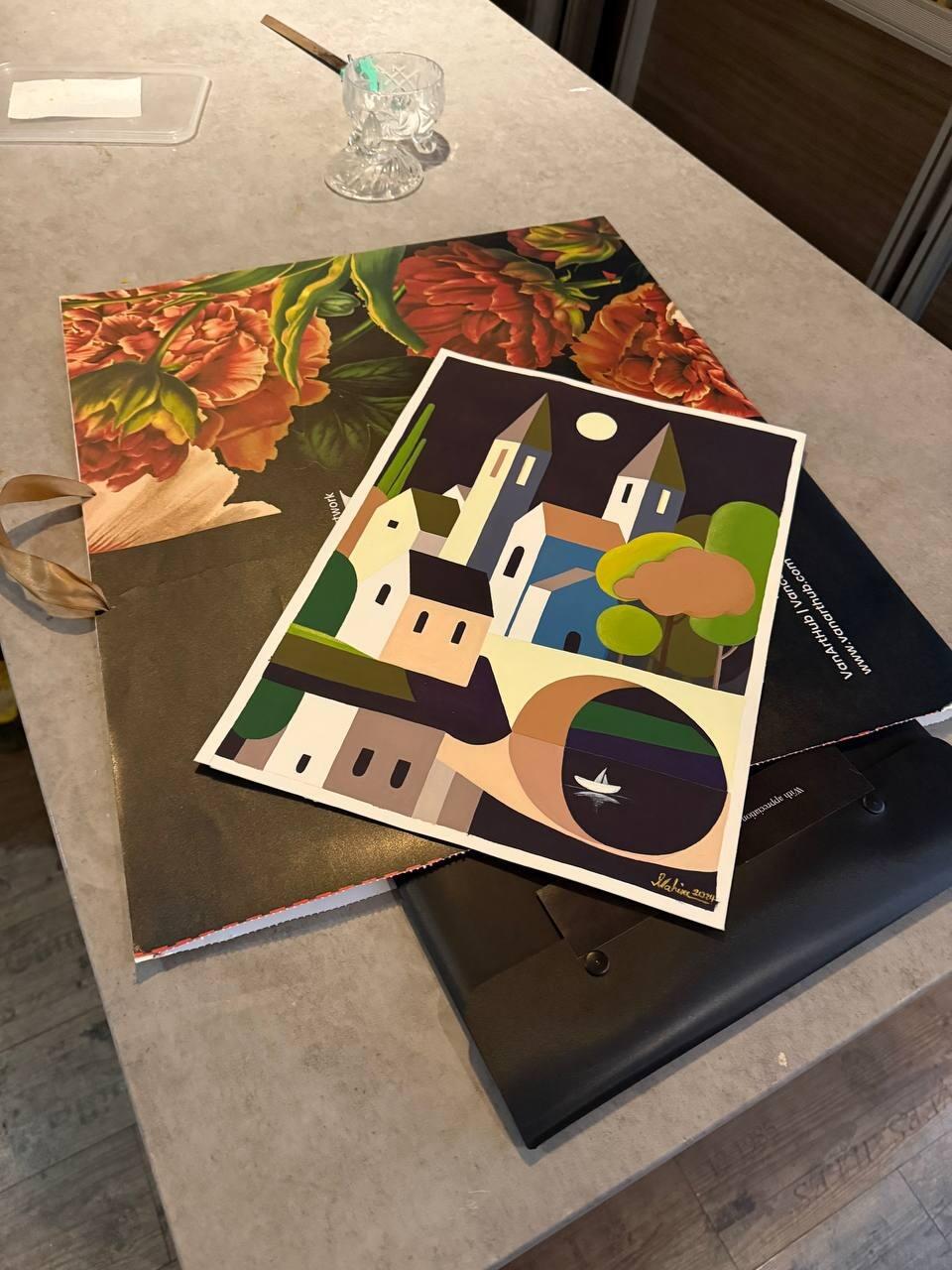
Moonlit Reflections by Nahira is an acrylic on canvas, 30 x 40 cm (11.8 x 15.7 in). It shows a stylised village under a dark night sky lit by a single pale yellow moon, with a light beige bridge reflected in dark water. It is a contemporary work with no stated link to Khayyam, shown here because it shares a subject with the stanza above: a moon over a place where people live.

Why old Persian copies of the quatrains have so few pictures
Manuscripts of long story poems, such as the Shahnameh of Ferdowsi and the Khamsa of Nizami, hold many paintings. William H. Martin and Sandra Mason write in the Iranica that manuscripts of the poems "were seldom if ever illustrated". They suggest one cause, the doubt about who wrote the verses, and their wording is careful: the doubt "may partially explain" it. Our page on Persian poetry in painting adds that a short poem has no single story for a painter to follow.
The earliest known illustrated copy dates from ca. 1500, the same writers report, and at least one of its paintings is attributed to the painter Behzad. The famous copy is MS Ouseley 140 in the Bodleian Library in Oxford. Mirafzali records that it was copied in Shiraz in December 1460 and that it provided the basis for FitzGerald's English.
Edward FitzGerald's English version of 1859
Edward FitzGerald (1809 to 1883) learned Persian from a friend, Edward Cowell, who began to teach him in December 1852, Dick Davis writes in the Iranica. In 1856 Cowell gave him a copy he had made of the Bodleian manuscript.
FitzGerald's version was published in London in 1859, without his name, by Bernard Quaritch, in 250 copies. The first edition went unsold. Jos Biegstraaten writes in the Iranica that in 1861 the booklet lay in Quaritch's remainder box at a penny a copy, where a scholar named Whitley Stokes bought one, came back for more and gave one to the poet and artist Dante Gabriel Rossetti.
How close is it to the Persian? The Harry Ransom Center at the University of Texas calls it "a loose translation". In Persian the quatrains are separate poems, and FitzGerald arranged them into one continuous poem that follows a speaker through a single day. Davis cites the count that Edward Heron-Allen made in 1899: 49 stanzas are faithful paraphrases of single Persian quatrains, 44 are each built from more than one, four come from Hafez and Attar, and three have no Persian source. So an English line of "Omar" may be FitzGerald's own. Our guide to Rumi and Hafez paintings lists the checks to make on a quoted line, and they apply here too: ask for the translator and the edition.
The illustrators: Vedder in 1884, Dulac in 1909, and those who followed
Elihu Vedder, 1884
The first fully illustrated Rubaiyat was published in Boston in 1884 by Houghton Mifflin, with drawings commissioned from the American artist Elihu Vedder (1836 to 1923). When the originals were shown at the Arts Club in Boston, they drew up to 2100 visitors a day, and the book sold out in six days.
Martin and Mason call the imagery "uncompromisingly Western". The Smithsonian American Art Museum in Washington holds drawings from the set, dated 1883 to 1884. One is The Loquacious Vessels, in chalk, pencil, ink and watercolour. The museum indexes the drawing under a group of male figures in classical dress.
The Metropolitan Museum of Art has a later painting, The Cup of Love of 1887, which Vedder based on one of the drawings.
Edmund Dulac, 1909
In 1909 Hodder and Stoughton published an edition with paintings by Edmund Dulac (1882 to 1953), who was born in France and moved to London in 1906. The National Art Library at the Victoria and Albert Museum holds a copy: 20 colour plates, each mounted inside an illustrated border. Martin and Mason call Dulac's pictures art nouveau and orientalist, the word for a European artist's imagined East.
Edmund Sullivan, 1913
Edmund Sullivan drew every one of the 75 stanzas of the first edition for a book of 1913. The Victoria and Albert Museum holds one of the originals, dated 1912. Its title is the first line of stanza XI, which it illustrates: "Here with a Loaf of Bread beneath the Bough". Martin and Mason count at least 220 people who have illustrated or decorated the poems since 1884.
The Great Omar and the Titanic
The Great Omar was a binding of Vedder's illustrated edition, 16 by 13 inches, made by the firm of Sangorski and Sutcliffe to the designs of the English bookbinder Francis Sangorski. The bookbinding dictionary of Etherington and Roberts, published on the conservation site CoOL, describes it: 1,050 jewels, a number it gives as a round figure, and a model of a Persian mandolin on the lower cover.
The Cooper Hewitt, Smithsonian Design Museum in New York records that on April 14, 1912, it sank on the Titanic. The dictionary adds that a later copy was destroyed in the Second World War.
Painters in Iran in the 20th century
Editions made in Iran usually print the Persian quatrains beside translations, with pictures by modern Iranian artists. Martin and Mason name one of the earliest: Sadeq Hedayat's selection of 1934, with illustrations attributed to Darvish, in a traditional style. From the late 1950s came editions with work by Mohammad and Akbar Tajvidi and by Hosayn Behzad (1894 to 1968), who kept the format and some of the imagery of the Persian miniature. He is a later painter than the Behzad of the 15th century.
Pictures and books to look up
| Subject | Work to look up | Where it is held |
|---|---|---|
| FitzGerald's Persian source | MS Ouseley 140, quatrains copied in Shiraz in December 1460 | Bodleian Library, Oxford, as the Iranica records |
| The English poem of 1859 | Rubaiyat of Omar Khayyam, first edition, with notes | University of Toronto Libraries, Representative Poetry Online |
| The first illustrated edition | The Loquacious Vessels, Elihu Vedder, 1883 to 1884 | Smithsonian American Art Museum, 1978.108.47 |
| The cup | The Cup of Love, painting by Elihu Vedder, 1887 | The Metropolitan Museum of Art, 1976.106.2 |
| Dulac's 20 colour plates | Rubaiyat of Omar Khayyam, Hodder and Stoughton, 1909 | Victoria and Albert Museum, National Art Library, L.1491-1909 |
| Stanza XI of the first edition | Here with a Loaf of Bread beneath the Bough, drawing by Edmund Sullivan, 1912 | Victoria and Albert Museum, SD.1009:3 |
| The jewelled binding | The Great Omar, Sangorski and Sutcliffe | Lost on the Titanic in 1912 |
In our view the Vedder drawings are the place to start, because they were the first and the museum shows them online.
Key Takeaways
- Omar Khayyam lived in Nishapur. Sources differ on his death: ca. 1123 in the Encyclopaedia Iranica, 1131 in MacTutor.
- His treatise on algebra solves fourteen cubic equations with geometry, and he was one of the astronomers Malik Shah gathered before the Jalali calendar was adopted in 1079.
- Nobody knows how many quatrains are his. The count under his name grew from 33 in a 13th-century anthology to 1,096 in a collection of 1941.
- Old Persian manuscripts of the quatrains were seldom illustrated. The pictures came after Edward FitzGerald's free English version of 1859, first from Elihu Vedder in 1884.
- The Great Omar, a jewelled binding of Vedder's edition, sank on the Titanic in 1912.
Frequently Asked Questions
Who was Omar Khayyam, and what is the Rubaiyat?
Omar Khayyam was a Persian mathematician, astronomer and poet who lived in Nishapur in the 11th and 12th centuries. The Rubaiyat is the collection of four-line poems that carry his name. Rubaiyat is the plural of roba'i, the Persian word for such a poem. Edward FitzGerald's English version of 1859 made the poems famous among readers of English.
When was Omar Khayyam born, and when did he die?
Sources agree on 1048 for the birth of Omar Khayyam and disagree on the year of his death. The Encyclopaedia Iranica gives ca. 1048 and ca. 1123, and reports a birth date of 18 May 1048 calculated from his horoscope. The MacTutor archive at the University of St Andrews prints 18 May 1048 and 4 December 1131, both at Nishapur.
Did Omar Khayyam write every quatrain in the Rubaiyat?
No one can say how many of the quatrains are his, and many are also credited to other poets. The Encyclopaedia Iranica records 33 quatrains under his name in a 13th-century anthology and 1,096 in a collection of 1941. Modern scholars have each accepted a smaller set, from 74 in Ali Dashti's selection to 179 in Mohammad Ali Foroughi's.
What did Omar Khayyam do in mathematics and astronomy?
In mathematics he wrote a treatise on algebra that sorts the equations up to the third degree into 25 kinds and solves fourteen cubic equations with geometry, by crossing two curves. In astronomy he was among the scholars whom the sultan Malik Shah gathered to observe the sun. Their calendar, the Jalali, was adopted on 15 March 1079 and begins the year at the spring equinox.
How close is FitzGerald's Rubaiyat to the Persian quatrains?
FitzGerald's version is a free one that joins separate Persian poems into one continuous English poem. A count made by Edward Heron-Allen in 1899, cited in the Encyclopaedia Iranica, found 49 stanzas that paraphrase a single quatrain, 44 built from more than one, four taken from Hafez and Attar, and three with no Persian source.
Who made the first illustrated Rubaiyat, and where are the drawings now?
The American artist Elihu Vedder made the first fully illustrated edition, published in Boston in 1884. The Smithsonian American Art Museum in Washington holds drawings from the set, dated 1883 to 1884, and shows them online. The Metropolitan Museum of Art in New York holds The Cup of Love, a painting of 1887 that Vedder based on one of the drawings.
What was the Great Omar, and what happened to it?
The Great Omar was a jewelled binding of Vedder's illustrated Rubaiyat, made by the bookbinding firm of Sangorski and Sutcliffe. A bookbinding dictionary gives it 1,050 jewels, as a round figure, and a model of a Persian mandolin on the lower cover. The Cooper Hewitt museum records that it sank on the Titanic on April 14, 1912. A later copy was destroyed in the Second World War.
Was Moonlit Reflections painted for a quatrain of Khayyam, and what arrives if I order it?
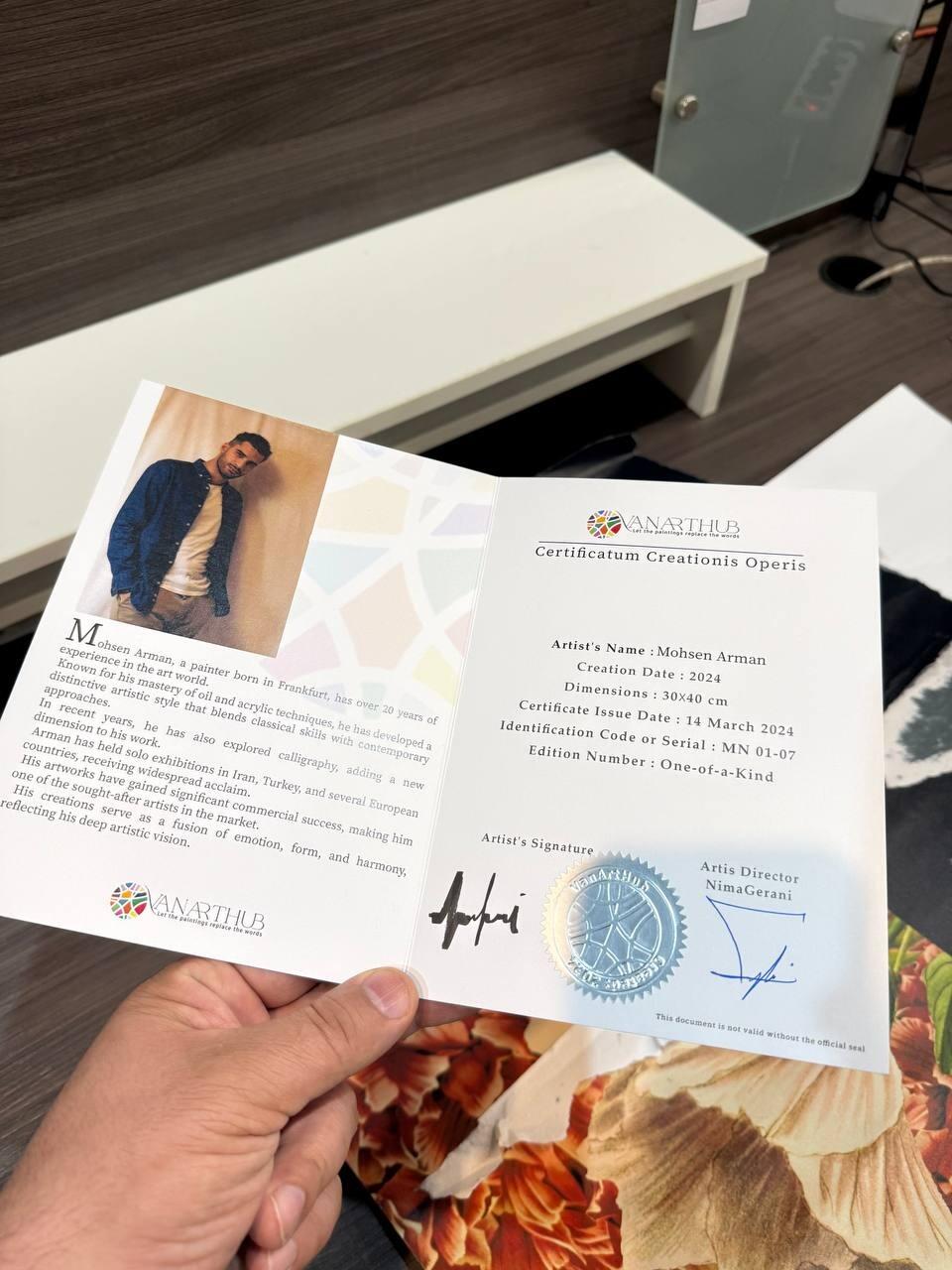
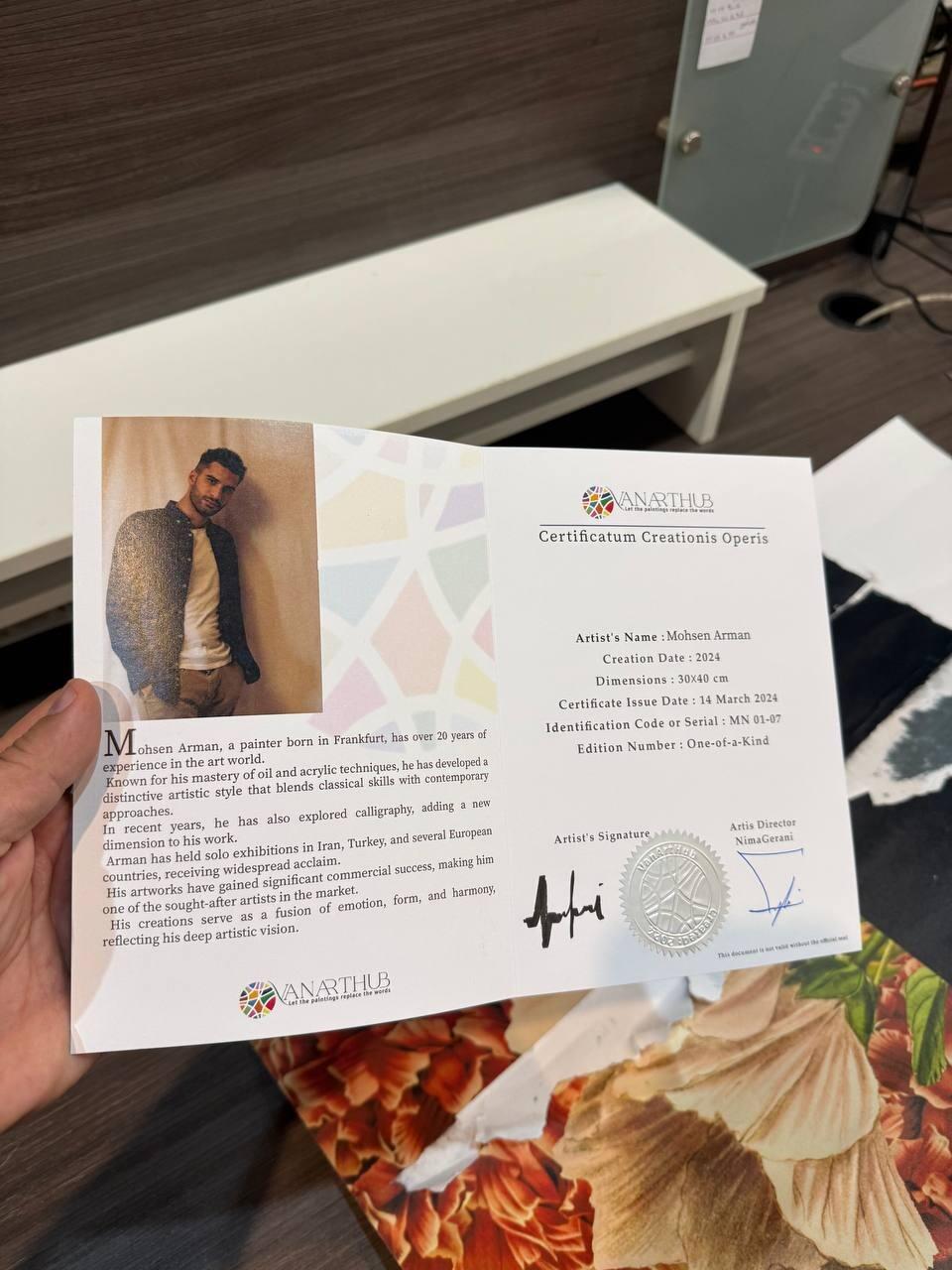
Moonlit Reflections has no stated link to Khayyam: Nahira's painting shows a village at night under a single pale yellow moon, and the moon is an image the quatrains use too. If you order Moonlit Reflections, you receive the signed original, an acrylic on canvas of 30 x 40 cm, one of a kind, with a Certificate of Authenticity.
What will I pay for delivery of a 30 x 40 cm painting, and when does it arrive?
You pay nothing for delivery, and the painting is fully insured while it travels. A work sent to an address in Canada arrives in 3 to 7 business days, and one sent to the United States in 5 to 10 business days. We send every work from Vancouver. Every painting we ship is an original, signed and one of a kind.
If I change my mind once the painting is on my wall, how do I get my money back?
You return the painting within 14 days of delivery and receive a full refund, and we pay the return shipping. Every work comes with this 14-day trial, so you can see it in the light of your own room before you decide. Our Buy with Confidence page sets out the terms, and our guide on how to buy Persian art covers other questions.
Sources
- Encyclopaedia Iranica, Khayyam, Omar, read October 2026.
- Encyclopaedia Iranica, Khayyam, Omar i. Life, by Hosayn Ma'sumi Hamadani, read October 2026.
- Encyclopaedia Iranica, Khayyam, Omar ii. Poetry, by Sayyed Ali Mirafzali, read October 2026.
- Encyclopaedia Iranica, Khayyam, Omar iii. Impact on Literature and Society in the West, by Jos Biegstraaten, read October 2026.
- Encyclopaedia Iranica, Khayyam, Omar iv. English Translations of the Rubaiyat, by Austin O'Malley, read October 2026.
- Encyclopaedia Iranica, Khayyam, Omar v. Illustrations of English Translations of the Rubaiyat, by William H. Martin and Sandra Mason, read October 2026.
- Encyclopaedia Iranica, Khayyam, Omar xiv. As Mathematician, by Bijan Vahabzadeh, read October 2026.
- Encyclopaedia Iranica, Khayyam, Omar xv. As Astronomer, by Younes Karamati, read October 2026.
- Encyclopaedia Iranica, Calendars ii. In the Islamic Period, by Reza Abdollahy, read October 2026.
- Encyclopaedia Iranica, FitzGerald, Edward, by Dick Davis, read October 2026.
- University of St Andrews, MacTutor History of Mathematics, Omar Khayyam, read October 2026.
- University of Toronto Libraries, Representative Poetry Online, Rubaiyat of Omar Khayyam, by Edward FitzGerald, first edition of 1859, read October 2026.
- Harry Ransom Center, The University of Texas at Austin, The Persian Sensation: The Rubaiyat of Omar Khayyam in the West, read October 2026.
- Smithsonian American Art Museum, Elihu Vedder, (Illustration for Rubaiyat of Omar Khayyam) The Loquacious Vessels, 1978.108.47, read October 2026.
- The Metropolitan Museum of Art, Elihu Vedder, The Cup of Love, 1976.106.2, read October 2026.
- Victoria and Albert Museum, Rubaiyat of Omar Khayyam, with illustrations by Edmund Dulac, L.1491-1909, read October 2026.
- Victoria and Albert Museum, Here with a Loaf of Bread beneath the Bough, drawing by Edmund Joseph Sullivan, SD.1009:3, read October 2026.
- Conservation OnLine (CoOL), Etherington and Roberts, Bookbinding and the Conservation of Books: A Dictionary of Descriptive Terminology, Great Omar, read October 2026.
- Cooper Hewitt, Smithsonian Design Museum, Bound to be Beautiful, read October 2026.
Sources read in October 2026. If you spot something out of date, tell us and we will correct this post.
About VanArtHub
VanArtHub is a gallery in Vancouver, Canada. Every painting we ship is an original, signed and one of a kind, and each arrives with a Certificate of Authenticity, free insured shipping and a 14-day trial. Persian art is also called Iranian art. To read more, start with our guide to contemporary Persian painting, or browse all the originals we have for sale.