Hafez in Painting: The Divan, Five Images and a Royal Copy
UpdatedHafez (museums write Hafiz) was a Persian poet of the 14th century who was born in Shiraz and died there. He is known for his ghazals, short lyric poems of love and wine, and his collected poems are called the Divan. We are VanArtHub, a Vancouver gallery that sells original paintings, and we show three of our paintings beside the images of his poems. Below are his life, the making of the Divan, five images from the poems, the royal copy made for Sam Mirza, and pictures to look up.
Who Hafez was, and the Shiraz he lived in
His name was Shams al-Din Mohammad. "Hafez" is a pen name, and Baha al-Din Khorramshahi writes in the Encyclopaedia Iranica that it is generally taken to mean a man who has memorised the Quran.
His dates are uncertain. Khorramshahi reports two proposed years of birth, 1317 and 1315. Some old sources put his death in 1389, and most modern scholars prefer 1390. The Metropolitan Museum of Art prints ca. 1325 to 1390, where "ca." marks a year as uncertain.
Shiraz changed rulers while he lived. Two local dynasties held the province of Fars, the Inju and then the Muzaffarids. The Muzaffarid Amir Mobarez al-Din Mohammad had the Inju ruler Abu Eshaq executed. Mobarez al-Din was known for puritanical severity, and his own son called him the town's mohtaseb, the official who enforced public morals. That son, Shah Shoja, deposed and blinded his father in 1358.
Most of Hafez's life as a poet passed under Shah Shoja. A literary anecdote tells that the ruler once complained that Hafez moved from wine to Sufism to the looks of the beloved inside a single ghazal.
How the Divan was put together after his death
A preface to the Divan says that after the poet's death its writer, Mohammad Golandam, collected and recorded the scattered ghazals. Julie Scott Meisami, in the Iranica, concludes that the first sources were many, oral or written.
The earliest copy of a Divan identified so far is in Tashkent and is dated 1400 to 1401, and she cites an estimate of at least 1,000 known manuscripts.
These copies differ. J. T. P. de Bruijn, also in the Iranica, lists how: a poem or a couplet is present in one and absent in another, the verses stand in a different order, and words are read differently. Three modern editions count 495, 486 and 484 ghazals.
So a line of Hafez can exist in more than one wording, and a careful quotation names its edition. Our guide to Rumi and Hafez paintings lists the checks to make on a quoted line.
Within a few decades of his death, Priscilla P. Soucek writes in the Iranica, professional calligraphers and illuminators were copying his poems for patrons of high rank. Our page on Persian illumination explains the gold ornament of such books.
The rose and the nightingale
What a painter can take from a ghazal is its images, and the same few return in poem after poem. Our page on Persian poetry in painting covers Hafez and seven other poets.
The first is the rose and the nightingale, gol o bolbol in Persian. Layla Diba explains the pair in the Iranica. The rose, "beautiful, proud, and often cruel", is the beloved. The nightingale, who "sings endlessly of his longing and devotion", is the lover. In mystical poetry, she adds, the bird's longing is an image for the soul that longs for union with God.
Painters used the pair. Diba finds rose trees with nightingales in their branches in manuscript pages of the 16th century.
Muraqqa': The Gold Shamseh by Kamal al-Din Ghotb is a Persian miniature in oil and gold, 30 x 40 cm (11.8 x 15.7 in). It is an album page with a gold sunburst medallion, a panel of nastaliq script on gold, and two panels of crimson roses with a blue-grey songbird and a teal bird. Those two panels are its link to this section. The product page gives no translation of the script and names no poet. More of his album pages are in the Kamal al-Din Ghotb collection.

Four more images: the cup, the tavern, the hair and the garden
The cupbearer and the wine cup
The saqi is the cupbearer. Ehsan Yarshater, in the Iranica, describes him as the "youth who serves wine in drinking sessions". The cup has its own legend: the jam-e Jam, the cup of the mythical king Jamshid, in which the tavern keeper reads hidden knowledge about the world. The Met gives the Sufi reading: wine "stands for heaven's divine light and the cup into which it is poured, for the devotee's heart".
The tavern and the ascetic
The poems contrast the tavern with the mosque and the cell of the zahed, the ascetic. For Hafez, Yarshater explains, the zahed is a man of false piety, and the poet praises the tavern keeper to shame such hypocrites. One line, in the English of the Iranica entry: "A drinker who is devoid of cant / is superior to a piety-seller who practices pretense".
Is the wine real? The sources disagree, and we report them without choosing. Yarshater holds that attempts at a mystical interpretation of the wine "are not supported by his Divan". De Bruijn answers that the ghazals were read as mystical poems from an early date, a fact that "must be taken seriously". The Smithsonian's National Museum of Asian Art calls wine "a common symbol for the Sufi search for divine knowledge".
The beloved's hair
De Bruijn's Iranica entry on the beloved gives the meanings that Persian love poetry attaches to hair. Curls form "a lasso to catch the Lover or a chain to keep him as a captive". Dark locks beside a light face show a beloved who hides and then reveals. Persian grammar leaves gender unmarked, he notes, so a painter must decide what the poem leaves open.
The garden in spring
The gatherings in the ghazals are often set in a garden, de Bruijn writes, and the first royal painting described below places its lovers in a spring garden. Diba adds that painted gardens suggested the gardens of paradise in the Quran.
The Secret of Creation by Roshan is an acrylic on canvas, 101.6 x 101.6 cm (40 x 40 in). A figure with long purple hair is at the upper left, partly hidden by waves of yellow and light blue. Its product page says that the painter drew on a verse of Hafez, and that the subject is love as the origin of existence and reason as the force that orders it. The page names no verse. It is a contemporary work with a subject of its own, shown here for the hair.

The royal Divan made for Sam Mirza, painting by painting
Soucek calls this the most celebrated illustrated copy. Harvard Art Museums explain why Sam Mirza is named as its patron: the name of this Safavid prince, born in 1517 and brother of Shah Tahmasp, appears on one of the paintings. Harvard keeps the manuscript and its lacquer binding, on which courtiers take refreshments while winged angels carry covered trays.
The dates differ: ca. 1527 in Soucek, c. 1530 at Harvard, ca. 1531 to 1533 at the Met. Soucek counts four paintings.
Lovers' Picnic. Harvard attributes it to Sultan Muhammad. Two courtly lovers sit hand in hand on a carpet in a spring garden. A wine bearer offers the young man a golden bowl, and musicians and dancers perform beside a stream. A couplet is written at its upper edge, and Harvard prints it in the English of Martin B. Dickson: "A rose without the glow of a lover bears no joy; / Without wine to drink, the spring brings no joy." It is Harvard's 2007.183.2.
Incident in a Mosque. This page, once folio 77, is signed by a second painter, Shaykh Zada. Harvard's record had no written description when we read it, so we report the title alone: the setting is the mosque, the place the poems contrast with the tavern.
The Feast of Id. Soucek gives the usual title as "The Feast of Eid Begins", folio 86, signed by Sultan Muhammad. Id is the celebration at the end of Ramadan, the month of fasting. Soucek lists two private collections among the owners of the book, and we found no museum page for this painting in October 2026.
Allegory of Worldly and Otherworldly Drunkenness. Folio 135, signed by Sultan Muhammad, is owned jointly by the Met and Harvard. It shows a tavern party, with angels on top of the pavilion. The Met reads the angels as a sign that "the state of drunkenness can be likened to that of spiritual enlightenment".
In our view the Lovers' Picnic is the page to look up first, because you can compare the picture with the couplet written on it.
Other painted copies: Herat, Kashmir and Mughal India
The Smithsonian holds an older Divan, made in Herat and dated 1523 to 1524. It names the artist as Shaykhzade, the name on Harvard's mosque page in another spelling. One folio is a Feast of Id, set in a lush garden, with the crescent moon in the upper right corner. The verse on it addresses the cupbearer, in the English of the Smithsonian's label, which names no translator: "Saqi (wine bearer), behold the moon in the king's face and bring wine." Another folio is a wine shop, where an old man who is both tavern keeper and religious elder greets the guests.
In Kashmir, in the late 18th and the 19th century, Soucek writes, painters divided the page into two levels. Below sits a bearded man, usually understood to be the poet reciting. Above is a scene from a story that the verse only names, such as Farhad or Shirin.
The British Library has Or 7573, a Divan that the Mughal ruler Jahangir had enhanced c. 1611 with nine illustrations, and the library's record counts c. 1000 painted birds through the text.
Taking an omen from the Divan
The custom is called fal-e Hafez. Yarshater links it to the poet's popular title, lesan al-ghayb, the Tongue of the Unseen, and writes that stories abound about his "inspired predictions". Khorramshahi notes that some early references use this title for the Divan itself.
Mahmoud Omidsalar describes the practice in the Iranica entry on divination. The Quran is used in the same way, he writes, and so is the Masnavi, the poem described in our post on Rumi in painting. In a group the Divan is opened at random. The ghazal on that page is read in the name of the first person, and each ghazal after it in the name of the next, in the order in which people sit. Then comes the shahed: one or three verses from the following ghazal, read after the person's own poem. A ghazal that has served one person cannot serve a second.
Omidsalar reports that Shiite scholars generally regard divination as irrational, if not impious. Rulers used the book too: Meisami records a copy with notes by Jahangir and an earlier Mughal ruler, Humayun, that show its use for omens. At the tomb in Shiraz, two restorations followed an omen, as the next section tells. Our post on gifts for Yalda night covers the night when families open the book.
His tomb in Shiraz, and Hafez in the West
The tomb is called the Hafeziya. Kuros Kamali Sarvestani describes it in the Iranica: it stands on the site of Mosalla, a pleasure ground often named in the poems. In 1452 a Timurid governor ordered a domed building over the grave. It was restored twice, under Shah Abbas I and Nader Shah, "both times as the result of omens" taken from the Divan.
In 1772 to 1773 Karim Khan Zand placed a marble slab over the grave, with two ghazals inscribed in nastaliq. The present building has a copper dome shaped like a dervish's hat on eight columns, with eight couplets in thuluth script, one on each column. Our page on the types of Persian calligraphy shows how to tell the two scripts apart.
The Victoria and Albert Museum holds a lithograph of 1825, "Tomb of Hafiz", made after a drawing by William Price.
Hafez in the West
The first poem by Hafez to appear in English was the work of Sir William Jones, printed in 1771 as "A Persian Song", Parvin Loloi writes in the Iranica.
In the spring of 1814 the German poet Goethe received a German translation of the Divan in two volumes. Hamid Tafazoli describes what followed in the Iranica: the West-Eastern Divan, first published in 1819. One of its books is the Saki Nameh, the book of the cupbearer.
His verse as writing: a carpet, word pictures and modern painters
One object that quotes Hafez is a carpet. The Ardabil Carpet in the Victoria and Albert Museum is dated 946H, which the museum gives as 1539 to 1540. The first two lines of a nastaliq panel at one end are his, in the museum's English, which names no translator: "Except for thy threshold, there is no refuge for me in all the world. / Except for this door, there is no resting-place for my head."
Soucek's modern example is Hossein Zenderoudi (the Iranica writes Hosayn Zendarudi), who made a "word picture" for each of the twelve ghazals in an anthology. Each has several layers of calligraphy. Our guide to buying Persian calligraphy art lists what to ask about writing in a picture.
Silent Echo by Peyman Mehdizadeh is an acrylic on canvas, 127 x 139.7 cm (50 x 55 in). Lines of white script run across layers of orange-red and teal-green. Its product description calls the script calligraphic and illegible. It is a contemporary work with no stated link to any poet, shown here because its script covers the surface as texture.

Paintings and objects to look up
| Image or subject | Work to look up | Where it is held |
|---|---|---|
| Rose, wine and spring garden | Lovers' Picnic, attributed to Sultan Muhammad, c. 1530 | Harvard Art Museums, 2007.183.2 |
| The mosque | Incident in a Mosque, signed by Shaykh Zada, c. 1530 | Harvard Art Museums, 1999.300.2 |
| The tavern, with angels | "Allegory of Worldly and Otherworldly Drunkenness", Sultan Muhammad, ca. 1531 to 1533 | The Metropolitan Museum of Art, 1988.430 |
| The book and its painted binding | Illustrated Manuscript of a Divan of Hafiz, c. 1530 | Harvard Art Museums, 1964.149 |
| The feast of Id | Feast of 'id, Herat, 1523 to 1524 | Smithsonian, F1932.51 |
| The wine shop | Wine shop, same Divan | Smithsonian, F1932.53 |
| Birds through the text | Divan of Hafiz, illustrations added c. 1611 | The British Library, Or 7573 |
| A couplet in nastaliq | The Ardabil Carpet, 1539 to 1540 | Victoria and Albert Museum, 272-1893 |
| The tomb | Tomb of Hafiz, lithograph after William Price, 1825 | Victoria and Albert Museum, SP.478:14 |
Key Takeaways
- Hafez was born in Shiraz and died there, in 1389 or 1390 by the sources.
- The Divan was collected after his death from scattered poems, so its manuscripts differ.
- Five images return in the poems and the pictures: rose and nightingale, cupbearer and cup, tavern and ascetic, the beloved's hair, the spring garden.
- The sources disagree on whether the wine is real wine or a Sufi symbol.
- The Divan made for Sam Mirza has four recorded paintings, and three have pages at Harvard or the Met.
Frequently Asked Questions
When did Hafez live, and who ruled Shiraz in his time?
Hafez lived in Shiraz in the 14th century. The Encyclopaedia Iranica reports 1315 and 1317 as proposed years of birth, and 1390 as the year of death that most modern scholars prefer. Two local dynasties ruled the province of Fars in his lifetime, the Inju and then the Muzaffarids. Most of his life as a poet passed under the Muzaffarid ruler Shah Shoja.
What does the name Hafez mean?
Hafez is a pen name, and the word is generally taken to mean a person who has memorised the Quran. The poet's own name was Shams al-Din Mohammad. A later title, lesan al-ghayb or the Tongue of the Unseen, was used in some early references for the Divan itself, the Encyclopaedia Iranica notes.
What do the rose and the nightingale stand for in Hafez?
The rose stands for the beloved, and the nightingale for the lover. Layla Diba writes in the Encyclopaedia Iranica that the rose is beautiful, proud and often cruel, and that the nightingale sings of his longing without end. In mystical poetry the bird's longing is an image of the soul that longs for union with God.
Is the wine in the poems of Hafez real wine or a symbol?
Both answers have named supporters. Ehsan Yarshater writes in the Encyclopaedia Iranica that a mystical interpretation of the wine is unsupported by the Divan. J. T. P. de Bruijn, in the same encyclopaedia, says the early mystical reading of the ghazals must be taken seriously. The Metropolitan Museum of Art describes wine as a Sufi symbol for heaven's divine light.
Which paintings belong to the Divan of Hafez made for Sam Mirza?
Four paintings are recorded: Lovers' Picnic, Incident in a Mosque, The Feast of Id, and the Allegory of Worldly and Otherworldly Drunkenness. Harvard Art Museums hold the first two and the manuscript with its lacquer binding. The Metropolitan Museum of Art and Harvard own the fourth jointly. The Encyclopaedia Iranica lists two private collections among the owners of the book.
What is a fal of Hafez, and what is the shahed?
A fal of Hafez is an omen taken by opening the Divan at random and reading the ghazal on that page. In a group, each ghazal after the first is read in the name of the next person, in the order in which people sit. The shahed is a second reading for each person: one or three verses from the ghazal that follows, according to the Encyclopaedia Iranica.
Where is Hafez buried, and what stands over the grave?
Hafez is buried in Shiraz, at a site called the Hafeziya, where a pleasure ground named in his poems once lay. A marble slab placed in 1772 to 1773 covers the grave, with two of his ghazals inscribed in nastaliq. Over it stands the present building, with a copper dome shaped like a dervish's hat on eight columns, as the Encyclopaedia Iranica describes it.
Is the script on Muraqqa': The Gold Shamseh a poem by Hafez, and what do I receive if I buy it?
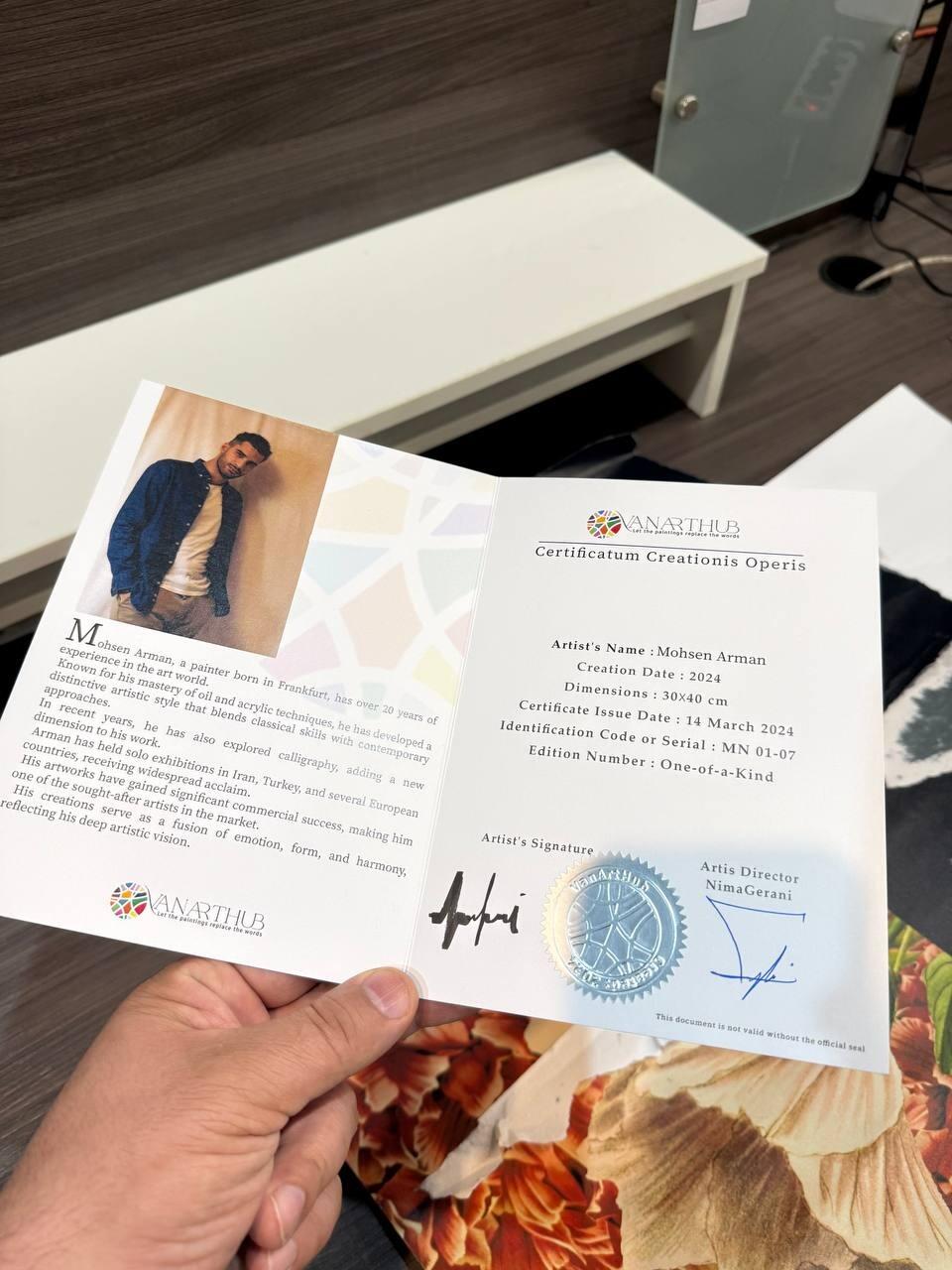
We cannot say whose words the script holds, because the product page gives no translation and names no poet. You receive the original Muraqqa': The Gold Shamseh by Kamal al-Din Ghotb, a Persian miniature in oil and gold of 30 x 40 cm, signed and one of a kind, with a Certificate of Authenticity.
I live in the United States: what will shipping cost, and how many business days should I allow?
Shipping to the United States is free, and the painting is fully insured on the way. Allow 5 to 10 business days for delivery. An address in Canada takes 3 to 7 business days, also free and insured. We send each work from Vancouver, and every painting we ship is an original, signed and one of a kind.
Is there a deadline for sending a painting back, and from which day is it counted?
The deadline is 14 days, counted from the day of delivery. Within that 14-day trial you can return the painting for a full refund, and we pay the return shipping. The terms are on our Buy with Confidence page, and our guide on how to buy Persian art answers other questions before you order.
Sources
- Encyclopaedia Iranica, Hafez i. An Overview, by Ehsan Yarshater, read October 2026.
- Encyclopaedia Iranica, Hafez ii. Hafez's Life and Times, by Baha al-Din Khorramshahi, read October 2026.
- Encyclopaedia Iranica, Hafez iii. Hafez's Poetic Art, by J. T. P. de Bruijn, read October 2026.
- Encyclopaedia Iranica, Hafez v. Manuscripts of Hafez, by Julie Scott Meisami, read October 2026.
- Encyclopaedia Iranica, Hafez x. Translations of Hafez in English, by Parvin Loloi, read October 2026.
- Encyclopaedia Iranica, Hafez xii. Hafez and the Visual Arts, by Priscilla P. Soucek, read October 2026.
- Encyclopaedia Iranica, Hafez xiii. and xiv. Hafez's Tomb (Hafeziya), by Kuros Kamali Sarvestani, read October 2026.
- Encyclopaedia Iranica, Gol o bolbol, by Layla Diba, read October 2026.
- Encyclopaedia Iranica, Beloved, by J. T. P. de Bruijn, read October 2026.
- Encyclopaedia Iranica, Divination, by Mahmoud Omidsalar, read October 2026.
- Encyclopaedia Iranica, Goethe, Johann Wolfgang von, by Hamid Tafazoli, read October 2026.
- The Metropolitan Museum of Art, "Allegory of Worldly and Otherworldly Drunkenness", Folio from the Divan of Hafiz, 1988.430, read October 2026.
- Harvard Art Museums, Lovers' Picnic, illustrated folio from a manuscript of the Divan of Hafiz, 2007.183.2, read October 2026.
- Harvard Art Museums, Incident in a Mosque, folio 77r from a Divan of Hafiz, 1999.300.2, read October 2026.
- Harvard Art Museums, Illustrated Manuscript of a Divan of Hafiz, 1964.149, read October 2026.
- Smithsonian's National Museum of Asian Art, Folio from a Divan by Hafiz, Feast of 'id, F1932.51, read October 2026.
- Smithsonian's National Museum of Asian Art, Folio from a Divan by Hafiz, wine shop, F1932.53, read October 2026.
- The British Library, Archives and Manuscripts Catalogue, Or 7573, Hafiz, Divan, read October 2026.
- Victoria and Albert Museum, The Ardabil Carpet, 272-1893, read October 2026.
- Victoria and Albert Museum, Tomb of Hafiz, lithograph after William Price, SP.478:14, read October 2026.
Sources read in October 2026. If you spot something out of date, tell us and we will correct this post.
About VanArtHub
VanArtHub is a gallery in Vancouver, Canada. Every painting we ship is an original, signed and one of a kind, and each arrives with a Certificate of Authenticity, free insured shipping and a 14-day trial. Persian art is also called Iranian art. To read more, start with our guide to contemporary Persian painting, or browse all the originals we have for sale.